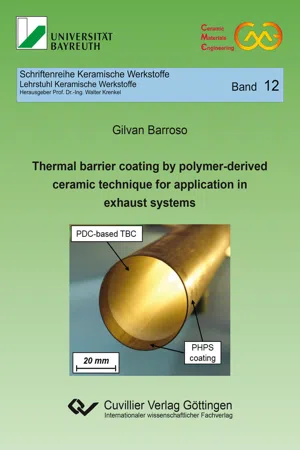
Thermal barrier coatings (TBCs) are ceramic coating systems developed to reduce the heat transfer from a hot medium to the coated parts. This technology can be used in automotive exhaust systems to reduce the heat transfer from the exhaust gases to the metal pipes. As a result, catalytic converters can reach the ideal temperature for the conversion of gases more quickly, reducing emissions. In order to be effective, coatings must be applied to the inside of pipes. However, conventional techniques for the preparation of ceramic coatings are not suitable for the deposition of coatings inside of long pipes with small diameter, or are too expensive. In this work, a TBC system was developed using the polymer-derived ceramics (PDC) technique. In this method, ceramic coatings are obtained by the thermal conversion of preceramic polymers into ceramics, after deposition of the coatings by simple lacquer techniques. Fillers are used to tailor the microstructure and the properties of the coatings. This book contains a review of the literature on PDC coatings, the procedures for the preparation of the TBCs, as well as their properties.
- 163 pages
- English
- PDF
- Available on iOS & Android
eBook - PDF
About this book
Information
Print ISBN
9783736998322
Edition
1Table of contents
- 1 Introduction
- 2 Background and Literature Overview
- 3 Experimental Procedures
- 4 Results and Discussions
- 5 Summary
- 6 Outlook
- 7 Zusammenfassung
- 8 References
- 9 Acknowledgements
- 10 Annexes
Trusted by 375,005 students
Access to over 1.5 million titles for a fair monthly price.
Study more efficiently using our study tools.