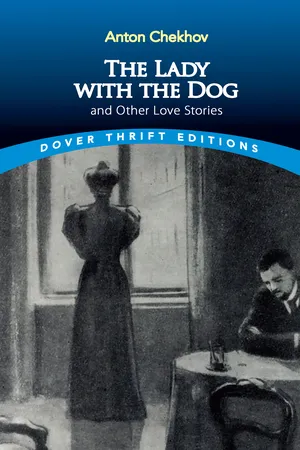
A master playwright and short story writer, Anton Chekhov is revered for his ability to examine the social forces in his characters' lives. His virtuosity with the written word is on full display in this collection of his best stories, which explore the euphoria and despair inherent in the process of falling and being in love. Eleven stories, including "A Misfortune," "Verochka," "About Love," and "The Lady with the Dog," offer readers a unique view into one of the most universal human experiences.
- 160 pages
- English
- ePUB (mobile friendly)
- Available on iOS & Android
eBook - ePub
The Lady with the Dog and Other Love Stories
About this book
Information
THE NAME-DAY PARTY
(Именины, 1888)
Sometimes known as “The Party” or “The Birthday Party” in English translations, the Russian name-day party is celebrated similarly to a birthday party, but denotes the saint’s day associated with a particular person’s name, in this case, Pyotr (or Peter).
Chekhov rarely admired his own work, but he was very proud of one aspect of this story. He wrote to his close friend and confided: “I satisfied the women with ‘The Name-Day Party.’ Wherever I go, they praise it all around. Truly, it’s not bad to be a doctor and understand what you’re writing about. The ladies say the childbirth is described correctly.”1
This is the only story in the anthology depicting the love, strained though it may be, of a married couple: “Olga Mikhalovna came to herself. She was suddenly aware of her passionate love for this man, remembered that he was her husband, Pyotr Dmitrich, without whom she could not live for a day, and who loved her passionately, too.” In its various editions, Chekhov wrestled with the shape of the story, eventually deleting several pages from the middle. He reflected on its composition to his friend: “I would gladly describe all of my hero, describe him with feeling, understanding, and deliberation. I’d describe his emotions while his wife was in labor. . . . I’d describe the midwife and doctors having tea in the middle of the night, I’d describe the rain. . . . It would be sheer pleasure for me, because I love digging deep and rummaging. But what can I do? I began the story on September 10th with the thought that I have to finish it by October 5th at the latest; if I miss the deadline I’ll be going back on my word and will be left without any money.”2 I have included as a footnote one short passage near the end about those “emotions” of Pyotr Dmitrich’s that Chekhov deleted in the final edition.
I
AFTER THE FESTIVE dinner with its eight courses and its endless conversation, Olga Mikhalovna, whose husband’s name-day was being celebrated, went out into the garden. The duty of smiling and talking incessantly, the clatter of the crockery, the stupidity of the servants, the long intervals between the courses, and the stays she had put on to conceal her condition from the visitors, wearied her to exhaustion. She longed to get away from the house, to sit in the shade and rest her heart with thoughts of the baby which was to be born to her in another two months. She was used to these thoughts coming to her as she turned to the left out of the big avenue into the narrow path. Here in the thick shade of the plums and cherry-trees the dry branches used to scratch her neck and shoulders; a spider’s web would settle on her face, and there would rise up in her mind the image of a little creature of undetermined sex and undefined features, and it began to seem as though it were not the spider’s web that tickled her face and neck caressingly, but that little creature. When, at the end of the path, a thin wicker hurdle came into sight, and behind it podgy beehives with tiled roofs; when in the motionless, stagnant air there came a smell of hay and honey, and a soft buzzing of bees was audible, then the little creature would take complete possession of Olga Mikhalovna. She used to sit down on a bench near the shanty woven of branches, and fall to thinking.
This time, too, she went on as far as the seat, sat down, and began thinking; but instead of the little creature there rose up in her imagination the figures of the grown-up people whom she had just left. She felt dreadfully uneasy that she, the hostess, had deserted her guests, and she remembered how her husband, Pyotr Dmitrich, and her uncle, Nikolai Nikolaich, had argued at dinner about trial by jury, about the press, and about the higher education of women. Her husband, as usual, argued in order to show off his Conservative ideas before his visitors—and still more in order to disagree with her uncle, whom he disliked. Her uncle contradicted him and wrangled over every word he uttered, so as to show the company that he, Uncle Nikolai Nikolaich, still retained his youthful freshness of spirit and free-thinking in spite of his fifty-nine years. And towards the end of dinner even Olga Mikhalovna herself could not resist taking part and unskillfully attempting to defend university education for women—not that that education stood in need of her defense, but simply because she wanted to annoy her husband, who to her mind was unfair. The guests were wearied by this discussion, but they all thought it necessary to take part in it, and talked a great deal, although none of them took any interest in trial by jury or the higher education of women. . . .
Olga Mikhalovna was sitting on the nearest side of the hurdle near the shanty. The sun was hidden behind the clouds. The trees and the air were overcast as before rain, but in spite of that it was hot and stifling. The hay cut under the trees on the previous day was lying ungathered, looking melancholy, with here and there a patch of color from the faded flowers, and from it came a heavy, sickly scent. It was still. The other side of the hurdle there was a monotonous hum of bees. . . .
Suddenly she heard footsteps and voices; someone was coming along the path towards the beehouse.
“How stifling it is!” said a feminine voice. “What do you think—is it going to rain, or not?”
“It is going to rain, my charmer, but not before night,” a very familiar male voice answered listlessly. “There will be a good rain.”
Olga Mikhalovna calculated that if she made haste to hide in the shanty they would pass by without seeing her, and she would not have to talk and to force herself to smile. She picked up her skirts, bent down and crept into the shanty. At once she felt upon her face, her neck, her arms, the hot air as heavy as steam. If it had not been for the stuffiness and the close smell of rye bread, fennel, and brushwood, which prevented her from breathing freely, it would have been delightful to hide from her visitors here under the thatched roof in the dusk, and to think about the little creature. It was cozy and quiet.
“What a pretty spot!” said a feminine voice. “Let us sit here, Pyotr Dmitrich.”
Olga Mikhalovna began peeping through a crack between two branches. She saw her husband, Pyotr Dmitrich, and Lubochka Sheller, a girl of seventeen who had not long left boarding-school. Pyotr Dmitrich, with his hat on the back of his head, listless and indolent from having drunk so much at the luncheon, slouched by the hurdle and raked the hay into a heap with his foot; Lubochka, pink with the heat and pretty as ever, stood with her hands behind her, watching the lazy movements of his big, handsome person.
Olga Mikhalovna knew that her husband was attractive to women, and did not like to see him with them. There was nothing out of the way in Pyotr Dmitrich’s lazily raking together the hay in order to sit down on it with Lubochka and chatter to her of trivialities; there was nothing out of the way, either, in pretty Lubochka’s looking at him with her soft eyes; but yet Olga Mikhalovna felt vexed with her husband and frightened and pleased that she could listen to them.
“Sit down, enchantress,” said Pyotr Dmitrich, sinking down on the hay and stretching. “That’s right. Come, tell me something.”
“What next! If I begin telling you anything you will go to sleep.”
“Me go to sleep? Allah forbid! Can I go to sleep while eyes like yours are watching me?”
In her husband’s words, and in the fact that he was lolling with his hat on the back of his head in the presence of a lady, there was nothing out of the way either. He was spoilt by women, knew that they found him attractive, and had adopted with them a special tone which everyone said suited him. With Lubochka he behaved as with all women. But, all the same, Olga Mikhalovna was jealous.
“Tell me, please,” said Lubochka, after a brief silence—“is it true that you are to be tried for something?”
“I? Yes, I am . . . numbered am...
Table of contents
- Cover
- Contents
- Agafya
- A Misfortune
- On The Road
- Polinka
- Verochka
- The Beauties
- The Name-Day Party
- After The Theater
- About Love
- The Darling
- The Lady With The Dog
Trusted by 375,005 students
Access to over 1.5 million titles for a fair monthly price.
Study more efficiently using our study tools.
Frequently asked questions
Yes, you can cancel anytime from the Subscription tab in your account settings on the Perlego website. Your subscription will stay active until the end of your current billing period. Learn how to cancel your subscription
No, books cannot be downloaded as external files, such as PDFs, for use outside of Perlego. However, you can download books within the Perlego app for offline reading on mobile or tablet. Learn how to download books offline
Perlego offers two plans: Essential and Complete
- Essential is ideal for learners and professionals who enjoy exploring a wide range of subjects. Access the Essential Library with 800,000+ trusted titles and best-sellers across business, personal growth, and the humanities. Includes unlimited reading time and Standard Read Aloud voice.
- Complete: Perfect for advanced learners and researchers needing full, unrestricted access. Unlock 1.5M+ books across hundreds of subjects, including academic and specialized titles. The Complete Plan also includes advanced features like Premium Read Aloud and Research Assistant.
We are an online textbook subscription service, where you can get access to an entire online library for less than the price of a single book per month. With over 1.5 million books across 990+ topics, we’ve got you covered! Learn about our mission
Look out for the read-aloud symbol on your next book to see if you can listen to it. The read-aloud tool reads text aloud for you, highlighting the text as it is being read. You can pause it, speed it up and slow it down. Learn more about Read Aloud
Yes! You can use the Perlego app on both iOS and Android devices to read anytime, anywhere — even offline. Perfect for commutes or when you’re on the go.
Please note we cannot support devices running on iOS 13 and Android 7 or earlier. Learn more about using the app
Please note we cannot support devices running on iOS 13 and Android 7 or earlier. Learn more about using the app
Yes, you can access The Lady with the Dog and Other Love Stories by Anton Chekhov, Bob Blaisdell in PDF and/or ePUB format, as well as other popular books in Literature & Classics. We have over 1.5 million books available in our catalogue for you to explore.