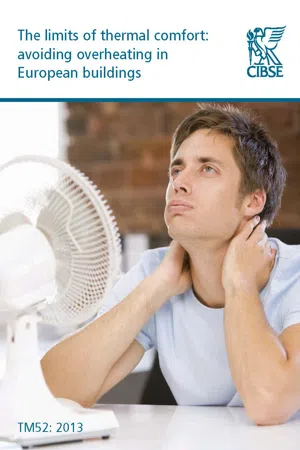
Overheating has become a key problem for building design. The need to reduce energy consumption whilst dealing with global climate change has reduced the options available for building comfortable, low-energy buildings. Research has been directed towards methods for increasing indoor winter temperatures but this can lead to lightweight, highly insulated buildings that respond poorly in the summer. CIBSE has responded by forming the Overheating Task Force.The Task Force realised that one problem for designers has been the absence of an adequate definition of overheating in naturally ventilated buildings. In the past overheating has been defined as a number of hours over a particular temperature, irrespective of conditions outside the building. Recent work embodied in European standards suggests that the temperature that occupants will find uncomfortable changes with the outdoor conditions in a predictable way. This research informs the CIBSE guidance presented in this Technical Memorandum. The meaning of the research and the link with overheating are explained and a series of criteria by which the risk of overheating can be assessed or identified are suggested.More detailed information about using simulation to predict the danger of overheating is available in CIBSE Guide A (CIBSE, 2006/2013). CIBSE KS16: How to manage overheating in buildings (2010) gives information directed at building managers and owners about the cause of overheating and some practical suggestions for avoiding or mitigating it.
- 24 pages
- English
- PDF
- Available on iOS & Android
eBook - PDF
The limits of thermal comfort (TM52)
About this book
Information
Year
2013eBook ISBN
9781906846343
Table of contents
- TM52 The limits of thermal comfort: avoiding overheating in European buildings OFC
- Contents
- 1 Introduction
- 2 Comfort and discomfort
- 3 Predicting discomfort
- 4 The basis of comfort standards
- 5 Risk of overheating
- 6 CIBSE recommendations for identifying overheating
- References
- Additional sources of information
Trusted by 375,005 students
Access to over 1.5 million titles for a fair monthly price.
Study more efficiently using our study tools.
Frequently asked questions
Yes, you can cancel anytime from the Subscription tab in your account settings on the Perlego website. Your subscription will stay active until the end of your current billing period. Learn how to cancel your subscription
No, books cannot be downloaded as external files, such as PDFs, for use outside of Perlego. However, you can download books within the Perlego app for offline reading on mobile or tablet. Learn how to download books offline
Perlego offers two plans: Essential and Complete
- Essential is ideal for learners and professionals who enjoy exploring a wide range of subjects. Access the Essential Library with 800,000+ trusted titles and best-sellers across business, personal growth, and the humanities. Includes unlimited reading time and Standard Read Aloud voice.
- Complete: Perfect for advanced learners and researchers needing full, unrestricted access. Unlock 1.5M+ books across hundreds of subjects, including academic and specialized titles. The Complete Plan also includes advanced features like Premium Read Aloud and Research Assistant.
We are an online textbook subscription service, where you can get access to an entire online library for less than the price of a single book per month. With over 1.5 million books across 990+ topics, we’ve got you covered! Learn about our mission
Look out for the read-aloud symbol on your next book to see if you can listen to it. The read-aloud tool reads text aloud for you, highlighting the text as it is being read. You can pause it, speed it up and slow it down. Learn more about Read Aloud
Yes! You can use the Perlego app on both iOS and Android devices to read anytime, anywhere — even offline. Perfect for commutes or when you’re on the go.
Please note we cannot support devices running on iOS 13 and Android 7 or earlier. Learn more about using the app
Please note we cannot support devices running on iOS 13 and Android 7 or earlier. Learn more about using the app
Yes, you can access The limits of thermal comfort (TM52) by Fergus Nicol in PDF and/or ePUB format, as well as other popular books in Technology & Engineering & Construction & Architectural Engineering. We have over 1.5 million books available in our catalogue for you to explore.