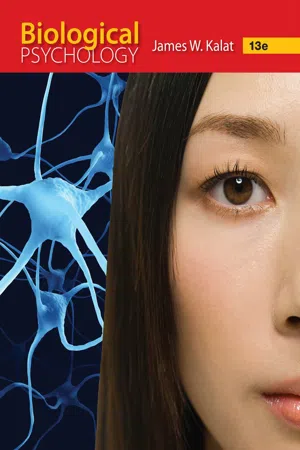
The most widely used text in its course area, James W. Kalat's BIOLOGICAL PSYCHOLOGY has appealed to thousands of students before you. Why? Kalat's main goal is to make Biological Psychology understandable to Psychology students, not just to Biology majors and pre meds--and he delivers. Another goal is to convey the excitement of the search for biological explanations of behavior. Kalat believes that Biological Psychology is "the most interesting topic in the world," and this text convinces many students--and maybe you, too--with clear writing, amusing anecdotes and intriguing examples. MindTap, an interactive online learning resource that integrates the text with videos, animations and a virtual bio-lab component, makes learning even easier and more enjoyable.
eBook - PDF
Biological Psychology
About this book
Information
Table of contents
- Cover
- About the Author
- Brief Contents
- Contents
- Preface
- Acknowledgments
- Introduction: Overview and Major Issues
- Chapter 1: Nerve Cells and Nerve Impulses
- Chapter 2: Synapses
- Chapter 3: Anatomy and Research Methods
- Chapter 4: Genetics, Evolution, Development, and Plasticity
- Chapter 5: Vision
- Chapter 6: Other Sensory Systems
- Chapter 7: Movement
- Chapter 8: Wakefulness and Sleep
- Chapter 9: Internal Regulation
- Chapter 10: Reproductive Behaviors
- Chapter 11: Emotional Behaviors
- Chapter 12: Learning, Memory, and Intelligence
- Chapter 13: Cognitive Functions
- Chapter 14: Psychological Disorders
- Appendix A: Brief, Basic Chemistry
- Appendix B: Society for Neuroscience Policies on the Use of Animals and Human Subjects in Research
- References
- Name Index
- Subject Index/Glossary
Trusted by 375,005 students
Access to over 1.5 million titles for a fair monthly price.
Study more efficiently using our study tools.
Frequently asked questions
Yes, you can cancel anytime from the Subscription tab in your account settings on the Perlego website. Your subscription will stay active until the end of your current billing period. Learn how to cancel your subscription
No, books cannot be downloaded as external files, such as PDFs, for use outside of Perlego. However, you can download books within the Perlego app for offline reading on mobile or tablet. Learn how to download books offline
We are an online textbook subscription service, where you can get access to an entire online library for less than the price of a single book per month. With over 1.5 million books across 990+ topics, we’ve got you covered! Learn about our mission
Look out for the read-aloud symbol on your next book to see if you can listen to it. The read-aloud tool reads text aloud for you, highlighting the text as it is being read. You can pause it, speed it up and slow it down. Learn more about Read Aloud
Yes! You can use the Perlego app on both iOS and Android devices to read anytime, anywhere — even offline. Perfect for commutes or when you’re on the go.
Please note we cannot support devices running on iOS 13 and Android 7 or earlier. Learn more about using the app
Please note we cannot support devices running on iOS 13 and Android 7 or earlier. Learn more about using the app
Yes, you can access Biological Psychology by James Kalat in PDF and/or ePUB format, as well as other popular books in Biological Sciences & Neuroscience. We have over 1.5 million books available in our catalogue for you to explore.