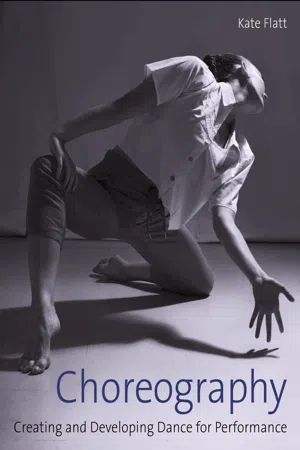
Choreography is the highly creative process of interpreting and coordinating movement, music and space in performance. By tracing different facets of development and exploring the essential artistic and practical skills of the choreographer, this book offers unique insights for apprentice dance makers. With key concepts and ideas expressed through an accessible writing style, the creative tasks and frameworks offered will develop new curiosity, understanding, skill and confidence. The chapters cover the key areas of engagement including what is a choreographer; getting started; improvisation and ideas; context, stage geometry and atmosphere; movement as dance in time and space; solo, duet, trio and group choreography and finally, structure and the 'choreographic eye'. This is an ideal companion for dancers and dance students wanting to express their ideas through choreography and develop their skills to effectively articulate them in performance. It is superbly illustrated with 143 practical colour and black & white photographs and diagrams. Kate Flatt has over forty years' experience as a choreographer, mentor and teacher.
- 176 pages
- English
- ePUB (mobile friendly)
- Available on iOS & Android
eBook - ePub
About this book
Trusted by 375,005 students
Access to over 1 million titles for a fair monthly price.
Study more efficiently using our study tools.
Information
Subtopic
DanceCHAPTER 1
WHAT IS A CHOREOGRAPHER?
THE CHOREOGRAPHER AS A PRACTITIONER
The choreographer as a practitioner is considered to be a creative artist equal to a composer of music, an author of a book and a film director. A thumbnail history of the choreographer’s emergence through history and how the role has changed and developed can be traced from dances in the village square, via the royal courts and into the range of contexts and theatres of today.

Noémie Larcheveque playing with shadow. JACK THOMSON
Dance without choreographers
Traditional dance forms from all over the world do not involve a choreographer as we know it. Social and ritual dances formed of circles, spirals and patterns emerged, apparently with no need of someone to decide what or how people should dance. Solo performers in diverse forms have evolved their own dances, recognizable as coming from a specific tradition or style. These universal expressions of dance occur as a spontaneous ritual or celebration with live music, often with traditions handed down through centuries, in urban or village settings. Similarly, in dance halls, social dance has developed without choreographers, by imitation and with semi-improvised elements as found in jive, samba, tango, jigs and street dance. Diverse traditional dance forms are available widely to view as video clips on social media and highlight the global riches of dance without choreographers. Dance traditions have been documented and researched by ethnog-raphers, as a record of how people danced in earlier times and in different parts of the world.
The dancing master
In the Renaissance, dance tutors emerged as experts and taught people in the royal courts of Europe to excel in the dances such as the pavane, galliard, la volta, minuet or sarabande. Elizabeth I was famous for her love of dancing and before breakfast would dance a galliard, a man’s jumping dance. Perhaps this was her way to keep fit? Her ministers attended her licensed dance academies, learning from Italian dancing masters, hoping to gain promotion by impressing the queen at the court ball. By the seventeenth century, in the reign of Louis XIV of France, dance had grown in prestige and importance. Dancing masters arranged dance events as court spectacle, whilst meticulously recording the dances and the corresponding court rules of etiquette.
The ballet master
In the nineteenth century, ballet masters developed ballet training to higher levels of technical accomplishment. There are many images captured by the painter Edgar Degas of tutu-clad young women being taught by an older man – the ballet master and guardian of ballet tradition. In the development of Western theatre dance, ballet was performed to instrumental passages as interludes in operas. It then grew into a respected art form handed down as the nineteenth-century story ballets of the Romantic era and later on the iconic classical Russian ballets of Swan Lake, The Nutcracker and The Sleeping Beauty.

Brazilian folk ritual of Bumba meu Boi, with dancer Carolina Paulino. SHEILA BURNETT

Queen Elizabeth I dancing at court.

Painting by Edgar Degas of a nineteenth-century ballet master in rehearsal.
The choreographer
In the early twentieth century, the Russian impresario Sergei Diaghilev created the Ballets Russes, basing the company in France. As a producer, he pioneered rich and ground-breaking productions combining dance, music and art. He enabled radical new creations, making ballet an avant-garde art form. He promoted his choreographers as lead artists, who collaborated closely with composers, artists, designers and performers. Among them, Fokine, Nijinsky, Massine, Balanchine and Nijinska would go on to work with artists such as Bakst, Matisse, Picasso, Derain and Dali as stage designers. Meanwhile, composers such as Stravinsky, Debussy, Prokoviev and Ravel collaborated in developing innovative new work with these pioneering choreographers.
Modernism and the choreographer
In the early twentieth century in America, in keeping with modern art, drama and music, Martha Graham pioneered a shift in emphasis away from entertainment and spectacle, towards inner, psychological motivation. Her work showed how emotion could be embodied in the movement. Along with Doris Humphrey, Graham had a profound influence on Alvin Ailey, José Limon, Pearl Lang, Katherine Dunham and Glen Tetley in the USA. One of her dancers, Robert Cohan, moved to the UK to develop his work there during the 1970s and 1980s.
Meanwhile, in Europe, choreographers of the Modernist movement, Mary Wigman, and Kurt Jooss, were to influence the work of late twentieth-century choreographer Pina Bausch. She, in turn, has had a profound influence on present-day choreographers, whose innovative work in dance and theatre is seen across Europe and America.
Choreographers and changing the space
In the mid-twentieth century, the stage space came also to be seen as an abstract canvas. Pioneering choreographer Merce Cunningham moved away from representation and narrative within choreography. Alongside innovative artists such as John Cage, Andy Warhol and Robert Rauschenberg, Cunningham is credited with breaking down the hierarchy of the stage space. He asserted that dance movement did not have to represent anything and also that no single place on the stage is more important than any other. He also pioneered thinking on the important interrelationship of space and time in choreography and introduced the strategy of chance operations. His innovations included site-specific works, use of interior and exterior locations, working with film and other new technologies. He has had a profound influence on succeeding generations of choreographers. The training technique he developed continues to be taught in dance schools around the ...
Table of contents
- Cover
- Title
- Copyright
- Contents
- Introduction
- 1. What is a Choreographer?
- 2. Getting Started: Essentials of Choreography
- 3. Movement in Time and Space
- 4. Context, Stage Geometry and Atmosphere
- 5. Choosing and Working with Music
- 6. Solo, Duet, Trio and Group Choreography
- 7. Structure and the Choreographer’s Eye
- Glossary
- Appendix I – Music Genres
- Appendix II – Searching for Music for Choreography
- Acknowledgements
- Index
Frequently asked questions
Yes, you can cancel anytime from the Subscription tab in your account settings on the Perlego website. Your subscription will stay active until the end of your current billing period. Learn how to cancel your subscription
No, books cannot be downloaded as external files, such as PDFs, for use outside of Perlego. However, you can download books within the Perlego app for offline reading on mobile or tablet. Learn how to download books offline
Perlego offers two plans: Essential and Complete
- Essential is ideal for learners and professionals who enjoy exploring a wide range of subjects. Access the Essential Library with 800,000+ trusted titles and best-sellers across business, personal growth, and the humanities. Includes unlimited reading time and Standard Read Aloud voice.
- Complete: Perfect for advanced learners and researchers needing full, unrestricted access. Unlock 1.4M+ books across hundreds of subjects, including academic and specialized titles. The Complete Plan also includes advanced features like Premium Read Aloud and Research Assistant.
We are an online textbook subscription service, where you can get access to an entire online library for less than the price of a single book per month. With over 1 million books across 990+ topics, we’ve got you covered! Learn about our mission
Look out for the read-aloud symbol on your next book to see if you can listen to it. The read-aloud tool reads text aloud for you, highlighting the text as it is being read. You can pause it, speed it up and slow it down. Learn more about Read Aloud
Yes! You can use the Perlego app on both iOS and Android devices to read anytime, anywhere — even offline. Perfect for commutes or when you’re on the go.
Please note we cannot support devices running on iOS 13 and Android 7 or earlier. Learn more about using the app
Please note we cannot support devices running on iOS 13 and Android 7 or earlier. Learn more about using the app
Yes, you can access Choreography by Kate Flatt in PDF and/or ePUB format, as well as other popular books in Media & Performing Arts & Dance. We have over one million books available in our catalogue for you to explore.