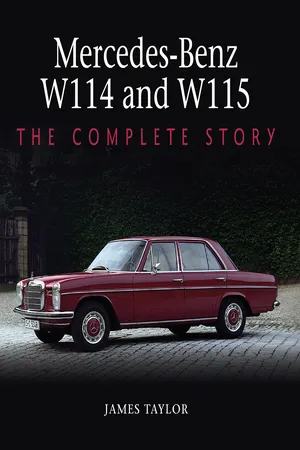
The W114 and W115 models were enormously successful for Mercedes-Benz, and their sales in nine years of production between 1967 and 1976 almost equalled the total of all Mercedes passenger models built in the 23 years between 1945 and the time of their introduction in 1968. There were many reasons for this success, but perhaps the most important was that Mercedes expanded the range to include a simply vast amount of variants including four-cylinder and six-cylinder petrol engines, four-cylinder diesels; saloons, coupes and long-wheelbase models. With around 200 photographs, this book features the story of the design and development of the W114 and W115 ranges. It gives full technical specifications, including paint and interior trim choices; includes a chapter on the special US variants; gives production tables and model type codes and explores the Experimental Safety Vehicles developed from these cars. Finally, there is a chapter on buying and owning a 114- or 115-series Mercedes.
- 160 pages
- English
- ePUB (mobile friendly)
- Available on iOS & Android
eBook - ePub
About this book
Trusted by 375,005 students
Access to over 1.5 million titles for a fair monthly price.
Study more efficiently using our study tools.
Information
CHAPTER ONE
SETTING THE SCENE
By the time Mercedes released its fourth generation of post-war medium saloons in 1968, the company had become one of the leaders of the global motoring scene. Hugely respected in Europe during the interwar years, it had taken a more global view after the end of World War II and had gradually built up a worldwide sales and service network that other manufacturers could only envy.
Yet the reputation that Mercedes cars enjoyed in the 1960s had not been easy to attain. It had been achieved through top-quality engineering and through steady expansion into countries around the world, for by the end of World War II, Mercedes-Benz and its parent company, Daimler-Benz, had been broken almost beyond repair. As a leading German engineering company, Daimler-Benz had inevitably been drawn into providing war materiel for Hitler’s Third Reich and, equally inevitably, its factories had been a key target for the Allies who were determined to prevent Hitler’s brand of fascism from spreading beyond Germany. The Daimler-Benz Board in 1945 famously and sadly admitted that the company had, by that stage, ‘practically ceased to exist’.
With its bombed factories in ruins and some irretrievably lost to the Russian Occupation Zone in the east, the company could only make a cautious start. Besides, the whole of what was now West Germany was subject to management by the Allied Control Commission, which was tasked with promoting economic and social recovery, but also with ensuring that German industrial output should not be allowed to exceed roughly half of its 1938 level. The Daimler-Benz factories that were still able to function were initially permitted to undertake repair and maintenance work on existing vehicles; only later did actual assembly of new ones begin. The exception was the Mannheim truck plant, which had remained relatively undamaged and here production of 3-ton trucks resumed during 1945. Such vehicles were more necessary to rebuild the economy than cars.
Miraculously, however, the production lines for the pre-war 170V saloon had survived the bombing. There was no call yet for saloon cars, but it was not difficult to adapt the chassis, engine and front panels of the 170V as the basis of a light commercial vehicle. So that was what began in November 1945 to roll from the assembly lines at the Untertürkheim and Sindelfingen factories in Stuttgart that had been primary targets of Allied bombing. Production was slow to build up. In 1946, just 214 vehicles were built; in 1947 the total was 1,045, but by 1948 recovery was more obviously under way and 1,304 were built in just under six months up to 20 June that year. They took several different forms, to meet demand – there were delivery vans, pick-ups, personnel carriers (for the new West German police) and ambulances.

Mercedes started car production in 1946 with vans and pick-ups based on this pre-war saloon model. The car pictured is a 170Va, which was still in production up to 1952.

Demand was for vehicles to help the recovery of the West German economy and Mercedes shrewdly bought the rights to a design for a multi-purpose agricultural type that used one of its engines. It was called the Unimog and its descendants are still in production more than seventy years later.
As the post-war difficulties began to ease, the Allies granted approval for Daimler-Benz to begin car manufacture again. There had been neither time nor finance to develop anything new, so the first saloons to emerge in May 1947 were almost carbon copies of the pre-war models. But conditions in West Germany continued to improve and at the Hanover Fair in May 1949 Daimler-Benz was able to unveil not only its first all-new post-war truck (the L3500), but also two new saloon cars. Based on the 170V, these expanded the range by adding a diesel engine (in the 170D) and a more roomy and substantial body with a more powerful engine (in the 170S). Cabriolet and coupé body options were added for the 170S, then in 1951 came a new 6-cylinder engine that created the 220 models in essentially the same structure. That same year, Mercedes-Benz introduced its first post-war luxury model – the big 6-cylinder 300 limousine that would become synonymous with West German officialdom during the 1950s.

The L3500 truck was Mercedes’ first new post-war design and made a major contribution to the company’s recovery. The one pictured is a preserved 1952 example used as a brewer’s dray.
These cars established a shape for the Mercedes range that would endure for a further decade and a half. There would be a medium-sized saloon and a big luxury saloon, and from 1954 the range was expanded to include sports cars as well, which of course depended on running gear initially developed for the saloon models. The old 170s and 220s gave way in 1953 to the second post-war generation of saloons, with modern unitary construction bringing them the nickname of ‘Ponton’ models (the word is German for pontoon, with the construction being reminiscent of a pontoon bridge). They had a range of engines that began with 1.8-litre 4-cylinder petrols and diesels and ran all the way up to 2.2-litre 6-cylinder petrol types. The 6-cylinder cars needed a ‘long-nose’ body shell, but had fundamentally the same design as the 4-cylinder types and in 1958 embraced ultra-modern fuel injection (earlier seen in the 300SL sports models) with the 220SE model.

Mercedes got back to building big luxury models for business leaders as soon as it could. This is the 300 model (internally coded W186) of 1951. There would be coupé and cabriolet derivatives later.

The monocoque Ponton models replaced the old pre-war designs from 1953 as the mainstream saloons. This is a late model, built in 1959 for a British buyer and close to the top of the range when new. It is a 220S model with a 6-cylinder engine.
Several factors had made this huge expansion of the Mercedes car range possible. One, of course, was the booming West German economy (the Wirtschaftswunder, or ‘economic miracle’) that had brought prosperity back to the country in the decade after the war. The other was a determined focus on export sales. Although the Daimler-Benz success in this area had largely been dependent on its truck and bus sales, with car sales following, in the USA the cars had made their own success story. Thanks to the entrepreneurial spirit of American importers, notably Max Hoffman on the east coast, Mercedes came to the attention of the rich and famous in North America. The 300SL and 190SL sports models of 1953 and 1954 were created largely for them and it was these and the glamorous coupés and cabriolets that established a lasting image for the Mercedes marque in the USA.

Sports cars followed Mercedes’ determination to get back into motorsport. This is the legendary W198 300SL ‘Gullwing’, so-called because of its upward-opening doors.
The importance that Mercedes attached to the American market became very obvious when the company introduced its third generation of medium-sized saloons in 1959. These were distinguished by discreet but unmistakable tail fins in the American idiom of the period; in the design stages, they had been larger than they became in production, being toned down for fear of upsetting European buyers who were less enthusiastic about the American fashion for fins and chrome. These cars, known to English speakers as ‘Fintail’ models (the Germans call them Heckflossen), directly replaced the Pontons with a similar range of engines. However, from 1961 they were also made available with the 3-litre 6-cylinder engine from the bigger luxury saloons – and that would have further consequences later on.
By the early 1960s, Mercedes had identified that there was a growing demand for luxury family saloons that were more expensive than its existing 6-cylinder models, but nonetheless not as grand or formal as its large 300 limousines. So in 1965, a new model was introduced to meet that demand. Cautiously based on the Fintail platform and running gear, this was available only with 6-cylinder engines of 2.5-litres and above, with a more spacious and substantial-looking body that developed the more rounded look introduced for the coupé and convertible derivatives of the Fintails. It was known as the S Class – the S supposedly standing for Super – and its arrival placed a new and very clear limit on the upper end of the medium-sized saloon range.

The 300SL was an exotic supercar, but in 1954 there followed an affordable sports roadster. The 190SL drew its 4-cylinder engine from the Ponton saloon range.
So it was that when work began at Stuttgart in the mid-1960s on a new medium-sized range, it was constrained by the need to offer less prestige than the S-Class models and by the need to offer engines that were no larger than the 2.5-litre size available in the entry-level S Class. But it was also free to develop in its own way without the constraint that the same basic design had to cater for a very different area of the market in addition to its core customers. That, at least, was the starting point. The position would change as time went by.

Mercedes was well attuned to the likes of US buyers by the mid-1950s and in 1957 introduced this roadster version of the 300SL to meet them.

The Fintail models replaced the Pontons as the mainstream saloon range f...
Table of contents
- Cover
- Halftitle
- Title
- Copyright
- Contents
- Introduction and Acknowledgements
- Timeline
- Chapter 1: Setting the Scene
- Chapter 2: Design
- Chapter 3: The Early Saloons 1968–72
- Chapter 4: A Change of Gear
- Chapter 5: The Series 2 Models 1973–6
- Chapter 6: The W114 Coupés
- Chapter 7: The New Generation Models in the USA
- Chapter 8: Long Wheelbases and Conversions
- Chapter 9: Buying and Owning a W114 or W115
- Appendix I: The ESF Programme
- Appendix II: Type Codes
- Appendix III: Production Totals
- Index
Frequently asked questions
Yes, you can cancel anytime from the Subscription tab in your account settings on the Perlego website. Your subscription will stay active until the end of your current billing period. Learn how to cancel your subscription
No, books cannot be downloaded as external files, such as PDFs, for use outside of Perlego. However, you can download books within the Perlego app for offline reading on mobile or tablet. Learn how to download books offline
Perlego offers two plans: Essential and Complete
- Essential is ideal for learners and professionals who enjoy exploring a wide range of subjects. Access the Essential Library with 800,000+ trusted titles and best-sellers across business, personal growth, and the humanities. Includes unlimited reading time and Standard Read Aloud voice.
- Complete: Perfect for advanced learners and researchers needing full, unrestricted access. Unlock 1.5M+ books across hundreds of subjects, including academic and specialized titles. The Complete Plan also includes advanced features like Premium Read Aloud and Research Assistant.
We are an online textbook subscription service, where you can get access to an entire online library for less than the price of a single book per month. With over 1.5 million books across 990+ topics, we’ve got you covered! Learn about our mission
Look out for the read-aloud symbol on your next book to see if you can listen to it. The read-aloud tool reads text aloud for you, highlighting the text as it is being read. You can pause it, speed it up and slow it down. Learn more about Read Aloud
Yes! You can use the Perlego app on both iOS and Android devices to read anytime, anywhere — even offline. Perfect for commutes or when you’re on the go.
Please note we cannot support devices running on iOS 13 and Android 7 or earlier. Learn more about using the app
Please note we cannot support devices running on iOS 13 and Android 7 or earlier. Learn more about using the app
Yes, you can access Mercedes-Benz W114 and W115 by James Taylor in PDF and/or ePUB format, as well as other popular books in Technology & Engineering & Automotive Transportation & Engineering. We have over 1.5 million books available in our catalogue for you to explore.