A beautifully illustrated guide that takes the reader through each Lamborghini production model and some of the most significant concept cars. It presents a thorough base for anyone who wishes to understand more about the history and depth of the company, and how the model line developed and evolved. There are specification sheets for each model and the history and development of the company is covered, from Ferruccio Lamborghini's origins in manufacturing tractors, to producing some of the best known and technologically innovative supercars today. Beautifully illustrated with 200 colour photographs.
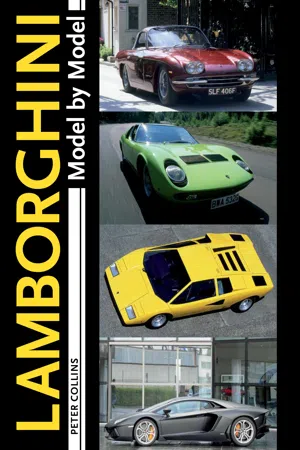
- 144 pages
- English
- ePUB (mobile friendly)
- Available on iOS & Android
eBook - ePub
Lamborghini Model by Model
About this book
Trusted by 375,005 students
Access to over 1 million titles for a fair monthly price.
Study more efficiently using our study tools.
Information
THE FERRUCCIO YEARS

An Auto Italia test sees the ex-Twiggy Miura leading two others at the test track.
AUTO ITALIA ARCHIVE
AUTO ITALIA ARCHIVE

350 GTV
AMONGST THE BACK pages of the 26 July 1963 issue of Autocar magazine is a one-page article. Alongside a photograph of a bare rolling chassis with engine fitted is the headline ‘Italian 3500cc GT from a New Constructor’. Thus the Lamborghini 350 GTV was introduced to many British readers over their morning cornflakes. Bare details, such as the engine will have twin overhead camshafts with a bore and stroke of 77 × 62mm and that the chassis weighs only 188lb (no metric then), were included, along with the information that a factory had been built to produce the new car.
It all seemed so simple, but, of course, there was a lot more to it than that.
It has passed into legend – or myth –that Ferruccio Lamborghini wanted to build what we would nowadays call a supercar and that he insisted it would be the best in the world and usable by anyone. His enthusiasm was rather like a virus and affected everyone he involved in the project. In the end, the final product – the GTV – was actually not what he had envisaged at all and he was quite disappointed.
As there was nowhere to build it, space was allocated in a corner of Ferruccio’s tractor factory for its construction. Ferruccio had taken on Ingegnere Giotto Bizzarrini to design the mechanicals and Franco Scaglione to design the bodywork. The chassis was to be built by the Modenese firm Neri & Bonacini. Ferruccio wanted plenty of power and it was settled that the motor would be of 3.5 litres and a short-stroke V12, but, with the designer being Bizzarrini, who had been part of Ferrari’s competition department and who was responsible for that company’s 250 GTO, what actually resulted carried more similarities to a race unit than one for touring, which was what Ferruccio really wanted.
The end result, as seen at the initial Press debut of the car on 26 October 1963, a week before its public announcement at the Turin Show, was such that, by this time, Ferruccio had already decided that the GTV was essentially not the way he wanted things to go and had already commissioned others to move his project forward.
Problems ranged from the fact that the chosen body designer, Scaglione, had rather fallen out of fashion; this can be seen in the basic shape of the car, which looks remarkably like the 1954 Alfa Romeo Sportiva, a lovely motor car but one that was then almost ten years old – an eternity in the automotive world. The body was constructed by Carrozzeria Sargiotto in their apparently tiny premises in Turin and the practical and pragmatic Ferruccio quickly realized that both it and the engine were not really what he wanted, despite the fact that it was, undeniably, spectacular and brought the name Lamborghini to the attention of the world.

A period picture of the 350 GTV showing the six exhaust outlets of the original car.
FERRET FOTOGRAPHICS
FERRET FOTOGRAPHICS

For many years the GTV was stored in non-working order in the factory. This picture of it was taken circa 1974.
FERRET FOTOGRAPHICS
FERRET FOTOGRAPHICS

Fully restored to working order over twenty years ago, this is the front of the GTV today.
KEITH BLUEMEL
KEITH BLUEMEL
Rob de la Rive Box, in his book History of Lamborghini, suggests that the car was designed around the engine, but, as is well known today, in fact the GTV had no engine under its bonnet at its debut, because, it was later suggested, it would not shut with the stack of vertical Weber carburettors on top of the engine block. It was also said that there might be a 2.2-litre 6-cylinder unit under development in addition to the V12, but any further allusions to that were to wait another three years. Road & Track magazine reported that there would be a competition version of the engine, but Ferruccio himself specifically ruled out racing as any part of Lamborghini’s forward planning and so it remained until recently.
Another member of the Ferrari competition set-up at Maranello was Ing. Gian Paolo Dallara, who was well known to Bizzarrini; the latter recommended him to Ferruccio as a possible candidate to take the new road-car project forward. Dallara was a cousin of Ing. Alfieri and had worked at Maserati, as well as alongside Carlo Chiti at Ferrari. At only twenty-four years old, he seemed a perfect fit for the job and was hired by Ferruccio, thus effectively ousting Bizzarrini. The result was that Dallara oversaw the toning-down of the GTV into a more reasonable product without, in any way, diminishing its dynamics. It was telling that Road & Track published a photo of a chassis on the Turin Show stand and described it as the ‘Touring’ version of the new car.
Autocar referred to the GTV as ‘fierce but not beautiful’ and alleged that it was designed by Giorgio Prevedi, under the supervision of Scaglione. We will probably never know the complete facts, but one thing was certain, Lamborghini was already hard at work ensuring the company’s future and the car with which it would succeed. Finally, many years later, Lamborghini agreed to selling the GTV to Bologna Lamborghini dealer Romano Bernardoni and his cousin Stefano Pasini. The long-neglected prototype at last had an engine – with the vertical carburettors – installed and on 26 January 1990 moved under its own power for the first time.
GTV
Engine | V12 |
Valve gear | Four overhead camshafts, two per cylinder bank |
Bore and stroke | 77 × 62mm |
Capacity | 3497cc |
Power | 350bhp approximately |
Transmission | ZF five-speed gearbox; rear-wheel drive |
Chassis/body | Tubular spaceframe with alloy body built by Carrozzeria Sargiotto |
Suspension | Independent all-round wishbones and coil spr... |
Table of contents
- Cover Page
- Title Page
- Copyright Page
- Contents
- Preface and Acknowledgements
- Introduction: In the Beginning
- CHAPTER 1 THE FERRUCCIO YEARS
- CHAPTER 2 UPHOLDING THE LEGEND
- CHAPTER 3 AUDI TAKES OVER
- Index
Frequently asked questions
Yes, you can cancel anytime from the Subscription tab in your account settings on the Perlego website. Your subscription will stay active until the end of your current billing period. Learn how to cancel your subscription
No, books cannot be downloaded as external files, such as PDFs, for use outside of Perlego. However, you can download books within the Perlego app for offline reading on mobile or tablet. Learn how to download books offline
Perlego offers two plans: Essential and Complete
- Essential is ideal for learners and professionals who enjoy exploring a wide range of subjects. Access the Essential Library with 800,000+ trusted titles and best-sellers across business, personal growth, and the humanities. Includes unlimited reading time and Standard Read Aloud voice.
- Complete: Perfect for advanced learners and researchers needing full, unrestricted access. Unlock 1.4M+ books across hundreds of subjects, including academic and specialized titles. The Complete Plan also includes advanced features like Premium Read Aloud and Research Assistant.
We are an online textbook subscription service, where you can get access to an entire online library for less than the price of a single book per month. With over 1 million books across 990+ topics, we’ve got you covered! Learn about our mission
Look out for the read-aloud symbol on your next book to see if you can listen to it. The read-aloud tool reads text aloud for you, highlighting the text as it is being read. You can pause it, speed it up and slow it down. Learn more about Read Aloud
Yes! You can use the Perlego app on both iOS and Android devices to read anytime, anywhere — even offline. Perfect for commutes or when you’re on the go.
Please note we cannot support devices running on iOS 13 and Android 7 or earlier. Learn more about using the app
Please note we cannot support devices running on iOS 13 and Android 7 or earlier. Learn more about using the app
Yes, you can access Lamborghini Model by Model by Peter Collins in PDF and/or ePUB format, as well as other popular books in Tecnología e ingeniería & Transporte e ingeniería automovilísticos. We have over one million books available in our catalogue for you to explore.