From the moment of its launch in 1998, the Rover 75 caught the public's imagination. Here, at last, was a car that felt like traditional Rovers and had been designed in Britain. Rover 75 and MG ZT charts the evolution of the models from the early 1990s onwards including full production histories and comprehensive specification details. Contents include: the development and production of the Rover 75 under BMW in the 1990s; becoming the MG Rover Group - from BMW to Phoenix Venture Holdings; expanding the Rover 75 with Longbridge Rover Salooons and Tourers; the MG models of the new millennium - the ZT and ZT-T; monogram 75, the five-millionth Rover; a facelift for the cars with the new V8 engines; moving production to China and the end of the MG Rover Group. Illustrated with 267 colour photographs, this is essential reading for motoring enthusiasts and fans of the Rover brand.
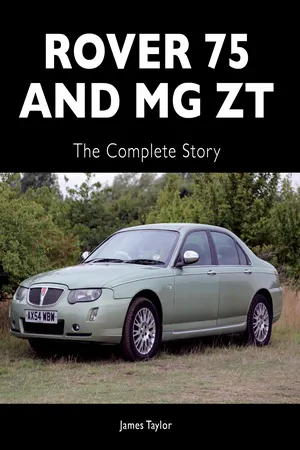
- 208 pages
- English
- ePUB (mobile friendly)
- Available on iOS & Android
eBook - ePub
About this book
Trusted by 375,005 students
Access to over 1.5 million titles for a fair monthly price.
Study more efficiently using our study tools.
Information
CHAPTER ONE

CONTEXT
The Rover 75 holds a special place in the history of Rover cars, and not only because it was the last completely new model to carry the Rover name. Its task was to revitalize the Rover marque, which had been gradually losing the respect of public and media alike in the 1990s with its competent but uninspired derivatives of Japanese Honda designs, and it fulfilled that task admirably. Nearly a decade after the last Rover 75 was built, few people have anything negative to say about it – and that is a huge accolade for any car.
Nevertheless, the trail that led from the original Rover Company to the Rover Cars responsible for the design and development of the 75 was a convoluted one. The reality is that the original Rover Company had ceased to exist more than a quarter of a century before the 75 was introduced in 1998. However, it had left a formidable legacy in the public mind (even though this had become somewhat tainted in the 1970s and 1980s), and there can be no question that the new Rover 75 inherited at least the UK public’s expectations of the Rover name and carried them forward with dignity.
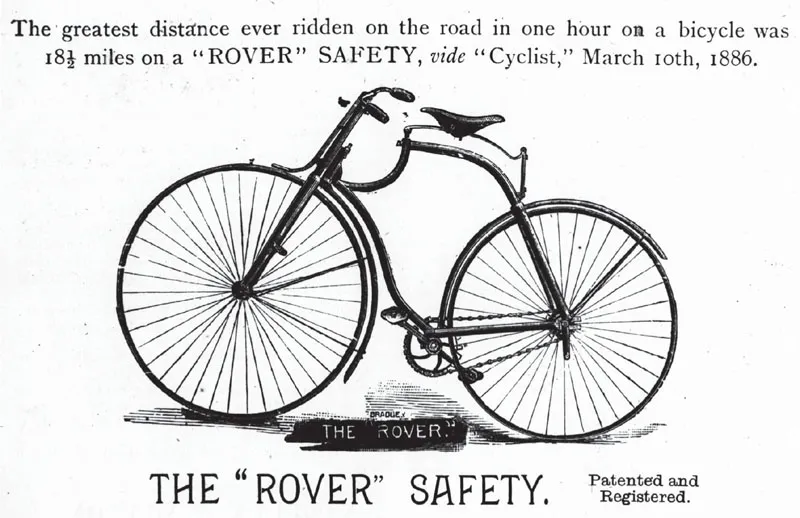
Recognizably the ancestor of the modern bicycle, this is the Rover Safety Cycle, made by the Starley Company.
The Rover 75 was introduced as the marque’s flagship car at a time when Rover belonged to the German BMW company – the first and only time that Rover had been foreign-owned. While the car was still relatively new, BMW tired of Rover’s business problems and sold the company, splitting the car division from the Land Rover side and selling them separately. Rover’s new owners, Phoenix Venture Holdings, reorganized the business to make more of the MG marque that they had also purchased, and named the new company MG Rover. Central to their plans were MG derivatives of the existing Rover saloons, and so the 75 was accompanied from mid-2001 by a reworked sister model called the MG ZT. Both were still in production when MG Rover collapsed in 2005, so bringing to an end more than 120 years of the Rover name.
In fact, Rover had not started out as a car maker at all. Its origins lay in the mid-nineteenth century, when James Starley had set up in business to make sewing machines in Coventry. Some years later, there was a rapid expansion of public interest in bicycles, and a number of new companies were established to cater for it, many of them in the Coventry area where the necessary skill base already existed. Starley decided to join them, and from 1877 began to make bicycles. Not content to follow the herd, he turned to innovation, and came up with the first ‘modern’ bicycle in 1885. Known as the Starley Safety Cycle, this replaced the large front wheel and tiny rear wheel of the traditional ‘Penny-farthing’ with two wheels of almost equal size on a diamond-shaped frame. It was very successful and widely imitated, and was soon marketed as the Rover Cycle. With this success came a change of name, and Starley’s cycle company became the Rover Cycle Company in 1896.
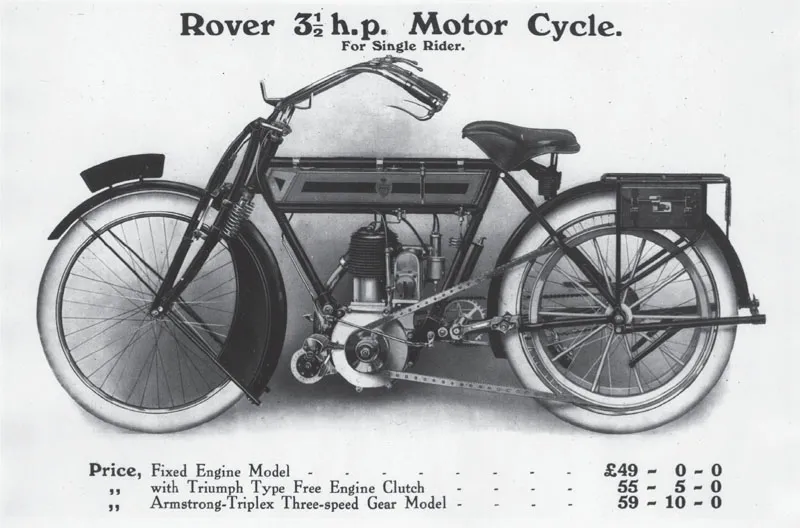
Rover built motorcycles from 1902. This is a 3½hp model dating from 1912.
As public tastes moved on, so did Rover. From 1902 they added motor-cycles to their repertoire, and then in 1904 they built their first car. Trading as the Rover Company from 1906, they continued to make bicycles and motor-cycles until 1925, but it was clear that motor cars were the way forward, and from the middle of the 1920s their focus was entirely on that form of transport.
However, Rover’s first quarter-century as a car manufacturer was a rather confused period. There were large cars and small cars, most of them well respected and well constructed, but it was very hard to identify what the Rover name really represented. At the time of the Depression, for example, the company was developing an advanced rearengined small car called the Scarab (which did not enter production), and yet in the early 1930s it was also aiming for success with a high-performance derivative of its large cars that was called the Meteor.
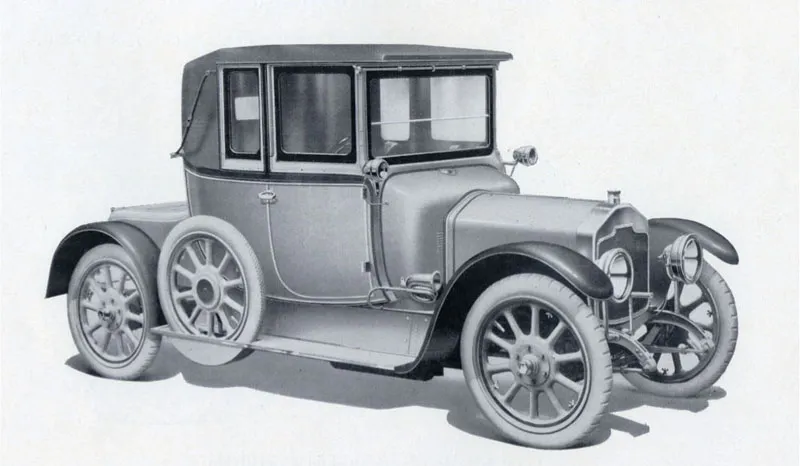
The ‘Clegg 12’, a 12hp model designed by Rover’s chief designer Owen Clegg, was available in the years that led up to the Great War of 1914–18.
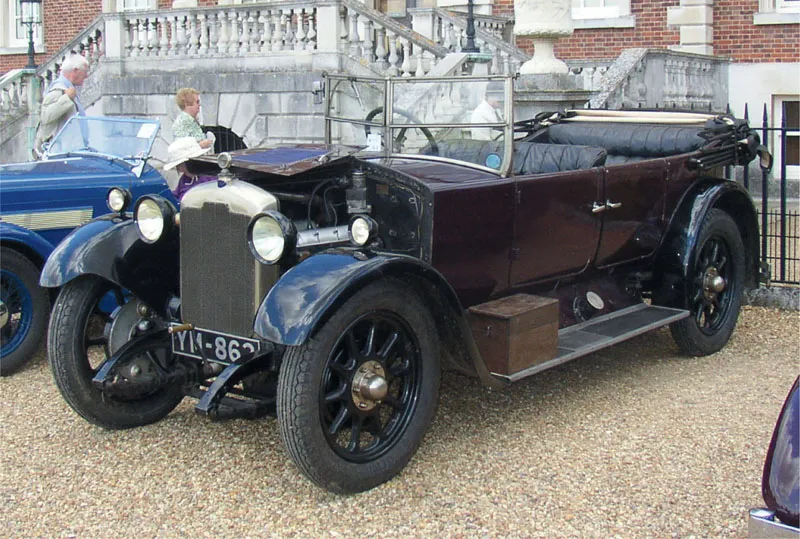
Typical of the Rovers of the mid-1920s was the 14/45 model. It was considered under-powered and many seem to have been re-engined to match the later 16/50 specification.
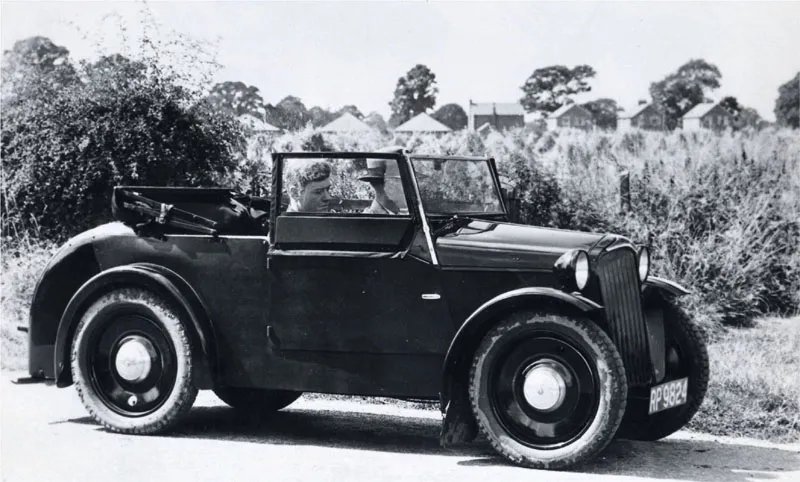
The Scarab was a cheap, small, rear-engined car that was displayed at London’s Olympia Motor Show in 1931. However, new management brought a change of product policy and the car did not enter production.
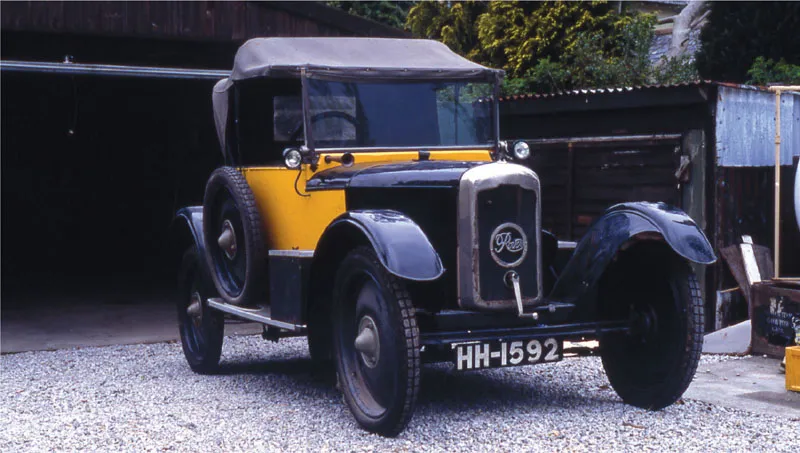
The air-cooled 8hp was Rover’s small car in the early 1920s. Though endowed with plenty of charm, it was an oddity in the maker’s range.
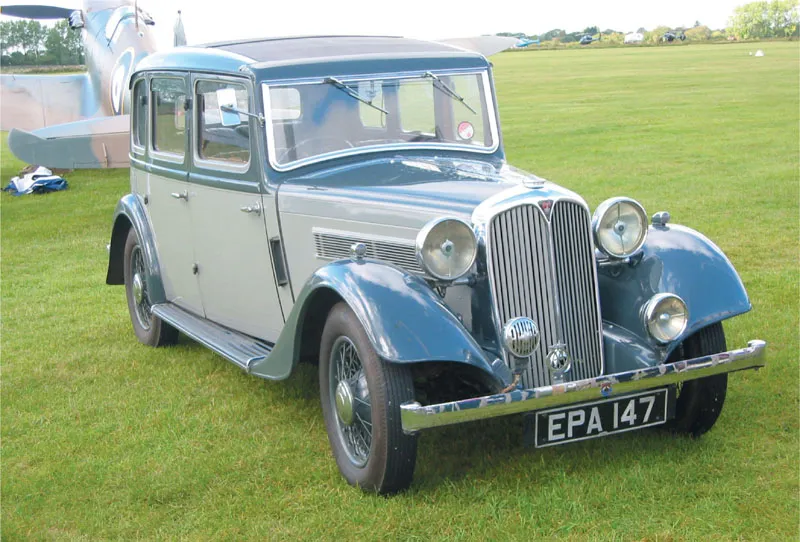
Typical of the early Wilks Rovers is this 1936 car, which pre-dates the Spitfire behind it by some years.
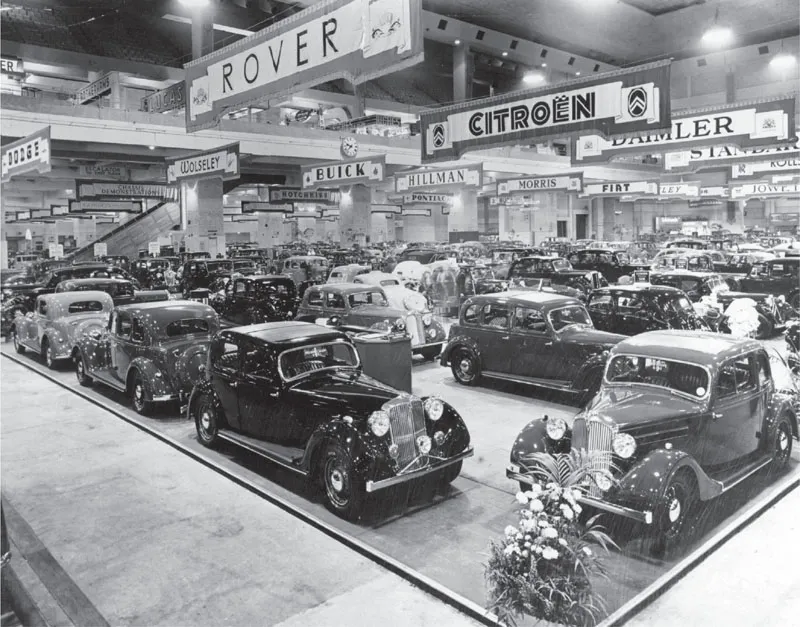
This was Rover at its peak in the late 1930s. The cars on display were part of the rationalized range introduced in 1936 for the 1937 season; the 10 coupé on the right was not introduced until a year later.
All this changed when a new management team was brought in at the start of the 1930s. The central figures included a Birmingham accountant, H. Howe Graham, who took charge of the company’s ailing finances and helped mastermind a remarkable turnaround. Meanwhile, Rover had benefited from the Rootes brothers’ takeover of Hillman, when a number of that company’s former employees decided to join them. Among them was S. B. (Spencer) Wilks, who became Rover’s Works Manager and swiftly earned promotion to Managing Director; he was followed by his younger brother M. C. (Maurice) Wilks, a gifted engineer who took over as Rover’s Chief Engineer.
The new team allowed most of the old Rover designs to wither on the vine, at the same time preparing a more rational range of cars based on a common design but with enough variety to cater for customers at several levels of the market. Most important was that these designs embodied both reliability and discreet good taste; they were exactly what the British professional classes wanted (exports were simply not part of the Rover programme then) and they quickly brought in the profits and gave Rover a whole new reputation. By the middle of the 1930s, Rover was regarded highly enough to be asked by the Government to manage one of the new ‘shadow’ aircraft factories that were being built as insurance against the threat of war with an expansionist Germany.
When war came, Rover was asked to manage a second ‘shadow’ factory, this time at Solihull to the south-east of Birmingham. Here, as at the No. 1 factory in Acocks Green and a third underground factory at Drakelow, it contributed to the war effort by manufacturing and repairing aircraft and aircraft components. At ‘dispersal’ factories established in former cotton mills in Lancashire, some of its engineers meanwhile became involved with the development of the Whittle jet engine, and it was, in fact, a Rover-developed engine that overcame the limitations of the original Whittle design to produce the first viable jet aircraft engine. These activities kept the company together during the war years, even though its original factory and head offices in Coventry had been destroyed by German bombing in November 1940.
Part of the contract with the British Government had been that Rover could buy the ‘shadow’ factories it managed at nominal prices when the threat of war receded. So Rover chose to move its headquarters to the Solihull factory when the war ended in 1945, and also took on the Acocks Green factory, where it made tank engines for the Government until 1954. That factory subsequently became Rover’s main engine-assembly plant.
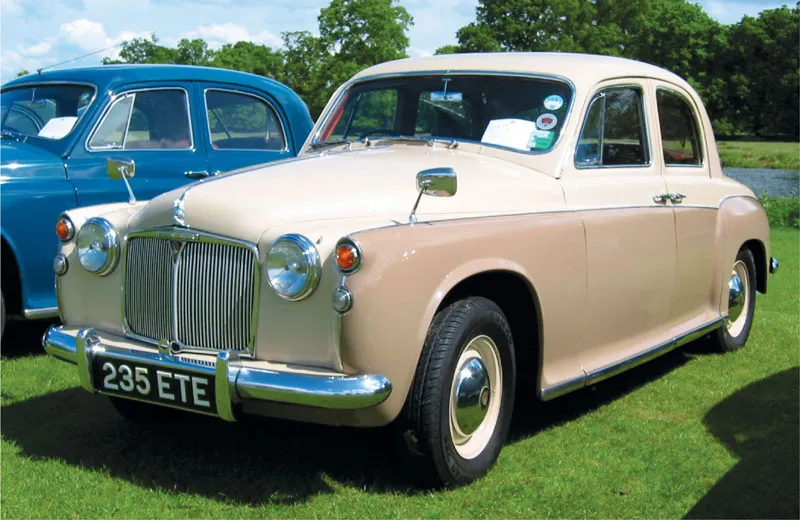
The P4 range lasted from 1949 to 1964 and established the post-war image of Rover. This is a 1958 model, in a short-lived two-tone colour scheme typical of the period.
However, post-war conditions saw Rover facing new challenges. In particular, the British Government put pressure on manufacturing industry of all kinds to build for export, in order to earn revenue that would help rebuild the country’s war-torn economy. Rover did its best, establishing an export department for the very first time and doing quite well selling what were still pre-war designs within Europe, the British Commonwealth and some British protectorates. But it was not enough; the company needed more to survive. So Chief Engineer M. C. Wilks proposed a light commercial vehicle, inspired by the wartime military Jeep but using existing Rover running gear, which he believed would find a ready export market in agriculture and light industry.
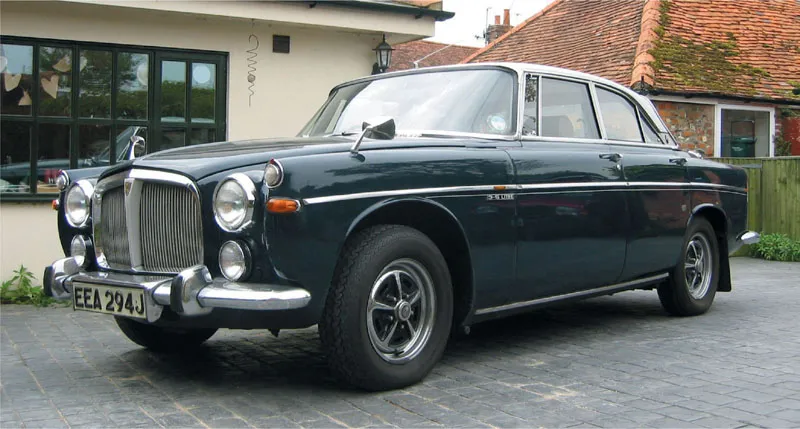
The P5 was a grander model than the P4 and was made in smaller volumes. This is one of the later cars with the 3.5-litre V8 engine that Rover bought from Buick in America; it is a 1971 example of the lower-roofed coupé variant.
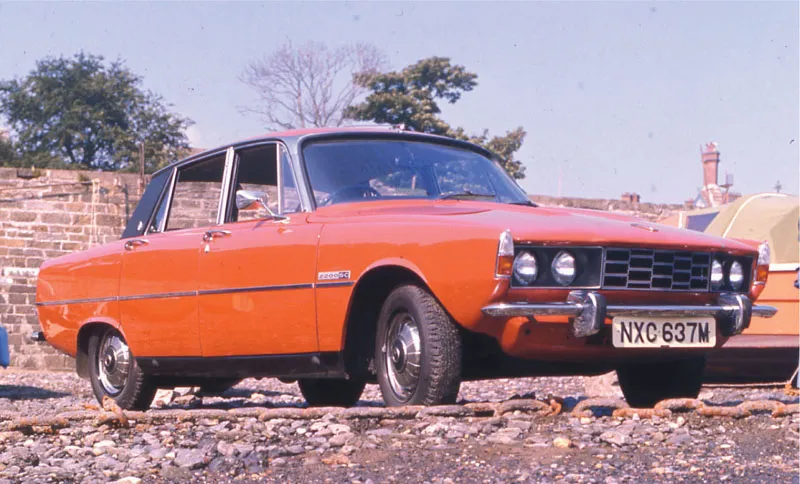
The P6 model was very advanced for its time. This is one of the later models, a 2200SC from 1974. The vinyl roof pillars were typical of the time.
He could not have been more right. Rover introduced its Land Rover in April 1948 and, within three years, it was outselling Rover cars by two to one. It had bought the company time to develop more modern car designs, but it had also completely changed the face of the Rover Company. Though there were many Rover die-hards who resisted the truth to the last, it was the Land Rover that became the company’s primary product from the start of the 1950s, while the cars were relegated to an elegant but profitable sideline.
Yet it was those cars that created the enduring Rover image to which the 1998 Rover 75 would owe so much. First came the P4 saloons (the 60, 75, 80, 90, 95, 100, 105, 105R, 105S and 110) from 1949 to 1964. Land Rover profits enabled the company to add a smaller volume, more expensive model known as the P5 (initially a 3-litre saloon, from 1962 joined by a coupé model, and then from 1967 to 1973 as a 3.5-litre V8 saloon and coupé). From 1963, the P6 joined the range; intended primarily as a replacement for the P4, it was an advanced design that attracted a younger clientele for Rover but lost none of the Rover reputation for excellent build quality, refinement and durability. Initially a 2.0-litre 2000, it took on the V8 engine in 1968 as a 3500; the 4-cylinder grew to 2.2 litres in 1973 and the last examples were made in 1977.
With these cars, Rover’s image as a maker of quality cars had been firmly established by the middle of the 1960s, when events in the wider motor industry had an impact on its future. In 1965, the British Motor Corporation (essentially Austin and Morris, plus MG, Riley and Wolseley) bought the body maker Pressed Steel, who had been building Rover’s car bodies since the late 1940s. Rover probably feared a rerun of what had happened to Jowett in the early 1950s when Ford had bought out Briggs, who had made the Jowett bodies; Jaguar had come to a similar conclusion and yielded to a BMC takeover offer during 1966. So Rover sought a partner that had access to a body-making plant, and by the end of 1966, it had agreed to a ‘merger’ with bus and truck maker Leyland, who already owned Standard-Triumph. Two years later, the British Government brokered a Leyland takeover of BMC, aiming to create a large British vehicle-manufacturing group capable of taking on the large continental European makers. After a brief period as the British Leyland Motor Corporation, the company became British Leyland Ltd.
Rover (and its Land Rover marque) were largely left alone for around three years, but by 1971, British Leyland had started to rationalize its somewhat disparate collection of companies. Riley and Wolseley had slipped away quietly in 1969; British Leyland now saw the need for only one ‘affordable’ sports car brand, and the choice fell on MG. Triumph, the other contender for the title, had also been a maker of both large and small quality saloons and, despite its more sporting associations, the brand was amalgamated with Rover. Rover-Triumph became a division of British Leyland, and from this point Rover ceased to exist as a separate entity.
Yet the Rover brand survived. Although plans for a new large Rover, the P8, had been brutally cancelled in 1971 when there were fears it would compete too closely with Jaguar, the new smaller Rover (P10) went ahead. It absorbed ideas from a similar-sized car planned at Triumph and became the first product of the Specialist Cars Division with the code-name of SD1. Reaching the market in 1976 as a Rover 3500, it broke new ground with its bold and sleek hatchback design by Rover stylist David Bache. Unfortunately, its initial promise soon faded, as build-quality issues became a major problem.
British Leyland had meanwhile gone bankrupt, and at the end of 1974 had been bailed out by the British Government. Under the management of Michael Edwardes from 1977, the company underwent a radical slimming programme to become more cost-e...
Table of contents
- Cover
- Title Page
- Copyright Page
- Contents
- Timeline
- Introduction and Acknowledgements
- Chapter 1 Context
- Chapter 2 Concept, Design and Development: 1993–98
- Chapter 3 The Cowley Cars
- Chapter 4 Expanding The Options
- Chapter 5 MG Models
- Chapter 6 Facelift
- Chapter 7 The V8 Models
- Chapter 8 Away from the Mainstream
- Chapter 9 Outside the UK
- Chapter 10 Not Quite British
- Appendix I: Vehicle Identification, Production Figures and Production Milestones
- Appendix II: Engine Identification
- Appendix III: R40 Model Availability
- Index
Frequently asked questions
Yes, you can cancel anytime from the Subscription tab in your account settings on the Perlego website. Your subscription will stay active until the end of your current billing period. Learn how to cancel your subscription
No, books cannot be downloaded as external files, such as PDFs, for use outside of Perlego. However, you can download books within the Perlego app for offline reading on mobile or tablet. Learn how to download books offline
Perlego offers two plans: Essential and Complete
- Essential is ideal for learners and professionals who enjoy exploring a wide range of subjects. Access the Essential Library with 800,000+ trusted titles and best-sellers across business, personal growth, and the humanities. Includes unlimited reading time and Standard Read Aloud voice.
- Complete: Perfect for advanced learners and researchers needing full, unrestricted access. Unlock 1.5M+ books across hundreds of subjects, including academic and specialized titles. The Complete Plan also includes advanced features like Premium Read Aloud and Research Assistant.
We are an online textbook subscription service, where you can get access to an entire online library for less than the price of a single book per month. With over 1.5 million books across 990+ topics, we’ve got you covered! Learn about our mission
Look out for the read-aloud symbol on your next book to see if you can listen to it. The read-aloud tool reads text aloud for you, highlighting the text as it is being read. You can pause it, speed it up and slow it down. Learn more about Read Aloud
Yes! You can use the Perlego app on both iOS and Android devices to read anytime, anywhere — even offline. Perfect for commutes or when you’re on the go.
Please note we cannot support devices running on iOS 13 and Android 7 or earlier. Learn more about using the app
Please note we cannot support devices running on iOS 13 and Android 7 or earlier. Learn more about using the app
Yes, you can access Rover 75 and MG ZT by James Taylor in PDF and/or ePUB format, as well as other popular books in Technology & Engineering & Automotive Transportation & Engineering. We have over 1.5 million books available in our catalogue for you to explore.