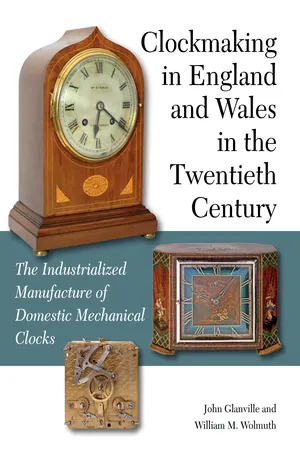
Over a decade John Glanville and Bill Wolmuth undertook an important horological project for the British Museum. This involved establishing a representative collection, for the Museum, of twentieth-century domestic mechanical clocks made in England and Wales using industrialized manufacturing methods. This remarkable book is the culmination of their efforts. Wide-ranging in its coverage, it will be a key reference tool for horologists, horoligical students, collectors, and antiques and clock dealers. It provides a comprehensive history of each significant manufacturer, including the principal people involved and covers the various mechanical clock movements that were produced. Previously unpublished research about the manufacturers, the clocks they made and the dates when they were manufactured is presented. Finally, this book informs readers how they can identify and date almost all of the clocks they are likely to encounter. This detailed and meticulously researched book on the domestic mechanical clocks made in England and Wales in the twentieth century, a culmination of ten years' research by the authors, will be a key reference tool for horologists, horological students, collectors, and clock and antiques dealers. Superbly illustrated with 1016 colour photographs and period black and white illustrations.
eBook - ePub
Clockmaking in England and Wales in the Twentieth Century
The Industrialized Manufacture of Domestic Mechanical Clocks
- 320 pages
- English
- ePUB (mobile friendly)
- Available on iOS & Android
eBook - ePub
Clockmaking in England and Wales in the Twentieth Century
The Industrialized Manufacture of Domestic Mechanical Clocks
About this book
Trusted by 375,005 students
Access to over 1.5 million titles for a fair monthly price.
Study more efficiently using our study tools.
Information
Chapter 1
Introduction
Although over the last 250 years The British Museum has built an extremely fine collection of mechanical clocks, in 2004 the authors noticed that it had yet to extend its collection to document the last 100 years of mechanical clockmaking in England and Wales. As a result, in 2005, the authors approached the Museum and volunteered to form for it a representative collection of mass-produced domestic mechanical clocks made in England and Wales in the twentieth century. The Museum warmly welcomed the offer and duly commissioned the project.
Apart from Alan and Rita Shenton’s book on clocks made between 1840 and 1940,1 relatively little had been published on the subject by 2005. In addition, the majority of the twentieth-century clocks are not marked with the manufacturer’s name or trademark. As a result, the authors have had to undertake extensive research to work out who made what and to find examples for the Museum. The research included a detailed study of The Horological Journal from the 1880s onward and of other trade journals where accessible to the authors;tracking down and examining manufacturers’ catalogues and brochures; searching national archives and specialist libraries; tracing and interviewing relatives of company founders and staff; and obtaining clocks and studying them. Clocks were mainly acquired by expeditions to specialist clock fairs and trade antiques fairs and by using eBay, not only for some of the purchases but also as a further research tool.
The research proved more challenging and interesting than the authors had anticipated and has resulted in them being able to piece together the history of the various companies in more detail than expected; to trace a surprising number of descendants of company founders and staff and obtain further unpublished information; to establish how almost all such clocks can be identified; and to form the collection of clocks for The British Museum.
As a result of the authors’ research, a detailed history of each significant manufacturer, the key people involved and the various mechanical clock movements has been established. Readers should therefore be able to identify the manufacturer and narrow down where and when almost any clock was made. The photographs included are predominantly of clocks collected for the Museum, but other clocks have been referred to where necessary. However, to avoid the challenge becoming unmanageable, the project has excluded alarm clocks, American clocks made in the UK, electric clocks and those primarily produced for commercial and industrial use. The project’s focus on manufacturing in England and Wales has resulted from the location of the factories concerned and not from any lack of interest in horology further afield in the UK.
Although hard to prove, it seems probable that as many domestic mechanical clocks were made in England and Wales in the twentieth century as in the four preceding centuries combined. This was made possible by industrialization of production to tight tolerances, which allowed components and assemblies to be mass-produced and yet to be completely interchangeable between all examples of any particular model of movement being produced. This eliminated the costly and time-consuming process by skilled clockmakers of hand-finishing the components, to achieve a satisfactory fit, so allowing relatively unskilled male and female labour to assemble clock movements.
HOROLOGY UP TO THE END OF THE FIRST WORLD WAR
During the nineteenth century mass production on industrial lines had revolutionized clock production in Germany, America and France. In the UK, imported clocks had captured most of the popular market. This resulted from the belief of traditional British clockmakers that only clocks made to craft standards were any good and that they should be able to sell their products at a higher price. However, the public clearly did not share this view and by 1885 the clockmaking trade in Britain was at low ebb, with 782,161 clocks being imported that year.2
One of the earliest companies in England and Wales to industrialize clock production was the British United Clock Company (BUCC), which was formed in 1885 and manufactured clocks until it ceased trading in 1909. Their designs reflected their founders’ experience of American clock production. The company was also ahead of its time employing women to operate equipment, a practice that later became firmly established in wartime. BUCC was followed by H. Williamson Ltd, which bought an existing works and, with the help of a German expert, re-equipped it to make domestic clocks using industrialized, tight tolerance production. The company continued making clocks for many years, and merged clock production in 1921 with Grimshaw, Baxter and J.J. Elliott to form English Clock & Watch Manufacturers Ltd, which Smiths acquired from receivers in 1932.
The advent of the First World War created a demand for millions of clockwork timing mechanisms for shell fuses and other military ordnance, which the British clock trade was ill-equipped to supply due to its previous reluctance to embrace industrialized manufacture. This resulted in concerted efforts by the Government to force change and The Horstmann Gear Company Ltd, which later made Newbridge clocks, was commissioned to manufacture tolerance gauges for use by other manufacturers to make parts to tight tolerances for the war effort. This then enabled components for the military to be made around the country and assembled in France. The war also spawned new engineering companies, like The Garrard Engineering and Manufacturing Company Ltd, which later used the skills it developed to make gramophones and, for many years, domestic clocks.
HOROLOGY BETWEEN THE WARS
During the First World War, at a time when food and war provisions came first, the Government introduced a wide-ranging import duty of one-third on non-essential cargo. The tax was known as the McKenna Duty, after the Chancellor of the Exchequer who introduced it, and it was very popular with British clock manufacturers as its scope included imported clocks and watches.
At the end of the First World War, with the McKenna Duty in place and widespread antipathy to Germany, there was a benign environment for an industrialized clockmaking industry to develop in the UK. Hirst Brothers of Oldham built a modern factory and started manufacture of Tame Side clocks and The Horstmann Gear Company of Bath started manufacture of Newbridge clocks. However, in the 1920s political vacillation caused constant insecurity for the clockmaking industry with the Liberal Party wanting to abolish the Duty in accordance with their free-trade principles and the Conservative Party wishing to maintain it. As the 1920s progressed, anti-German feeling also abated and UK clock importers, such as Bentima and Andrew & Co., flourished importing German clocks. By the late 1920s both Hirst and Horstmann had abandoned clock manufacture and yet there was a growing awareness of the need for industrialization of clock production for Britain to have a healthy clockmaking industry.
A further company, F.W. Elliott, was founded in the 1920s and manufactured domestic clocks in volume aiming at the upper end of the market. Although it did not manufacture in as large quantities as its later rivals, it was the longest lived, continuing to make mechanical clocks until the 1990s. It was one of the few companies that used English designs; it made its own high quality cases and its clocks are still much sought after.
The early 1930s saw the development of what was to grow into a major English clockmaking industry. Hyperinflation in Germany resulted in many German business closures with the associated clockmaking machinery and many movement designs being available. In addition, the associated unemployment resulted in skilled German personnel becoming available to help set up clockmaking factories in the UK and to train British staff. Within a few years, clocks were being made in England, using industrialized manufacture and German expertise, by The Garrard Engineering & Manufacturing Company Ltd, The Norland Clock Company Ltd, The Clarion Clock Company, the Enfield Clock Company (London) Ltd, Stephen Davall & Sons Ltd and The Perivale Clock Manufacturing Company Ltd. While all of these companies trumpeted British manufacture in their marketing, their use of German designs and expertise has remained a largely untold story. As part of the authors’ research, the sources of the majority of the English manufacturers’ movement designs have been established and are explained in the various chapters of the book.
In the 1930s the upsurge in clock production in England and Wales was very rapid. It was estimated in the 1930s that the total output of British clock manufacturers in 1931 was 65,000 clocks; in 1933 it was between 900,000 and one million; and in 1934 it was thought to have exceeded a million.3 This growth in production was achieved despite competition remaining fierce; in 1938 nearly five million complete clocks and clock movements of all types were imported, of which approximately 3.85 million were German. Most of the UK production was for home consumption: only 10,000 complete clocks were exported in 1938.4
In 1933 the new clockmaking businesses formed The British Clock Manufacturers’ Association with the objective of having a vehicle to represent its members to Government on matters of common interest, such as import duties, Empire preference and the trade marking of imported goods. Until the Second World War they had some success. By 1939 the Association had twenty-three members, of whom approximately half made domestic mechanical clocks industrially; the only firm that had industrialized its production, and was initially involved but did not remain with the Association, was F.W. Elliott.
Before the Second World War it was common for retail jewellers to have clocks supplied ‘in the white’ unsigned by the maker but with their own name on the dial. Because of this it took the authors some time before they detected that, while not physically stamped with the maker’s name, there were other unique markers that were just as effective. These have been indicated when describing the clocks: they vary from the style and layout of Made in England stampings to the shape of exposed components and the layout of the movements.
While at the outbreak of war in 1939 the country had a far larger and more productive clockmaking industry than had been the case in 1914, there was still a great shortage of capacity for the production of the many mechanical timing devices required for military ordnance and for precision engineering of all kinds. In some respects there were great opportunities and some firms, including Smiths, Garrard and Perivale, suspended domestic clock production for the duration of the war and switched to manufacture in support of the military. However, by 1940 Norland and Clarion had stopped clock manufacture, never to resume.
HOROLOGY AFTER THE SECOND WORLD WAR
By 1939 English clock manufacturers were well established and after the impetus provided by the Second World War they flourished. In the 1950s England and Wales could claim to make more domestic clocks than any other European nation.
Because of the poor financial state of the national economy, which made income from export of vital concern, it was some years after the Second World War ended before clock production for the domestic market recommenced; most manufacturers introduced their new postwar ranges in about 1949.
For the next twenty years trade was good but the writing was on the wall. From the early 1970s the popular market for mechanical clocks collapsed with the growing production of battery-powered electric clocks and then quartz technology. This was compounded by a change in fashion that resulted in greatly reduced demand for chiming and striking clocks. Within a few years all production had ceased other than of timepieces. The old mechanical clocks were soon being thrown away, unloved by the owners and not yet of interest to collectors and enthusiasts. The last manufacturer of domestic mechanical clocks on an industrial basis, F.W. Elliott Ltd, who made better clocks in fine cases, soldiered on until 1997.
RECENT TIMES AND FURTHER THOUGHTS
In recent years there has been a growing interest in the long-vanished mechanical clockmaking industry of England and Wales. Whether or not the twentieth-century clocks were in cases appealing to modern tastes, the movements were usually made robustly and today offer the layman, enthusiast and collector a taste of history at a very modest price. As a result, the authors hope that the reader will find much in the book of interest, whether he or she wants to know more about the subject in general or has a specific clock and wants to date it or identify its origin. It is hoped that the book will also result in such clocks being appreciated to a much greater extent and perhaps help dealers to find new, loving homes for them.
Throughout the book, when describing clock movements, the authors have included dimensions to assist the reader with identification. Although the clocks were generally made to tight tolerances, minor variations in plate height, width and thickness did occur. Nominal dimensions that the authors have given show plate dimensions rounded to the nearest millimetre. Plate thicknesses are given to the nearest tenth of a millimetre, since rounding to the nearest millimetre would obscure the difference between a clock with a 1.6mm plate thickness and another of 2.4mm thickness, despite such differences being worthy of note. Similarly, the distance between plates is given to the nearest tenth of a millimetre.
Readers who wish to view the collection, known as The Glanville & Wolmuth Collection, may do so to a limited extent online at The British Museum’s website. Although a shortage of exhibition space precludes the collection from being on general view at the Museum, individual clocks may be inspected by appointment. The combination of this book, which has been carefully referenced, and the collection provides a research resource that will enable those interested to conduct further study.
Anyone endeavouring to research clockmaking in England and Wales will find The Horological Journal an invaluable source of reference and the authors are no exception. As a result, they wish to thank The British Horological Institute for publishing the journal continuously for more than 150 years and for their generosity in allowing the authors to reproduce historical material from it.
This book and the collection formed for The British Museum have only come about as a result of the openmindedness and encouragement of The British Museum staff. The authors wish to thank for their support Neil MacGregor, The Director of The British Museum, and Jonathan Williams, Deputy Director and former Keeper of the Department of Prehistory and Europe. The authors are also greatly indebted to The British Museum’s Horological Collections team of David Thompson, the Senior Curator until his retirement in 2013, his successor, Paul Buck, and Curators Oliver Cooke and Laura Turner, for their help and support, without which the project would not have been undertaken or successfully completed.

Location of factories manufacturing domestic mechanical clocks, using industrialized techniques, in England and Wales in the twentieth century.
Chapter 2
The British United Clock Co., Tame Side and Newbridge
This chapter provides the history of three of the companies that pioneered the application of industrialized manufacturing techniques to clockmaking in Britain: The British United Clock Co. Ltd of Birmingham; Hirst Bros & Co. Ltd of Oldham, which manufactured clocks using the Tame Side trademark; and The Horstmann Gear Co. Ltd of Bath, which formed Newbridge Clocks. Details of a further pioneer, H. Williamson Ltd, are provided in Chapter 3. Their history spans a pe...
Table of contents
- Cover Page
- Title Page
- Copyright Page
- Contents
- Forewords
- Dedication
- Acknowledgements
- Abbreviations
- Chapter 1 Introduction
- Chapter 2 The British United Clock Co., Tame Side and Newbridge
- Chapter 3 Williamson, English Clock & Watch Manufacturers (up to 1932), Rotherham and Mercer
- Chapter 4 J.J. Elliott, Grimshaw, Gillett & Johnston and F.W. Elliott
- Chapter 5 Smiths, English Clock & Watch Manufacturers (1932 onward), Enfield and United Kingdom Clock Co.
- Chapter 6 Garrard, Norland and Clarion
- Chapter 7 Perivale, Davall, Newport and Francis
- Glossary
- References
- Index
Frequently asked questions
Yes, you can cancel anytime from the Subscription tab in your account settings on the Perlego website. Your subscription will stay active until the end of your current billing period. Learn how to cancel your subscription
No, books cannot be downloaded as external files, such as PDFs, for use outside of Perlego. However, you can download books within the Perlego app for offline reading on mobile or tablet. Learn how to download books offline
Perlego offers two plans: Essential and Complete
- Essential is ideal for learners and professionals who enjoy exploring a wide range of subjects. Access the Essential Library with 800,000+ trusted titles and best-sellers across business, personal growth, and the humanities. Includes unlimited reading time and Standard Read Aloud voice.
- Complete: Perfect for advanced learners and researchers needing full, unrestricted access. Unlock 1.5M+ books across hundreds of subjects, including academic and specialized titles. The Complete Plan also includes advanced features like Premium Read Aloud and Research Assistant.
We are an online textbook subscription service, where you can get access to an entire online library for less than the price of a single book per month. With over 1.5 million books across 990+ topics, we’ve got you covered! Learn about our mission
Look out for the read-aloud symbol on your next book to see if you can listen to it. The read-aloud tool reads text aloud for you, highlighting the text as it is being read. You can pause it, speed it up and slow it down. Learn more about Read Aloud
Yes! You can use the Perlego app on both iOS and Android devices to read anytime, anywhere — even offline. Perfect for commutes or when you’re on the go.
Please note we cannot support devices running on iOS 13 and Android 7 or earlier. Learn more about using the app
Please note we cannot support devices running on iOS 13 and Android 7 or earlier. Learn more about using the app
Yes, you can access Clockmaking in England and Wales in the Twentieth Century by John Glanville in PDF and/or ePUB format, as well as other popular books in Technology & Engineering & Industrial Engineering. We have over 1.5 million books available in our catalogue for you to explore.