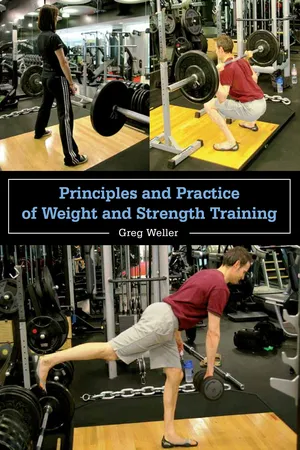
The practical application of exercise theory by strength and conditioning coaches the world over has helped develop exercise research knowledge into effective training methods. Principles and Practice of Weight and Strength Training will cover how to properly prepare yourself for your chosen sport or activity by increasing strength.It examines the following: Common postural problems and how to improve posture; Techniques for self-myofascial release; A wide range of mobility and stability exercises, shown through step-by-step colour photography; More advanced weight and core exercises for the improving athlete; Implementing effective training programmes. Principles and Practice of Weight and Strength Training will help people make sure they train effectively, reduce injuries, improve their performance and enjoyment, and not waste time and effort on poor practice.'I owe Greg Weller my career. He is by far the best strength and conditioning coach I have ever had the pleasure of working with, in or outside of professional rugby.' Dan Smith, Professional Rugby Player, Doncaster Knights, Bath Rugby, England U21s. A practical guide to how to properly prepare yourself for your chosen sport by increasing strength, aimed at athletes and those supplementing their training in specific sports. Superbly illustrated with 230 step-by-step colour photographs. Greg Weller has been involved in sport and the fitness industry for over twenty years.
- 160 pages
- English
- ePUB (mobile friendly)
- Available on iOS & Android
eBook - ePub
Principles and Practice of Weight and Strength Training
About this book
Trusted by 375,005 students
Access to over 1.5 million titles for a fair monthly price.
Study more efficiently using our study tools.
Information
CHAPTER 1 POSTURE
Correct postural balance and strength are important for efficient movement in everyday life and for optimal performance in sporting situations and it all begins when we are babies. In the womb we develop in the foetal position and after birth we start strengthening the muscles that comprise the posterior chain. These are the muscles running from the head down the spine to the hips and down the back of the legs to the feet. Babies have great mobility and quickly start to develop the stability and strength they need to get to their feet and start walking. Motor patterns and movement are practised and perfected until they can stand, then walk and eventually run around with confidence and good posture. Toddlers have great squatting and dead-lifting technique too.
As children start attending school they find themselves sitting down for longer periods at a time, and this is when bad postural habits and muscle imbalances can start to develop. Kids need to move. Movement develops motor skills, maintains mobility and is vital to ensure healthy development of the whole body. As we get older the pressures of modern life make it harder to find opportunities to maintain optimal mobility and good posture. We spend more and more of our waking hours sitting down: on the way to work, on the train or in the car; at work for hours on end; on the way home again; and at home in the evening watching television. None of this is good for the posterior chain that developed so well in infancy. Then, to make things worse, because we sit around so much we develop a paunch, so we start doing sit-ups in a vain attempt to get six-pack abs. This only adds to the overdevelopment of the anterior chain and contributes to poor posture, among other problems.
Athletes and non-athletes develop posture and movement dysfunctions through daily habits and poorly designed training programmes. Poor posture can lead to neck, shoulder, back, hip or knee and ankle pain, and possibly injury. Adopting the correct posture during athletic movements will reduce the risk of injury by making sure that all joints and structures are in the right position to absorb and generate forces. Good posture can be encouraged and reinforced with an appropriate mobility and strength programme that addresses muscle imbalances and movement dysfunctions.
Healthy Posture
Posture can be influenced by many factors, from repetitive sporting actions and frequently held positions at work or rest, to acute or chronic injuries, emotional stress and even sleep positions. It is a very complex subject and one that cannot be extensively explored here. Proper analysis and treatment of postural and movement dysfunction, especially in the presence of pain, requires the skills of an appropriately qualified therapist. However, some of the more common and basic dysfunctions can be assessed with movement screens such as the Functional Movement Screen (FMS) devised by Gray Cook and helped with corrective exercise strategies. Below are some basic explanations of common postural dysfunctions, which will give an idea of how the body is linked throughout with many ways of integrating muscles for producing movement and providing support.

Side view of ideal posture: ear in line with shoulder, normal spinal curves, neutral pelvic position and alignment from hips through knees to ankles.
Healthy posture does not need to be perfect and the ideal posture should be used as a guide to assess where there may be areas that need attention. When the body is viewed from the side there should be alignment from the ear to the shoulder through the hip joint just behind the centre of the knee and down to the ankle. From the front the head should be held straight, the shoulders and hips should be level and, with the feet hip width apart, there should be good alignment from hip to knee and ankle. With a good posture the spine has three natural curves: a lordosis at the neck and lumbar spine and a kyphosis at the thoracic spine.

Front view of ideal posture: shoulders level, arms straight by the sides, pelvis level and alignment from hips through knees to ankles.
Looking at static posture can provide some information of possible dysfunction, but it is also vital to assess dynamic posture. This is where the Functional Movement Screen is used to assess how the joints and segments move and interact with each other in order to perform effective and efficient movement. At the bottom of the squat for instance the pelvis must be able to tilt anteriorly, to maintain a strong and stable spine position. If the pelvis tilts posteriorly the lumbar spine will round out and be subjected to damaging compressive and shear forces.
Common Postural Dysfunctions
Rounded Shoulders
Some of the most common postural dysfunctions start with the position of the head. When the head is held forward of the shoulders it results in extension at the neck and a rounding of the shoulders and thoracic spine. The sternocleidomastoid is a muscle attaching at the skull behind the ears, running down to the clavicle (collar bone) and sternum, which exerts a simultaneous upward and downward force when the head is held in the right position. The downward force tilts the head backwards and the upward force tilts the head forwards. When in the correct postural position the sternocleidomastoid’s upward force pulls on fascial connections running all the way down the front of the torso to the pubis, which lifts the chest and helps with the correct pelvic position. When the head is carried forward of the shoulders the sternocleidomastoid cannot exert its upward pull so the chest drops and the abdominals slacken, allowing the pelvis to tilt forward.
Slouched shoulders can cause neurogenic tension in the lumbar spine, which can then make an anterior pelvic tilt worse. In addition, the muscles across the chest, particularly the pectoralis minor, tend to be over-active and the muscles of the upper back tend to be under-active. All this contributes to what Janda termed the ‘upper crossed syndrome’ and is very commonly seen in today’s largely sedentary population.

Example of poor posture: forward head carriage, rounded upper back and shoulders. This posture can lead to neck, back and shoulder pain and movement dysfunctions.
Anterior Pelvic Tilt
Another common problem is at the pelvis, independent or in conjunction with a forward head carriage. Anterior pelvic tilt is when the front of the pelvis tilts forwards, resulting in an exaggerated lumbar lordosis. There can be a number of contributing factors in any postural dysfunction and it may be necessary to change daily habits or sports techniques as well a s addressing mobility, stability and muscle imbalances. Anterior pelvic tilt can result in a tight lower back and hip flexors or a tight lower back and hip flexors can contribute to an anterior tilt. Rather than trying to discover what came first, the best approach might be to address the most common contributing factors. Sitting down for long periods can lead to reduced activation in the glutes and over-activation in the hip flexors. Repetitive short-range hip flexion, as in running and cycling, can also lead to tight hip flexors, which can then caus...
Table of contents
- Principles and Practice of weight and strength Training
- Acknowledgements
- CONTENTS
- INTRODUCTION
- CHAPTER 1 POSTURE
- CHAPTER 2 TRAINING PREPARATION/WARM-UP PHASE
- CHAPTER 3 STRENGTH TRAINING
- CHAPTER 4 THE TORSO OR ‘CORE TRAINING’
- CHAPTER 5 DOUBLE-LEG MOVEMENTS
- CHAPTER 6 SINGLE-LEG MOVEMENTS
- CHAPTER 7 VERTICAL AND HORIZONTAL PULLING
- CHAPTER 8 VERTICAL AND HORIZONTAL PUSHING
- CHAPTER 9 PLANNING TRAINING
- BIBLIOGRAPHY
- INDEX
Frequently asked questions
Yes, you can cancel anytime from the Subscription tab in your account settings on the Perlego website. Your subscription will stay active until the end of your current billing period. Learn how to cancel your subscription
No, books cannot be downloaded as external files, such as PDFs, for use outside of Perlego. However, you can download books within the Perlego app for offline reading on mobile or tablet. Learn how to download books offline
Perlego offers two plans: Essential and Complete
- Essential is ideal for learners and professionals who enjoy exploring a wide range of subjects. Access the Essential Library with 800,000+ trusted titles and best-sellers across business, personal growth, and the humanities. Includes unlimited reading time and Standard Read Aloud voice.
- Complete: Perfect for advanced learners and researchers needing full, unrestricted access. Unlock 1.5M+ books across hundreds of subjects, including academic and specialized titles. The Complete Plan also includes advanced features like Premium Read Aloud and Research Assistant.
We are an online textbook subscription service, where you can get access to an entire online library for less than the price of a single book per month. With over 1.5 million books across 990+ topics, we’ve got you covered! Learn about our mission
Look out for the read-aloud symbol on your next book to see if you can listen to it. The read-aloud tool reads text aloud for you, highlighting the text as it is being read. You can pause it, speed it up and slow it down. Learn more about Read Aloud
Yes! You can use the Perlego app on both iOS and Android devices to read anytime, anywhere — even offline. Perfect for commutes or when you’re on the go.
Please note we cannot support devices running on iOS 13 and Android 7 or earlier. Learn more about using the app
Please note we cannot support devices running on iOS 13 and Android 7 or earlier. Learn more about using the app
Yes, you can access Principles and Practice of Weight and Strength Training by Greg Weller in PDF and/or ePUB format, as well as other popular books in Biological Sciences & Sport & Exercise Science. We have over 1.5 million books available in our catalogue for you to explore.