Brickwork and Bricklaying is written for those who are new to the craft of bricklaying, and those who are improving their skills. It provides an overview of the materials, processes, craft skills and related subjects to enable the reader to construct their own simple brickwork projects and undertake brickwork-related maintenance projects around the home.The book covers: Materials; Constituents and mix proportions of good quality concrete and mortars, and how to successfully mix both, with an overview of different types of bricks and blocks; Foundations: How to place, compact and cure concrete for simple foundations and bases; Setting-Out: Methods of setting out the positions of simple wall lines, corners and buildings; Bricklaying: Overview of tools required; step-by-step methods and instruction on all the basic craft skills of bricklaying from first principles; different methods of bonding and finishing mortar joints; Boundary Walls: Design principles for boundary and garden walls, including the application and construction of piers; Decorative Brickwork: Simple methods of decoratively enhancing brickwork projects; Maintenance: Identification of the common defects associated with brickwork and masonry and methods for rectifying those defects. A practical guide aimed at those who are new to the craft of bricklaying and also for those who are improving their skills. Provides details of materials, processes and craft skills for the reader to construct their own simple brickwork projects and maintenance around the home. Superbly illustrated with 110 colour photographs and 160 diagrams. Jon Collinson has been involved in bricklaying within the construction industry, as well as teaching brickwork, for over twenty-five years.
- 176 pages
- English
- ePUB (mobile friendly)
- Available on iOS & Android
eBook - ePub
About this book
Trusted by 375,005 students
Access to over 1 million titles for a fair monthly price.
Study more efficiently using our study tools.
Information
CHAPTER 1
Introduction

The use of bricks and the ancient craft of bricklaying have been in existence for thousands of years. The oldest shaped mud bricks, discovered near Damascus in Syria, date from as far back as 7500BC. Mud bricks were extensively used by the civilization of Ancient Egypt and the first sun-dried clay bricks date back to 4000BC, having been discovered in Mesopotamia (now Iraq). The Chinese also were experts in stonemasonry and bricklaying, the most iconic example of their work being the Great Wall of China, which was begun in the fifth century BC and is claimed to be the only man-made object visible from outer space.
The Romans made use of fired bricks and the Roman legions, who were known to operate mobile kilns, introduced bricks to many parts of their empire, including Europe around 2000 years ago. Great innovators in many areas, the Romans developed bricklaying as a craft, including the use of mortar and different types of bonding arrangements; however, with the eventual decline of the Roman Empire, the craft of bricklaying declined with it.
It was not until the latter half of the seventeenth century, after the Great Fire of London in 1666 in fact, that the English again started to use bricks in building and it took almost another 200 years, until the middle of the nineteenth century, before the mechanized production of bricks began to replace manual methods of manufacture. Despite the advent of mechanized production, however, growth in the brick industry was relatively slow as the moulded clay bricks were still being fired in fairly inefficient static or intermittent kilns. In 1858, a kiln was introduced that allowed all processes associated with firing the bricks to be carried out at the same time, and continuously. Since the introduction of this, the Hoffmann kiln, the brick industry has made great progress, particularly since 1930, when the output of bricks in Great Britain doubled up to the start of the Second World War.
Clay has provided the basic material of construction for centuries and brick properties vary according to the purpose for which they are intended to be used. Today, clay bricks feature in a wide range of buildings and structures, from houses to factories. They are also used in the construction of tunnels, waterways and bridges, and so on. Many hundreds of attractive varieties, colours and texture of brick are available, which can be used imaginatively and creatively to greatly enhance the physical appearance and design of modern buildings.
CHAPTER 2
Concrete
Concrete is a mixture of cement (usually Ordinary Portland cement), acting as a binder, fine aggregates such as sharp sand, and coarse aggregates such as gravel or crushed stone. Alternatively, fine and coarse aggregates may come pre-mixed as all-in ballast. Water is added to form a paste with the cement, which covers the surface area of every stone and aggregate particle in the mix, binding them together to form a solid mass when the concrete hardens. The aggregates are not physically altered in any way, but are firmly set into the hardened, rock-like cement paste.
Concrete has numerous applications, among them the foundations of buildings, oversite concrete under suspended timber ground floors, solid floor slabs, driveways, paths, benching in man-holes, and many others.
In some cases a chemical plasticizer is mixed with the water in order to make the concrete easier to work and to protect it from frost while it sets.
CEMENT
Cement is generally regarded as the most important binding material used in the construction process and is used for the manufacture of mortar and concrete. The use of cement is so common that it is the second most consumed substance in the world after water! The most commonly used is Ordinary Portland cement (OPC), so called because, in its solid state, its grey colour is much like that of natural Portland stone. The fact that Portland cements form a solid when mixed with water means they are often referred to as ‘hydraulic cements’.

Hydration
The reaction between the cement and water is an exothermic (meaning ‘giving off heat’) chemical reaction known as ‘hydration’, which results in the setting of the cement paste. Concrete, and mortars for that matter, set as a result of the completion of the hydration process and not simply by drying out.
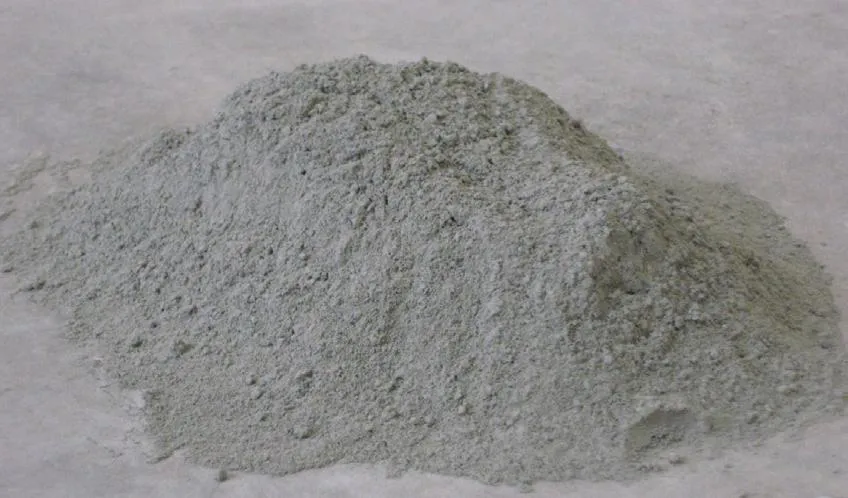
Fig. 1 Ordinary Portland cement.
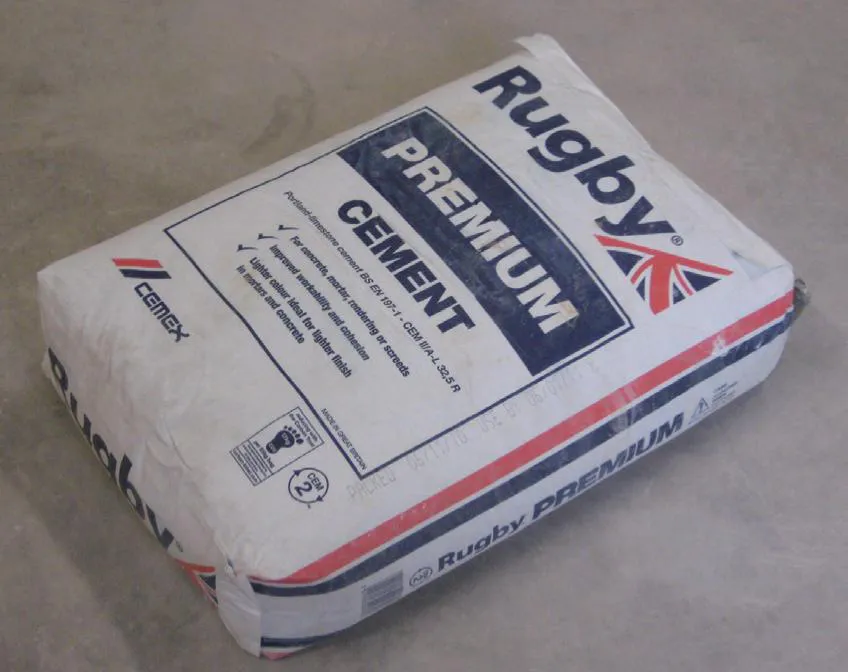
Fig. 2 A 25-kg bag of Ordinary Portland cement.
Cement Hazards
Cement is classified as an irritant, having the potential to cause severe cases of dermatitis and burning of the skin. Great care must therefore be taken when handling cement (and the materials made from it) in order to avoid contact with the skin or eyes and breathing in cement dust. The use of PPE (personal protective equipment) is essential.
Cement is made from chalk (calcium carbonate) excavated from natural chalk deposits, which is then heated in a rotating cement kiln at temperatures of up to 1450 degrees centigrade. The resultant clinker is then ground to a fine powder, which is then packaged in 25-kg bags.
Although Ordinary Portland cement is the most commonly used for concrete and general construction purposes, there are various other types with slightly altered chemical compositions for specialized circumstances. These include rapid-hardening cement, sulphate-resisting cement, special cements for working in cold weather, and so on.
Being hydraulic, bags of cement must be protected from damp before use. Preferably, bags should be stored clear of the ground on a wooden pallet in a well-ventilated, rain-proof shed. Bags of cement should be stacked flat, no more than five bags high, otherwise the bags at the bottom will set due to the pressure exerted by the bags above. ‘Pressure setting’, as it is called, is sometimes known as ‘warehouse setting’.
Even when stored in ideal conditions, cement still has a ‘shelf life’ and will lose around 20 per cent of its strength over a period of a couple of months. Accordingly, care must be taken to ensure that cement is used in the same sequence in which it was delivered – in other words, old bags fir...
Table of contents
- Cover
- Title Page
- Copyright
- Contents
- Preface
- Acknowledgements
- CHAPTER 1: Introduction
- CHAPTER 2: Concrete
- CHAPTER 3: Mortar
- CHAPTER 4: Bricks and Blocks
- CHAPTER 5: Simple Foundations and Bases
- CHAPTER 6: Basic Setting-Out and Levelling
- CHAPTER 7: Bricklaying Tools
- CHAPTER 8: Bonding of Brickwork and Blockwork
- CHAPTER 9: Bricklaying Basic Skills
- CHAPTER 10: Basic Joint Finishes
- CHAPTER 11: Cavity Walls
- CHAPTER 12: Boundary Walls, Copings and Caps
- CHAPTER 13: Simple Decorative Work
- CHAPTER 14: Defects and Maintenance
- Useful Addresses & Websites
- Index
Frequently asked questions
Yes, you can cancel anytime from the Subscription tab in your account settings on the Perlego website. Your subscription will stay active until the end of your current billing period. Learn how to cancel your subscription
No, books cannot be downloaded as external files, such as PDFs, for use outside of Perlego. However, you can download books within the Perlego app for offline reading on mobile or tablet. Learn how to download books offline
Perlego offers two plans: Essential and Complete
- Essential is ideal for learners and professionals who enjoy exploring a wide range of subjects. Access the Essential Library with 800,000+ trusted titles and best-sellers across business, personal growth, and the humanities. Includes unlimited reading time and Standard Read Aloud voice.
- Complete: Perfect for advanced learners and researchers needing full, unrestricted access. Unlock 1.4M+ books across hundreds of subjects, including academic and specialized titles. The Complete Plan also includes advanced features like Premium Read Aloud and Research Assistant.
We are an online textbook subscription service, where you can get access to an entire online library for less than the price of a single book per month. With over 1 million books across 990+ topics, we’ve got you covered! Learn about our mission
Look out for the read-aloud symbol on your next book to see if you can listen to it. The read-aloud tool reads text aloud for you, highlighting the text as it is being read. You can pause it, speed it up and slow it down. Learn more about Read Aloud
Yes! You can use the Perlego app on both iOS and Android devices to read anytime, anywhere — even offline. Perfect for commutes or when you’re on the go.
Please note we cannot support devices running on iOS 13 and Android 7 or earlier. Learn more about using the app
Please note we cannot support devices running on iOS 13 and Android 7 or earlier. Learn more about using the app
Yes, you can access Brickwork and Bricklaying by Jon Collinson in PDF and/or ePUB format, as well as other popular books in Technology & Engineering & Construction & Architectural Engineering. We have over one million books available in our catalogue for you to explore.