Taking a fresh approach, this book delivers an up-to-date review by investigating the essential characteristics, design and driving experience that defines the Porsche legend and its cars. From icons like the 356 and 911, through to the transaxle Porsches and recent models of Boxster, Cayman, Panamera, Macan, Tycan and more, Porsche Model by Model offers a detailed yet engaging commentary upon the marque. With over 275 archive and specially commissioned photographs, this book presents the full marque history from Ferdinand Porsche's defining Bohemian effect to the brand and design language today. It covers the 356 to the Taycan in concise yet detailed discussions; explores historical and technical details including specification tables and includes driving descriptions and owners' views.
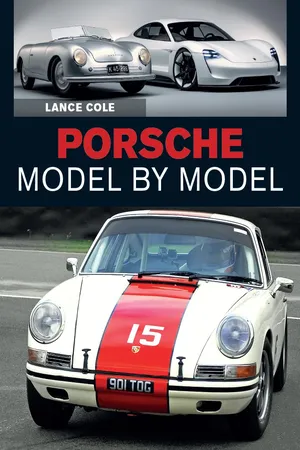
- 240 pages
- English
- ePUB (mobile friendly)
- Available on iOS & Android
eBook - ePub
Porsche Model by Model
About this book
Trusted by 375,005 students
Access to over 1 million titles for a fair monthly price.
Study more efficiently using our study tools.
Information
PORSCHE PRECURSOR

Ferdinand Anton Porsche (Snr): founder, genius and defining influence on the twentieth-century car design. His electric motor and drive hub/axle experiments of 1893–1901 seem set to have defined electric car dynamics, too, via the Taycan. PORSCHE
AN ELEGANCE OF FUNCTION
| CHAPTER 1 | PORSCHE PRECURSOR |
THE PORSCHE ‘PROCESS’ is the critical ingredient that makes these cars something other than just cars. Perhaps more so than with many other marques today, the ethos of Porsche, the design language and the design research psychology of Porsche remain the essential core of a Porsche car and its appeal to the buyer and driver. The heart of the Porsche passion stems from one man and his legacy handed down across many decades through his descendants and dedicated followers. From Ferdinand Porsche came the engineering of design that led to that famous Porsche statement of ‘an elegance of function’. Throw in ‘designed for driving’ and the combination of the function of excellence amid the Porsche process, and we have the resulting cars.
Bohemia, Vienna, and Austro-Hungarian themes are writ large in the history of Porsche. All the 1947 Porsche 356 development team were Austrians – not Germans. Ferdinand Porsche ‘became’ German as did his cars, but old Vienna and all its cultural influences are part of Porsche, something many of today’s commentators and even some Porsche owners, know little of.
Those Porsche owners do sometimes fall into tribes; some are purists, some prefer the 356, and the 911 is a legend that has a dedicated following. Some Porsche fans (including the author) can admire the rear-engined Porsches yet at the same time, are fascinated by the front-engined Porsche story: the 928 suddenly seems a massive achievement in design terms and the 924 and 944 were vital to the continuance of Porsche AG.
Then there came the modern era, controversy, change and the new class of Porsche and new technology. Demands of marketing and finance led to cars such as 914 long before the 924 etc referred to above, then after a long gap, the Cayenne, Boxster and Macan; without them, the truth is that the 911 would not have sustained Porsche. Above all this lies ‘911’, but the truth is that Porsche is now about more than 911 – even though those magical numbers define a legend.
Before we journey through the cars of Porsche it is important to understand the thinking that lay within them and that remains a critical part of what is a modern, new Porsche.
UPON ENTERING THE COMMAND POST
When you climb into a current Porsche (or, indeed, an older one) the correctness of it all embraces you immediately: there is a tangible ‘feel’ and a purpose apparent. It feels like a tailored cocoon, perhaps even a touch military in its efficiency of cockpit purpose. The link to the past setting of such parameters is real. Everything falls to hand, to function: the seat is perfect, the design is classy. Nothing is too fashionable, little will quickly date. Only floor-hinged pedals are currently missing from the place they once occupied. Inside and outside lies Porsche Design – with a capital D.
We can only wonder what a Lutz ‘Luigi’ Colani-designed Porsche would have looked like, but his genius and ego, his uncompromising future-vision, would probably have been too much for the rigid rules of Stuttgart’s corporate hierarchy. But we cannot ignore the fact that a Porsche was, and remains, ‘biodynamic’ in its curves and ellipsis of form and function. Did the Boxster and the 996 subconsciously channel Colani? Some think so. And we know that Colani approved of the 928’s ‘biodynamic’ lines; sadly he was dismissive of the 911’s development in the 1970s and 1980s.
A shiny new Porsche can convey its heritage amid the brand and marketing-speak of today’s era. To understand how and why, we need to look under the bonnet of the story and its cars. For cast large upon Porsche and its vehicles are the personality and principles of Ferdinand Porsche, his progeny and his employees amid a distinct, defined, design research thinking.
Ferdinand Porsche was originally of Austria and of Bohemia, not of what we now frame as the Germany of the post-1871 and post-1918 restructurings of the old German States or Protectorates. Bohemia ranged in the west from today’s Bavaria, north to Poland, south to Austria and east to Slovakia via the Czech Republic. It was a place amid a time now modified by politics and conflict after the Weimar Republic and the Anschluss of 1938. Bohemia gave us many things in engineering including some of the great names of car design and automotive engineering: Austro-Daimler, Laurent and Klemin, Lohner, NSU, Praga, Rumpler, Skoda, Steyr and Tatra, to name just a few.
The reader may also be surprised to know that just as today’s ‘German’ Porsche was not German in its DNA or early home, neither was Bayerische Motoren Werke AG, as German as it appears today – the Munich-based legend that is Bavaria’s BMW was founded by three men and two of them were Austrians! Franz Joseph Popp, BMW’s founding engineer, was born in Vienna. Dr-Ing Max Friz was an engine designer, and Camillo Castiglioni was a Trieste-based banker; both men were brought in by Popp as he started BMW from its earlier Eisenach and Wartburg origins. Like Ferdinand Porsche, Franz Joseph Popp worked for Austro-Daimler in his early career, where he built aero-engines under licence from the Rapp Works.
Thus two of the three great names of southern German automotive history – Porsche and BMW – have Austrian roots, yet both were touched by another great marque: Stuttgart-based Daimler-Benz (Mercedes-Benz). Porsche worked for Steyr of Austria – so too did the other ‘great’ of car design of this era, Hans Ledwinka (latterly of Tatra fame), another Bohemian.
Hans Ledwinka was perhaps the leading automobile engineer/designer of Bohemia prior to the rise of Porsche: Ledwinka’s Tatra cars, later clothed in the ‘aerodyne’ bodywork of Paul Jaray (another Bohemian of Austro-Hungarian lineage) with rear-mounted engines and monocoque airframe-type body construction, set down an early marker for any rival to exceed. Perhaps only the French – Voisin, Gerin, Cayla, Lefebvre, and Bugatti – rivalled the talent of Bohemia in these early years of the motor car.
ELLIPSIS
British genius was slower to manifest upon the road and in the air: Sir Frederick Lanchester was, arguably, at this time the leading British exponent of aeronautical and automotive genius – he produced an elliptical wing and flight tests of it to prove its efficacy as early as 1894. This was years before Ludwig Prantl, and Ernst Heinkel made elliptically winged aircraft and claimed the credit – that was even cited as of origin to the Supermarine Spitfire in an error of massive historical proportions (the Spitfire’s ellipsoid wing was very different to Heinkel’s and was designed by a young Canadian genius named Beverley Shenstone). Elliptical and aerodynamic effects were soon to be the focus of German aircraft and car design and can be seen in Porsche output, too.
Even Ettore Bugatti was touched by ellipses and also by Bohemia, and made his first cars in Germany and painted them the German national racing colour of white, not the later Bugatti Blue. Northern Italians were also part of this great arc of engineering design that lay from Italy to Silesia, the remnants of the Austro-Hungarian Empire and its centre of European history and artistic culture.
In 1951, when Ferdinand Porsche died, he was rated as the last of the great designers of the founding epoch of the motor car. He was defined alongside Bugatti, Daimler, Giacosa, Lancia and Ledwinka. Prior to his demise, there were decades of advanced thinking and design in the age when German, and notably Bohemian, innovators were the creators of the motor car.
Prior to 1910 British car marques were yet to make their true rise to dominance: it was French and German marques that dominated. Very early British cars and aircraft used French engines, or were entirely French designed and built. Amid the new German identity, there lay the effect of Austria and Bohemia and its inventors as they migrated to Stuttgart and Munich.
Bohemia was also the heart of early aviation and great advances in aerodynamics – Alexander Lippisch, inventor of the delta wing being of note. Great writers and great composers also stemmed from Bohemia. This land, now scattered amid the lines-on-the-map that define Poland, Germany, Austria, the Czech Republic and Slovakia, was a cauldron of intellectual and academic talent. For some reason, a strain of creatives and engineering-minded men stemmed from the mountains, rivers, and valleys of magical Southern Silesia and Bohemia.
Vienna was Austria’s capital and was ‘Bohemian’ in every sense of the word. It bred fresh thinking of multi-cultural input – Berlin would later rival Vienna for its broad-thinking society and cultural freedom, at least until the Nazis came to power in 1933. Ferdinand Porsche was born in this crucible of genius in 1875 – exactly the correct time in history. Porsche was born into an Austro-Hungarian state amid a Germanic influenced community in a small village named Maffersdorf – then part of the Austro-Hungarian empire, but today known as Vratislavice nad Nisou, in the Czech Republic. The nearest big town was Reichenberg (now Liberec). He was not high-born: he was the son of a metal worker, a tinsmith. It is possible that the name ‘Porsche’ is derived from eastern, Slavonic origins, but this does not necessarily indicate that Porsche was of Slav origin – many mixtures and modifications of names and origins were forced upon people as the map of Europe changed during the turbulent years between 1875 and 1914. A record of the Porsche name appears in East German regional records dating back to the fifteenth century, but Ferdinand’s family may not have been of this strain as they were from further south.1
Ferdinand’s great-great-grandfather Porsche came from the region of Reichenberg and Bohmisch-Leipa in northern Bohemia. As politics and war raged in the early years of the twentieth century, this area became part of German Sudetenland within the new Czechoslovak state that appeared after World War I. Porsche was not Czech, but Austro-German, yet had no choice other than to accept Czechoslovak citizenship as central Europe was reshaped. To deny it would have left Porsche as a passport holder of a restricted Austrian state that had been part of losing World War I and Porsche and his technological works would have been constrained by the terms of the Treaty of Versailles. So it would be entirely wrong to label Ferdinand Porsche ‘the Sudetenland German’ as some observers choose to do – after all, Germany as it became, let alone Sudeten Germany, did not exist when Porsche was born. Thus the Porsche family had no interest nor part in the German nationalism that would soon be encouraged in the region after 1933 by the ‘new’ Germany.
The Porsche family men were artisan craftsman and highly valued by the local nobility. Ferdinand’s father, Anton was a tinsmith and his mother Anna Ehrlich was a local woman. The Porsche couple had five children but their eldest son died young, so it was the third-born child, Ferdinand, who was intended to take over the family metal-bashing business. But Ferdinand was obsessed by mechanical devices as a boy and soon focused on experiments with the new science of electricity and all its potential, in a series of teenage thoughts. Packed off by his parents to the local technical school’s evening classes, young Ferdinand soon had the family home rigged up with electric light via a generator and wiring that he had created and installed on his own. No other working man’s house in the village had electricity.
This is where Porsche’s analytical behavioural approach began. It really took off when his father let him enrol at the Vienna Technical College. Ferdinand was offered a job as an intern at the Bela Egger Company (which became the famous, Brown Boveri company), run by the Ginzkey family. Aged 18, Ferdinand Porsche went off to Vienna, which was how it all began.
By his early twenties, Porsche was running the Bela Egger company’s test laboratory but he soon joined Jacob Lohner & Co. in Vienna and went on to design the very early ‘electric’ cars for Lohner – who was ‘by appointment’ to Aust...
Table of contents
- Cover
- Halftitle
- Title
- Copyright
- Contents
- Dedication and Acknowledgements
- Porsche – Timeline
- Introduction: Old Wien and New Borders
- Chapter 1: Porsche Precursor
- Chapter 2: 356: Defining Moment
- Chapter 3: 901–911: Classic Icon
- Chapter 4: 996–997–991–992: Afterwards and Before
- Chapter 5: 914 Vierzehner – The Misunderstood Porsche?
- Chapter 6: 924–944–968–928: Transaxle Klasse
- Chapter 7: Boxster & Cayman: Accessible Porsche
- Chapter 8: Carrera Gt to 918
- Chapter 9: Cayenne & Macan To Panamera: A Different Road
- Chapter 10: Taycan
- References
- Bibliography
- Appendix: Porsche racing special cars of the classic era
- Index
Frequently asked questions
Yes, you can cancel anytime from the Subscription tab in your account settings on the Perlego website. Your subscription will stay active until the end of your current billing period. Learn how to cancel your subscription
No, books cannot be downloaded as external files, such as PDFs, for use outside of Perlego. However, you can download books within the Perlego app for offline reading on mobile or tablet. Learn how to download books offline
Perlego offers two plans: Essential and Complete
- Essential is ideal for learners and professionals who enjoy exploring a wide range of subjects. Access the Essential Library with 800,000+ trusted titles and best-sellers across business, personal growth, and the humanities. Includes unlimited reading time and Standard Read Aloud voice.
- Complete: Perfect for advanced learners and researchers needing full, unrestricted access. Unlock 1.4M+ books across hundreds of subjects, including academic and specialized titles. The Complete Plan also includes advanced features like Premium Read Aloud and Research Assistant.
We are an online textbook subscription service, where you can get access to an entire online library for less than the price of a single book per month. With over 1 million books across 990+ topics, we’ve got you covered! Learn about our mission
Look out for the read-aloud symbol on your next book to see if you can listen to it. The read-aloud tool reads text aloud for you, highlighting the text as it is being read. You can pause it, speed it up and slow it down. Learn more about Read Aloud
Yes! You can use the Perlego app on both iOS and Android devices to read anytime, anywhere — even offline. Perfect for commutes or when you’re on the go.
Please note we cannot support devices running on iOS 13 and Android 7 or earlier. Learn more about using the app
Please note we cannot support devices running on iOS 13 and Android 7 or earlier. Learn more about using the app
Yes, you can access Porsche Model by Model by Lance Cole in PDF and/or ePUB format, as well as other popular books in Technology & Engineering & Automotive Transportation & Engineering. We have over one million books available in our catalogue for you to explore.