Hawker Siddeley's history can be traced back to 1912 and the formation of the Sopwith Aviation Company by Tom Sopwith which metamorphosed into Hawker Aircraft after World War One. In 1934-35, Gloster, Avro, Armstrong Siddeley, Armstrong Whitworth and others were taken over to create the Hawker Siddeley Group. The Group built some of the most important aircraft and missiles of the 1960s, 1970s and beyond; its best-known products included the Harrier, Buccaneer, Nimrod and Hawk warplanes, Sea Dart missile and HS748 airliner. Its collaborative projects included the European Airbus and various satellite programmes. Hawker Siddeley was subsumed into British Aerospace in 1977, but some of its products still remain in service to this day. This is their story. Illustrated with over 400 colour and black & white photographs, many of them previously unpublished.
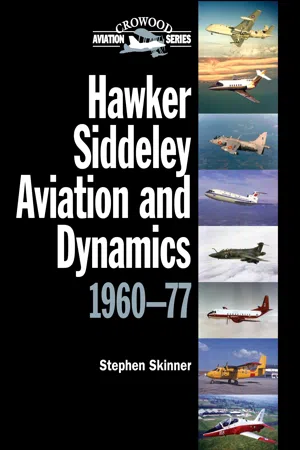
- 208 pages
- English
- ePUB (mobile friendly)
- Available on iOS & Android
eBook - ePub
About this book
Information
CHAPTER ONE
Hawker Siddeley from 1910 until the End of the 1950s
Beginnings
In September 1910 Thomas Octave Murdoch Sopwit (see Appendix I) visited Brooklands Airfield in Surrey, paid £5 and was taken for a sedate cruise of two circuits of the airfield in a Henri Farman biplane. From that moment, Sopwith decided he was going to be a pilot. He began by buying a little Howard Wright Avis monoplane though, as there were no dual controls, he would just have to get into the thing and teach himself to fly. It was not only the aviator’s, but also the machine’s, maiden flight. After a few runs he guided the machine into the air and, after two or three hundred yards, he rose suddenly to forty feet and for a moment looked like he was going to fall backwards, so steep was the angle. Fortunately he righted the plane, but in landing he came down sideways, smashing the propeller and chassis, and damaging one wing.
Undaunted, Sopwith sought new worlds to conquer. The next month he bought a bigger Howard Wright biplane for £630; on 26 November he flew it 107 miles (172km) in 3 hours 20 minutes to establish British distance and duration records – and this within a week or so of qualifying for his aviator’s certificate. He then competed for the £4,000 Baron de Forest prize for the longest non-stop flight from anywhere in England to anywhere on the Continent. On the morning of 18 December 1910 he took off from Eastchurch, in Sheppey. His compass went unserviceable, so he steered by the sun until it was hidden by cloud and then carried on by instinct. As he crossed the Belgian frontier the wind became so gusty that he was nearly thrown out of his aircraft; soon it became too strong to make headway, and he landed in a field near Beaumont. He had flown in a straight line for 169 miles (272km) and was declared winner.
The early years of the century saw the beginnings of British flying. Others whose firms were to become part of the Hawker Siddeley Group were making their first flights at this time. A.V. Roe (later Sir Alliott Verdon-Roe) made a short hop at Brooklands in 1907, and Geoffrey de Havilland (later Sir Geoffrey) was experimenting at Newbury with a biplane built in a shed off Fulham Palace Road. In 1912 he was designer-pilot to the Royal Aircraft Factory at Farnborough, where he produced the famous BE biplane. Associated with him at the Factory was Harry Folland, who later joined Hawker Siddeley as designer for Gloster Aircraft and later formed Folland Aircraft, which itself joined the Group in 1959. Bob Blackburn, too, was flying a monoplane on Filey sands in 1909.

Tom Sopwith’s 1910 Howard Wright biplane. Author’s collection
Sopwith Aviation Company
Sopwith established an aircraft firm of his own at the end of 1912. Fred Sigrist, who had been employed in 1910 as an engineer on Sopwith’s yacht, was soon helping adapt and design aircraft. A year later the Sopwith Aviation Company Ltd was formed. About this time a young Australian, Harry Hawker, came to England to study flying and went to Brooklands, where Sopwith taught him to fly: he had a natural flair so soon took over the test flying. Thereafter, the driving force behind the Sopwith Company in producing the famous line of Sopwith aircraft in World War One was the triumvirate of Sopwith as salesman and promoter, Sigrist controlling production, and Hawker designing and flying. As the firm expanded Sopwith invested money in proportion, so maintaining control of it.
The first Sopwith aeroplane, the Sopwith-Wright, was built in a disused skating rink at Kingston-on-Thames. It had an openwork fuselage for pilot and passenger, wings copied from Sopwith’s Wright, and was powered by the 70hp Gnome from the Blériot. Eventually it was bought by the Admiralty – the first of many thousands of Sopwith aircraft for the Services.
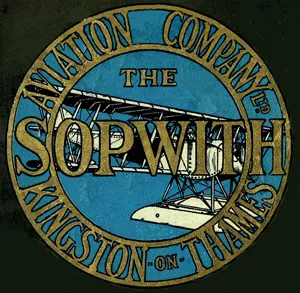
The Sopwith Aviation Company logo. BAE Systems

The Sopwith Triplane, one of Sopwith’s successful World War One fighter designs. BAE Systems
World War One gave the Sopwith Company its big chance. Seven different aircraft types were ready for immediate service and were snapped up by the Royal Naval Air Service. But it was the subsequent series of fighters that brought fame and fortune to the firm. First came a two-seater fighter-bomber known as the 1½ Strutter, then a line of single seaters: the Pup, Camel, Triplane and others, finishing with the Snipe, which remained in service with the RAF for many years after the war.
At the beginning of the War two other figures entered the aircraft industry who were to hold major roles in the years ahead: Tom Sopwith employed Frank Spriggs to help with the books, while A.V. Roe employed Frank Dobson; both these men were to have a major influence in the years ahead (see Appendix I).
When peace came the Sopwith Company carried on for a year or so. They built the Atlantic biplane in which Harry Hawker and his navigator, Kenneth Mackenzie-Grieve, attempted the first direct crossing of the Atlantic in May 1919. Forced down, they were rescued in mid-Atlantic after being missing for a week and given up for lost.

Sopwith Snipe and Salamander production at Richmond Road, Ham, Kingston. BAE Systems
Hawker
By 1920, with no orders for aircraft in hand and threatened with a demand from the government to pay substantial Excess War Profits Duty, Sopwith told his board they must wind up the company while still solvent. But soon afterwards a new firm was formed, named H.G. Hawker Engineering after Harry, both as a tribute to his work as test pilot during the war and to avoid confusion with the former Sopwith company. Hawker Engineering took over Sopwith’s patent rights and support for Sopwith aircraft in the RAF. The original directors were Tom Sopwith, Harry Hawker, Fred Sigrist and Bill Eyre.
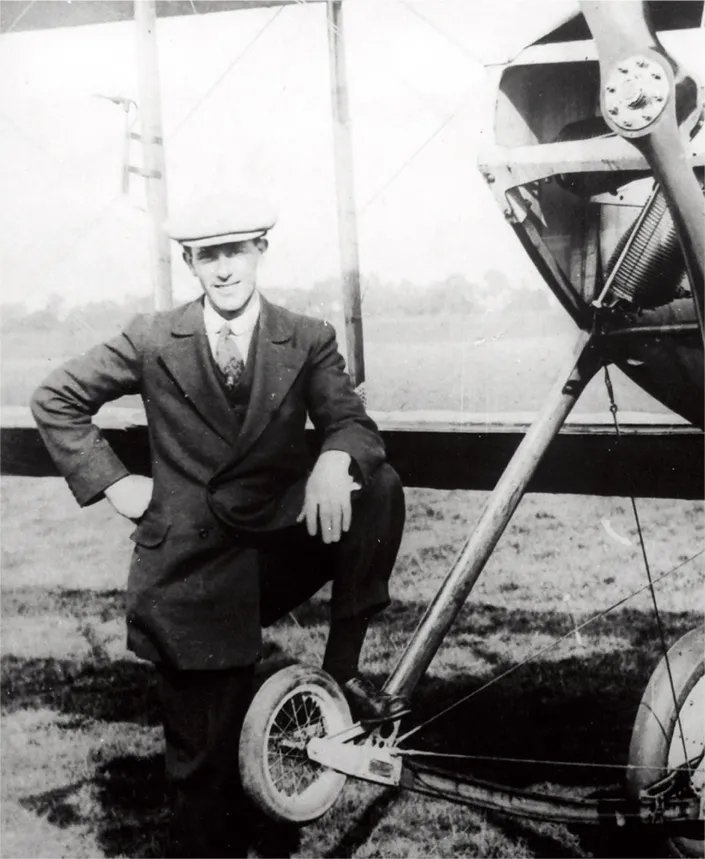
Harry Hawker. Author’s collection

The Hawker Hurricane prototype K5083 at Brooklands, which made its maiden flight on 6 November 1935. BAE Systems
The intention was to keep Hawker a small firm, making aircraft whenever there was a demand and keeping going the rest of the time by making motorcycles and other things. This plan fell by the wayside, however, and it blossomed over the years to become Hawker Siddeley Group, comprising about a half of the entire British aircraft industry and becoming the largest aerospace group in Europe by the 1960s.
The first aeroplane built by the Hawker firm was a military monoplane, the Duiker. But Harry did not live to see it fly: before it was ready he was killed testing a Nieuport Goshawk at Hendon. Thereafter the Hawker firm built many aircraft for the RAF, from the Woodcock fighter to the big Horsley bomber. The latter was the first military aircraft to be developed by Sir Sidney Camm, who joined the firm in 1922 and was destined to become Chief Engineer of Hawker Aircraft. During the 1930s the mainstays of the RAF’s fighter and bomber strength were Camm’s Harts and Furies.
In 1934 Camm produced his masterpiece, the Hurricane. Hawker directors, inspired by Tom Sopwith, saw they had a winner and laid down a production line even before they had an Air Ministry order. This decision was a key factor in the Battle of Britain, in which more Hurricanes took part than any other fighter.

Avro Anson G-AGPG. Though the Anson dated back to the 1930s, this one only flew after the war, in August 1945. It was used as an Avro/Hawker Siddeley communications aircraft for many years; in 1969 it was sold to Pye Telecom and received a new nose to accommodate radar. BAE Systems
The Formation of Hawker Siddeley Aircraft Ltd
The British aircraft industry consisted of about twenty aircraft and aero-engine manufacturers until 1928, when Vickers acquired control of Supermarine. This set the pattern for future mergers in that Vickers let Supermarine carry on as a separate entity until 1957: so it was to be with firms in the Hawker Siddeley Group until 1960.
After World War One, many other aircraft firms ran into financial trouble. Alliott Verdon Roe had to sell a majority holding in Avro to Crossley Motors in 1920, but by 1928 Crossley’s car-manufacturing business was in serious trouble so Avro was sold to Sir John Siddeley. He was the owner of the Armstrong Siddeley Development Company, which also owned Armstrong Whitworth Aircraft, Armstrong Sidd...
Table of contents
- Cover
- Title
- Copyright
- Acknowledgements
- Contents
- Preface
- 1 HAWKER SIDDELEY FROM 1910 UNTIL THE END OF THE 1950s
- 2 HAWKER SIDDELEY FROM 1960 TO NATIONALIZATION
- 3 LEGACY MILITARY AIRCRAFT PROGRAMMES
- 4 LEGACY CIVIL AIRCRAFT PROGRAMMES
- 5 FROM THE ARGOSY TO THE HAWKER SIDDELEY 681
- 6 FROM THE ARGOSY TO THE HAWKER SIDDELEY 681
- 7 AIRLINERS AT HATFIELD – FROM TRIDENT TO 146
- 8 EXECUTIVE JET SUCCESS – THE HAWKER SIDDELEY 125
- 9 AIRBUS – FROM PARTNER TO SUBCONTRACTOR
- 10 AVRO CANADA TO DE HAVILLAND CANADA
- 11 SPACE AND MISSILES – HAWKER SIDDELEY DYNAMICS
- 12 VULCANS AND VICTORS AT WOODFORD
- 13 BUCCANEERS AND PHANTOMS AT BROUGH
- 14 VERTICAL HAWKERS
- 15 THE MIGHTY HUNTER – NIMROD
- 16 HAWK!
- Conclusion
- Appendix I The Top Men of Hawker Siddeley
- Appendix II High Duty Alloys
- Appendix III Bristol Siddeley
- Appendix IV Hawker Siddeley Group Major Activities in 1969
- Bibliography and Notes
- Index
Trusted by 375,005 students
Access to over 1.5 million titles for a fair monthly price.
Study more efficiently using our study tools.
Frequently asked questions
Yes, you can cancel anytime from the Subscription tab in your account settings on the Perlego website. Your subscription will stay active until the end of your current billing period. Learn how to cancel your subscription
No, books cannot be downloaded as external files, such as PDFs, for use outside of Perlego. However, you can download books within the Perlego app for offline reading on mobile or tablet. Learn how to download books offline
Perlego offers two plans: Essential and Complete
- Essential is ideal for learners and professionals who enjoy exploring a wide range of subjects. Access the Essential Library with 800,000+ trusted titles and best-sellers across business, personal growth, and the humanities. Includes unlimited reading time and Standard Read Aloud voice.
- Complete: Perfect for advanced learners and researchers needing full, unrestricted access. Unlock 1.5M+ books across hundreds of subjects, including academic and specialized titles. The Complete Plan also includes advanced features like Premium Read Aloud and Research Assistant.
We are an online textbook subscription service, where you can get access to an entire online library for less than the price of a single book per month. With over 1.5 million books across 990+ topics, we’ve got you covered! Learn about our mission
Look out for the read-aloud symbol on your next book to see if you can listen to it. The read-aloud tool reads text aloud for you, highlighting the text as it is being read. You can pause it, speed it up and slow it down. Learn more about Read Aloud
Yes! You can use the Perlego app on both iOS and Android devices to read anytime, anywhere — even offline. Perfect for commutes or when you’re on the go.
Please note we cannot support devices running on iOS 13 and Android 7 or earlier. Learn more about using the app
Please note we cannot support devices running on iOS 13 and Android 7 or earlier. Learn more about using the app
Yes, you can access Hawker Siddeley Aviation and Dynamics by Stephen Skinner in PDF and/or ePUB format, as well as other popular books in Business & Transportation Industry. We have over 1.5 million books available in our catalogue for you to explore.