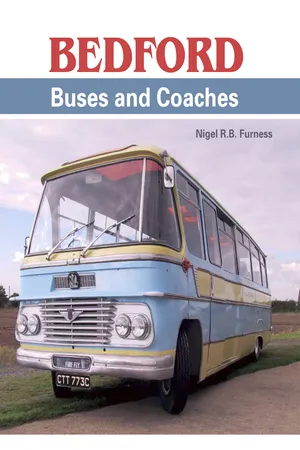
Bedford Buses and Coaches provides a detailed review of the entire range of purpose-built Public Service Vehicle (PSV) bus and coach chassis that carried the Bedford name from 1931 until production ceased in 1986. Bedfords were once a familiar sight on the roads not only of the United Kingdom, but throughout the world. They were produced in such volume that the advertising slogan 'You see them everywhere' was quite legitmately adopted by Vauxhall Motors, the manufacturer of Bedford vehicles. Fully illustrated thoughout with hundreds of photographs, the majority in colour, the book includes detailed descriptions of the Bedford petrol and diesel engines and other manufacturers engines used in Bedford bus and coach chassis. Detailed specifications and production histories are given for all the full-size passenger chassis including the WHB/WLB, WTB, OB/OWB, SB, VAS, VAL, VAM, Y-series and the Venturer. Road tests and owners' experiences are covered along with advice on buying and restoring a Bedford bus or coach. This book will be of great interest to all bus enthusiasts and historians and is superbly illustrated with 200 colour and 50 black & white photographs.
- 300 pages
- English
- ePUB (mobile friendly)
- Available on iOS & Android
eBook - ePub
Bedford Buses and Coaches
About this book
Trusted by 375,005 students
Access to over 1.5 million titles for a fair monthly price.
Study more efficiently using our study tools.
Information
CHAPTER ONE
____________________________
THE BEDFORD STORY
ORIGINS
Vauxhall Motors has its origin in the firm of Alex Wilson & Co. Engineers, a business established by Alexander Wilson in 1857 at premises near to Vauxhall Gardens, a large park and pleasure gardens originally laid out in the late seventeenth century. By Alexander Wilson’s time the place had acquired something of an unsavoury reputation for being the haunt of vagabonds and ‘ladies of easy virtue’ and so the gardens closed in 1859.
The company had principally been involved in the manufacture of marine engines and pumps. Wilson left the company in 1897 and it was at this time that the firm’s name was changed to the Vauxhall Ironworks Company Ltd. This event has some bearing on the history of Bedford owing to speculation on how the name ‘Bedford’ came to be adopted. The first motor car appeared from the Ironworks in 1903 and was called a Vauxhall – clearly in the tradition of names related to place of origin – so it is perfectly reasonable to conclude that the Bedford name is the consequence of the product having been manufactured at Dunstable in Bedfordshire. One might argue that a logically correct consequence would have been to name the product ‘Dunstable’, but Bedford is nearby and trips off the tongue somewhat more easily, an important marketing consideration. It is hard to imagine a purveyor of seaside tours calling out ‘come for a ride in my new Dunstable!’ – with due respect to the denizens of that town, of course.
The griffin emblem associated with Vauxhall and Bedford was chosen by Alexander Wilson for his company as a result of a legend concerning the name of the area known as Vauxhall; allegedly the name is a corruption of ‘Fulke’s Hall’, after Fulk le Breant, a minor thirteenth-century nobleman of Normandy whose coat of arms included the griffin. By curious coincidence, le Breant held the manor of Luton, whence the car manufacturing side of the Vauxhall Ironworks came in 1905, bringing the griffin back to Luton, as it were.
Vauxhall Arrives in Luton
The expansion of the business soon started to put pressure on the south London site, which was leased rather than owned, so Vauxhall Motors came to Luton in 1905. There they found a seven-acre site in Kimpton Road on which they could set up manufacturing premises. On 29 March 1905 the first Luton-built car left the factory. The cars produced by Vauxhall at Luton in the period up to the early 1920s acquired a reputation for quality and reliability as well as achieving a good deal of success in sporting events. These included the famous ‘Prince Henry’ models, which have been called the first true British sports car – entirely fitting, then, that one of best performing and best looking of the recent crop of small sports cars is the Vauxhall VX220. The early cars were not particularly cheap and indeed were often to be found in the possession of the wealthier motorist. By 1922, sporting success was becoming rarer for Vauxhall and sales were dropping off, so the emphasis changed to producing a cheaper range of cars for the ‘ordinary’ motorist in the hope of increasing sales. It was during this period that the name ‘Bedford’ first appeared, being used for a saloon car body produced on the L-type 14/40 chassis.
GENERAL MOTORS TAKES AN INTEREST
Vauxhall was struggling to compete in the mass car market in the early 1920s – its production methods were outdated and expensive and they had yet to apply the techniques of mass production pioneered by Ford and others in the USA. The company tried to address this by reorganizing the Luton factory to incorporate a production line, but as this was largely applied only to engine manufacture it did not achieve the success that was hoped for. It didn’t help that there seemed little will from the most senior management; Leslie Walton, the company chairman, claimed that the Vauxhall workforce was neither trained, nor equipped nor had the desire to produce large quantities of mass produced cars and so would continue the policy of producing a limited number of quality cars at a commensurate price. This ‘can’t do’ attitude, the fall-off in sales and a growing financial crisis within the company put Vauxhall Motors in a position where it was ripe for absorption by a larger manufacturer.
At the same time, US automotive manufacturer General Motors Corporation (GM) was looking for a way to build its market in the UK. GM had established a small plant at Hendon, Middlesex, in 1923 to build cars from its US product range and Chevrolet light commercials for sale in the UK. These were imported in kit form then assembled at Hendon in order to benefit from lower import tariffs compared with bringing in complete cars. This enterprise did not grow as rapidly as hoped, being disadvantaged by competition from cheaper mass-produced models from Austin and Morris; the Buicks, Cadillac, La Salle and Chevrolets attracting higher engine size tax, more expensive insurance and higher servicing costs compared with home-grown models. The Hendon plant was turned over to the production of Chevrolet commercial vehicles utilizing locally built bodies and GM decided that its best option to maintain a slice of the UK automobile market was to acquire a ready-made UK operation. GM’s first choice was Austin. While Herbert Austin himself was favourably disposed to the proposed purchase, the majority of Austin’s board of directors were not, favouring a modest expansion plan of their own rather than allow the company to fall into US ownership, something that was felt would damage the company’s standing in the eyes of the public and attract criticism from the motoring press.
Vauxhall, on the other hand, had no such qualms. Negotiations took around two months and Vauxhall passed into GM ownership on 25 November 1925. GM paid $2,575,291 for Vauxhall, which, taking the gold-standard exchange rate for 1925 at $4.87 to the pound amounted to £528,807. Despite the takeover, Vauxhall’s problems were not over; financial losses continued through 1927 to 1929. As Austin’s directors had feared, the British motoring press were scathing in their criticism of Vauxhall, Motor being the most vociferous in its attacks to the point where Vauxhall withdrew its advertising and loan of cars for testing with the magazine for nearly two years.
BEDFORD COMMERCIALS BEGIN
A significant event resulting from the takeover was the transfer of manufacture of Chevrolet trucks from Hendon to Luton in 1929. This included the LQ model, which could be bodied as a small bus with around fourteen to sixteen seats and from 1928 onwards was fitted with the ‘Stovebolt Six’ Chevrolet straight-six ohv petrol engine. This engine became the foundation from which all Bedford petrol engines would be derived. One of the problems faced by General Motors was that Chevrolet was also an American company, the products of which were not allowed to be exported from the UK. Thus it was necessary to establish a British brand if GM were to break into the export market with commercials made in the UK. It is most likely this factor that prompted the establishment of ‘Bedford’ as a brand for commercials built at Vauxhall’s Luton plant.
In the early years of production at Luton, the name Bedford was used purely as a model name, and the manufacturer’s name that appeared on the instruction book was that of Vauxhall Motors, the address being The Hyde, Hendon, as it had been in the General Motors period before. Indeed, the look and feel of the instruction books for the Bedford models was exactly the same as those of the Chevrolet predecessors, although the latter of course had the General Motors name on the front cover.

This WHB is described by Vauxhall as the first purpose-built Bedford bus. New in August 1931 with a fourteen-seat body by Waveney of Lowestoft, remarkably the bus remained in service until 1956, when it was sold into preservation. It is now owned by Vauxhall at Luton and is looked after by the Vauxhall Heritage Collection. VH
The first commercials to carry the Bedford name were the WHG and the WLG light 2-ton (2,032kg) trucks and vans. These were developments of the Chevrolet LQ, the WHG sharing the same 10ft 11in wheelbase as the LQ and powered by a Bedford-modified version of the Stovebolt Six petrol engine. The WHG and the WLG appeared in April 1931, closely followed by the first proper bus chassis, the WHB and WLB, which were intended for fourteen-seat and twenty-seat bus bodies, respectively. Luton could and did build complete trucks, but the passenger chassis were always bodied by independent specialist coachbuilders, although there were small ‘station bus’ or ‘hotel bus’-type conversions seating around seven passengers based on the standard 12cwt (610kg) van. The light weight per passenger of the Bedford passenger chassis soon became a major selling point – a fully laden twenty-seat ‘Sun Saloon’ body by Duple Bodies and Motors Ltd on a Bedford chassis weighed only 4.25 tons (4,318kg) and was the first laden twenty-seat bus allowed to cross the Menai Strait suspension bridge in north Wales, which at the time had, by coincidence, a weight limit of 4.25 tons!
The last Chevrolets were delivered in early 1932, the overseas success of the new Bedfords being cited as the reason for ending Chevrolet production.
The new Bedford models had a 6-cylinder engine as in their Chevrolet forebears, though this had four main crankshaft bearings as against the three of the Chevrolet, and pressure-feed lubrication instead of the combined pressure-and-splash lubrication of the Chevrolet. Lucas electrical systems appeared for the first time in place of US-made Delco-Remy components.
DUPLE MAKES AN ENTRANCE

Small operators would often have their Bedford chassis bodied locally. Townsend’s Tours of Torquay owned this 1935 WTL with Mumford of Plymouth coachwork. It had twenty-six seats, a sunshine roof and a rear entrance. A. CROSS
It is probably no coincidence that Duple of Hendon emerged as the most prolific body builder on Bedford chassis, being physically located almost next door to the site of Vauxhall’s sales office. The introduction of the Certificate of Fitness (COF) by the Ministry of Transport in the Road Traffic Act 1930 encouraged chassis builders to work more closely with coachbuilders to ensure that requirements of the certificate could be met – this affected things like the size and positions of entrances and gangways, seat spacing and so on. As far as Bedford was concerned, this meant building relationships with coach-builders constructing complete vehicles that could be sold through the Vauxhall dealer network. Duple thus became a principal, though not the only, approved body supplier for Bedford chassis.
At the 1931 Commercial Motor Show, twenty-seat buses based on the WLB chassis were on show from: Waveney of Lowestoft (who had bodied the first WHB); Grose, who also built bespoke car bodies on Vauxhall chassis; and Duple. All were similarly priced at £545 for a complete bus from Waveney and Grose and £550 for that from Duple. Interestingly, Waveney had a history of supplying typically fourteen-seat buses on the earlier Chevrolet LM and LQ chassis, Lincolnshire Road Car Co. Ltd and the United Automobile Omnibus Co. Ltd being just two of the larger territorial bus companies that took a number of these in the late 1920s. Waveney was based at Lowestoft and its fourteen- to sixteen-seat bus bodies were marketed as the ‘Hendon’ – clearly intended to associate them with the Chevrolet make; however, the association did not prosper and while Waveney continued to trade throughout the 1930s, it did not survive the Second World War.
While there was some competition from the likes of Morris Commercial, Dennis, Guy and others, these products tended to be more expensive, so by 1932 Bedford had made the small-bus market its own; 65 per cent of the twenty-seat-and-under buses registered in the UK in that year were made by Bedford.
Spurling Motor Bodies Ltd was another company located close to the Vauxhall sales office in Hendon and also became closely associated with Bedford over the years, particularly in the manufacture of twelve- to fourteen-seat bodies on Bedford goods chassis. However, the first reference to Spurling in connection with Bedford comes in a review in 1934 of a power-assisted brake conversion for current Bedford chassis, which at that time were powered only by the strength of the driver’s leg applied to the pedal and thence through mechanical rods and linkages to the brake linings.

The 1935 WLB with Duple twenty-seat forward-entrance body was new to T. J. Roberts of Bethesda in northwest Wales. The driver stands proudly by waiting to take the bus to Bangor, his fare collection bag over his shoulder. Roberts traded as Purple Motors. VH

New in March 1936 to Enterprise & Silver Dawn of Scunthorpe, this series 1 WTB has a rare twenty-six-seat body by Layne & Co. Ltd of Brigg, Lincolnshire. VH
Bedfords continued to sell well throughout the early 1930s, and in 1934 the WT 3-ton (3,050kg) range was introduced. A passenger version built by Duple from the WTL lorry chassis was not available until later in the year and the WLB continued in production alongside the WTL. This was only a stop-gap measure as a passenger chassis proper – the WTB – appeared in November 1935 and superseded both the WLB and the WTL. The same straight-six engine was employed as before, although now the power had increased to 64bhp at 2,800rpm.

This 1937 WTB bus belonged to the Lancashire Electric Power Co. Ltd, seen here on a works outing in Manchester. The body was the standard Duple twenty-six-seat product. VH
The rapid success of Bedford stabilized the fortunes of Vauxhall and by the end of 1937 Bedford sales in the one-ton and heavier commercial market were exceeding 26,000 per year. In 1938 the Luton factory gained a new engineering block, known rather appropriately as the ‘V Block’. It cost £175,000 and provided accommodation for 335 staff, giving Vauxhall the most up-to-date design and development facility in the UK at the time. Production was now running along modern lines and Vauxhall was in a strong position by 1939, with several new models ready to come to market, notably the new OB bus and coach chassis, introduced in August as successor to the WTB. However, on 1 September 1939 Germany invaded Poland and the deadliest conflict of all time began.

The 1946 OB brochure issued by Bedford. GM
THE RISE OF MOTOR COACH TRAVEL
It was the arrival of the railway as a common carrier in the early nineteenth century that brought the idea of leisure travel to the general public. The roads in Britain had suffered little attention since Roman times and had largely fallen into disrepair until the emergence of the turnpike trusts in the seventeenth century. This brought some improvement, but the canals provided a better way of moving goods so there was little impetus to invest heavily in the roads. Despite this, the need for good roads w...
Table of contents
- Cover Page
- Title Page
- Copyright Page
- Contents
- Introduction and Acknowledgements
- Chapter 1: The Bedford Story
- Chapter 2: The WLG, WHB, WLB, WTL and WTB
- Chapter 3: The OB and OWB
- Chapter 4: The SB
- Chapter 5: The Engines
- Chapter 6: The VAS, VAL and VAM
- Chapter 7: The Y Series
- Chapter 8: The Final Ventures – The JJL and YNV
- Chapter 9: Goods Chassis Converted for PSV USE
- Chapter 10: Preserving a Bedford Bus or Coach
- Appendix – Engines Fitted to Bedford Buses and Coaches
- Bibliography
- Index
Frequently asked questions
Yes, you can cancel anytime from the Subscription tab in your account settings on the Perlego website. Your subscription will stay active until the end of your current billing period. Learn how to cancel your subscription
No, books cannot be downloaded as external files, such as PDFs, for use outside of Perlego. However, you can download books within the Perlego app for offline reading on mobile or tablet. Learn how to download books offline
Perlego offers two plans: Essential and Complete
- Essential is ideal for learners and professionals who enjoy exploring a wide range of subjects. Access the Essential Library with 800,000+ trusted titles and best-sellers across business, personal growth, and the humanities. Includes unlimited reading time and Standard Read Aloud voice.
- Complete: Perfect for advanced learners and researchers needing full, unrestricted access. Unlock 1.5M+ books across hundreds of subjects, including academic and specialized titles. The Complete Plan also includes advanced features like Premium Read Aloud and Research Assistant.
We are an online textbook subscription service, where you can get access to an entire online library for less than the price of a single book per month. With over 1.5 million books across 990+ topics, we’ve got you covered! Learn about our mission
Look out for the read-aloud symbol on your next book to see if you can listen to it. The read-aloud tool reads text aloud for you, highlighting the text as it is being read. You can pause it, speed it up and slow it down. Learn more about Read Aloud
Yes! You can use the Perlego app on both iOS and Android devices to read anytime, anywhere — even offline. Perfect for commutes or when you’re on the go.
Please note we cannot support devices running on iOS 13 and Android 7 or earlier. Learn more about using the app
Please note we cannot support devices running on iOS 13 and Android 7 or earlier. Learn more about using the app
Yes, you can access Bedford Buses and Coaches by Nigel R B Furness in PDF and/or ePUB format, as well as other popular books in Tecnología e ingeniería & Transporte e ingeniería automovilísticos. We have over 1.5 million books available in our catalogue for you to explore.