Painting on canvas poses many exciting opportunities for the artist. Along with the immediacy, vibrancy and unpredictability of watercolours, it is a liberating and creative process. This practical book explains how to start painting with watercolours on canvas and goes on to encourage new style and experimentation. It gives step-by-step demonstrations on different techniques to achieve loose, dynamic images. It is a beautiful and passionate account of how to work on a non-traditional surface to achieve striking and innovative paintings. It covers; advice on selecting and preparing canvases to accept watercolour; ways to adapt your materials and working process to canvases; step-by-step demonstrations on different techniques to achieve loose, dynamic images; Ideas for experimentation, both in style and subject, and stunning, finished images to inspire; A beautiful book that shows how to paint with watercolour on canvas to achieve bold, stunning results. Of great interest to all artists and craftsmen, it is superbly illustrated with 149 colour photographs. Liz Chaderton is a professional watercolour artist and specializes in painting animals.
- 112 pages
- English
- ePUB (mobile friendly)
- Available on iOS & Android
eBook - ePub
Painting Watercolours on Canvas
About this book
Information
Topic
ArtSubtopic
Techniques d'artCHAPTER ONE
SUPPLIES, MATERIALS AND EQUIPMENT
Paints, brushes and other supplies
While this book is not intended as an introduction to the joys of painting in watercolour, it is worth briefly revisiting the basics.
Even if you are an experienced painter, the demands of the canvas surface mean you will need to look again at some of your materials; canvas is tough on soft brushes, pigments need to be chosen for maximum lightfastness, quantities alter as you change the scale of your work, even your eraser may need to be adjusted.
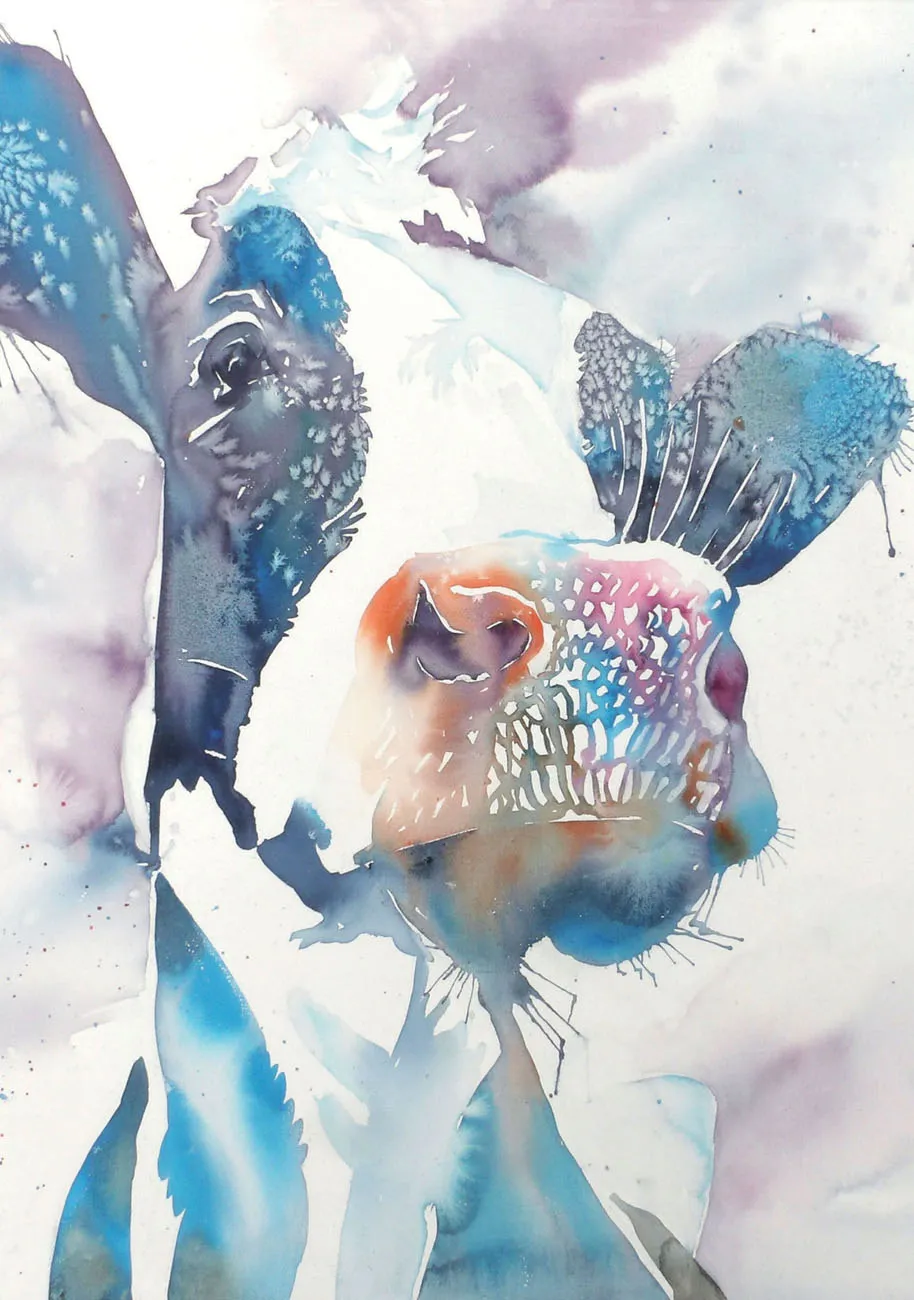
La Vache, 50 × 50cm, watercolour on canvas.
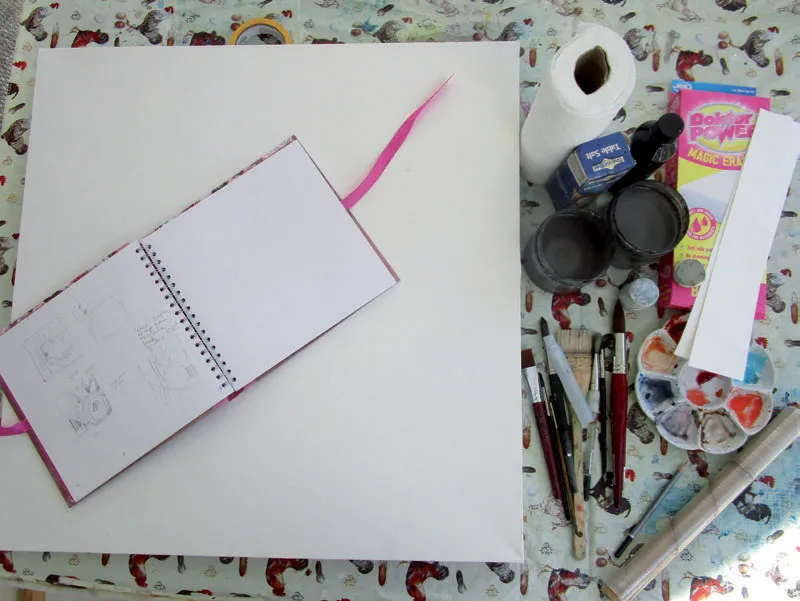
Get your supplies ready and laid out conveniently before you start. If you are right-handed it is best to have them to the right of the canvas, with reference materials to the left.
Good quality materials, suited for the effect you are after, will make your painting time more pleasurable and ensure that you get as close as possible to achieving your vision.
If you are starting out, it is worth considering the materials you wish to invest in, making sure that they will work with you rather than hinder your progress. Every artist has a cupboard of supplies, bought on impulse but rarely used. Let us not add to this stock pile, but make each part of your painting kit a valued contributor.
Paint
All paints are made of pigment plus a binder. While oil paints are bound with linseed oil, acrylics with an acrylic polymer, tempera with egg yolk, watercolour paint is pigment plus a binder of gum Arabic. The same pigments are generally used throughout – only the binder and additives differ.
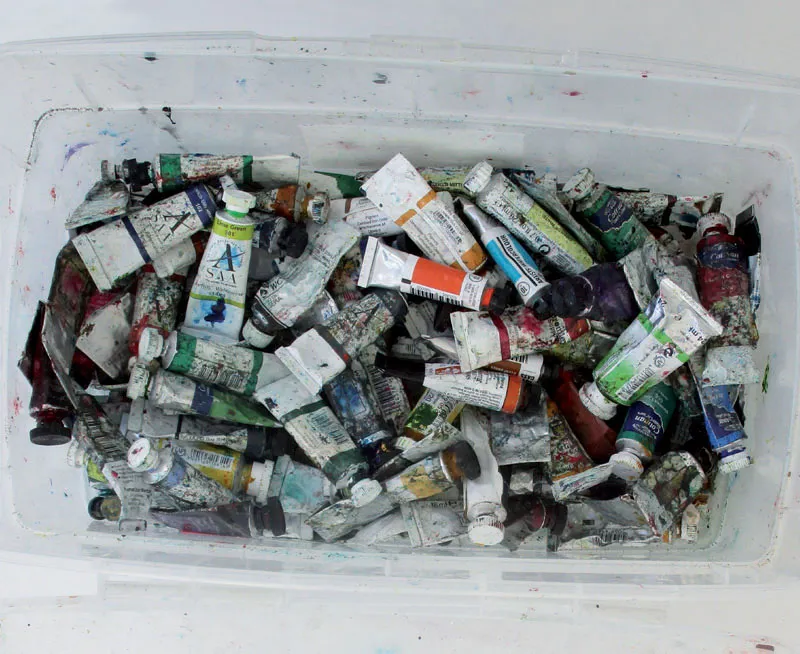
Colour is a joy in watercolour, but you don’t need a huge range to get started though you will, no doubt, accumulate a wonderful variety over time.
Watercolour paint is available in two different physical forms – tubes or pans (sometimes called cakes), and is available in two different qualities – student or artist.
Given that one of the prime motivations of painting on canvas is the richness of the colour that can be achieved and the lack of restriction in size, it makes sense to opt for tube colours – it is far easier to be generous and to mix up rich creamy washes. The colours are less likely to be contaminated, as they are kept in sealed tubes.
On the other hand, pans are certainly convenient and portable. They tend to be more compact, if storage is an issue. Should you opt to use pans, then spraying with clean water as you are preparing to paint will pre-moisten the cakes, letting them release their colour more readily. It will help you avoid having to scrub the pan endlessly to mix up a creamy wash. If you are painting outside, or sketching, pans are easy to maintain and use. One drawback is that colours can become contaminated rather easily when going from pan to pan without washing your brush.

The Hare Who Ate Too Many Cornflowers, 90 × 90cm, ink and watercolour on canvas. Artist quality pigments move and flow with a life of their own on the canvas. They have a special vibrancy, so it pays to use the best you can afford.
Artist quality paints rather than student quality will reward you in the long run. Student quality are less expensive because some of the good stuff has been left out and cheaper filling elements have been used in their place.
Artist quality paints use the best quality and the most finely ground pigments. These are likely to have better lightfastness properties, as well as vibrancy. You will notice that artist pigments have more life and respond as they move around the surface through the water. In general, use the best quality paints you can afford. The own-brand artist quality paints from the big retailers are often of very good quality and considerably cheaper than the branded tubes. If you are on a more restricted budget you will find that the student range from well-known manufacturers such as Winsor and Newton or Daler-Rowney offer a consistent and affordable choice. But be warned, once you start trying artist quality pigments you will find it hard to go back. Art suppliers have regular sales, so you should be able to find good quality supplies at an affordable price without having to compromise.
Each of the major global brands offer a stunning array of colour choice – perhaps with up to 250 colours. Patently you cannot afford and certainly do not need this many. You may find you prefer one brand over another, but more likely, you will end up having a favourite colour within individual ranges. Some of the more standard colours will be indistinguishable, but often paint with the same name will differ entirely. You will need to check the pigment reference to be sure of what you are buying (see box). Do consider the size of tube you buy. It is hard to be generous with a colour if you only have a tiny 5ml tube.
Many people consider gouache to be its own form of paint, but it is really an opaque form of watercolour. Most artists choose to create paintings exclusively with gouache, but it can also be used in conjunction with watercolour to strengthen highlights or intensify colours. A tube of white gouache is certainly a useful addition to your paint box and can be used to add a few finishing details.
Looking after your paints
Even if working on a larger scale, you do not get through a large quantity of watercolour paint. If you look after your paints they will last years.
Assuming you have chosen tube colour, start by squeezing the tube from the bottom. Make sure you put the lid back on tightly. If a tube becomes hard over time, don’t throw it away. Slice it open with a sharp knife and peel back the tube. Use it like pan colour. If you get a puddle of clear liquid when you squeeze colour out, the gum Arabic has separated. Put the lid on and massage the tube to mix the paint. Some colours are prone to this separation. Store the tube on its lid and the liquid will rise to the top (in effect the end of the tube), allowing you to squeeze colour out. If you have paint in your palette you can simply let it dry and add water to reactivate it upon resuming your painting. It is possible, though rare, for tube colour to go ‘off’. The smell is unmistakeable; just throw it out.
If you are using pan colours, ensure the box is fully dry before closing and storing it. In hot, humid areas you can find mould will take hold. In such a case, spray with dilute surgical spirit/rubbing alcohol or even vodka to kill the spores. A gentle wipe with antiseptic should also work. Exposure to strong sunlight will have a similar effect. If you are struggling to keep the fungus at bay, then a cotton ball soaked in alcohol left in the box should prevent growth, or the small sachets of silica found in shoeboxes, could be kept in your paint box to absorb moisture. You may find it is your water source which is causing the contamination. Consider using distilled or bottled water. Some manufacturers add a fungicide, some say that the honey added to their formulation is naturally anti-fungal. It should not be a problem if you care for your paint box.
GUIDE TO USEFUL INFORMATION ON A TUBE
Have you ever considered the information on the side of your paint tube? It can be incredibly useful.
Colour name
This is the name of the colour which is not necessarily unique to a range or manufacturer. Just because it is called the same name, does not mean it is the same colour.
Series number
An indication of the relative price of the colour. Usually series 1 is the least expensive. Price usually reflects the expense of the pigment.
Permanence rating
Measures lightfastness and depending on the manufacturer, may also take into account the stability of the paint. Look for paints with the highest rating.
Lightfastness may be shown with an ASTM rating for the pigment. The ASTM abbreviation stands for the American Society for Testing and Materials. I and II are considered permanent for artists’ use. If you are not displaying work, lightfastness will potentially be of lesser concern.
Pigment code
Every pigment is identified by its Colour Index Generic Name. This allows you to compare different manufacturers’ formulations and accounts for why they are not always visually the same colour. More than one pigment abbreviation indicates multiple pigments, which is worth knowing to avoid mixing muddy colours.
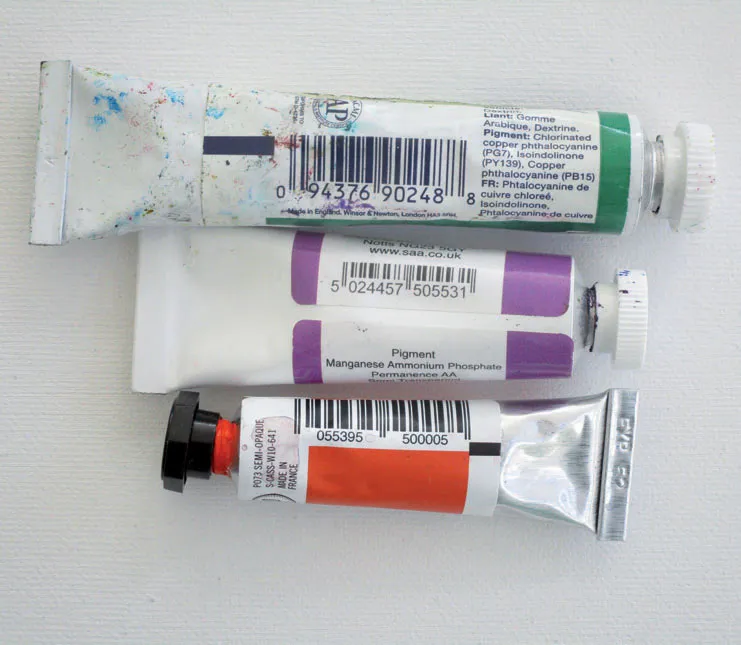
It is worth becoming familiar with your pigments. Somewhere on the tube there will be useful information which should indicate the pigment number, the transparency, permanence and staining characteristics. However, information varies from maker to maker and will become obscured as you use the tube.
Opacity
Symbols are used to represent the transparency/opacity of a colour. Transparent colours are marked with a clear circle or square, semi-transparent colours are marked with a diagonal line and opaque colours are marked with a filled-in symbol.
Granulating/staining
Not all manufacturers show this but if marked as G, the pigment granulates. Staining colours are those that cannot be lifted with a damp sponge and are marked as St.
A basic palette
A great starter palette consists of a warm and a cool primary, a couple of earth colours and perhaps a ‘treat’ colour. This should see you through just about any subject. So select one from each of the first six and then any of the remaining you fancy.
• Cadmium yellow/gamboge/quinacridone gold/Indian yellow
• Lemon yellow
• Cadmium red
• Alizarin/quinacridone rose/carmine
• French ultramarine/indanthrone blue
• Cerulean/Prussian blue/phthalo blue
• Burnt Sienna or burnt Umber
• Raw Sienna
• Raw Umber
• Dioxazine purple/manganese violet
• Viridian/pthalo green
• Sap green
A small tube of white gouache (opaque watercolour) is useful for missing highlights.
Colour is a joy, but don’t try to use too many colours in one painting. A limited palette will be more harmonious. As you gain experience really get to know your pigments – are they transparent? Do they stain? Are they a single pigment or a mix? Such knowledge will make you a better painter.

A warm and a cool primary is vital (in a circle on the right) and a few earth colours, plus a ready mixed green and ...
Table of contents
- Cover
- Title Page
- Copyright
- Contents
- Introduction
- 1 Supplies, Materials and Equipment
- 2 All You Need to Know About Canvas
- 3 Getting Started
- 4 Composition and Subject Selection
- 5 Textural Techniques and Mark Making
- 6 Taking it Further
- 7 Gallery, Finishing and Presentation
- Glossary
- Suppliers
- Useful Resources and Further Reading
- Featured Artists
- Index
Trusted by 375,005 students
Access to over 1.5 million titles for a fair monthly price.
Study more efficiently using our study tools.
Frequently asked questions
Yes, you can cancel anytime from the Subscription tab in your account settings on the Perlego website. Your subscription will stay active until the end of your current billing period. Learn how to cancel your subscription
No, books cannot be downloaded as external files, such as PDFs, for use outside of Perlego. However, you can download books within the Perlego app for offline reading on mobile or tablet. Learn how to download books offline
Perlego offers two plans: Essential and Complete
- Essential is ideal for learners and professionals who enjoy exploring a wide range of subjects. Access the Essential Library with 800,000+ trusted titles and best-sellers across business, personal growth, and the humanities. Includes unlimited reading time and Standard Read Aloud voice.
- Complete: Perfect for advanced learners and researchers needing full, unrestricted access. Unlock 1.5M+ books across hundreds of subjects, including academic and specialized titles. The Complete Plan also includes advanced features like Premium Read Aloud and Research Assistant.
We are an online textbook subscription service, where you can get access to an entire online library for less than the price of a single book per month. With over 1.5 million books across 990+ topics, we’ve got you covered! Learn about our mission
Look out for the read-aloud symbol on your next book to see if you can listen to it. The read-aloud tool reads text aloud for you, highlighting the text as it is being read. You can pause it, speed it up and slow it down. Learn more about Read Aloud
Yes! You can use the Perlego app on both iOS and Android devices to read anytime, anywhere — even offline. Perfect for commutes or when you’re on the go.
Please note we cannot support devices running on iOS 13 and Android 7 or earlier. Learn more about using the app
Please note we cannot support devices running on iOS 13 and Android 7 or earlier. Learn more about using the app
Yes, you can access Painting Watercolours on Canvas by Liz Chaderton in PDF and/or ePUB format, as well as other popular books in Art & Techniques d'art. We have over 1.5 million books available in our catalogue for you to explore.