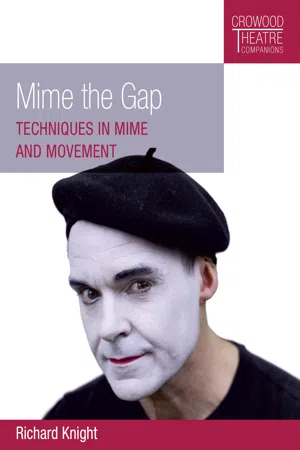
Mime the Gap: Techniques in Mime and Movement explores the physicality of movement in storytelling, offering new ideas about acting and performance, whilst encouraging a contemporary resurgence of this traditional performance art. With detailed, step-by-step instructions of basic to advanced mime illusions, the book addresses the key areas of physicality, including when to move and when not to move, making the invisible 'visible' and the fundamental principles of physical articulation. Additional topics include how to use the elements of Fire, Earth, Water and Air for physical characterization; techniques for performing classic mime routines, such as the Glass Box and the Moonwalk; how to mime with props and objects, both visible and invisible; using breath, posture and gesture to enhance performance and perceptions, and finally, creating and producing an authentic performance. Offering numerous exercises suitable for solo or group work, this new book will help you to explore and develop your physicality and build an awareness of how to apply it to a performance.A practical guide to mime - a traditional performance art which is having a resurgence.Addresses the key areas of physicality including when to move and when not to move; making the invisible 'visible'; principles of physical articulation and much, much more.A valuable guide for acting students, mime artists and anyone looking to increase personal confidence and presentation skills.Gives detailed step-by-step instructions of basic to advanced mime illusions.Superbly illustrated with 181 colour photographs.Richard Knight has over thirty years experience of performing, directing and teaching in the theatre, film and television industry.
- 192 pages
- English
- ePUB (mobile friendly)
- Available on iOS & Android
eBook - ePub
About this book
Trusted by 375,005 students
Access to over 1.5 million titles for a fair monthly price.
Study more efficiently using our study tools.
Information
Subtopic
Theatre1
THE HISTORY OF MIME
This chapter offers a brief look at the history of mime. For anyone wishing to delve deeper into this comprehensive subject, Annette Lust’s book From the Greek Mimes to Marcel Marceau and Beyond (The Scarecrow Press, 2000) is a great resource with detailed information.

For the purposes of this chapter, the words ‘mime’ and ‘pantomime’ are used interchangeably. Throughout history, the use of the body to express emotion and story through posture, gesture, facial expressions and breath has been called both mime and pantomime, and historic references use both words to describe this. ‘Pantomime’ is not to be confused with the English performance tradition of bawdy, festive performances.
Mime may at times mean to ‘imitate’, but this is not the only skill of the mime artist, so like much other history, it can be hard to piece together.
ENTERING DOCUMENTED HISTORY
Mime enters written history between 1700BC and 110BC in Indian Hindu texts called the Vedas. Chinese drama was influenced by the Hindus, and a very old Chinese pantomime is said to be about Wu Wang’s conquest of China at least 1,000 years BC Japan’s Noh theatre roots may well date from these early times as well. Across Asia, the performance of mime has been carefully choreographed and honed so that even tiny movements of the eye, the breath and finger positions and actions hold an encoded meaning, which the audience has learnt to understand. This technical and detailed method may be likened to Decroux’s work in the twentieth century, three thousand years after its inception in the East.
Mime then crossed the oceans and walked on to the solid, well preserved recorded platform of Grecian terrain. These writings – opinions, reviews, plays and literature – report that mime was an established and well known art form in ancient Greece.
THE GREAT GREEKS
Greece is said to be the birthplace of modern mime. It charmed the playwrights and philosophers, and became recognized across the country, cropping up in village dances, in soldiers’ barracks and on a raised area we know as a stage. The ancient Greeks marry the words ‘pan’ (meaning ‘each’, ‘all’) with ‘mimeomai’ (meaning ‘I mimic’).
Masks, scripted works and choreographed dances all mingled with mime in the fertile land of Greece, as they always had done and as they continue to do so. Theatre, dance, movement and mime practitioners still debate which belongs to whom in terms of their respective histories.
THE ROYAL ROMANS
Despite these mild contentions between present-day practitioners, the development of mime continued in Rome, where it became very popular. Mime plays were written, and we see the familiar faces of Harlequin and other commedia dell’arte characters in Roman statues and art (although at this time they are not known by the names of the Italian characters such as Harlequin, the Dottore or Pantolone). Roman emperors were caught in feuds about who was the greatest mime artist. Julius Caesar, the famous Roman politician, travelled with an entourage of mime artists, and citizens wore the colours of the mime artist whose side they favoured, in the same way as today’s loyal football fans. For a long time mime was adored and loved by all.
However, as with all meteoric rises, there is often a hard fall. As the Roman Empire fell, so too did the popularity of mime.
THE DARK AGES
Here and there in Europe between the fifth and the fifteenth centuries, mime sometimes peeked its head from dingy street corners – but the Church held the lands and peoples in a firm grip, and gradually mime was forgotten, its light and colour fading from memory.
In Europe between the fifth and the fifteenth centuries, there are very few records of mime artistry, as the power of the Church excommunicated anyone caught watching theatre.
It was largely down to performing nomads, who struggled to put food in their mouths, that we now have a rich theatrical culture. They struggled, and suffered for their art, being that it was the only profession they knew, wandering from village to village, across borders and earning what they could, where they could, keeping the traditions of drama and mime alive in scared communities. Our romantic notion of the Bohemian artiste perhaps stems from the Dark Ages.
However, religious dramas (known as mystery, miracle and morality plays) were soon created to educate the populace as to the right and proper way of conducting themselves, their life and their worship, and once more mime had a place on the streets, in village squares and even inside churches. Mime performances incorporated gesture along with song and voice as a tool to engage apathetic audiences in the parables.
Actions and movements are written in Latin in the scripts of such plays, and it was the layman who performed mime actions of the scriptures and dedicated his life to the mime of the Bible stories. Performance began to infiltrate all the Christian festivals, and entertainment sprang up around the country again. Morris dancing and mummers’ plays had their origins in this re-emergence of theatre.
THE ITINERANT ITALIANS
Commedia dell’arte is not the subject of this chapter, but its life is undeniably wrapped up in that of mime. The Italian commedia actors were such masters of mime that in France, when they performed to the French natives, it is said they were able to understand every part of the story. Indeed it is often remarked that Italian natives were so naturally adept at comedy and gesture that even the village tailor performed a better harlequin than any seen in England, and the troupes were of such genius, they could read the ‘scenario’ before going on stage, and could perform without need for rehearsal, script or direction.
Comedy, clowning, buffoonery and such were all now ensconced in the performing culture across Europe. Clowns, harlequins and pierrots were seen with ‘floured’ faces, and this brought mime closer to its recognizable form today.
SHAKESPEARE IS ALIVE!
In the sixteenth century, personified Mime brushes engrained street dust from his breeches, pulls on some new hosiery, and saunters into theatres that have been influenced by the Italian plays. Ben Jonson, Thomas Kyd and Shakespeare all make reference to Mime’s exclusive appearance in ‘dumb shows’. The Puritan government suppressed theatre, but Mime stepped in as the star again in some dramatic exhibitions by Robert Cox. Performed under the guise of ‘rope dancing’, these performances delighted audiences all in fear of their own lives for watching theatrical shows. Perhaps it was down to this heroic gesture that John Weaver was motivated to honour a play after him, a pure pantomime, called a production of ‘dancing, action and motion’.
GARRICK, DRURY LANE AND LONDON
From the seventeenth century onwards, mime became popular amongst the élite, who rejected ‘straight acting’ in favour of mime’s magnificent ability to demonstrate story and feeling on stage. In R. J. Broadbent’s The History of Pantomime (Echo Library, 1901), David Garrick wrote:
They in the drama find no joys,
But doat on mimicry and toys,
Thus, when a dance is on my bill,
Nobility my boxes fill;
Or send three days before the time
To crowd a new-made Pantomime.
But doat on mimicry and toys,
Thus, when a dance is on my bill,
Nobility my boxes fill;
Or send three days before the time
To crowd a new-made Pantomime.
It is suggested that Garrick’s success was down to his outstanding abilities at pantomime. Drury Lane theatre regularly relied on pantomimes for its trade. ‘Wiktionary’ refers to a pantomime (one who mimics all) as:
(now rare) A Classical comic actor, especially one
who works mainly through gesture and mime.
who works mainly through gesture and mime.
This brings us nicely to the greatest comedy performer who is still revered today: Joseph Grimaldi.
THE EIGHTEENTH EPOCH
In the eighteenth century Joseph Grimaldi graced the stage with his unsurpassed reputation of being the greatest clown in memory. His mime was imbued with the greatest sense of fun, and as much as he was an actor and clown, he was a mime, and entertained thousands of people.
Friends, colleagues and Joseph Grimaldi’s own son continued to perform mime in London through to the late 1800s – whilst across the channel, Jean-Gaspard Deburau was born in 1796. This small young boy struggled to keep up with his acrobatic family. Often falling and stumbling, Deburau left the idea of the circus behind, and found himself outside a stage door. The childlike heart of Pierrot was embodied in Deburau, who carried the years of never fitting in within his soul. Mime helped his inner spiritual poetry be filtered through his limbs and facial expressions, and he found he was able to hold an audience in the palm of his hand. Deburau got his ‘break’ at the Théâtre des Funambules, which was as much in the dumps as Deburau was when he first arrived there. Jean-Gaspard Deburau carried mime into this down-on-its-luck theatre, and was thoroughly loved by his audience. Of Deburau was written:
I have never seen an artist who was more serious, more conscientious, more religious in his art. He loved it passionately and spoke of it as a grave thing, whilst always speaking of himself with the extremest modesty. He studied incessantly. He did not trouble to think whether the admirable subtleties of his play of countenance and his originality of composition were appreciated by artists. He worked to satisfy himself, and to realize his fancy. This fancy, which appeared to be so spontaneous, was studied beforehand, with extraordinary care.
THE LAST ONE HUNDRED YEARS
On 6 June 1930, the headline of the British newspaper The Daily Telegraph ran as follows (taken from Irene Mawer’s The Art of Mime, published by Methuen and Co. 1932):
Last of the Great French Mimes.
The Great Severin is dead
The Great Severin is dead
One of the greatest mimes that France has ever known is dead. The last representative of a school of acting that passes away with him, the Great Severin will play Pierrot no more.
Although the history of mime often only covers Europe, it flourished everywhere at some time or another. America in the 1800s had popular performers and clowns mimicking Hamlet actors and creating mirth for audiences in New York. Russia and Germany (amongst others) had performers who developed their own ways of perfecting the expression of the human body. The great pedagogues Meyerhold and Brecht recognized the importance of using the body to capture the fullness of human expression in acting.
In 1901, R. J. Broadbent in the History of Pantomime predicted a surge of interest in mime in Britain. If mime is seen as the silent protagonist of the early silent movies, then he was indeed correct.
George Wague was one such actor in those early silent movies. He had previously played Pierrot on stage, and created his own pantomimes until his debut on screen. He paved the way for mime to move into modern times, and consulted with mime to figure out how best to teach the art and develop performers’ bodies so they were capable of creating everything from nothing. Wague and mime made astonishing changes with operatic singers, turning them into excellent actors as well as vocalists.
At about the same time, Jacques Copeau opened an acting school where mime actors started to harness its power. Etienne Decroux took these mime exercises and worked on them extensively, believing that it was possible for the body to express not only what is visible, but all that is invisible, the manifestation of the universal. All that is practically impossible to convey via text, but is experienced and understood by one and all.
Decroux...
Table of contents
- Cover Page
- Title Page
- Copyright Page
- Contents
- Dedication
- Acknowledgements
- Preface
- Introduction
- 1 The History Of Mime
- 2 Basic Mime Techniques
- 3 The Elements
- 4 Posture and Gesture
- 5 The Breath
- 6 Levels of Tension
- 7 Mime Illusions
- 8 Teaching Mime
- 9 Creating a Mime Performance
- 10 Using Mime in Everyday Life
- 11 Mime and Beyond
- Conclusion
- Bibliography and Further Reading
- Index
Frequently asked questions
Yes, you can cancel anytime from the Subscription tab in your account settings on the Perlego website. Your subscription will stay active until the end of your current billing period. Learn how to cancel your subscription
No, books cannot be downloaded as external files, such as PDFs, for use outside of Perlego. However, you can download books within the Perlego app for offline reading on mobile or tablet. Learn how to download books offline
Perlego offers two plans: Essential and Complete
- Essential is ideal for learners and professionals who enjoy exploring a wide range of subjects. Access the Essential Library with 800,000+ trusted titles and best-sellers across business, personal growth, and the humanities. Includes unlimited reading time and Standard Read Aloud voice.
- Complete: Perfect for advanced learners and researchers needing full, unrestricted access. Unlock 1.5M+ books across hundreds of subjects, including academic and specialized titles. The Complete Plan also includes advanced features like Premium Read Aloud and Research Assistant.
We are an online textbook subscription service, where you can get access to an entire online library for less than the price of a single book per month. With over 1.5 million books across 990+ topics, we’ve got you covered! Learn about our mission
Look out for the read-aloud symbol on your next book to see if you can listen to it. The read-aloud tool reads text aloud for you, highlighting the text as it is being read. You can pause it, speed it up and slow it down. Learn more about Read Aloud
Yes! You can use the Perlego app on both iOS and Android devices to read anytime, anywhere — even offline. Perfect for commutes or when you’re on the go.
Please note we cannot support devices running on iOS 13 and Android 7 or earlier. Learn more about using the app
Please note we cannot support devices running on iOS 13 and Android 7 or earlier. Learn more about using the app
Yes, you can access Mime the Gap by Richard Knight in PDF and/or ePUB format, as well as other popular books in Media & Performing Arts & Theatre. We have over 1.5 million books available in our catalogue for you to explore.