![]()
1 |
how to restore an E-Type Jaguar
by Peter Neumark |
Classic Motor Cars Ltd was set up in 1993 in order to restore classic Jaguars to the highest levels. However, our experience started back in 1982 at the dawn of Jaguar restoration. Over the last thirty-plus years our workforce has grown and developed into one of the most skilled bands of craftsmen in the world. Today we employ some sixty people, including six apprentices. We occupy a state-of-the-art facility covering some 60,000 square feet (5,600sq m), and carry out every aspect of the restoration process in house, except for chrome work.
As with most things in life, there is not a right nor a wrong way to restore a classic motor car, and while we set out our way of restoration, it should not be taken as sacrosanct as there is always more than one way of skinning a cat. The book itself is a guide, littered with helpful hints and tips, but it is not an attempt to create a step-by-step instruction manual.
Organization is the key to a successful restoration, cataloguing everything, making lists, taking photographs and carrying out research. Taking your time is also important. When you are not used to completing a certain task, it can take twice as long as someone who carries out that work on a daily basis. We have spent exactly 2,956 man hours restoring Chassis 60 – the featured car – which means that someone with limited knowledge and experience could spend 6,000 hours and more in order to complete a similar restoration.
My advice is to set some targets, such as completion dates. If you have limited spare time, you must be realistic about what you can achieve at home in your garage. Also be aware of your capabilities. Do not try and do too much. Perhaps when you set out the parameters of the project, put a list together of which parts of the project you can undertake with the skills and tools you possess. Also put together a further list of skills and parts of the project that you would like to attempt. You can then decide whether additional training is required, or indeed whether this task should be entrusted to a specialist company. Once you have an overall plan you can sit down and work out the budgets required.
We live in a world that gives us all free access to almost every piece of information available to mankind, so please do not try and over-analyse it all, as it will lead to paralysis. Keep things simple, and follow the ‘KISS’ rule: you will have an enjoyable journey and end up with a beautiful motor car.
![]()
2 |
preparing a workspace and dismantling the vehicle by Ian Ryder |
For the restoration of any motor car you really need at least the space of a double garage: one half where the car can sit, and one side that can be racked out with shelving to take parts as they are removed, plus another clean section to keep the restored parts. The overall square footage required will be some 360sq ft (33sq m). This could be a single garage, plus a large wooden shed or attic space. But do not fool yourself into believing that the restoration can be completed successfully in a single garage or shed.
Once the workspace is organized ready for the dismantling process, there is one more very important stage to complete prior to getting those spanners out, and that is to photograph the car – and by this we mean photograph every possible part of it: outside, inside, underneath, engine bay, boot and so on. When you think that you have taken all the photographs required, go round the car again: the more photographs, the better. These photographs are imperative for recording the detail and will act as an aid, not just for remembering how the basic vehicle comes apart and goes back together, but also for all the small details, such as where a particular transfer fitted, or which way up a particular split pin was inserted. When you have taken the photographs, load them on to your PC and file them. Be as organized with the photographs as you will be when laying out the nuts, bolts, wishbones and the rest.
You are now ready to open that toolbox. This book is not going to itemize all the tools and equipment required in order to restore a classic Jaguar, so if it is your first restoration, we suggest you start with a much simpler vehicle.
Cleanliness is very important; also, do not use any products that contain silicone, as these will get into the atmosphere and on to the car body, which causes problems when you come to the painting process.
DISMANTLING THE DONOR CAR
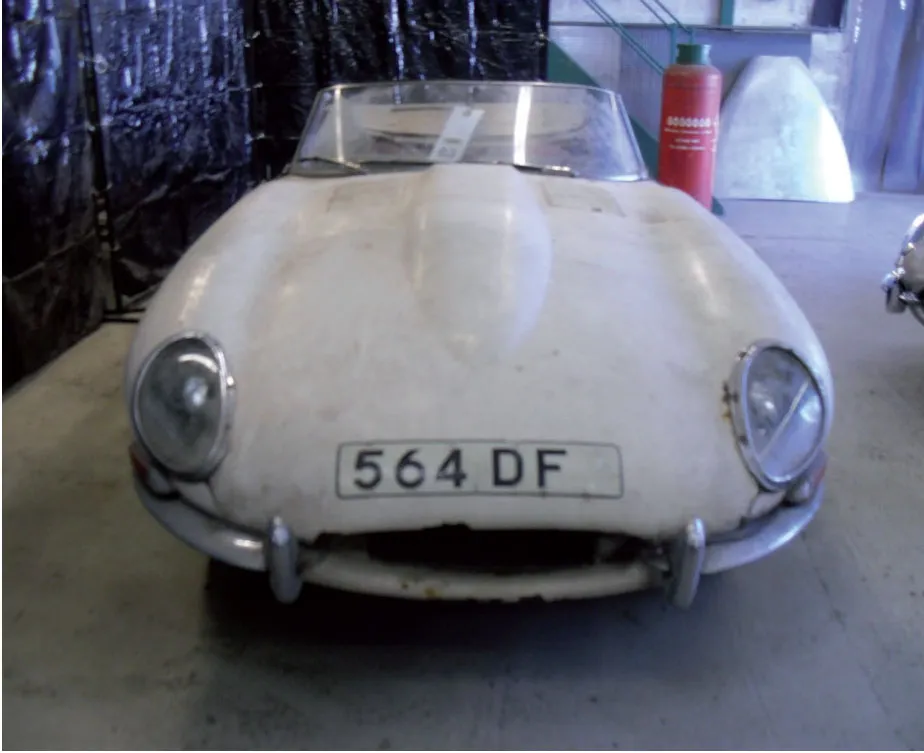
The car prior to dismantling.
Most people regard the dismantling or stripping of the donor car as simple, and a process that can be carried out quickly and without a great deal of care. This is a myth. The dismantling of the donor car must be carried out with as much care and dedication as you would put into its assembly or refitting. A huge amount of damage can be caused if rusted and corroded bolts are not removed carefully.
Different types of bolt markings. The first bolt is standard ‘R’, rated at 45–55 tons per square inch. The centre bolt is ‘S’, rated at 55–60 tons per square inch, and the bolt on the right is ‘T’, rated at 55–65 tons per square inch.
The intention of any well planned and detailed restoration is to save as much of the original vehicle as possible, even down to items such as hose clips, nuts and bolts. Different types of bolt are used throughout a motor car, from cheap standard bolts to the high shear bolts used for securing the propshaft. The designation of the different bolts can be found on the heads.
The first step is to jet wash the whole vehicle, or at least the outside and underneath, in order to remove as much dirt and debris as possible. Take more photographs: remember that you can never take enough. Also purchase a full Jaguar parts manual for the car, along with a Jaguar service manual. These will be very useful companions.
Then make the car safe. Remove the battery, and then jack the car up and place it on suitable stands. Jack up the rear of the car and remove the rear radius arms: this will reveal a cup where the axle stand can be placed. Jack up the front of the car by placing the jack under the picture frame, and then place an axle stand at the corner of the picture frame. The ideal height from the floor is about 24in (60cm).
To carry on making the car safe you need to drain all the fluids: engine oil, gearbox oil, differential oil, fuel tank, water/antifreeze plus brake and clutch fluids. Please remember that all these fluids must be disposed of safely. Your local council will provide the means of disposal free of charge if you t...