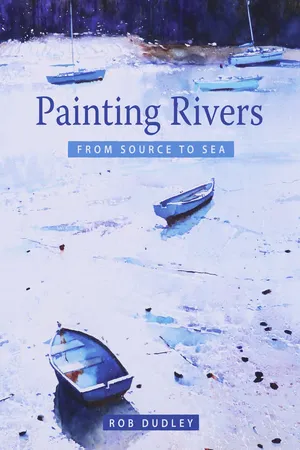
Rivers can be enchanting or exciting, but are always absorbing. They provide a myriad of painting opportunities and challenges for the artist. Focusing on watercolour - one of the most direct of mediums - this practical book explains how to paint a river and capture its life, light, movement, colour and interest. With over 200 colour images, Rob Dudley shares his methods, techniques and ideas to make this beautiful book a must-have for all landscape and en plein-air artists. It explains each stage of a painting; inspiration and focus, sketching and information gathering, planning and painting; and advises on how to paint water so that it captures the colour, shape and tone of light and reflections. It also looks at the various moods and characters of rivers - from the early streams and cascades through to strong, busy waterways and finally to the tidal estuary, where the river meets the sea, and instructs on how to bring a painting to life by including the features of a river - the boats, wildlife, people and bridges. Finished paintings, examples and step-by-step sequences are used throughout to support the detailed instruction. Beautifully illustrated with 233 colour images.
- 160 pages
- English
- ePUB (mobile friendly)
- Available on iOS & Android
eBook - ePub
Painting Rivers from Source to Sea
About this book
Trusted by 375,005 students
Access to over 1 million titles for a fair monthly price.
Study more efficiently using our study tools.
Information
Topic
ArtSubtopic
Art TechniquesChapter 1
Getting Started
Watercolour is one of the simplest of media an artist can choose: it doesn’t require the strong-smelling solvents common to oil painting; it is more stable when dry than a pastel painting; it is immediate, fluid and fun. With just a few tubes of colour, brushes, palette, paper and water you are ready to paint.

But where to start? It’s no wonder that when confronted with racks of papers, dozens of colours and scores of brushes in various shapes and sizes, that many would be painters feel bewildered by the options available. So let’s take a look at the essential requirements for the watercolour painter: namely paper, paint and brushes.

The Stream near Modbury. Size: 42 × 25 cm (16½ × 10 inches).
PAPER
The choice of paper is often overlooked by those new to watercolour painting. How often have I heard from students when asked what paper are they using, ‘I don’t know; it’s just paper’? To the watercolour painter there is no such thing as ‘just paper’, its choice is crucial to the overall success or otherwise of a watercolour painting. Choose the right paper and certain effects are possible to achieve; choose the wrong paper and those desired effects might prove disappointing or even impossible. For instance, a paper with a smoother surface will tend to lend itself to a finer, more precise type of painting, whereas a rougher paper is often better suited to a looser style of watercolour.
The four qualities that artists consider when making their choice of paper on which to paint are: texture, weight, hardness, and whiteness or colour.
Texture

From left to right: Hot pressed, NOT and Rough papers. Note how the texture of the paper has a direct influence on the mark created.
Watercolour paper is manufactured in three different types of surface texture. The types are known as Hot Pressed (HP), Cold Pressed (NOT) and Rough, the classification decided upon by the surface texture, the ‘tooth’ as it is sometimes called. You might like to think of them simply as smooth, medium and rough. A smoother paper will prove easier to work on when producing a tighter, more detailed painting, whereas a rougher surface allows for a looser, more expressive style of brush stroke.
A Cold Pressed (NOT) style of paper, which offers an acceptable amount of texture and allows for both the easy flow of washes and a degree of detail, is the preferred paper of many. Most of the paintings and exercises in this book are painted on Cold Pressed (NOT) papers.
Weight
Watercolour paper is available in a variety of different weights and thicknesses. The most common is 190gsm (90lb), a fairly thin one; 300gsm (140lb) is medium thickness; 638gsm (300lb) is much thicker. The lower the number, the lighter the paper.
Lighter papers are likely to wrinkle and distort when painted on, artists and papermakers refer to this as ‘cockling’. Heavier papers cockle less than lighter ones, but even these will with the addition of enough water. Therefore, to reduce the chances of cockling it is advisable to stretch the paper before painting. This involves soaking the paper in water and sticking it to a stout wooden board with tape. As it dries the paper is pulled flat, and when painted upon will remain virtually cockle-free. Nobody enjoys painting on a bumpy surface and a flat, taut sheet of watercolour paper almost shouts out to be used!
Hardness
Watercolour paper comes in different degrees of absorbency and this is known as the paper’s ‘hardness’. The degree of hardness is arrived at during the manufacturing process with the addition of ‘size’. This has nothing to do with the physical dimensions of the paper, but is the term given to the additive introduced during the manufacturing process that reduces the paper’s capacity to absorb water. The more size used, the less absorbent the paper and the harder it is.
The level of a paper’s hardness has a direct influence on the behaviour of watercolour washes and on the marks possible. A softer paper allows for the layering of delicate, subtle mixes of colour whereas with harder papers washes tend to float for longer on the surface, making the blending of colours easier. Each type of paper has its own characteristics and strengths and with experience the artist will learn which paper is best suited to their work.
Whiteness/Colour
Paper manufacturers produce a variety of ‘white’ papers, some of which are whiter than others. Other colours are also available – pale blues, cream and grey, for example – and the choice of paper colour is decided upon by the subject matter of the painting. For example, a snow-covered river scene might work better if a pale blue paper were used, rather than a creamy white.
Paper can be bought in sheets, pads or blocks. When painting in the landscape a spiral-bound A3 (297 × 420mm) watercolour pad will be large enough, particularly as the spiral binding allows for the pad to fold completely flat, making it much easier to work on. Anything larger than can prove difficult to carry. Watercolour blocks are sheets of watercolour paper glued on all four edges that are meant to do away with the need for stretching as the glued edges are designed to keep the sheets taut when painted on. I find that although the first couple of sheets remain flat, after being taken in and out of my painting bag a few times the remaining sheets begin to separate and any benefit the block might have had is quickly lost. In the studio A1 (594 × 841mm) sheets of paper are often the best choice as they can be cut to the required size and stretched accordingly.
Stretching paper

Step 1: Soak the paper in cold water for a couple of minutes, longer if the paper is very heavy. If using the kitchen sink or bath make certain that it is clear of any soap or cleaning residue as this can affect the paper’s performance when painting.

Step 2: Lay it carefully onto a wooden or plywood board no less than 13mm in thickness, and leave it for about a minute. Be careful not to catch the paper with anything sharp, as it is very soft and susceptible to damage when wet. With the four pieces of gum strip already cut to size, moisten with water, and stick them to the paper and board. Make certain that at least a third of the gum strip is stuck to the watercolour paper and the remainder to the board. Masking tape will not do as a substitute for gum strip.

Step 3: If puddles of water have gathered, remove carefully with kitchen roll.

Step 4: Leave to dry flat, avoiding direct heat, overnight if possible.
To check if the paper is completely dry, use the back of your fingers or hand to test it. If it feels colder than the ambient temperature of the room it is still damp and needs to be left longer. Some artists will test the surface of the paper by drawing with a 2B pencil. If it makes a mark easily then it is likely to be dry enough to use.
To check if the paper is completely dry, use the back of your fingers or hand to test it. If it feels colder than the ambient temperature of the room it is still damp and needs to be left longer. Some artists will test the surface of the paper by drawing with a 2B pencil. If it makes a mark easily then it is likely to be dry enough to use.
Sample paper packs are available from manufacturers and some online stockists. These packs are particularly useful as they allow the artist to test out the various papers before purchasing larger quantities.
Papers can vary widely in price, with the beautiful handmade papers being among the most expensive and machine-made papers less so. Over the years I have tried many manufacturers’ papers, finally settling on two makes that suit my style of painting. One is a beautifully textured handmade artisan paper made by the Two Rivers Paper Company in Somerset, England; the other is a more economically priced mould-made paper, Bockingford, again made in Somerset by St Cuthberts Mill Ltd. Both are excellent papers and a pleasure to work on.
PAINT AND PIGMENTS
Paintings are brought to life by the colour artists use. Colour can stir emotions, create moods, it can instil a sense of calm and stillness or dramatic excitement; it can create the illusion of space and distance, and although the tone often does all the hard work it’s the colour that the viewer will notice first. Therefore the colours chosen are elemental to a painting’s overall success and should be chosen wisely.
Watercolour paint comes in two grades: student quality and artist or professional quality, the student quality being cheaper than the artist quality and although student colours have improved over the years, artist colours tend to deliver better results. They often flow better, dry brighter and go further than those offered in the s...
Table of contents
- Cover Page
- Title Page
- Copyright Page
- Contents
- Introduction
- Chapter 1 Getting Started
- Chapter 2 Objectives, Composition and Design – an Approach
- Chapter 3 The Colour of Water
- Chapter 4 The Young River
- Chapter 5 River Moods
- Chapter 6 The Working River
- Chapter 7 Bridges
- Chapter 8 Wildlife
- Chapter 9 The Estuary
- Suppliers
- Index
Frequently asked questions
Yes, you can cancel anytime from the Subscription tab in your account settings on the Perlego website. Your subscription will stay active until the end of your current billing period. Learn how to cancel your subscription
No, books cannot be downloaded as external files, such as PDFs, for use outside of Perlego. However, you can download books within the Perlego app for offline reading on mobile or tablet. Learn how to download books offline
Perlego offers two plans: Essential and Complete
- Essential is ideal for learners and professionals who enjoy exploring a wide range of subjects. Access the Essential Library with 800,000+ trusted titles and best-sellers across business, personal growth, and the humanities. Includes unlimited reading time and Standard Read Aloud voice.
- Complete: Perfect for advanced learners and researchers needing full, unrestricted access. Unlock 1.4M+ books across hundreds of subjects, including academic and specialized titles. The Complete Plan also includes advanced features like Premium Read Aloud and Research Assistant.
We are an online textbook subscription service, where you can get access to an entire online library for less than the price of a single book per month. With over 1 million books across 990+ topics, we’ve got you covered! Learn about our mission
Look out for the read-aloud symbol on your next book to see if you can listen to it. The read-aloud tool reads text aloud for you, highlighting the text as it is being read. You can pause it, speed it up and slow it down. Learn more about Read Aloud
Yes! You can use the Perlego app on both iOS and Android devices to read anytime, anywhere — even offline. Perfect for commutes or when you’re on the go.
Please note we cannot support devices running on iOS 13 and Android 7 or earlier. Learn more about using the app
Please note we cannot support devices running on iOS 13 and Android 7 or earlier. Learn more about using the app
Yes, you can access Painting Rivers from Source to Sea by Rob Dudley in PDF and/or ePUB format, as well as other popular books in Art & Art Techniques. We have over one million books available in our catalogue for you to explore.