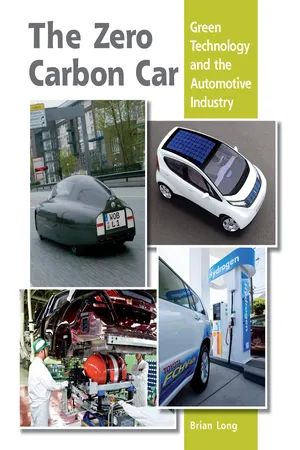
The Zero Carbon Car examines the hundreds of ways in which car manufacturers are trying to reduce our carbon footprint, and the adaptation of the automotive industry to changing technology in a world where environmental issues are becoming ever more prevalent. The book's in-depth research into green car technology shows that manufacturers make concerted efforts, but sometimes also defeat the gains of their innovation. Topics covered include: What is meant by the terms 'global warming' and 'green', and how these can be defined; An account of the long history of green automotive technology; Alternative fuels, including diesel and hydrogen; Developments in environmentally friendly engine technology; Electric cars; Environmental issues in material usage and car body manufacture. A wide-ranging survey of the hundreds of ways in which car manufacturers are trying to reduce our carbon footprint.Written in an easy-to-understand manner, the book enables the reader to fully understand what is meant by 'global warming'. Examines alternative fuels, material usage and the motive power options available to us. Superbly illustrated with 350 colour photographs.Brian Long is a professional writer and motoring historian with over sixty books to his credit.
- 208 pages
- English
- ePUB (mobile friendly)
- Available on iOS & Android
eBook - ePub
About this book
Information
CHAPTER ONE
ZERO CARBON: WHAT EXACTLY DOES IT MEAN?
Nowadays we hear or see the phrase ‘zero carbon’ on an almost daily basis, used by government departments and manufacturers in fields as diverse as house building through to the motor industry. But what does it actually mean, both in the literal sense and, just as importantly, in the real world?

Every day we are subjected to ‘Greenwashing’ – people jumping on the eco bandwagon to further their image or cause. But saving the planet is important. It’s also our moral duty, as it’s the only place mankind has to live. NASA-JPL
Basically, zero carbon (sometimes referred to as ‘carbon neutrality’) describes a nett emissions goal, aimed at significantly reducing, and ultimately eliminating, the release of greenhouse gases (often shortened to the initials ‘GHG’) that cause damage to the planet’s delicate ozone layer. Some of these gases build up and trap the radiation that should bounce off the Earth’s surface into space (the greenhouse effect, leading to global warming), while others deplete the ozone layer, leaving us exposed to harmful UV B rays from the sun.
Carbon dioxide (CO2) is recognized as the main culprit in upsetting the balance of the ozone layer, but worldwide controls are being called for on the discharge of other radiative greenhouse gases, such as methane (CH4), nitrous oxide (N2O), chlorofluorocarbons (CFCs), hydrochlorofluorocarbons (HCFCs), hydrofluorocarbons (HFCs), sulphur hex-afluoride (SF6), and perfluorocarbons (PFCs).
After water vapour in the atmosphere, over which we have little control, carbon dioxide is classed as the largest contributor to the greenhouse effect. For clarity, all greenhouse gases are given a ‘CO2 equivalent’ (CDE) rating, to bring their damage levels into perspective. Methane is less of a threat by volume, but its global warming potential (GWP) is said to be seventy-two times higher than carbon dioxide over a twenty-year timescale, while nitrous oxide is some 289 times higher. Certain chemicals outlined in the Kyoto Protocol are several thousand times more likely to have a long-term radiative effect, which would ultimately accelerate global warming.
Burning fossil fuels is recognized as being responsible for creating around 21 billion tonnes of carbon dioxide each year, not to mention being a chief cause behind other forms of air pollution. It is the speed with which we are upsetting the balance of nature that frightens scientists, with the eco-system unable to absorb the levels of emissions we are producing.
In the background, the sustainability question also has to be raised. Even though it is a rather different problem to global warming, our current energy policies mean the two are related. As James Zachos of the University of California recently said: ‘With fossil fuels today, we’re taking what took millions of years to accumulate and releasing it in a geological instant.’

A drawing showing how an increase in GHGs can expedite global warming. NASA-GSFC

Satellite image of the hole in the ozone layer over the Antarctic. This series of shots was taken in 1979, 1989 and 2006, with dark blue and purple showing the worst affected areas. NASA-GSFC
One should also bear in mind that CFCs and HCFCs, commonly found in refrigerants, aerosols and solvents, have the ability to destroy the ozone layer, as do other gases which are either man-made or occur naturally as part of the mechanism of the eco-system. We talk about the delicacy of the ozone layer, but it’s hard to imagine just how flimsy it is. To give the reader some idea of the scale, if it were compressed down to air pressure at 0ºC, it is only 3mm (0.12in) thick, yet it absorbs around 98 per cent of the sun’s UV B rays, protecting the planet and its inhabitants. Since the 1970s, ozone-layer depletion has been recorded at a rate of about 4 per cent every decade. Due to the unusually cold weather, ozone loss over the Arctic was so severe in 2011 that scientists reported an ‘ozone hole’ like the one that already exists in the Antarctic.

A hole-punch cloud, or a fall-streak hole, photographed by the author in the summer of 2011. This form of cloud seeding is thought to relate to jet aircraft activity, but, being a totally new phenomenon, the exact science behind it, and its impact on local climate, is as yet unknown. B. Long
GLOBAL WARMING
In historical terms, global warming has become a top news item only recently. The greenhouse effect has been recognized for well over a century, but it wasn’t until 1974 that ozone depletion was first recognized by scientists. Even then, no one really took any notice, and as a result, the layman had never really considered it to be an issue. Now, of course, in this age of electronic communication, one is bombarded with ‘facts’ citing gloom and doom, and counter-facts that tell us not to worry.
Certain governments have deliberately employed scientists to challenge established data, saying industry and current lifestyle practices are not the cause of global warming. This is simply a case of politicians pandering to lobbyists who are only interested in protecting their livelihood and short-term profit margins.
Yes, the world may be warming up naturally due to sunspot activity, and it’s easy to point out that Earth has been through phases before, which have taken us through from a world in the tropics to the Ice Age – but to ignore the damage being done by the planet’s inhabitants is foolish in the extreme. For instance, the smog that shrouds London, Madrid, Milan and Athens from time to time, as well as Mexico City and highly populated parts of California and Japan, now covers huge chunks of China on a daily basis, and is entirely of our own doing.

The British government appointed a ‘Royal Commission on Noxious Vapours’ in 1876. The smog over Britain today (this picture was taken in April 2011, when the brownish haze hovering over the capital triggered an air quality alert) cannot be blamed on the Industrial Revolution. MODIS Rapid Response Team at NASA-GSFC
We may or may not be able to stop the polar ice caps melting little by little – an unlikely situation in the Antarctic, as it happens, and not really a big problem in the Arctic beyond wildlife concerns, as this is floating ice – though we definitely need to avoid the ice sheets of Greenland melting away, otherwise sea levels could rise by as much as seven metres! However, we can certainly reduce ozone-layer damage, and we can certainly make an effort to keep the air we breathe as clean as possible.
We have the tools to address the problem, but it seems that politicians often feel they have to look after those who funded their rise to power before they think of their children’s future. They often appear to be too selective, creating taxes that hurt the ‘little man’ in a bid to look ‘Green’ on the surface, whilst happily turning a blind eye towards the real villains in the equation, coming up with wondrous schemes such as ‘carbon offsetting’, which allows...
Table of contents
- Cover
- Title Page
- Copyright
- CONTENTS
- INTRODUCTION
- CHAPTER ONE: ZERO CARBON: WHAT EXACTLY DOES IT MEAN?
- CHAPTER TWO: THE DIESEL BOOM
- CHAPTER THREE: PETROL AS A ‘CLEAN’ OPTION
- CHAPTER FOUR: FULL HYBRIDS: THE PETROL-ELECTRIC AND DIESEL-ELECTRIC BRIGADE
- CHAPTER FIVE: PURE ELECTRIC VEHICLES AND EREVs
- CHAPTER SIX: ALTERNATIVE POWER
- CHAPTER SEVEN: THE BODY BEAUTIFUL
- CHAPTER EIGHT: WHAT THE FUTURE HOLDS
- ZERO CARBON ABBREVIATIONS
- INDEX
Trusted by 375,005 students
Access to over 1.5 million titles for a fair monthly price.
Study more efficiently using our study tools.
Frequently asked questions
Yes, you can cancel anytime from the Subscription tab in your account settings on the Perlego website. Your subscription will stay active until the end of your current billing period. Learn how to cancel your subscription
No, books cannot be downloaded as external files, such as PDFs, for use outside of Perlego. However, you can download books within the Perlego app for offline reading on mobile or tablet. Learn how to download books offline
Perlego offers two plans: Essential and Complete
- Essential is ideal for learners and professionals who enjoy exploring a wide range of subjects. Access the Essential Library with 800,000+ trusted titles and best-sellers across business, personal growth, and the humanities. Includes unlimited reading time and Standard Read Aloud voice.
- Complete: Perfect for advanced learners and researchers needing full, unrestricted access. Unlock 1.5M+ books across hundreds of subjects, including academic and specialized titles. The Complete Plan also includes advanced features like Premium Read Aloud and Research Assistant.
We are an online textbook subscription service, where you can get access to an entire online library for less than the price of a single book per month. With over 1.5 million books across 990+ topics, we’ve got you covered! Learn about our mission
Look out for the read-aloud symbol on your next book to see if you can listen to it. The read-aloud tool reads text aloud for you, highlighting the text as it is being read. You can pause it, speed it up and slow it down. Learn more about Read Aloud
Yes! You can use the Perlego app on both iOS and Android devices to read anytime, anywhere — even offline. Perfect for commutes or when you’re on the go.
Please note we cannot support devices running on iOS 13 and Android 7 or earlier. Learn more about using the app
Please note we cannot support devices running on iOS 13 and Android 7 or earlier. Learn more about using the app
Yes, you can access Zero Carbon Car by Brian Long in PDF and/or ePUB format, as well as other popular books in Technology & Engineering & Automotive Transportation & Engineering. We have over 1.5 million books available in our catalogue for you to explore.