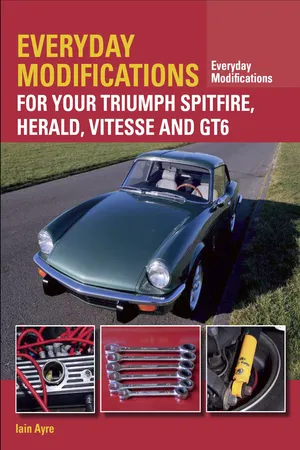
The books in the Everyday Modifications series are designed to guide classic car owners through the workshop skills needed to make their vehicles easier to use and enjoy. This book is concerned with improving the 4-cylinder Spitfire and Herald, and the 6-cylinder Vitesse and GT6, with engines ranging in size from 948cc to 1998cc. Classic car author and journalist Iain Ayre gives his hands-on advice on maintaining and modifying the Triumph Herald/Vitesse and Spitfire/GT6, covering both keeping them going and either subtly or dramatically improving them, with additional rescue options offered for Triumphs deemed economically terminal. The advice, based on decades of restoration and racing, covers improvements in power, handling, comfort and safety; period design faults isolated and remedied; electrics demystified, modernizing options discussed; six case studies; radical - as well as mild - modification options discussed. Superbly illustrated with over 250 colour photographs including rare period shots.
- 300 pages
- English
- ePUB (mobile friendly)
- Available on iOS & Android
eBook - ePub
Everyday Modifications for Your Triumph
About this book
Trusted by 375,005 students
Access to over 1 million titles for a fair monthly price.
Study more efficiently using our study tools.
Information

Spitfire bonnet badge for the American market only – it would have looked inappropriate in the UK to have used an RAF roundel to connect a little 1147cc sports car directly to the machines that won the Battle of Britain. BMW now owns both the Triumph and presumably the Spitfire names – so will they have the nerve to use it?
1
buying the right Triumph: value for money
You have to be crystal clear about the reasons why you want a small Triumph. If you would enjoy getting involved in restoration or pottering, you can be much more flexible when looking for a car. If you have a MIG welder and a garage and would enjoy cutting out rusty panels and making and welding in new ones, then by all means buy and rescue a rusty car. However, if you just want to own and drive a Triumph, only buy the best. The general rule about buying the best one you can find is critical with these cars, because it could cost three or four times the value of a good finished car to restore a bad one.
SAVE MONEY – BUY A ZOBO OR A BOMB
Heralds, which were originally codenamed Zobo, are the least expensive of the flip-front Triumphs. If, again, you are looking for a hands-on hobby project car that needs work, they are available for well under £1,000. Between £1,000 and £2,000 should get you a running and fairly solid but scruffy run-of-the-mill saloon with an MOT. Insist on an MOT before buying, by the way, unless the price is at scrap level.
From £3,000 to £4,000 will get you a nice saloon and into the convertible arena, possibly an older restoration, and also into some of the rarer models that will appreciate more. On a random winter Internet surf, we find a 1960 948cc saloon in nice condition for £4,500, and £2,750 gets a 1966 estate, which would be a very useful vehicle: if you didn’t need to go anywhere far or fast, you could use that as a very economical daily car.
£6,000 gets us into buying a car from a dealer. At this level you’re looking for no rust at all, and those on offer will mostly be convertibles. If you pay something like £8,000 for a Herald, you’re going to get a fresh restoration and almost a new car – and somebody will have lost quite a lot of money, because it will have cost three times that much to carry out a half-decent restoration. But often, the labour doesn’t come into the calculation because it would have been a hobby project. You don’t really clock the hours of labour involved when you go skiing or sailing, because you expect to pay for hobbies, not to be paid for doing them. Quite of lot of hobby restorers just want to get rid of a freshly finished car for enough money to get on with the next one. Like a jigsaw, it’s of no interest when it’s finished.

A Spitfire 1500 offers very good value for money. This particular example had just been expensively restored and was on sale for $7,000 Canadian – around £3,500. Tempting, as it was pretty well perfect.
Moving up a class to Vitesses, a tempting example at the time of writing was £2,500 for a scruffy red Mk II with overdrive, wire wheels and a sunroof – though that rather scruffy-looking drivable project would probably be a temptation best resisted unless it was very solid. At the £4,000 to £6,000 level you’re looking at fairly good Vitesses. The premium for a convertible seems less strong than with Heralds, and the engine size and date doesn’t seem to matter too much. The 2000cc engine is torquier, but the earlier 1600cc is revvier and sweeter. Two concours Vitesses were on offer for £11,000 and an optimistic £20,000. Paying something between £8,000 and £12,000 for a virtually new Vitesse could make sense, because you certainly couldn’t have one restored for that – although if you supplied the labour yourself for the fun of it, you could probably home-restore a Vitesse to a good level for £10,000.
Spitfires were originally known by the codename Bomb, and are plentiful and cheap. The later ones are generally even cheaper. The 1500cc engine shared with the MG Midget provides useful touring torque, but the favourite engine among the Spitfirati is the 1300.
For just a few hundred pounds we’re looking at viable restoration projects with holes in the floors, and if you’re not keen on welding, many abandoned restoration projects are sold very cheaply at the magic 90 per cent level, with all the structural rust already repaired. Cars in pieces are worth very little. People do the big and difficult bits, and they – or their wives – get totally sick of the interminable boring last details and just give up, passing on a bargain to you or me. A few months of reassembly and a paint job, and we’re driving a very nice car.

The least favourite Spitfire among the cognoscenti is the later 1500, which is heavier, slower-revving and more modern. Try various models and engine sizes before deciding on your chosen period.

Spitfire Dick is in his nineties and still breaks up Spitfires as a paying hobby. He collected enough good parts to win concours prizes with his assembled parts collections.
‘Been standing for while, runs, £1095 ONO’ is also worth a look and can probably be had for £500 worth of waved twenties. (Carry £20 notes rather than fifties, as they make a more impressive wad.)
Between £2,000 and £3,000 gets us a reasonable and drivable Spit, and above £4,000 they start getting nicer. Above £5,000 and we’re getting older restorations, new paint, new engines and some of the more interesting cars: a 1969 1300 with 70,000 miles (112,000km) and a full history could be a nice buy at £5,000. We also have the option of buying from the trade. This means paying over the odds, but traders don’t generally bother buying in rubbish, and with the small claims court as an option for back-up, you can get faults sorted out. Classic car traders are also more likely to be reasonably honest than mainstream second-hand car types.
There are also intriguing buys about, if you’re patient and quick – how about £2,200 for a 1976 Spit with a Dolomite 1850 engine, overdrive gearbox and GT6 bonnet? That would go like stink until the head gasket blew.
On the subject of the GT6, this is the top of the small Triumph class. They are best treated as tourers than sports cars, though – the engine is heavy and too far forwards in a light car, and the handling on early ones is not up to the amount of power available. They’re exquisitely pretty, and as in the E-Type, the coupé GT6 version of the Michelotti design is prettier than the convertible Spitfire, although there’s nothing wrong with the lines of a Spitfire. The GT6 was often referred to as the ‘poor man’s E-type’, and there’s truth in that. Their desirability means they tend to start at £6,000 for something fairly good, rising to £9,000 and above for restorations or survivors: a 48,000-mile (77,000km) 1967 Mk I with no welding and its original paint sounds fairly priced at £11,500 – although with that one, you’d really have to tolerate the original and periodcorrect rear suspension, rather than sort it out.
Triumph-based kit cars offer some good deals and some good fun. The most frequently available ones are Gentries, which are replicas of the early 1950s MG TF. They’re sometimes built on a Triumph chassis and sometimes on a custom chassis, which will be made of girders. They tend to sell for between £3,000 and £5,000 if functional, and a small fraction of that if unfinished. If buying an unfinished one, make sure that it uses an original Triumph chassis with a valid registration as a Gentry, or has been registered as a Gentry with a new chassis, or you’ll have to go through a difficult, silly and expensive (£500) government test.
There are also the plan-built, plywood-bodied Burlingtons and JC Midges, which look more like the 1930s period than the 1950s. I write for Kitcar magazine, and I am the madman who built the first 6-cylinder, 2-litre, Vitesse-based Midge. After much of the usual hassle, the Vitesse rear axle was changed for a live axle from a Dolomite, on a custom linkage with a Panhard rod. You can do that on a kit car, although it would be a bit tricky on a Triumph body and chassis. It’s certainly out of the purlieu of everyday modifications.
Burlingtons and Midges are cheaper than Gentries because they’re more free-form in concept, and many have proportions that look grotesque. However, they can all be aesthetically saved with more plywood and a set of bolt-on hubs and 18in wire wheels.
ORIGINALITY
Mentioned elsewhere in this chapter is one car I would not modify – an £11,500 Mk I GT6 with 48,000 miles (77,230km) and its original paint. Any low-mileage, untouched, time-capsule survivor has intrinsic historic value and potentially substantial longer-term financial value, and should really be preserved. The rest of the remaining Triumph fleet is, however, fair game for an individual treatment, and there are still thousands of cheap old Triumphs out there to play with.
Some types of modification will definitely add value, such as a set of wire wheels or an extra carb fitted to a single-carb engine. Overdrive is a boon for nearly all Triumphs, but the best way to buy an overdrive set-up is to get the entire system from another Triumph, including the switch – which means either steering column electrics with the right extra stalk, or a g...
Table of contents
- Cover
- Title Page
- Copyright
- Contents
- Introduction
- 1 Buying the Right Triumph: Value for Money
- 2 Masterclasses
- 3 Triumph Engines
- 4 Transmission
- 5 Suspension and Steering
- 6 Brakes
- 7 Wheels and Tyres
- 8 Structure and Interior
- 9 Electrics
- 10 Maintaining Performance
- 11 Case Studies
- Index
Frequently asked questions
Yes, you can cancel anytime from the Subscription tab in your account settings on the Perlego website. Your subscription will stay active until the end of your current billing period. Learn how to cancel your subscription
No, books cannot be downloaded as external files, such as PDFs, for use outside of Perlego. However, you can download books within the Perlego app for offline reading on mobile or tablet. Learn how to download books offline
Perlego offers two plans: Essential and Complete
- Essential is ideal for learners and professionals who enjoy exploring a wide range of subjects. Access the Essential Library with 800,000+ trusted titles and best-sellers across business, personal growth, and the humanities. Includes unlimited reading time and Standard Read Aloud voice.
- Complete: Perfect for advanced learners and researchers needing full, unrestricted access. Unlock 1.4M+ books across hundreds of subjects, including academic and specialized titles. The Complete Plan also includes advanced features like Premium Read Aloud and Research Assistant.
We are an online textbook subscription service, where you can get access to an entire online library for less than the price of a single book per month. With over 1 million books across 990+ topics, we’ve got you covered! Learn about our mission
Look out for the read-aloud symbol on your next book to see if you can listen to it. The read-aloud tool reads text aloud for you, highlighting the text as it is being read. You can pause it, speed it up and slow it down. Learn more about Read Aloud
Yes! You can use the Perlego app on both iOS and Android devices to read anytime, anywhere — even offline. Perfect for commutes or when you’re on the go.
Please note we cannot support devices running on iOS 13 and Android 7 or earlier. Learn more about using the app
Please note we cannot support devices running on iOS 13 and Android 7 or earlier. Learn more about using the app
Yes, you can access Everyday Modifications for Your Triumph by Iain Ayre in PDF and/or ePUB format, as well as other popular books in Tecnología e ingeniería & Transporte e ingeniería automovilísticos. We have over one million books available in our catalogue for you to explore.