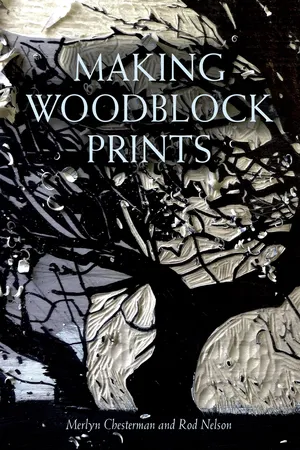
Woodblock printing is an ancient art form, which produces beautiful, subtle and lively pieces with just a few simple materials. This book introduces the art, and shares technical information and ideas for those with more experience. A wide range of exciting examples of printed woodcuts are shown along with advice on materials and tools, and a step-by-step guide to sharpening. Techniques to achieve quality prints and perfect registration are covered too. Drawing on the vibrant living traditions from China and Japan, it is both a technical guide and an inspiration. Beautifully illustrated with 160 colour photographs.
- 112 pages
- English
- ePUB (mobile friendly)
- Available on iOS & Android
eBook - ePub
Making Woodblock Prints
About this book
Trusted by 375,005 students
Access to over 1 million titles for a fair monthly price.
Study more efficiently using our study tools.
Information
Topic
ArtSubtopic
Art TechniquesCHAPTER ONE
AN INTRODUCTION TO THE WOODBLOCK PRINT
The ability to print an image is as old as the human race itself. A finger, dabbed in some mud, imprints upon a face. A handprint is pressed on to the wall of a cave, and then another one and another, until a pattern is made.
Tens of thousands years later, the same process developed through what we now regard as simple technologies into a process that would change the world immeasurably. There are woodblock prints on silk from China pre-dating 220CE. By the mid-seventh century in China, sophisticated prints, both image and text, were made on paper from planks of wood.
To make a woodcut or woodblock print (the two are synonymous), four things are required: sharp tools, smooth wooden surfaces, paper (or cloth) and ink. Sharp metal tools are needed to shape the planks, smooth them, and incise marks into the smooth surface. Ink must then be applied to the plank, on to which the paper is then pressed.
This is a process that can be carried out repeatedly, resulting in printed sheets of information or decoration that is permanently available, transportable and relatively inexpensive.
Printing was a revolutionary discovery. The woodblock print – or woodcut – was born as a medium. Suddenly, using this newly discovered method, practical knowledge, data, wisdom and art could be made available to a vastly greater number of people than had previously had access to it. By doing so, it facilitated profound intellectual and technical development in China and in the Far East, generally at a time when the transfer of knowledge in the West could only be done by handwritten books and verbal traditions.
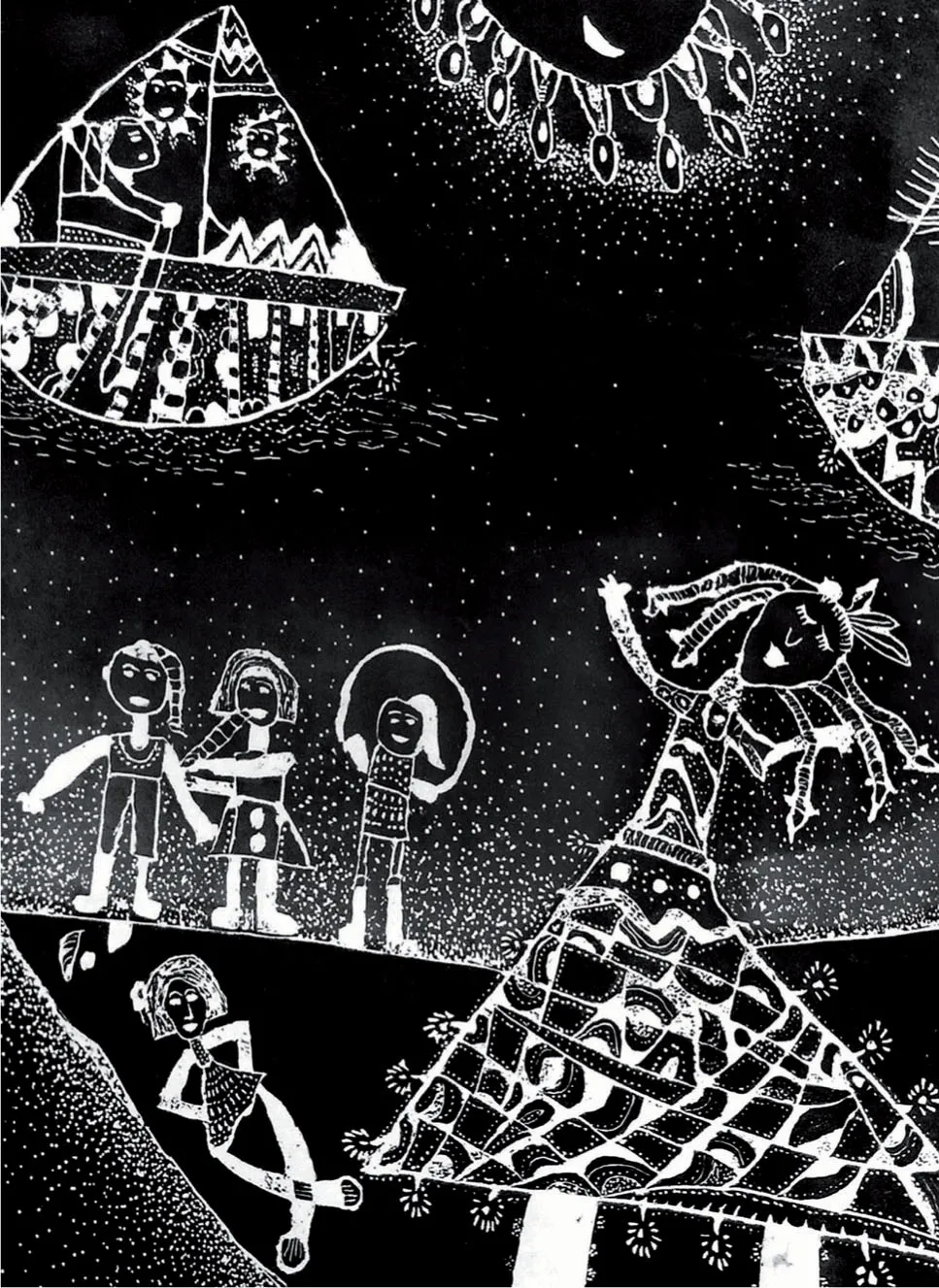
The Moon Boat by Qianyi Huang from the Sweet-Scented Osmanthus Primary School of Longhua, Shenzhen City, teacher Ri Rao Zhang.

Cueva de las Manos, Patagonia, prehistoric handprints.

Cut marks incised into a smooth surface – Leaf Surface (block) by Rod Nelson.
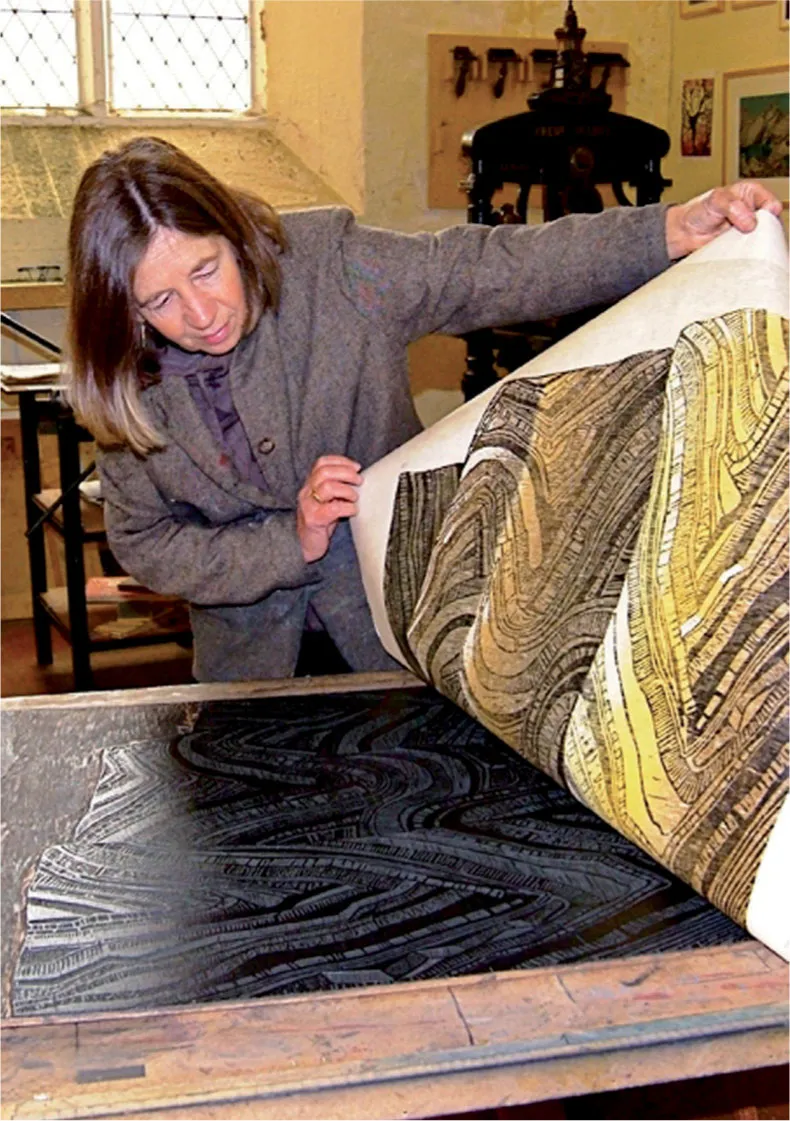
The author lifting a print.
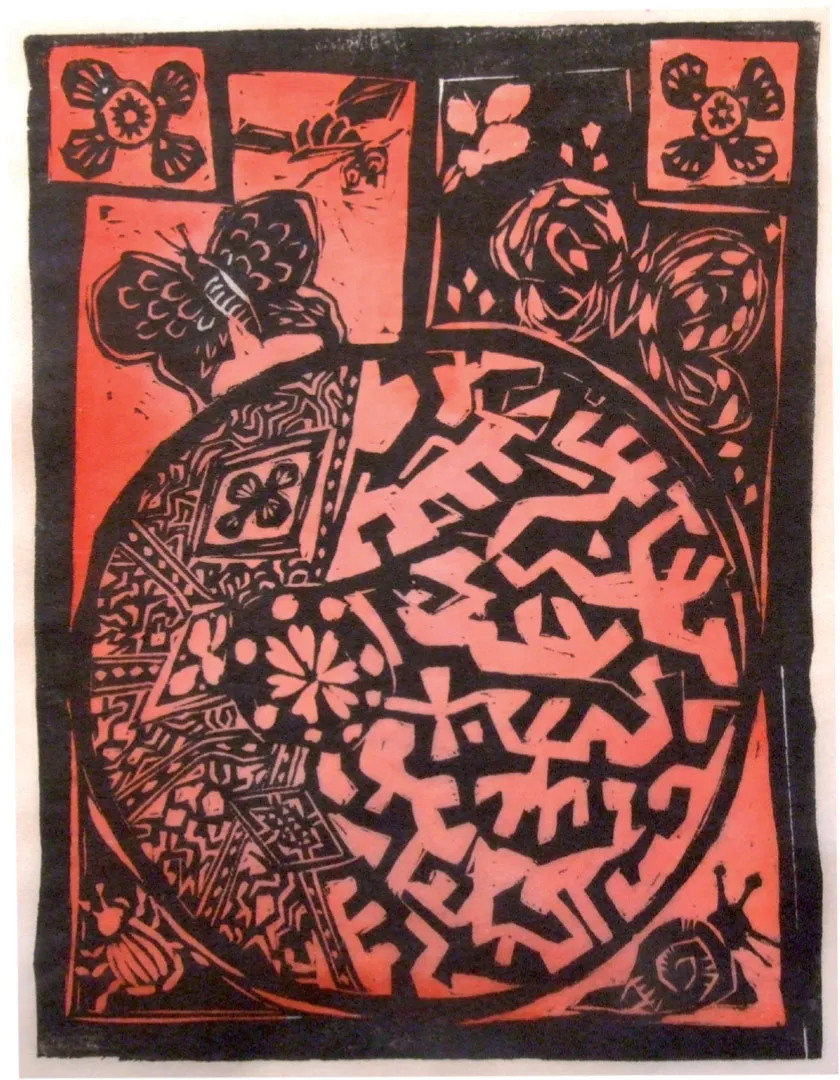
Pattern of Small Beings (in Sõsaku Hanga style) by Rod Nelson.
Although printing has developed immeasurably since that time, and the technology has evolved through several powerful transformations on a thousand-year evolutionary journey from Gutenburg’s important invention of moveable type to the amazing possibilities of the modern digital print, the art and craft of making prints from wood still has unique creative potential. To put it simply, one can make images using this most ancient technique of printing, which cannot be made in any other way, even using the most modern technology. Because of this, woodblock printing still has relevance and a life of its own as an art form – it will not die out or become obsolete despite the development of more sophisticated technologies.
Woodblock printmaking reached its technical apotheosis in nineteenth-century Japan, where specialist artists and craftsmen produced phenomenally beautiful and delicate images. As many as seventeen blocks, each one printing a separate colour, were used in the production of a single print.
Blocks were cut by teams of specialist craftsmen. However, early in the twentieth century there was a reaction against this specialization by some Japanese artists who wished to take full control of the printing process themselves. They formed the ‘Sõsaku-hanga’ (literally ‘creative prints’) movement of artist-craftsmen. They were influenced by Western artists, particularly by Van Gogh, the Impressionists and the Vienna school. The artists of the Sõsaku-hanga have influenced our own approach to printmaking, and in this book, their presence is to be found as one of a number of influences.
Woodblock prints can still carry more ‘punch’ than almost any other art form. In China itself, it is notable that the iconic images of the Communist revolution of the 1950s and 1960s were all derived from woodblock prints.

Revolutionary poster of Mao Zedong, mid-1960s china.
One of the most attractive aspects of woodblock printmaking is its democratic nature: it really is available to almost everyone. Even young children, if taught carefully how to hold and use the tools safely, can do lovely work. The woodcut The Moon Boat shown earlier in this chapter, and My Rabbit in Chapter 1 are beautiful examples by very young artists.
Woodblock printmaking requires no great strength or any special visual acuity. It is not expensive, nor does it need costly equipment. It has difficulties – for example, that of making reversed images – but these can be turned to the advantage of the artist, who can end up with work that surprises and amazes with its energy. When one lifts the printed image from the block for the first time and sees the fruits of maybe several hours of work appear, there can be hardly any greater pleasure.
Woodblock printmakers may have the fortune to work in beautiful, well equipped studios with expensive equipment, but equally they can produce wonderful work on their kitchen table with simple tools and only a little skill, and with little more equipment than would fit in a handbag.
This book is aimed at helping anyone to make woodcuts, from the most naïve beginner who just wants to make a birthday card, to artists who already have a strong sense of their own abilities and techniques, who wish to broaden the expressive range of their work through this powerful medium. Whilst it is only really possible to learn woodblock print-making by doing it, we hope that reading this book will enable our readers to save time and energy which they might otherwise have had to expend in experiment. Over time we have learned methods – often from other printmakers – which we hope can prove helpful to our readers and to those who come after us. We would like to think that in another thousand years there will still be woodblock printmakers working in ways that are relevant to their time, using techniques that the Chinese would have recognized in the ninth century.

Top block of Sea Rocks by Pine Feroda.
WOODCUT OR WOOD ENGRAVING?
Wood engraving is similar, but not identical to woodblock printmaking. In wood engraving, the end grain, not the side grain, of the wood is used.
Very hard, close-grained woods are used – traditionally boxwood, lemonwood or cherry. The tools used – scorpers, spitstickers, gravers – result in images that are exquisitely delicate. These tools cut in quite a different way from the chisels and gouges that are used to make woodblock prints, and can make the finest of white lines, thinner than a hair. Engraved prints are generally quite small.
To this day, some wonderful book illustration is done with this method. Wood engraving is, however, a specialism that is beyond the scope of this book.

End grain and side grain explained.

Wood engraving: The Three Bathers by John Buckland Wright, 1957.

Woodcut: Sp...
Table of contents
- Cover Page
- Title Page
- Copyright Page
- Acknowledgements
- Dedication
- Contents
- Foreword
- 1 An Introduction to the Woodblock Print
- 2 Materials
- 3 Equipment and Sharpening
- 4 Getting Started
- 5 Design and Cutting a Woodblock Print
- 6 Colour and Inks
- 7 Registration
- 8 Proof and Print
- Appendix I: Rollering – A Step-by-Step GUIDE
- Appendix II: Printmakers’ Gallery
- Further Information
- Index
Frequently asked questions
Yes, you can cancel anytime from the Subscription tab in your account settings on the Perlego website. Your subscription will stay active until the end of your current billing period. Learn how to cancel your subscription
No, books cannot be downloaded as external files, such as PDFs, for use outside of Perlego. However, you can download books within the Perlego app for offline reading on mobile or tablet. Learn how to download books offline
Perlego offers two plans: Essential and Complete
- Essential is ideal for learners and professionals who enjoy exploring a wide range of subjects. Access the Essential Library with 800,000+ trusted titles and best-sellers across business, personal growth, and the humanities. Includes unlimited reading time and Standard Read Aloud voice.
- Complete: Perfect for advanced learners and researchers needing full, unrestricted access. Unlock 1.4M+ books across hundreds of subjects, including academic and specialized titles. The Complete Plan also includes advanced features like Premium Read Aloud and Research Assistant.
We are an online textbook subscription service, where you can get access to an entire online library for less than the price of a single book per month. With over 1 million books across 990+ topics, we’ve got you covered! Learn about our mission
Look out for the read-aloud symbol on your next book to see if you can listen to it. The read-aloud tool reads text aloud for you, highlighting the text as it is being read. You can pause it, speed it up and slow it down. Learn more about Read Aloud
Yes! You can use the Perlego app on both iOS and Android devices to read anytime, anywhere — even offline. Perfect for commutes or when you’re on the go.
Please note we cannot support devices running on iOS 13 and Android 7 or earlier. Learn more about using the app
Please note we cannot support devices running on iOS 13 and Android 7 or earlier. Learn more about using the app
Yes, you can access Making Woodblock Prints by Merlyn Chesterman,Rod Nelson in PDF and/or ePUB format, as well as other popular books in Art & Art Techniques. We have over one million books available in our catalogue for you to explore.