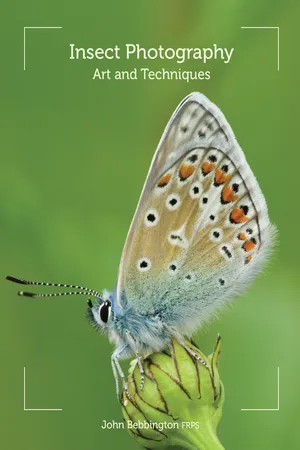
Insect photography is a challenging and stimulating art. Well-shot images give stunning results, which can aid study and enhance enjoyment of the natural world. This practical book explains how to reliably take those photographs. Through introducing insects and their behaviour, it advises on when and how to see nature at work and, by instructing on techniques, it shows how to capture the moment to dramatic effect. This new book advises on buying and using equipment for both compact camera and SLR users; it describes how to find and understand insects, and encourages responsible photography and good fieldcraft and instructs on composition, exposure, lighting and advanced techniques. Ways of sharing images, cataloguing and caring for them, and backing them up are given too. This book is aimed at amateur and professional naturalists and photographers, as well as artists.
- 160 pages
- English
- ePUB (mobile friendly)
- Available on iOS & Android
eBook - ePub
About this book
Trusted by 375,005 students
Access to over 1.5 million titles for a fair monthly price.
Study more efficiently using our study tools.
Information
Topic
ArtSubtopic
Photography TechniquesChapter 1
Photographing Insects With a Compact
Whether you use a compact or a single-lens reflex camera, or perhaps you are considering purchasing a new camera, you will get the best results from understanding what is required from your camera and equipment. (‘Compact’ here refers to models with non-interchangeable lenses, usually called ‘compact’ or ‘bridge’ cameras. Those with interchangeable lenses, however compact, are referred to in Chapter 2.)
It is often said that it’s not possible to take good insect photographs with a compact camera, but this is not necessarily true. The capabilities of a compact may be relatively limited, and you will not have the flexibility offered by a single-lens reflex camera with interchangeable lenses, but on the other hand a thorough understanding of your camera and the accessories (commercially-produced and homemade) which you can use with it, along with careful choice of subject and a disciplined approach, will enable you to produce images which will be very acceptable. There are two main advantages over the SLR: your camera will be much lighter and you will not be troubled by dust getting onto the sensor, as the camera is a sealed unit; you will probably be able to attach your camera to a microscope; and with current high megapixel counts you will be able to crop an image, especially one taken at lower sensitivity (ISO rating), and still retain sufficient quality for projection or identification purposes.

Fig. 1.2
‘Greenbottle’ fly basking. Nikon Coolpix P5100, +4 dioptre accessory close-up lens on tube mount, 1/80sec ƒ7.3, ISO 100. Full-frame original file.
‘Greenbottle’ fly basking. Nikon Coolpix P5100, +4 dioptre accessory close-up lens on tube mount, 1/80sec ƒ7.3, ISO 100. Full-frame original file.

Fig. 1.3
‘Greenbottle’ fly basking. Nikon Coolpix P5100, +4 dioptre accessory close-up lens on tube mount, 1/80sec ƒ7.3, ISO 100. Image cropped to central portion.
‘Greenbottle’ fly basking. Nikon Coolpix P5100, +4 dioptre accessory close-up lens on tube mount, 1/80sec ƒ7.3, ISO 100. Image cropped to central portion.
THE BASIC CONTROLS
When you buy a camera, it is usually preset to full auto mode. You may have been tempted to leave it set up in this way, because this is the easiest way to produce images and requires little thought. However, if you want to progress beyond this stage and to produce images which reflect your vision, you need to understand the basic controls and learn how to exploit them. This understanding will give you confidence in your equipment and enhance your creativity. The camera handbook or operating manual may be a printed version or it may be on CD/DVD. It may appear daunting at first, but it is important to read some critical sections. The version on disc should be an indexed PDF file, and you can search for a specific topic rather than thumbing through the book.
Ideally your compact camera should allow you to have some control over focusing, metering modes, aperture, shutter speed, shutter release mode, sensitivity and exposure. A zoom lens with a ‘macro’ mode (a flower symbol on one of the controls) will enable you to focus close-up, although it will not give you true macro images. If the lens has a wide zoom range including telephoto you can use accessory lenses to obtain closer focus. The camera should offer some sort of image stabilization (VR, SR, IS), which is especially important when the lens is on telephoto setting. Video capability and a hinged live view screen are useful.
Focus
Focusing mode in the more basic models will probably be ‘autofocus’, perhaps with a choice of where in the frame the camera chooses, but more advanced models such as the Canon G12 have a manual focus mode. This will allow you to choose precisely where you want the plane of focus to be. If the camera is set on autofocus, and the subject is small and some distance away from the background, it may focus on the wrong area and your subject may be partly or wholly outside the area of focus. However, if the subject is static, you can try several different shots, taking care to ensure that the subject is in focus (Figs 1.4 and 1.5).

Fig. 1.4
Brindled Beauty moth larva Apocheima hispidaria – camera autofocus has locked on hedge in background.
Brindled Beauty moth larva Apocheima hispidaria – camera autofocus has locked on hedge in background.

Fig. 1.5
Brindled Beauty moth larva Apocheima hispidaria, Somerset, UK. Care taken to position spot autofocus point on subject. Nikon Coolpix P5100, 1/1000sec ƒ2.7, ISO 400.
Brindled Beauty moth larva Apocheima hispidaria, Somerset, UK. Care taken to position spot autofocus point on subject. Nikon Coolpix P5100, 1/1000sec ƒ2.7, ISO 400.
If your subject is small, you can place a large leaf close behind it so that the camera focuses correctly. You can even hold a finger next to the subject to ensure that the camera focuses correctly – the result may not be very artistic but you will at least have a sharp image for identification purposes.
Metering mode usually offers a choice of spot, centre-weighted or average (matrix); in some models there is a choice of where in the frame the spot meter reads so that if, for example, the main subject is off-centre it is still correctly metered.
Exposure
Aperture (ƒ no.) can be set in AV (aperture priority) mode. As you change the ƒ number, the camera will adjust the shutter speed to give a correct exposure. Using aperture priority allows you to control depth of field (see Chapter 5) although it is unlikely that the minimum aperture will be hig...
Table of contents
- Cover
- Title Page
- Copyright
- CONTENTS
- Introduction
- Chapter 1: Photographing Insects With a Compact
- Chapter 2: SLR Cameras and Accessories
- Chapter 3: Knowing Your Subject
- Chapter 4: Fieldcraft
- Chapter 5: Perception, Composition and Depth of Field
- Chapter 6: Exposure and Lighting
- Chapter 7: Capturing the Moment
- Chapter 8: Advanced Techniques
- Chapter 9: Processing Your Images
- Chapter 10: Cataloguing and Sharing
- Chapter 11: Expanding Your Horizons
- Useful Information
- Index
Frequently asked questions
Yes, you can cancel anytime from the Subscription tab in your account settings on the Perlego website. Your subscription will stay active until the end of your current billing period. Learn how to cancel your subscription
No, books cannot be downloaded as external files, such as PDFs, for use outside of Perlego. However, you can download books within the Perlego app for offline reading on mobile or tablet. Learn how to download books offline
Perlego offers two plans: Essential and Complete
- Essential is ideal for learners and professionals who enjoy exploring a wide range of subjects. Access the Essential Library with 800,000+ trusted titles and best-sellers across business, personal growth, and the humanities. Includes unlimited reading time and Standard Read Aloud voice.
- Complete: Perfect for advanced learners and researchers needing full, unrestricted access. Unlock 1.5M+ books across hundreds of subjects, including academic and specialized titles. The Complete Plan also includes advanced features like Premium Read Aloud and Research Assistant.
We are an online textbook subscription service, where you can get access to an entire online library for less than the price of a single book per month. With over 1.5 million books across 990+ topics, we’ve got you covered! Learn about our mission
Look out for the read-aloud symbol on your next book to see if you can listen to it. The read-aloud tool reads text aloud for you, highlighting the text as it is being read. You can pause it, speed it up and slow it down. Learn more about Read Aloud
Yes! You can use the Perlego app on both iOS and Android devices to read anytime, anywhere — even offline. Perfect for commutes or when you’re on the go.
Please note we cannot support devices running on iOS 13 and Android 7 or earlier. Learn more about using the app
Please note we cannot support devices running on iOS 13 and Android 7 or earlier. Learn more about using the app
Yes, you can access Insect Photography by John Bebbington in PDF and/or ePUB format, as well as other popular books in Art & Photography Techniques. We have over 1.5 million books available in our catalogue for you to explore.