Whether you are an artisan, an architect or a homeowner, The Stone Restoration Handbook demonstrates the best approach and techniques to use when preserving and repairing historic buildings. It introduces the materials and the processes, and explains the proven methods to conserve, repair and restore stone, masonry, statuary and monuments. This new book is packed with illustrations, examples and advice on stone selection and working, lime and mortars, pointing, cleaning and repairing mortar and stone. It guides you through assessing the job on the first site visit through to discussing the options and difficulties you can face. This is essential reading for those who care for and repair historic buildings and monuments. Contents include: surveying for a conservation report; setting up workshop and tools; stone selection and working; lime and mortars; pointing; repairing mortar and stone; cleaning; consolidation; casting and scagliola. Superbly illustrated with 564 colour photographs.
eBook - ePub
Stone Restoration Handbook
A Practical Guide to the Conservation Repair of Stone and Masonry
- 224 pages
- English
- ePUB (mobile friendly)
- Available on iOS & Android
eBook - ePub
Stone Restoration Handbook
A Practical Guide to the Conservation Repair of Stone and Masonry
About this book
Trusted by 375,005 students
Access to over 1.5 million titles for a fair monthly price.
Study more efficiently using our study tools.
Information
Subtopic
Bau- & Architekturtechnik
A rainy day in Bath. The façade of this shop is soiled by scurf, the result of acid rain pollution and accumulation of sooty particulates. The impervious painted sign is causing water to run off and keeping the stone clean directly below it by washing, while under the cornice the scurf builds up.
CHAPTER ONE
DECAY OF STONE
The problem with buildings, and the reason for this book, is that over time they will wear out. The process can pass unnoticed until it gets really bad, as buildings are at the mercy of the ravages of time, the elements and, quite often, of people. With such a hardy material as stone it is often an accumulation of factors that will set about the demise of a building, and once started it is very difficult to reverse the process.
Heritage conservation has the responsibility for reducing the impact and, where possible, setting things right – but always without losing the essential character of the structure.
What is the Problem?
The first step is to identify what is happening and what is causing it. A building will tell us what is happening to it; interpreting the story requires an ability to read the signs, plus common sense and intelligence. What will become noticeable in this chapter is that there is one unifying factor: water.
The Inspection
The extent of investigation here is assumed to be an overall view of what is happening to a building; the depth of this study will be defined by what is found. First, make sure you have all the kit needed and try to choose a good day: too much sunlight may mean that significant details may be hidden in shadow (though you will get nice pictures) and, obviously, it should not be too wet.
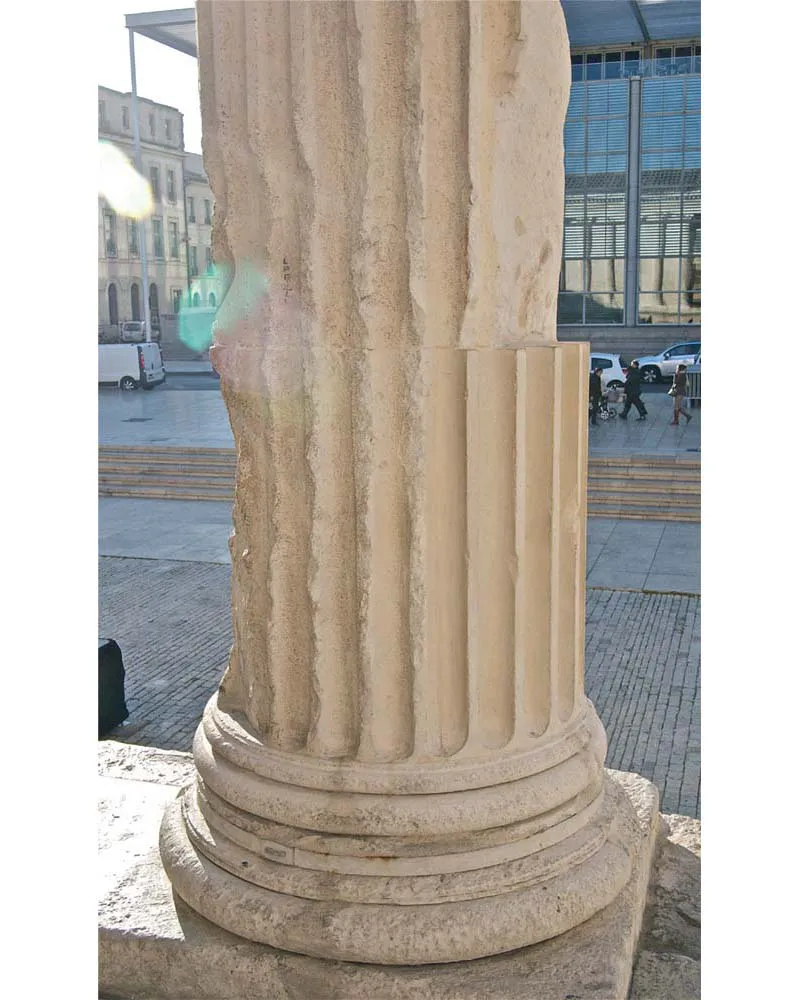
Roman column, Nîmes, France. Gently wearing away with time, inevitable but true to nature.
THE ROLE OF WATER
It can be generally assumed that where there is decay of stone that is not wholly caused by structural movement, water will be or has been significant to the process. Stone will at some time come into contact with water, or be contaminated by moisture; problems arise when the water carries soluble materials, is blocked in its travel or exerts unwanted pressure. If a stone could be isolated from any form of moisture it would probably remain whole, with no significant degradation taking place. As this situation is one that is impossible to maintain, because buildings are exposed to the elements, it is in the best interests to identify the deteriogens, to render them and their source inert or to remove them. Obviously artefacts such as monuments or statuary can be insulated to a degree from moisture ingress by the use of DPMs underneath or where they touch walls, but this is impossible with buildings.
SIZE MATTERS
There is a physical action whereby water will move through very fine spaces more quickly and easily than through large openings; this is known as capillary attraction. Buildings can often have myriads of fine cracks, especially in cementitious materials, which physically draw water into the fabric; so it behoves the inspector to get up close and check these out.
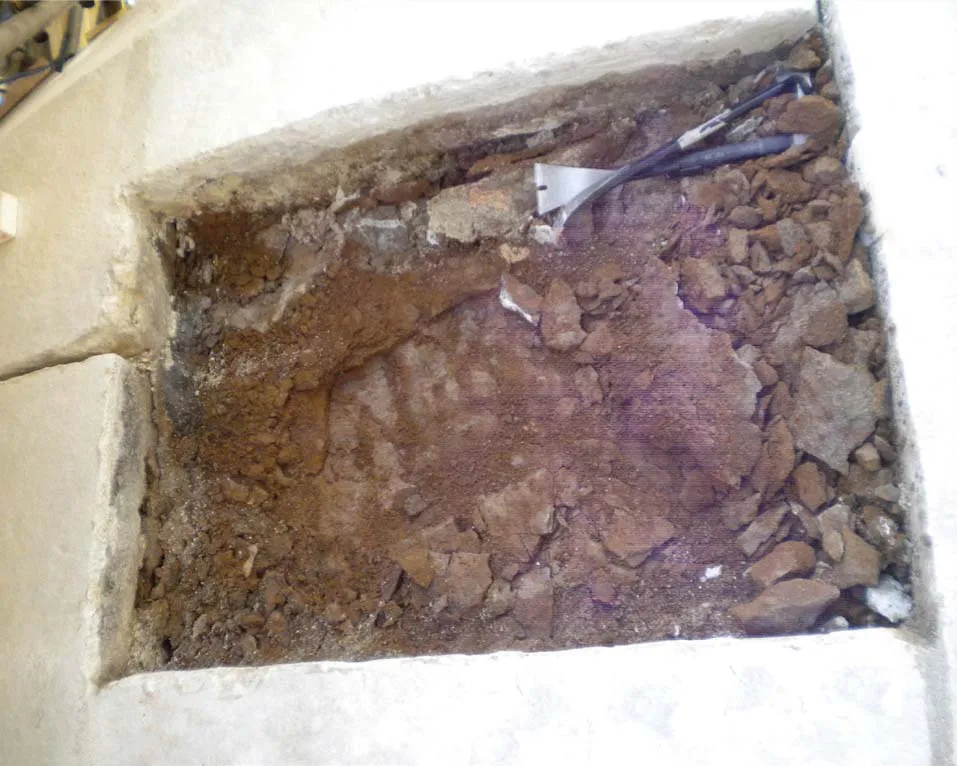
A dome cover stone has been lifted and the poor condition of the fabric discovered; decades of damp trapped inside by misguided and budget attempts to prevent this had caused the building to rot from the inside outwards.
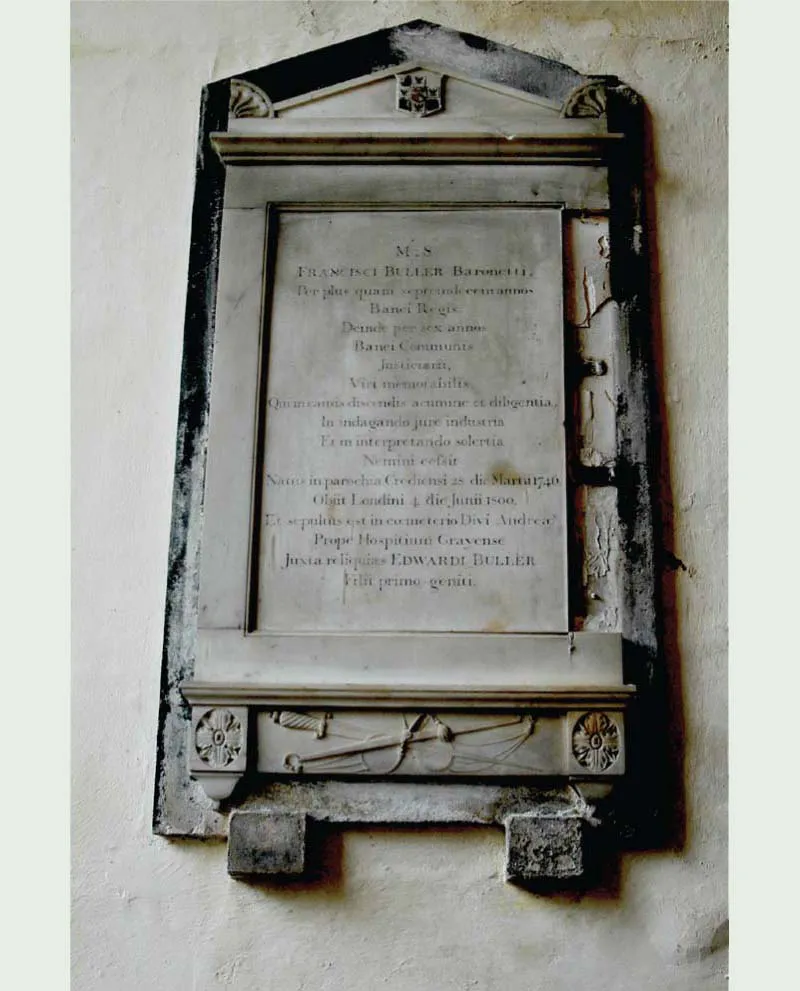
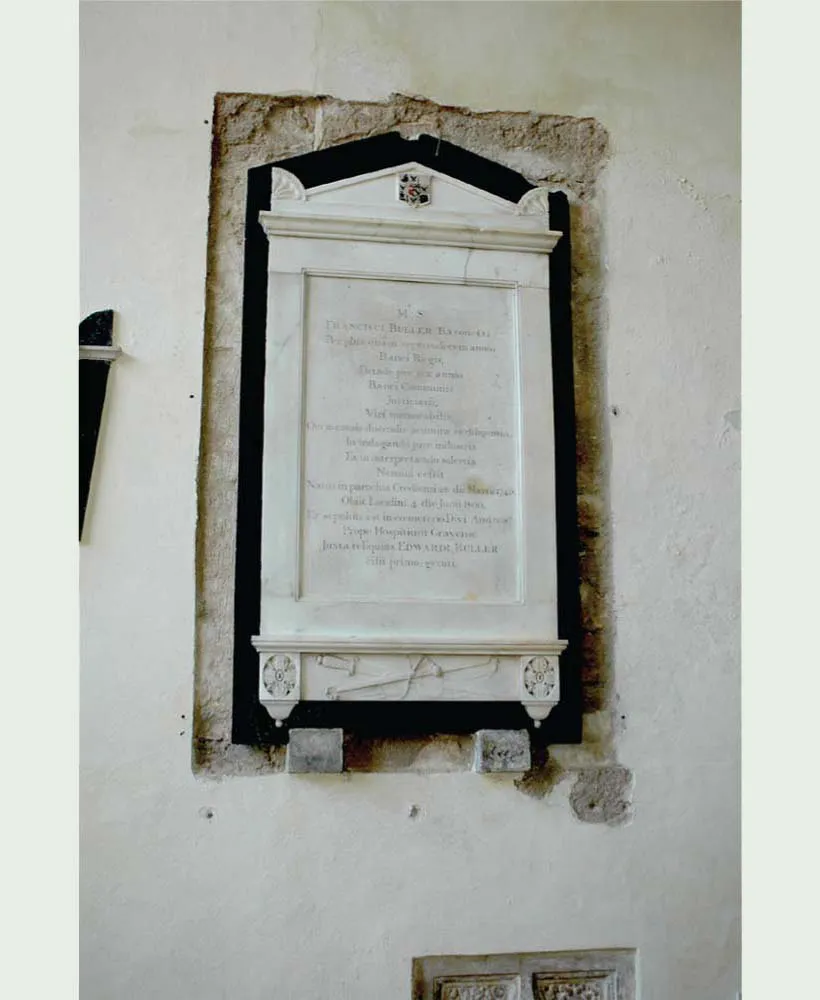
Wall monument, the ‘before’ picture showing the effect of decay from salts and rusting iron dowels. After the repair work, plaster was removed around and it was spaced out from the wall to prevent moisture travel contamination. Note that moisture travel is just that, while moisture movement is the result of disruption or expansion; try not to get them mixed up.
Ground Level
Start at the bottom and have a walk round. Ground water is a major problem so you will be looking to find a soil level lower than the floor level; if it is not, then moisture can creep into the masonry and travel upwards before it starts to exit. Is there pooling water at the base; does the terrain slope down to the building?
The area first affected is that up to a metre above ground level; evidence will be denuded pointing and decaying stone at the evaporation zone on the outside and damp decaying plaster inside. Often the previous attempts to solve this problem (which is only the symptom) will be hard (cementitious) pointing or impervious plasters on the inside; these ‘remedies’ have the unfortunate effect of pushing the moisture higher or into other areas, often leading to exacerbated decay of timber in the structure and collapse of internal floors or roofs.
Good drainage is the key here so figure out why the water is choosing to enter the building rather than drain away in the ground; often it is previous work that is at fault. Concrete aprons around churches are a typical example of attempted remedial work. Designed to form a wash or trough system to divert the water, they usually shrink or crack, allowing water in but preventing it from evaporating; and thus the crux of all work to historic buildings (and obviously modern ones as well) is highlighted: moisture will always get in – it is letting it out that is crucial, hence our promotion of porous repair.
Surface water drains should be cleared regularly.

Rising damp exhibits itself in the deeper colour of the limewash, while the excessive moisture is promoting the growth of algae at the foot of the wall.

The evaporation zone is the area of the wall where moisture rises through the fabric to a point where it cannot go any further under its own pressure and decides to get out. Here all the soluble salts trapped in the surface of the stone have gone through a series of wetting and drying cycles, promoting crystal growth that exerts pressure enough to break the bonds of the grains in the stone, thus leading to devastating erosion. Note that areas of decay in this manner tend to be worse in detailed parts of the building, such as jambs, mullions, quoins, etc., where the surface area of the feature is high when compared to that of ashlar. This allows faster evaporation that causes more moisture to travel to these regions, and so the problem grows.

A bitumen apron (or cement equivalent) has often been used to prevent water collecting at the foot of the wall. Unfortunately here it has shrunk away from the stone allowing water to run easily into and under it, where it will be trapped unless it rises through the masonry; thus the perceived cure has made the problem worse.

Here a tomb restoration was carried out under some ambiguous specification, with the slabs in the enclosure being relaid; it was only after rainfall that the lack of drainage became evident as a potential problem.
Off the Wall
The next area is the masonry itself. Well-designed stonework has detailing that effectively disperses or reduces the impact of water; this includes projections of cills with drips, string courses, hood moulds and sloping (weathered) surfaces, all designed to throw off or keep water from running into the fabric. Check the condition, looking for open joints, mortar breakdown, fractures or damaged/missing elements. Pointing can look moth-eaten but still be doing its job; if it is near the surface of the wall and cannot b...
Table of contents
- Cover
- Title Page
- Copyright
- Contents
- Introduction
- 1 Decay of Stone
- 2 Producing a Report and Selecting the Stone
- 3 The Workplace
- 4 Tool Skills
- 5 Limes and Mortars
- 6 Repointing
- 7 Dutchman Repairs
- 8 Mortar Repairs
- 9 Consolidation of Stone
- 10 Cleaning Stone
- 11 Casting
- Appendix 1: Putting in a Slab
- Appendix 2: Keeping it Together
- Glossary
- Index
Frequently asked questions
Yes, you can cancel anytime from the Subscription tab in your account settings on the Perlego website. Your subscription will stay active until the end of your current billing period. Learn how to cancel your subscription
No, books cannot be downloaded as external files, such as PDFs, for use outside of Perlego. However, you can download books within the Perlego app for offline reading on mobile or tablet. Learn how to download books offline
Perlego offers two plans: Essential and Complete
- Essential is ideal for learners and professionals who enjoy exploring a wide range of subjects. Access the Essential Library with 800,000+ trusted titles and best-sellers across business, personal growth, and the humanities. Includes unlimited reading time and Standard Read Aloud voice.
- Complete: Perfect for advanced learners and researchers needing full, unrestricted access. Unlock 1.5M+ books across hundreds of subjects, including academic and specialized titles. The Complete Plan also includes advanced features like Premium Read Aloud and Research Assistant.
We are an online textbook subscription service, where you can get access to an entire online library for less than the price of a single book per month. With over 1.5 million books across 990+ topics, we’ve got you covered! Learn about our mission
Look out for the read-aloud symbol on your next book to see if you can listen to it. The read-aloud tool reads text aloud for you, highlighting the text as it is being read. You can pause it, speed it up and slow it down. Learn more about Read Aloud
Yes! You can use the Perlego app on both iOS and Android devices to read anytime, anywhere — even offline. Perfect for commutes or when you’re on the go.
Please note we cannot support devices running on iOS 13 and Android 7 or earlier. Learn more about using the app
Please note we cannot support devices running on iOS 13 and Android 7 or earlier. Learn more about using the app
Yes, you can access Stone Restoration Handbook by Chris Daniels in PDF and/or ePUB format, as well as other popular books in Technik & Maschinenbau & Bau- & Architekturtechnik. We have over 1.5 million books available in our catalogue for you to explore.