- 360 pages
- English
- ePUB (mobile friendly)
- Available on iOS & Android
eBook - ePub
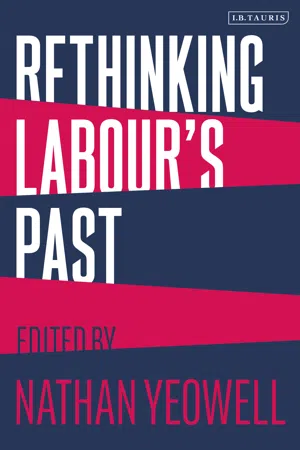
Rethinking Labour's Past
About this book
The Labour Party after Jeremy Corbyn is charting a new direction. Here, Nathan Yeowell has brought together a remarkable array of contributors to provide expert insight into twentieth-century British history and Labour politics – and how they might shape thinking about Labour's future.
Reframing the span of Labour history and its effects on contemporary British politics, the book provides fresh thinking and analysis of various traditions, themes and individuals. These include the shifting significance of 1945, the need for more grounded interpretations of Tony Blair's legacy, and the enduring importance of place, identity and aspiration to the evolution of the party. Contributions from leading historians such as Patrick Diamond, Steven Fielding, Ben Jackson, Glen O' Hara and Florence Sutcliffe-Braithwaite are supplemented by those with experience of Labour electoral politics, such as Rachel Reeves and Nick Thomas-Symonds.
The result is an intellectually rich and politically relevant roadmap for Labour's future.
Information
1
Introduction: Rethinking Labour’s past
The year 2020 represented a decisive, if not seismic, break in the history of the United Kingdom. This did not necessarily come as a shock. The collapse of Theresa May’s premiership and the election of Boris Johnson as Conservative leader in the summer of 2019 heralded six months of constitutional and civil turmoil, unprecedented in modern times, as Johnson broke and then recast the Conservative Party in his image and as his personal political vehicle to ‘get Brexit done’. He won a decisive victory in the December 2019 general election, securing for the Conservatives their largest parliamentary majority since 1987 and sounding the death knell of ‘Remainer’ hopes to prevent a hard Brexit by any legal, constitutional or extra-parliamentary means. The UK left the EU on 31 January 2020 – and this alone marked the year out as a turning point, for good or ill or merely as a moment of apparent closure after more than four and a half years of existential debate and division over the country’s relationship with the rest of Europe and its place in the wider world.
Within three months, Covid-19, the worst pandemic for over a century, spread rapidly across the UK, heralding the gravest political and economic crisis since the Second World War, and necessitating the greatest ever peacetime extension and mobilization of state power. From March 2020 to March 2021, the UK suffered one of the worst recessions of any developed economy as well as sustaining one of the highest Covid-related mortality rates: 126,284 deaths as of 23 March 2021 (the first anniversary of lockdown). The crisis shone a light on the widening inequalities that scarred the country and had been exacerbated by the Conservatives’ ideological commitment to economic austerity after 2010: in Labour leader Keir Starmer’s memorable phrase, Covid crept into ‘the cracks and crevices of … society and forced them open with tragic consequences’.1 As Renewal’s Florence Sutcliffe-Braithwaite and Emily Robinson observed: ‘the experience of the pandemic … [was] primarily structured by class, and its intersections with race and gender: by our ability to work from home, to avoid public transport, to access technology and good food, to draw on savings, to share the responsibility of caring, and by the spaces and conditions in which we live’.2 Perhaps most tellingly, it brought the interconnectedness of the UK’s fragmented society into sharp focus, illustrating how the consequences of inequality – the polarization of the labour market, the proliferation of insecure work and poor working conditions, soaring household debt, inadequate and overcrowded housing, fraying public services – impacted on everyone.
Taken together, the ‘twin traumas of managing two exits’ from the EU and Covid-19, combined with the continuing crisis of climate change, present ‘a dire moment in our national history’ and one that ‘demands an urgent plan for national recovery’.3 This has been a common refrain for commentators, academics and politicians alike. In an interview with The Observer in February 2021, former civil servant and social reformer Louise Casey called for ‘a new Beveridge Report … The nation has been torn apart, and there’s no point being defensive about that. We’ve got to gift each other some proper space to think. We’ve got to work out how not to leave the badly wounded behind.’4 Hot on her heels, the British Academy released Shaping the COVID Decade: addressing the long-term societal impacts of COVID-19, calling for reforms to tackle widening digital, geographical and social inequalities, for the resolution of long-simmering tensions between local and central government, and for the rejuvenation of community-led social infrastructure that had been cut away since 2010. The report found that ‘in many places there is a need to start afresh, with a more systemic view, and where we should freely consider whether we might organise life differently in the future’.5 As a rallying cry for British social democrats, Labour MP Stella Creasy and academic Karl Pike argued that the
list of failures, and devastating problems emerging or being made visible during the pandemic, is long. Many of them speak to decades-long problems of inequality, market failure, and a lack of political commitment or proficiency. The challenge for the left is to ensure the need to act on these problems is not lost after the crisis abates – but is part of a post-crisis politics that says this is why we should act now. That this is what’s important.6
As Starmer himself wrote on the first anniversary of his election as Labour leader, the UK ‘is at a fork in the road. We can attempt to patch up our broken system and hope it works next time. Or we can choose a brighter future, built on security and prosperity for all, one that harnesses everyone’s talents.’7
If, to quote US President Joe Biden, Covid-19 represents the beginning of a ‘progressive paradigm shift’ in UK politics, then much will depend on the Labour Party. In the last two great turning points in British political history, in the late 1970s and in the immediate wake of the 2008 financial crisis, Labour – and progressives more widely – were unable to prevent their political opponents from framing events in ways that contributed to major rightward shifts in British politics.8 In the face of Johnson’s pandemic populism, is the party capable of bucking this trend, galvanizing British society and successfully translating the extraordinary revival of community solidarity seen in 2020–1 into an attractive, national political project?9 Starmer, like Biden, acknowledged the gravity of this moment in his speech to the virtual Labour Connected event in September 2020, arguing that the ravages of Covid-19 meant ‘that even the challenges of 2019 already [seemed] like ancient history’.10 These challenges may well feel like ancient history when viewed through the prism of Covid-19 but that does not make them any less monumental. The year 2019 was truly terrible for the Labour Party, a landmark year for all the wrong reasons. Jeremy Corbyn led the party to its fourth, successive general election defeat in nine and a half years, losing sixty parliamentary seats in the process. The new parliament saw only 202 Labour MPs return to Westminster, the smallest cohort since 1935. Labour’s share of the vote fell by 7.8 per cent, from 40 per cent in 2017 to 32.2 per cent – a loss of over 2.6 million votes on a smaller turnout in two and a half years – with an average 4.7 per cent swing towards the Conservatives across Great Britain.11 The election accelerated change in historic demographic and geographical voting patterns. The Conservatives breached stretches of the so-called ‘red wall’ of Labour seats that snaked north-eastwards from north Wales, through the Midlands and on to Yorkshire, Teesside and County Durham, turning long-standing Labour strongholds into relatively safe Conservative seats. To quote directly, and in full, from polling expert David Cowling:
Based on the current composition of the House of Commons, the party needs to gain 123 seats at the next election simply to secure a majority of one. In order to secure a 40 seat [sic] majority, that might see a reforming government through a full term, they will need to gain 142 seats. Since 1900, there have been only three elections where Labour has gained more than 123 seats – 1929 (+126); 1945 (+199); and 1997 (+146).
The scale of the challenge that Starmer inherited in April 2020 is clear, with the possibility ‘that the disastrous finale of Mr Corbyn’s leadership has exiled his successor to the political wilderness for at least the best part of a decade’.12
The rejection of Corbyn at the ballot box also meant the rejection of Corbynism as Labour’s dominant political project (although at the time of writing his political legacy remains bitterly contested and he himself is suspended from the Parliamentary Labour Party).13 To its supporters, Corbynism was a moment of almost euphoric political transformation, ‘an attempt to convert a centrist Labour Party into a radical socialist movement’, a rejection of ‘the lies of the Iraq war, the MP expenses scandal, the corruption of cash for honours – and, most of all, the failure of either side of the political divide to articulate meaningful policies for the country post-crash’.14 Even to many sceptics, the period saw a necessary break with the intellectual timidity that had marked the party in the run-up to the painful 2015 election defeat, whilst the relative gains of the 2017 election challenged many dominant assumptions about British politics and revealed a deep frustration with the status quo. But to its critics, Corbynism brought the party to the brink of electoral, political and moral collapse. In the judgement of Labour MP Wes Streeting, it ‘saddled’ Labour
with a manifesto [in 2019] that people didn’t believe in, with an endless wishlist of promises that led to real questions about whether they were achievable, let alone desirable. It offered a worldview that people reviled, from the response of the poisoning of the Skripals in Salisbury to a back catalogue of public statements about terrorists that led voters to question whether the Labour Party would side with our country’s enemies over our friends. It presided over a culture that people feared, with the unchecked spread of a toxic, antisemitic, conspiracy theorist politics that saw Jewish MPs and members hounded out of the Labour Party.15
Starmer’s election in April 2020 gave the party a much-needed reprieve, an opportunity to repair the damage done to its reputation as a credible party of government. The success of Starmer’s leadership will depend much upon the readiness of Labour Party members to adapt to this task of reconstruction and get stuck into the hard work of rebuilding their relationship with the public. It will also depend upon their ability to accept that the ‘great crashes’ of 2019–21 – the rise of Johnson, the demise of Corbynism, Brexit, Covid-19 and its aftermath – represent as much of a natural breakpoint in the life and history of the Labour Party as they do in those of the country. Labour has an opportunity to move on from increasingly sterile arguments about the rights and wrongs of the Corbyn years (and before) and craft a new narrative capable of defining a new future for country and party alike – if it has the confidence to grasp it.
Historian David Edgerton believes that the ability to capitalize on this potentially critical juncture would be much improved if the party undertook a more honest reassessment of its past. Writing in anticipation of Starmer’s victory, he argued that:
British politics has an intimate relationship to history, not least Labour politics. But it’s often a version of history that never really happened. In order to generate fresh thinking about policy – something sadly lacking in the leadership debate – Labour has to free itself from the shackles of its own invented histories. An intelligent and respectful politics of the left needs a richer account of what Labour has proposed and what has actually taken place … Labour’s past is a resource, an important one, for the party. But too often the usually recalled history does not do justice to the variety of Labour’s policies, politics and practices, which were never fixed in time, nor easily understood on the usually defined left-right axis. To reinvent itself, as either a radical or a conservative force, it needs not only a better grip on the present but a much richer, more practical understanding of its past.16
The increased commodification of political history from the 1980s onwards has played a role in this subversion of historical reality. Emily Robinson believes that history has become ‘an ever-present point of reference in political discourse, providing a source of lessons, warnings and precedents’, appropriated by the dominant ‘present-focused view of the past as “heritage”, which can be embraced or rejected as politically expedient’.17 The exponential growth of social media has exacerbated this, with the explosion of highly partisan commentators, with narrow political perspectives but enormous Twitter followings in the tens or hundreds of thousands, increasingly dominating the discussion online and frequently in traditional media. We need to strip away some of the myths, distortions and stereotypes that have built up, and been perpetuated, around Labour’s history, and provide fresh perspective on the long-term effects and significance of Labour’s role as one of the two main parties of state. As Jon Cruddas writes, Labour has to ‘move beyond the ever-present trap of political binaries … excavate history [and] reclaim progressive traditions absent from the modern conversation. A return to history might also help the party own its recent victories and dissect successive defeats.’18 This collection is an attempt to do just that: excavate Labour’s history, whilst remaining conscious of the dangers of lapsing into nostalgia or treating historical exploration as a displacement activity from the urgent task of understanding the sociological and economic complexities of contemporary British society.
Crucial to this is a better understanding of the ideological continuum that has sustained the Labour Party since 1900. I think that there have been three distinct phases during this period, defined by specific ideological and organizational them...
Table of contents
- Cover
- Halftitle Page
- Title Page
- Contents
- List of contributors
- Acknowledgements
- Foreword
- Part 1
- Part 2
- Part 3
- Part 4
- Part 5
- Further Reading
- Index
- Imprint
Trusted by 375,005 students
Access to over 1.5 million titles for a fair monthly price.
Study more efficiently using our study tools.
Frequently asked questions
Yes, you can cancel anytime from the Subscription tab in your account settings on the Perlego website. Your subscription will stay active until the end of your current billing period. Learn how to cancel your subscription
No, books cannot be downloaded as external files, such as PDFs, for use outside of Perlego. However, you can download books within the Perlego app for offline reading on mobile or tablet. Learn how to download books offline
Perlego offers two plans: Essential and Complete
- Essential is ideal for learners and professionals who enjoy exploring a wide range of subjects. Access the Essential Library with 800,000+ trusted titles and best-sellers across business, personal growth, and the humanities. Includes unlimited reading time and Standard Read Aloud voice.
- Complete: Perfect for advanced learners and researchers needing full, unrestricted access. Unlock 1.5M+ books across hundreds of subjects, including academic and specialized titles. The Complete Plan also includes advanced features like Premium Read Aloud and Research Assistant.
We are an online textbook subscription service, where you can get access to an entire online library for less than the price of a single book per month. With over 1.5 million books across 990+ topics, we’ve got you covered! Learn about our mission
Look out for the read-aloud symbol on your next book to see if you can listen to it. The read-aloud tool reads text aloud for you, highlighting the text as it is being read. You can pause it, speed it up and slow it down. Learn more about Read Aloud
Yes! You can use the Perlego app on both iOS and Android devices to read anytime, anywhere — even offline. Perfect for commutes or when you’re on the go.
Please note we cannot support devices running on iOS 13 and Android 7 or earlier. Learn more about using the app
Please note we cannot support devices running on iOS 13 and Android 7 or earlier. Learn more about using the app
Yes, you can access Rethinking Labour's Past by Nathan Yeowell in PDF and/or ePUB format, as well as other popular books in Politics & International Relations & Political History & Theory. We have over 1.5 million books available in our catalogue for you to explore.