Is the EU a success or a failure?
Should It Stay or Should It Go? Britain and the EU
The Big Waste or Essential to Feed Europe? The Common Agricultural Policy
Observers of the European Union could be forgiven in thinking that since its inception the EU project has been under threat from near constant crises. In recent years, controversial issues such as EU enlargement, the fallout from the Eurozone crisis, migration policies, Brexit and the Corona pandemic have tested the EU to its limits and divided public opinion in the process.
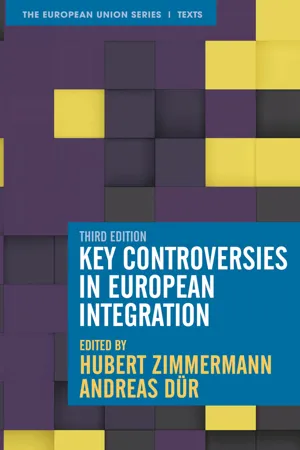
The major third edition of this comprehensive textbook on the EU seeks to introduce the integration project by looking at the thorny debates politicians, European citizens and the media contend with on a daily basis. Well known for its unique and pedagogically-innovative key debates format, the editors have invited top names in the field to contribute a stirring contribution either 'for' or 'against' each of the toughest political questions the EU faces. In doing so, not only does it offer a broad introduction to all the key concerns of the Union, but it does so in a way that is contemporary, engaging and designed to spark controversy.
New to this Edition:
- All chapters fully revised and updatedNew chapter on the transatlantic partnership
- All chapters now with key takeaway points
- Across all controversies, more inclusion of mainstream gender and feminist approaches
- 264 pages
- English
- ePUB (mobile friendly)
- Available on iOS & Android
eBook - ePub
Key Controversies in European Integration
About this book
Information
1 The European Union: Success or Failure?
Editors’ Introduction
Is the European Union a success or a failure? Responses to this question could not be more varied. For a long time, the EU was celebrated and presented as a model for the rest of the world. It has been credited with peace and prosperity in Europe. In the early 1950s when, with the creation of the European Coal and Steel Community (ECSC), the origins of the current union were laid, Europe had just emerged from World War II. Germany and France had fought three major wars in less than a century. And yet, only five years after the end of World War II, the two countries agreed to pool the production of coal and steel, and thus make future wars less likely. Moreover, the shattered economies of the countries participating in the ECSC, and later the European Economic Community (EEC), experienced high growth rates in the 1950s and 1960s, allowing Europeans to catch up in terms of economic strength with the United States. The EU also claims a long series of successful transitions of accession countries to democracy. Many of the newer member states did not have a long tradition of democracy when entering the EU. Nevertheless, their political systems have stabilized, with no country backsliding into outright dictatorship, as of yet.
But the EU’s record is not all rosy, at least according to EU sceptics. Among the many faults that have long been noted are their cumbersome decision-making, economic inefficiency and un-democratic, elite-driven political processes. Critics see the EU as driven by an unaccountable bureaucracy that lacks democratic oversight and pursues policies far- removed from the preferences of the citizens in member states. Rather than contributing to the wealth of member countries, EU policies are said to stifle growth and economic competitiveness. Others view the EU’s economic policies as being too ‘neoliberal’, undermining the welfare states of continental European countries. Both of these views have gained wide currency in the wake of the financial and sovereign debt crisis that hit Europe from 2008 onwards. Brexit campaigners successfully exploited these negative views. Some countries have experienced the emergence of large, right-wing eurosceptic parties.
In the first of two contributions on the overall pros and cons of the EU, John McCormick states that the EU is a success. He argues that it has contributed to peace in Europe, it has allowed its member states to gain power in international affairs, and it provides an institutional template that is being imitated around the world. Recent crises provide opportunities for more and better integration. Jan Zielonka accepts that even though many factors and actors contributed to peace and prosperity in Europe, and the EU often wrongly claimed credit for these achievements, the EC/EU has accomplished a lot in its more than six decades of existence. That said, according to him, the EU is performing poorly at present and it has lost the support of most of Europe’s citizens. The EU also seems unable to reform itself. In effect, it has become a hindrance to, rather than a facilitator of, integration.
Several of the points raised in this pair of texts will be treated in more detail in later chapters, notably in the debates on intergovernmentalism versus supranationalism in Chapter 2, the democratic deficit in Chapter 3, integration by law in Chapter 4, and the euro in Chapter 7.
1.1 Why Europe works
John McCormick
For those of us who study and write about the European Union, it has been difficult over the past few years not to feel like passengers on a ship sailing through storm- tossed waters, surrounded by seasick fellow passengers who are convinced that we are heading to our doom. Not too long ago, books were being published about the EU with such up-beat titles as Why Europe Will Run the 21st Century (Leonard, 2005). Then came the crisis in the euro zone, the Syrian refugee crisis and Britain’s decision to leave the EU, and the gloom set in; now it is more usual to find such pessimistic titles as The EU: An Obituary (Gillingham, 2018) and The Strange Death of Europe (Murray, 2018).
Of course, there will always be mixed opinions about all the great questions faced by humanity, and we will always experience cycles of optimism and pessimism. The doomsters might currently have the upper hand in conversations about the EU, but we should never forget how much the exercise of European integration has achieved over the long-term, or stop considering how much it still promises. It is also important to remember that, in a world of uncertainties, the track record of the EU offers critical certainties; its member states mainly sit atop almost every international ranking system, whether the focus is on democracy, human development, environmental management, gender equality, human rights or personal happiness. To be sure, these achievements can be credited in large part to the work of individual states or groups of citizens within these states, but there is much that can also be credited to the cooperative influence of the European Union.
To some extent, the EU has been a victim of circumstance. It has fallen foul of the dictum that bad news attracts more attention than good, its problems often having the kind of grim qualities that make for dramatic news headlines. Its successes, meanwhile, have tended to evolve over a longer period of time and attract less attention. The EU has also suffered the effects of a troubling knowledge deficit: many Europeans know little about how it works, making it difficult for them to objectively assess the claims of the critics. They often misunderstand the powers of the EU’s institutions, which are often dismissed as being elitist, opaque and technocratic, when in fact they can mainly do only as much as the treaties and the governments of the member states allow. Few euro-myths, for example, have more staying power than those surrounding the EU budget, routinely regarded both as enormous and a waste of taxpayer money, when in fact, it is no bigger and no more or less wasteful than the budget of a typical large national government department. In 2020, EU spending worked out at about five euros per person per week, barely the price of a good latte in a Brussels coffee shop.
Building the EU was never going to be easy. It was, after all, a marked departure from previous models of international cooperation, and it has since been built largely on the fly, often navigating unchartered territory and being blown off course by changing political tastes. Jean Monnet, one of its founders, long ago warned that ‘Europe would be built through crises, and…would be the sum of their solutions’ (Monnet, 1978: 417). He also noted, rather pessimistically – in what became known as Monnet’s Law – that ‘people only accept change when they are faced with necessity, and only recognize necessity when a crisis is upon them’ (Monnet, 1978:109). This has certainly often been true of the EU, but all systems of government and governance have their problems, because they are the construct of the human mind with its many flaws; that the EU should have had so many problems is a reflection less of defects inherent in the European project than of its sheer size and audacity.
If we think matters are forbidding in Europe, consider the case of the United States. We are often told that it is a beacon of democracy, one of the most open and productive marketplaces in the world, a paragon of technological inventiveness, the ultimate military power, a cultural superpower, owner of the most important currency in the world and a magnet for immigrants seeking to improve themselves. This is all true, and yet consider its problems: the U.S. national debt is spiralling out of control, its society is fractured along racial and ideological lines, the gap between rich and the poor is large and growing, its government is divided between two parties that have forgotten how to compromise, its political system is full of critical flaws (one of which has twice recently prevented the winner of the popular vote from becoming president) and much of its infrastructure is in urgent need of repair. In spite of these problems, few people would seriously suggest that what the United States has achieved is anything short of remarkable, or that Americans would be better off out of their union.
Returning to Europe, we find mixed public feelings reflected in the results of Eurobarometer polls. More people feel that things in the EU are headed more in the wrong direction than in the right one, but they feel the same way about the directions being taken by the countries in which they live. Meanwhile, strong majorities in almost every EU member state believe that their country stands to better face the future inside the EU, a majority feels that their voice counts in the EU and a large majority feels that the EU voice counts in the world. Those who have a positive view of the EU greatly outnumber those with a negative view; large majorities associate it with such positive traits as democratic, modern, forward-looking and protective. Meanwhile, although only about 42–44 per cent of Europeans trust the EU, this is about ten percentage points higher than the number who trust their own national governments (all results from Eurobarometer, 2019).
We should also note that while the EU has faced numerous crises, and has been counted out many times before, it has not only survived but has proved adept at learning from its mistakes and moving on. The British departure from the EU, known as Brexit, has been one of the most serious of these crises, and yet we should have seen it coming: many Britons have long been sceptical about membership of the EU, while also having a relatively poor record on understanding how it works and what it means. If there has been one positive effect of Brexit, it is that support for the EU has grown in many countries since 2016, and the controversy surrounding Brexit has apparently helped Europeans learn more about how the EU works. While those who admitted their failure to understand how the EU worked were once in a slight majority, those who claim to understand it now outnumber those who do not by almost two to one.
Having argued, then, that the character and powers of the EU are widely misunderstood, and that every experiment in political organization faces problems, what is there to defend in the story of the European project? A great deal, as it happens. The list of benefits is too long to outline in a few short pages, so this contribution focuses on just three: the roles of Europe as a peacemaker, as a global model and as an institutional model.
Europe as a peacemaker
To appreciate the greatest achievement of European integration, we must first remind ourselves of its core original purpose: the European Coal and Steel Community was founded to encourage peace between Germany and France as a first step towards broader post-war European cooperation. Looking back from our contemporary vantage point, it is hard to imagine the antagonism, doubt and foreignness with which Europeans regarded each other in 1945, the dark political and economic clouds that hovered over the region or the uncertainties about where Europe was headed. And yet so successful has been the reconciliation of its two major continental powers that the notion of European states ever going to war with one another again is unthinkable. So unthinkable, indeed, that we now take peace in Europe for granted; the region is living out Kant’s notion of perpetual peace, and while the credit cannot be laid entirely at the door of European integration, its role has been essential.
At the heart of the EU’s contributions lie the benefits of economic integration, particularly of the European single market. This is a project with which even the most hardened of eurosceptics can generally agree. It has always made sense that bringing down the barriers to the movement of people, money, goods and services will create new ties and opportunities, encourage competition and innovation, and discourage market-skewing quotas, tariffs, monopolies and price differentials. This is precisely what has happened, and on an entirely voluntary basis. The task is not yet complete, but even if the European project were to collapse tomorrow, economic integration has built so much momentum that it would be nearly impossible to stop. Even the British outside the EU will find themselves influenced by the magnetic forces of European integration.
To be sure, peace in Europe can also be ascribed to the security offered by the North Atlantic Treaty Organization (NATO) and the military guarantees offered for decades by the United States. The EU has not had a strong record in building a combined military capacity, a problem that has become more telling in the wake of recent threats posed by Putin’s Russia and the longer-term military aspirations of China. A peace built on military capacity, though, is arguably unsustainable, and it creates its own problems by posing a threat to other states, making them nervous and encouraging them to respond by expanding their own militaries. Far better, surely, to build a peace built on the kind of opportunities for cooperation and development offered by the economic and social model presented by European integration.
Integration has also encouraged peace through its role in promoting broader notions of citizenship and identity. We often hear the (overstated) charge that Europeans have found it difficult to identify with the EU, but thanks in large part to integration, they have become less foreign to one another and have come to realize how much they have in common. There is today a distinctive European view of politics, economics and society, which goes beyond support for democracy, human rights and free markets, and includes support for welfare liberalism, cosmopolitanism (association with universal ideas), the collective society, sustainable development, secularism and civilian and multilateral approaches to international relations (for more details see McCormick, 2010). If Europeans were to think of the EU less as a network of institutions and a body of laws, and more as a set of common values, they might better appreciate the changes wrought by the EU and better understand the peaceful meaning of identity with Europe.
Europe as a global leader
The second major achievement of the European project has been the manner in which it has allowed European states to reassert themselves in the world. This may seem a hollow claim given the EU’s many well-publicized problems with foreign and security policy, or its repeated crises of political leadership (or lack thereof), but if we look past the usual (mainly military) measures of power and consider longer-term trends, we find substantial achievements. The EU has collectively developed a set of alternative explanations for the causes of key international problems, it offers a constructive set of mainly civilian and soft prescriptions for the resolution of those problems, it represents the distinctive set of values listed above, it is the biggest source of – and magnet for – foreign direct investment in the world, it is by far the biggest provider of official development assistance, and while the euro has had problems, it is the first credible alternative to the U.S. dollar since the latter finally displaced the pound sterling in the 1950s. The EU has also provided leadership on a variety of more focused issues, such as climate change and human rights. In short, the EU exerts a positive global influence that cannot be ignored.
The importance of its global role has become particularly clear as the balance of power and interests in the international system have changed since the end of the Cold War. The political differences between the United States and Europe have become more apparent, first spilling most clearly into the open with the fallout over Iraq in 2003. We are often reminded that European governments were divided over the issue, with Britain, Spain, and Italy supporting the U.S.-led invasion while Germany and France were opposed, but much less is usually said about opinion polls that found 70-90 per cent opposition to the war right across Europe. Other polls taken at the same time revealed – not coinci...
Table of contents
- Cover
- Series-page
- Titlepage
- Copyright
- Table of Contents
- Abbreviations
- List of Figures and Tables
- Notes on Contributors
- Introduction: Key Controversies in European Integration
- 1 The European Union: Success or Failure?
- 2 More Powers for Brussels or Renationalization?
- 3 How Democratic Is the EU?
- 4 Too Much Power for the Judges?
- 5 Can There Be a Common European Identity?
- 6 Lobbying in the EU: How Much Power for Big Business?
- 7 The Future of the Euro: Union or Disintegration?
- 8 Can the EU Tame Big Finance?
- 9 The Big Waste? The Common Agricultural Policy
- 10 Does the EU Act as Normative Power?
- 11 Has EU Enlargement Gone Too Far?
- 12 Towards a Common European Army?
- 13 Britain’s Decision to Leave the EU: Good or Bad?
- 14 Promise and Peril of a New German Hegemony
- 15 What Future for the Transatlantic Partnership?
- Bibliography
- Index
Trusted by 375,005 students
Access to over 1.5 million titles for a fair monthly price.
Study more efficiently using our study tools.
Frequently asked questions
Yes, you can cancel anytime from the Subscription tab in your account settings on the Perlego website. Your subscription will stay active until the end of your current billing period. Learn how to cancel your subscription
No, books cannot be downloaded as external files, such as PDFs, for use outside of Perlego. However, you can download books within the Perlego app for offline reading on mobile or tablet. Learn how to download books offline
Perlego offers two plans: Essential and Complete
- Essential is ideal for learners and professionals who enjoy exploring a wide range of subjects. Access the Essential Library with 800,000+ trusted titles and best-sellers across business, personal growth, and the humanities. Includes unlimited reading time and Standard Read Aloud voice.
- Complete: Perfect for advanced learners and researchers needing full, unrestricted access. Unlock 1.5M+ books across hundreds of subjects, including academic and specialized titles. The Complete Plan also includes advanced features like Premium Read Aloud and Research Assistant.
We are an online textbook subscription service, where you can get access to an entire online library for less than the price of a single book per month. With over 1.5 million books across 990+ topics, we’ve got you covered! Learn about our mission
Look out for the read-aloud symbol on your next book to see if you can listen to it. The read-aloud tool reads text aloud for you, highlighting the text as it is being read. You can pause it, speed it up and slow it down. Learn more about Read Aloud
Yes! You can use the Perlego app on both iOS and Android devices to read anytime, anywhere — even offline. Perfect for commutes or when you’re on the go.
Please note we cannot support devices running on iOS 13 and Android 7 or earlier. Learn more about using the app
Please note we cannot support devices running on iOS 13 and Android 7 or earlier. Learn more about using the app
Yes, you can access Key Controversies in European Integration by Hubert Zimmermann,Andreas Dür in PDF and/or ePUB format, as well as other popular books in Politics & International Relations & European Politics. We have over 1.5 million books available in our catalogue for you to explore.