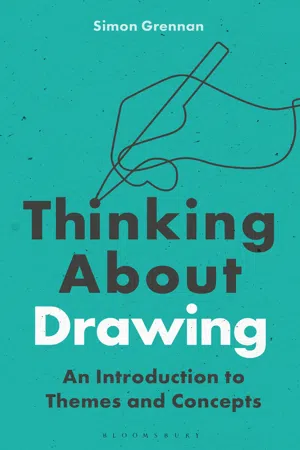
This accessible book explains the significance of relationships between the body and the mark, visual imitation, drawing and writing and visual storytelling, providing a simple guide to these key ideas. For millennia drawing has been conceived as an exploratory activity, mediating between the vision of the drafter and what they are drawing. Drawing reveals hidden relationships, directs attention, scrutinises the material world and provides plans for further action.
The book unpacks the key ideas that have shaped the rich, complex and foundational activity of drawing. It presents an unexpected, engaging and authoritative range of illustrated examples of drawings made by culturally and historically diverse people for different purposes, with different media, in widely different times and situations.
Educator, author and artist Simon Grennan builds together concepts to create a complete guide to ideas about drawing.
- 176 pages
- English
- ePUB (mobile friendly)
- Available on iOS & Android
eBook - ePub
About this book
Information
1
IMITATION
The idea that drawing can be described and assessed as a visual imitation of the visible world is one of the oldest ways of thinking about drawing. It derives from the philosopher Plato (429?–347 BCE), in the classical period of ancient Greece (Illustration 1.1). In a comparison of the visual and verbal arts, Plato claimed that the function of visual images is ‘mimesis’, that is, to imitate the visible world. This idea, of mimesis, appears to be simple, because it predates current distinctions that we might make between the different techniques and media used to make visual images, such as drawing and painting. If Plato’s idea is to be understood, these technical differences really need to be set aside. For Plato, current categories of drawing and painting were not meaningful, because they did not exist in the fourth century BCE.

ILLUSTRATION 1.1 The Tymbos Painter (attributed), Attic Red Figure (White Ground) Lekythos with Charon (detail), 500–450 BCE. Ashmolean Museum, Oxford, by Following Hadrian. Licensed under CC BY-SA 2.0.
What is most significant (and influential) about Plato’s idea of imitation is his conception of visual images as motionless. He thought that visual images cannot represent change and also thought that the processes by which these images are made are absolutely insignificant. According to him, there is no meaning to be found in the work of the drafter until the visual image reaches the point of imitating the visible world.
Plato contrasted this idea with a definition of poetry, in which the activity of verbally telling a story is paramount rather than the idea of achieving an imitation that aims to become a visual illusion. For Plato, poetry was an art that could represent change because it involved description and action, whereas drawings could not as they always remain still. The residue of this idea survives, against the odds. As recently as 2001, art historian Eileen Adams (b.1962) was able to claim that the value of drawing activities reside in their scrutiny and imitation of the visible world, as well as their interpretation and notation.
However, despite the considerable influence of this residual idea, we can immediately see difficulties with the idea of visual imitation. In fact, these difficulties arise from the technology used to make visual images. Plato is silent about the degree to which an image should imitate the visible world. He does not consider the point at which an image achieves imitation. A perfect visual imitation is an illusion, rationally speaking, in which the viewer is not aware of the technology used in the production of the image but rather perceives the representation as the object that it represents, as a view of the real thing. Experiences of true visual illusions are the stock-in-trade of entertainers such as stage magicians (Illustration 1.2). The type of situation in which a viewer actually takes an image for the object it represents is so unusual that it points to the fact that either literal imitation was not what Plato meant or Plato had misconceived the function of visual images.

ILLUSTRATION 1.2 Bertrand ‘Pepper’s Ghost’, Le Monde Illustré, engraving, 1862.
These considerably influential, residual ideas have not escaped subsequent commentators, but the overriding idea of the stillness of visual images remained largely unexamined. This was until the advent of lens-based visual media in the nineteenth century (such as photography) and the growth of ideas about storytelling in the twentieth and twenty-first centuries.
The role of different techniques in producing visual imitations is a long-standing topic, of which Platonic conceptions of the different status of drawing, painting and plan making are the outdated survivors. How does the material used to produce a mimetic image influence the way in which the image is understood? Is there more or less emotional potential in paint, ink, pencil or pixel, or in scratching, rubbing, splashing or computer programming?
The threshold of visualization and the problem of media
The contradiction between visible imitation and the means by which the image is drawn is exemplified best in drawings that self-consciously seek to test this contradiction. What are the limits beyond which the imagined scenes shown in depictions begin to fragment, simply becoming views of the materials used to make them? This is a boundary of imagination across which the viewer spontaneously travels when they see a depiction. This might be difficult to understand. When the viewer looks at drawn marks on a surface, the mind of the viewer imagines that the viewer is experiencing their own experience of seeing the drawn scene. They imagine that they are experiencing themselves seeing a scene, when they look at drawn marks on a surface.
Viewers themselves establish this boundary between material and scene, and it is different for every viewer. Either they visualize a depicted scene at the same time as they see the marked surface, they experience indeterminacy (as they struggle to visualize the scene) or they only see the marked surface and cannot visualize the scene.
The art of producing this moment has a long history, associated with a very wide range of ideas. On the one hand, the fifteenth-century Chinese drawing traditions of ‘haboku’ (broken ink) and ‘hatsuboku’ (splashed ink) aimed to produce this visual indeterminacy, so as to promote and represent a Chan Buddhist religious idea of the similarity of spiritual transcendence and experiences of daily life. The moment of indeterminacy can be prolonged indefinitely (Illustration 1.3).

ILLUSTRATION 1.3 Sesshu Toyo, Haboku-Sansui, ink on paper, 1495.
On the other hand, Alexander Cozens’s (1717–1786) manual of drawing A New Method of Assisting the Invention in Drawing Original Compositions of Landscape (1786), laid out a method of blotting paper with ink so as to produce shapes that prompted students to imagine scenes. Cozens had been using this method since the 1750s to teach drawing students how to liberate their visual imaginations, by struggling to make visual imitations of scenes from random marks on a page (Illustration 1.4).

ILLUSTRATION 1.4 Alexander Cozens, A New Method of Assisting the Invention in Drawing Original Compositions of Landscape, ink on paper, 1786.
Of particular historic significance, for thinking about the relationship between the drawn mark and visual imitation, was a sixteenth-century Italian public relations campaign, which was undertaken to promote the value of the work of the painter Titian (Tiziano Vicelli, 1490–1576) by his friend the poet Pietro Aretino (1492–1556). Aretino launched the idea that there is a distinction between line and colour, bundled with the idea that the use of colour allows visual imitations of things that the use of drawn lines does not. The idea arose in discussions making ‘paragone’ or ‘comparisons’ between the different depictive potential of drawings and paintings. On the one hand, the Italian word ‘colore’ meant the depiction of the ‘air’, or the light and atmosphere of a scene, while ‘colorito’ meant the technical methods for producing a depiction of this light and atmosphere. ‘Colorito’ techniques were defined by blending lighter and darker tones and blending different colours. On the other hand, the Italian word ‘disegno’ meant the identification of divisions and contours, or drawn lines, as a method for depicting silhouettes, encompassed volumes and the boundaries between one object and another.
This Venetian discussion of ‘colore’ and ‘disegno’ was not intended to create a new distinction between media. It was intended to promote Titian’s technique of blending colours. Titian blended colours in order to represent the ‘air’ or the atmosphere in which his scenes appeared, rather than outlining the objects and characters of which they were comprised.
Historically, however, Aretino achieved just such a distinction between different media. At the same time, he established visual depiction as a distinct category of visual experience, defined by both seeing the materials that produce the representation whilst also visualizing the represented scene. Ideally, before Aretino, those materials that made a visual imitation were invisible. In drawing traditions in the West, he established that both materials and representation were important parts of the visual image. Aretino recognized that the material used to make the image and the artist’s technique of using those materials, were not ideally invisible or insignificant, as Plato proposed. Rather, the way in which the image is made and the scene that the image represents mutually affect each other.
Depiction and visualization
In the twentieth century, the experience of seeing both the materials and the represented object at the same time has become known as visual depiction. Although we might use the word to describe a range of types of visual representation, it now also has a specific meaning. Depiction is a unique type of visual representation, described most memorably by philosopher Richard Wollheim (1923–2003) as ‘seeing-in’. It always involves seeing the materials that the depiction is made out of, whilst also visualizing the scene that the depiction shows.
Visualization, that is, visual imagining, is a type of mental representation. You don’t have to see something to imagine that you are seein...
Table of contents
- Cover
- Halftitle Page
- Title Page
- Dedication Page
- Contents
- List of illustrations
- Introduction: What is Drawing?
- 1 Imitation
- 2 Mark
- 3 Trace
- 4 Story
- 5 Drawing today
- Selective Glossary
- Bibliography
- Further Reading
- Index
- Imprint
Trusted by 375,005 students
Access to over 1.5 million titles for a fair monthly price.
Study more efficiently using our study tools.
Frequently asked questions
Yes, you can cancel anytime from the Subscription tab in your account settings on the Perlego website. Your subscription will stay active until the end of your current billing period. Learn how to cancel your subscription
No, books cannot be downloaded as external files, such as PDFs, for use outside of Perlego. However, you can download books within the Perlego app for offline reading on mobile or tablet. Learn how to download books offline
Perlego offers two plans: Essential and Complete
- Essential is ideal for learners and professionals who enjoy exploring a wide range of subjects. Access the Essential Library with 800,000+ trusted titles and best-sellers across business, personal growth, and the humanities. Includes unlimited reading time and Standard Read Aloud voice.
- Complete: Perfect for advanced learners and researchers needing full, unrestricted access. Unlock 1.5M+ books across hundreds of subjects, including academic and specialized titles. The Complete Plan also includes advanced features like Premium Read Aloud and Research Assistant.
We are an online textbook subscription service, where you can get access to an entire online library for less than the price of a single book per month. With over 1.5 million books across 990+ topics, we’ve got you covered! Learn about our mission
Look out for the read-aloud symbol on your next book to see if you can listen to it. The read-aloud tool reads text aloud for you, highlighting the text as it is being read. You can pause it, speed it up and slow it down. Learn more about Read Aloud
Yes! You can use the Perlego app on both iOS and Android devices to read anytime, anywhere — even offline. Perfect for commutes or when you’re on the go.
Please note we cannot support devices running on iOS 13 and Android 7 or earlier. Learn more about using the app
Please note we cannot support devices running on iOS 13 and Android 7 or earlier. Learn more about using the app
Yes, you can access Thinking About Drawing by Simon Grennan in PDF and/or ePUB format, as well as other popular books in Art & Art Techniques. We have over 1.5 million books available in our catalogue for you to explore.