- 192 pages
- English
- ePUB (mobile friendly)
- Available on iOS & Android
eBook - ePub
About this book
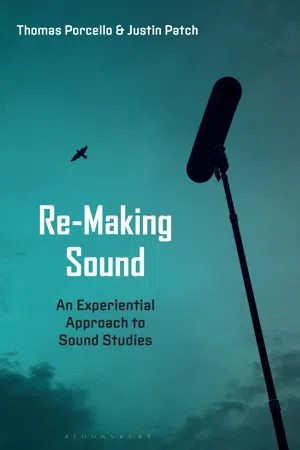
Re-Making Sound is concise and flexible primer to sound studies. It takes students through six ways of conceptualizing sound and its links to other social phenomena: soundscapes; noise; sound and semiotics of the voice; sound and/through/in text; background sound/sound design; and sound art. Each chapter summarizes the history and scholarly theoretical underpinnings of these areas and concludes with a student activity that concretizes the historical and theoretical discussion via sound-making projects. With chapters designed to be flexible and non-sequential, the text fits within various course designs, and includes an introduction to key concepts in sound and sound studies, a cumulative concluding chapter with sound accompanying podcast exercise, and an extensive bibliography for students to pursue sound studies beyond the book itself.
Information
1 Soundscape: Sound, Space, and Listening
Key concepts: acoustemology, consumer culture, malls, mediation, Muzak, the senses
Orientation: Three Soundscapes
I. The opening chapter of Theodore Dreiser’s 1925 novel, An American Tragedy, recounts the effort of a small family to proclaim the (very Christian) word of God on a downtown street corner of a large, though anonymous, midwestern American city in the early twentieth century.1 Dreiser’s evocative prose hints at the density of the city’s sounds: multitudes of people stream noisily along the sidewalk; cars incessantly clang their bells (the precursor to the steering wheel push-horn); hawkers shout loudly to peddle their wares (food, tabloids, trinkets); all amid towering buildings that create canyon-like, echoing spaces. A sonic wall closes in and down, overwhelms and blurs individual sounds into an undifferentiated stew of noise. Against this densely layered sonic landscape—in other words, against the city’s soundscape—the small, humble family breaks out a portable pump organ to sing psalms with and to preach from the Bible, struggling both to be heard against the din of the city and to be listened to amid its smorgasbord of secular life—even though their preaching and singing add (even if barely) to that very noise. The chapter weaves together multiple auditory sources—voices, language, music, instruments, machines—and embeds them in the historical, social, and built environments in which they are being sounded and listened to. The reader is immersed in a sensuous encounter with the aural environment of the time and place in which the story is set. The remainder of the novel does not linger on sound and the contestation between individuals and the larger physical and social worlds in which they live, but the opening starkly highlights how public spaces can be ill-suited to the social and communicative activities that people may be trying to create and participate in.2 It also highlights that the concepts of “soundscape” and “noise” (Chapter 2) are deeply intertwined.
II. Roughly sixty years later and approximately 8,500 miles away, American ethnomusicologist Steven Feld is making field recordings in a pocket of the highland rainforest of Papua New Guinea that is home to roughly 1,200 indigenous people. This is not Feld’s first time in the area that is home to the Bosavi people. His doctoral research fifteen or so years earlier had focused on examining the complex relationships among the Kaluli language (spoken by a subset of the Bosavi people), on Kaluli speakers’ expressive use of speech and song, their cosmological and spiritual belief systems, and how each of these is intimately linked to the auditory dimensions of their rainforest surroundings. In his fascinating book Sound and Sentiment: Birds, Weeping, Poetics, and Song in Kaluli Expression, Feld details not only how language describes and interprets the sonic world of the rainforest but also how it reflects it: how the sounds of the rainforest appear as elements deeply woven into the Kaluli language itself, how several types of Kaluli singing incorporate acoustic properties characteristic of birdsong and moving water, and how the sheer density of overlapping sounds in the rainforest becomes an aesthetic and stylistic element of Kaluli expression.3
Feld writes in the liner notes to Voices of the Rainforest, the recording that resulted from this later trip, “Kaluli people think of themselves as ‘voices in the forest.’ They sing with birds, insects, water. And when Kaluli sing with them, they sing like them. Nature is music to Kaluli ears. And Kaluli music is naturally part of the surrounding soundscape.”4 Ultimately, the goal of Feld’s recording project is to translate the book, which is constrained by the medium of writing in its presentation of how language and song and sounds of the natural world are woven together by the Bosavi people, into a recording that can more directly capture and convey it in sound. The Papua New Guinea Highlands are a far cry from Dreiser’s urban soundscape, but they are no less sonically complex. Making this complex sonic environment directly experienceable in sound is the ultimate aim of Feld’s field recording project.
What Voices of the Rainforest as a sonic document, and what Feld’s subsequent writings and interviews about it, demonstrates is a remarkably layered sonic environment that, unlike the “wall” metaphor that describes Dreiser’s city, is a much more markedly three-dimensional space of sound. Animals such as wild pigs move along the forest floor, their footsteps and grunting locatable in, and contained to, lower-level vertical space. Birds are less constrained vertically of course, as they may descend to the forest floor or be perched in trees. One can, in theory, track their movements by listening to wing flaps or the positionality of their singing. As different bird species gather to rest or breed at different heights among the trees, understanding differences between birds’ songs, and being able to discern the height from which those songs are coming, can help with species identification. In the rainforest, sounds of water are also ubiquitous. Once again, one can imagine differences in vertical space, in which raindrops may only be heard overhead (when, for instance, the rain is lighter and the canopy denser, and most of the rain sound results from water dripping from higher onto lower leaves). This will, of course, contrast with water flowing in streams, or moving across rocks in the rapids, or plunging over a waterfall; flowing water is comparatively anchored to the ground, like the wild pigs. The sonic verticality of the rainforest also suggests how important the ability to decode distance and depth purely through sound could be to forest residents. Except where paths have been created by people or animal trails, or where deliberate clearing of vegetation has happened, rainforests are visually dense, making the ability to see long distances forward (or even up) difficult. One’s eyes may be entirely unhelpful in trying to determine how far away an animal that one is hunting or a person who poses a threat is.
Dreiser’s description of the urban soundscape essentially presents sounds as “facts” that can be objectively described and whose implications and meanings to the people who hear them are straightforward. Feld paints a more nuanced picture over the corpus of his scholarly work focusing on the Kaluli. There are of course, he argues, “factual” elements of any soundscape: some places have braying donkeys, or church bells that ring at noon, or train horns that blow throughout the night, or shared walls where domestic violence doesn’t stay private. Other places don’t have these sounds. Privileged spaces can be built to isolate one from intrusive or distressing sounds; those without privilege are less able to do so. Part of what Feld asks us to recognize is that what one hears is deeply rooted in social class and economic standing. But by extension, his work considers the extent to which the mere concept of the soundscape can remain located only in sound or whether it must be considered a relational concept that emerges between sounds and those who hear them. Further, since anyone who hears a sound has come to understand the world through the cultural ears of their upbringing, to what extent is any soundscape actually constituted, experienced, or understandable outside of a broader consideration of culture?
III. The soundscape as a concept or an analytic object is not limited to the outdoors. One can consider, for example, spaces that present sonic challenges, while one tries to function in them: challenges ranging from the inhibition of easy communication (a blaring public address announcement at an airport boarding gate that drowns out one’s ability to talk on the phone) to impeding the ability to concentrate on a project (a loud college or public library) to making uninterrupted sleep impossible (garbage trucks thundering by or squealing their brakes outside the bedroom window at 3:00 a.m.). Conversely, one can think about indoor spaces whose soundscapes are in fact well designed for their intended use (though conscious attention to sound design and the willingness to invest properly in it are harder to come by, which makes for a shorter list of examples): control and mixing rooms in professional sound recording studios, where tens of thousands of dollars are often invested in the room’s sonic properties; to high-end automobile interiors; to built spaces ranging from funeral homes (designed to be quiet), to auditoriums and theaters.
The college that the authors of this book work at remodeled its central dining hall in 2017 as part of hiring a new food provider. Before the renovation, the hall had a centralized kitchen with two large dining rooms that opened off it, each with dozens of rectangular tables that sat six to eight people. The floor of the dining area was carpeted, and the tables sat underneath a dropped ceiling lined with acoustic tile. Given that each dining room could seat several hundred students at any given time, they were never exactly quiet spaces at peak dining hours, but students (and faculty who met them there) indicated that if you had a table of your own, conversation was easily intelligible. During the 2017 renovation, the space was converted to reflect a more typically “industrial” look: carpeted floors were replaced by polished concrete, the acoustic tile was removed to display the air duct circulation system, and the space was opened up such that the dining rooms were less compartmentalized from the food preparation areas. The rectangular dining tables were replaced by modular, irregularly shaped wooden tables. Previously upholstered chairs were dispensed with in favor of wooden blocks with metal legs. This look mimics larger trends in the restaurant industry since the mid-2000-aughts, and in many ways, the college’s students reacted positively to the look and feel of the space, which now more closely evoked a contemporary gastropub.
But while the remodeled dining hall may have been visually more contemporary and in line with students’ aesthetic tastes, complaints soon emerged about how much harder it was to study in it. It had previously been a hub of collaborative student work, but now it was too loud and often too difficult to talk and to be clearly heard in. The college’s language departments had long held “study tables” one or more nights a week there, and some reported that, due to the changed acoustics of the redesigned space, they were relocating these events to the building that housed their department offices and lounges. Students anecdotally indicated that they were less likely to linger there of their own accord. All of this was in spite of the fact that their satisfaction with the food service had actually increased since the remodel and the arrival of the new vendor. While it may be reductive to lay all the blame for students’ hesitancy to hang out on the acoustics of the new space, there is ample anecdotal evidence that converting areas that were acoustically conducive to group study into ones that made it harder to communicate changed how students utilized the dining center as part of their academic lives.
Dreiser asks us to contemplate how soundscapes overtake our lives and constrain our capacity to share our messages; Feld refines how to think about the soundscape and forces us to ask how much of it is “in” sound as opposed to being in how we encounter sound as socially constituted beings; the college’s dining hall then requires that we add the use of spaces, and how those uses do or do not line up with their sonic properties, into what the term “soundscape” ultimately means.
Defining “Soundscape”
Sound studies scholars typically locate the sustained systematic usage of the term “soundscape” in the work of Canadian composer R. Murray Schafer who, in 1977, published a book called The Tuning of the World, re-released in 1994 with the title, The Soundscape: Our Sonic Environment and the Tuning of the World. Schafer employed the term “soundscape” to refer to the total “sonic environment,” by which he meant not only physical environments but also “abstract constructions such as musical compositions and tape montages.”5 Despite this broad definition, Schafer focused primarily on issues related to noise pollution: its increase over time, how one might visually map its presence and intensity in a given location, and how one might initiate large-scale social, material, and behavioral processes of noise abatement. His thesis was both historical (that humans have progressively made the world a louder and more noise-polluted place) and prescriptivist (that the problem is dire enough that change needs to occur). “Noise pollution is now a world problem,” he wrote. “It would seem that the world soundscape has reached an apex of vulgarity in our time, and many experts have predicted universal deafness as the ultimate consequence unless the problem can be brought strictly under control.”6 Throughout, his writing hews closely to language used in the environmental movements of the United States, Canada, and much of Europe in the 1960s and 1970s; Schafer writes repeatedly of “noise pollution,” “overpopulation,” and “abatement” (and even coins the uniquely memorable phrase, “the big sound sewer of the sky,” when discussing aircraft noise).
Schafer’s thesis is heavily chronological and unidirectional, offering a narrative in which human beings, their activities, and their inventions have progressively altered—and loudened—a supposedly more “natural” pr...
Table of contents
- Cover
- Half-title Page
- Title Page
- Contents
- List of Figures
- Preface
- Acknowledgments
- Introduction
- 1 Soundscape: Sound, Space, and Listening
- 2 Noise: From the Everyday to the Exceptional
- 3 Voice: Hearing and Ascribing Individual and Social Identity
- 4 Sound on the Page: Echoes and Resonances in Writing
- 5 Sound Design/Designing Sounds: Intentionally Crafted Sonic Worlds
- 6 Sound Art: What Is Sound Art? Debates and Examples
- Concluding Project: Putting the Pieces Together through Audio Narratives
- Author Biographies
- Index
- Copyright Page
Trusted by 375,005 students
Access to over 1.5 million titles for a fair monthly price.
Study more efficiently using our study tools.
Frequently asked questions
Yes, you can cancel anytime from the Subscription tab in your account settings on the Perlego website. Your subscription will stay active until the end of your current billing period. Learn how to cancel your subscription
No, books cannot be downloaded as external files, such as PDFs, for use outside of Perlego. However, you can download books within the Perlego app for offline reading on mobile or tablet. Learn how to download books offline
Perlego offers two plans: Essential and Complete
- Essential is ideal for learners and professionals who enjoy exploring a wide range of subjects. Access the Essential Library with 800,000+ trusted titles and best-sellers across business, personal growth, and the humanities. Includes unlimited reading time and Standard Read Aloud voice.
- Complete: Perfect for advanced learners and researchers needing full, unrestricted access. Unlock 1.5M+ books across hundreds of subjects, including academic and specialized titles. The Complete Plan also includes advanced features like Premium Read Aloud and Research Assistant.
We are an online textbook subscription service, where you can get access to an entire online library for less than the price of a single book per month. With over 1.5 million books across 990+ topics, we’ve got you covered! Learn about our mission
Look out for the read-aloud symbol on your next book to see if you can listen to it. The read-aloud tool reads text aloud for you, highlighting the text as it is being read. You can pause it, speed it up and slow it down. Learn more about Read Aloud
Yes! You can use the Perlego app on both iOS and Android devices to read anytime, anywhere — even offline. Perfect for commutes or when you’re on the go.
Please note we cannot support devices running on iOS 13 and Android 7 or earlier. Learn more about using the app
Please note we cannot support devices running on iOS 13 and Android 7 or earlier. Learn more about using the app
Yes, you can access Re-Making Sound by Justin Patch,Thomas Porcello in PDF and/or ePUB format, as well as other popular books in Media & Performing Arts & Music. We have over 1.5 million books available in our catalogue for you to explore.