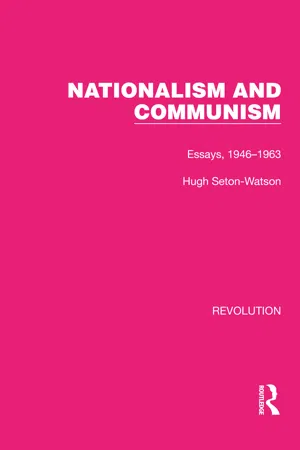
This book, first published in 1964, collects a number of essays united by the general theme of national and social revolution. They examine features of revolutionary movements, and, particularly, revolutionary leadership in an analysis of the social conditions and personal motives which impel men towards forming revolutionary elites.
- 262 pages
- English
- ePUB (mobile friendly)
- Available on iOS & Android
eBook - ePub
About this book
Information
One: Twentieth-century History
Nationalism and Multi-national Empires
There have been many great empires in human history, and the subjects of many of these have included people of different religion, language and social customs. But the expression ‘multinational empire’ can only be used of the period since the birth of the modern concept of secular nationalism. Nationalism, as we understand it, hardly existed before the French Revolution.
Nationalism and Legitimacy
In the traditional empires of the past, subjects were expected loyally to obey and serve their ruler, whose position was believed to be sanctioned by divine law. The monarch was the ruler appointed by God, and responsible only to God. He in turn accepted the devotion of his subjects, and had the duty to protect them. This did not, however, imply equality among his subjects. Not only were there social privileges and hierarchies, rich and poor, but whole categories of persons might be regarded as second-class subjects. This was notably the case in Christian and Moslem empires. Here the division was one of religion. In the Mogul Empire in India, the Hindu majority were second-class citizens, enjoying fewer rights than Moslems. So were the Jews in medieval Christian states in Western Europe, the Christians in the Balkan provinces of the Ottoman Empire and the Moslem Tatars in the Russian Empire of the seventeenth and eighteenth centuries. This does not necessarily mean that they were persecuted for their religious beliefs, though this did happen from time to time in all these cases. It was also possible for individuals to change their religion. If they were converted to the dominant religion, they enjoyed its rights.
The principle of nationalism emerged gradually in Western Europe, and was theoretically formulated in revolutionary France. Nationalism is essentially secular and essentially democratic. It gradually replaces (though it does not necessarily completely eliminate) loyalty to the religious community and loyalty to the ruler by loyalty to the nation. It is of course true that, under most earlier forms of government, both monarchical and republican, devotion to the fatherland (patria, patrié) was recognized, and encouraged, but even if this included love of a city or a piece of land, a heritage of literature and art, or loyalty to a way of life, the essential focus of patriotism was still the ruler and the faith.1 It is true also that the word ‘nation’, in its Latin form and French and Italian derivatives, can be found in medieval Europe. The University of Prague, founded in 1348, had German, Czech and Polish nationes, and in Dante’s Italy the expressions nazione fiorentina or nazione milanese were used. But the idea that the ‘nation’ is the focus of loyalty for the citizens of a State was not yet born. The conception of loyalty to the nation, as it arose in eighteenth-century France, rejected the divine sanction of government, and implied that the collective personality of the nation is more important than the individual person of the monarch. Most nationalists in the nineteenth century continued to practise their religions - Christian or Moslem or other. Many, perhaps even most, nationalists were not opponents of the institution of monarchy. Fundamentally, however, the idea of nationality contains within itself that of the sovereignty of the people. Thus, the rulers of 1815 (Metternich, Alexander I of Russia and others) were right to feel that nationalism was a subversive idea, a threat to the power both of churches and of dynasties.
Nationalism, as a political movement, dates from the Revolution of 1789. Thenceforth, it was increasingly claimed that the interests of whole nations (interpreted of course by those who claimed to represent their will) should have first priority in political life, both domestic and international. Nationalism, in fact, provides a new principle of legitimacy for government, an alternative to the traditional legitimacy of monarch and religion.
However, the problem then arose, how was one to define the nation. Nationalisms have become an effective force only where there has been national consciousness among at least an important section of the people concerned. The growth of national consciousness always precedes the birth of nationalism. Historically this growth has had different origins in different countries.
The Growth of National Consciousness
In the oldest nations, national consciousness was the product of the State and the monarchy. England and France are the obvious examples. The English monarchy arose from the union of a number of Saxon kingdoms, and was later strengthened by the Norman conquest. The French monarchy resulted from the extension of the power of the Capetian kings from their original small territorial base in the Ile de France. In both cases the monarch had to struggle against powerful regional forces as well as independent-minded social élites. In both cases the subjects of the monarch included people of several languages. In England there were Cornishmen, Saxons and Frenchmen, not to mention the Welsh, who remain nationally different to this day. The Franco-Saxon synthesis created the English language itself. In France there were Bretons, Normans, Proven-çaux, Burgundians, Flemings, Germans, Basques, and Catalans in addition to the Frenchmen who were themselves a product of a Gallo-Roman synthesis. A third case is Scotland. Saxons, Celts and Norwegians each had a share in the creation of the Scottish nation, and traces of these different origins can still be found. In Spain the monarchy created the nation from people of Roman, Visigothic, Arab, Basque and still older origins. To this day Catalans, Castilians, Andalusians, and Basques remain different, yet Spanish nationality has been one of the great facts of human history, and is still a reality. The growth of the Russian nation has points of similarity with that of the French and Spanish. After the Tatar conquest of the thirteenth century, the region around Moscow played the same role, as a nucleus of the Russian State, as the Ile de France had played for the French. The expansion of Muscovy, like that of Castile, had also a religious character: it was a crusade against the Moslems (Arabs in Spain, Tatars in the Volga valley and southern steppes).
National consciousness can also be created by foreign conquest. The obvious examples are the nations of America. The Spanish, Portuguese, English, and French immigrants brought their own traditions with them, but developed a national consciousness separate from that of their homelands. The Brazilian and the Hispano-American nations were also created by intermarriage with indigenous peoples (in the Brazilian case to some extent also with imported negro slaves), whereas the English and French exterminated most of the indigenous people, and the English refused intermarriage with their negro slaves. Whether the North American French are a nation is a matter of argument in the Province of Quebec. To a Scot it seems clear that they are, even if, like the Scots, they do not possess a State of their own. In Africa European governments created states by arbitrarily drawing lines on the map in agreement with other European governments. In this way such huge states as Nigeria, Congo, and Sudan came into existence. Within these artificial frameworks a sense of nationality certainly grew among a limited number of educated Africans: how wide and deep the belief in the existence of a Nigerian, Congolese, and Sudanese nation has spread, still remains to be seen.
National consciousness can also be preserved by the memory of a State. Poland is the obvious case. Throughout 150 years of partition, the Polish educated classes (nobility, priests, and secular intelectuals) kept alive the tradition of Polish patriotism. The same is true of Hungary from 1526 to 1867: the period of foreign rule was longer, but the foreign rulers made less determined efforts to destroy the patriotism than in the case of the Poles. In other cases one may say that memories which have virtually died out have been artificially revived: the Czechs and Bulgarians fall into this group. India is a special case. Here the sense of religious and cultural unity was continuous under many different foreign rulers, but the belief in an Indian statehood was artificially developed in the nineteenth century, and based on romantic and questionable interpretations of the history of the sub-continent.
National consciousness has been derived from religion in the case of peoples ruled by foreigners whose religion is different from their own. Obvious examples are the Catholic Irish; the Moslem Bosnians; and the Turkic, Iranian and Arab peoples ruled by Britain, France and Russia. The subject peoples of the Ottoman Empire in the Balkans always regarded themselves as distinct from their rulers: they were Christians, and the rulers were Moslems. For a long time ‘Christian’ was more or less identified with ‘Greek’, since the great Christian State of the Balkans, the Byzantine Empire, had been a Greek State, and the Orthodox hierarchy was in Greek hands. The medieval Serbian State had been independent of Constantinople until the Turkish conquest, and after the conquest many Serbs found refuge under Austrian rule. Thus the Serbs were never so subject to Greek influence as the other Balkan Orthodox.
It was not until the mid-nineteenth century that the Roumanians and Bulgarians acquired a national consciousness, in relation to the Greeks, comparable to the religious consciousness which they had always had in relation to the Turks.
The Moslems of Bosnia are an interesting case. Their language was always Serbo-Croat, not Turkish, and they were the descendants of the inhabitants of the medieval Bosnian State. But once converted to Islam, they identified themselves with their rulers, and were accepted by them. They were never Turks, but they were Osmanli. When they came under Austrian rule in 1878, they insisted on being distinguished from the (Catholic) Croats and (Orthodox) Serbs who shared their homeland and spoke the same Serbo-Croat language as themselves. In the Yugoslav State which succeeded Austria in 1918, they remained a separate community, and became known as the Moslem ‘nationality’ (nacionalnost): Islam became recognized as a national category.
In the Moslem countries ruled by European Great Powers, the sense of separateness was of course based on religion. The peoples were Moslem, their rulers Christian. As politically conscious élites developed, they put forward demands on behalf of the Moslem people. Their main concerns were to adapt Islam to the modern world and to obtain greater autonomy in all fields (political, cultural, and economic) in relation to the imperial Government. Thus we have the democratizing, modernizing movements in Egypt and among the Volga Tatars. It was only after some decades that the concept of a Tatar nation and an Egyptian nation arose, and much later still that the Egyptians spoke of themselves as Arabs. In Algeria right up to the present the conflict has been conceived, by the great majority of those involved, as one between français and musulmans — that is, between a national and a religious category. This is still true today, even though an increasing number on the Moslem side regard themselves as Arab nationalists, and though all Algerian Moslems are so regarded by all Arab nationalists outside Algeria.
The last category on which national consciousness has been based, and in modern times by far the most important, is language. In the old nations of Europe, national consciousness grew from other roots, despite diversity of language, but the national language was forged in the process, and became the expression of a nationality which was already there. Thus, the English, French, Spanish, and Russian languages have become the expression of nationality and patriotism (including American, Canadian, Australian, New Zealand, and Scottish as well as English; Belgian and Swiss and Canadian as well as French). In more modern national movements, which began on the basis of a sense of distinction from the rulers, based on religion, further differentiation has taken place on the basis of language. This process has clearly been connected with cultural and social secularization, with the declining influence of religion on society. There have even been some cases of nationalities artificially created on the basis of languages, not only by nationalist intellectuals or politicians but even by imperial governments seeking to disrupt nationalist movements directed against themselves.
In the Ottoman Empire, the Roumanians and Bulgarians became aware, during the nineteenth century, that they were different from the Greeks, because they spoke different languages. The struggle against Greek supremacy was conducted in the economic field and within the ecclesiastical hierarchy. As the Ottoman State itself began to disintegrate, the rivalry between Bulgarians, Greeks, and Serbs took the form of assassinations and gang warfare between komitadji bands, recruited from the subjects of the Ottoman Empire and subsidized by the governments in Belgrade, Athens, and Sofia. Linguistic distinction was the main basis of nationalism, but it was buttressed by claims based on romantic interpretations of history (revendications historiques or revendications hystériques). The frontiers of the State of the Serbian emperor Dushan (1332-56) or the Bulgaro-Macedonian Tsar Samuel (d. 1015) were claimed as sacred for all time. The Roumanians provide a special case of some interest. They based their nationality not so much on conquering heroes of the past (Michael the Brave, who united Transylvania with Wallachia in 1599, is an exception) as on the foreign conqueror of their country, the Roman Emperor Trajan, after whom until recent times every Roumanian provincial town named at least one hotel. Roumanians, it was claimed, were Latins not only by language but by race, being descended from Trajan’s legions. Even if every Roman legionary in Dacia had performed prodigies of reproduction, it is difficult to see how the miscellaneous riff-raff of Spaniards, Berbers, Englishmen, Syrians, or Thracians could have produced a pure Latin progeny from the conquered Dacians of Roumania, even if all the Slav and Magyar and other invasions of subsequent centuries were treated as non avenas. However, the Roumanian nationalists, having satisfied themselves that they were Latin, and therefore culturally superior to Slavs or Turks, claimed for themselves all territory in which Roumanian-speaking peasants could be found. This linguistic nationalism was combined with a more modest interest in the genuine historical past of the Roumanian principalities of Moldavia and Wallachia. Thus, in the Roumanian case too, state tradition had a part (though secondary to the linguistic factor) in the formation of national consciousness.
In Central Europe, the Slovak nation arose on a linguistic basis in the nineteenth century. It is of course true that, before the Hungarian conquest in the ninth century, there was a state (of which very little is known) called the Moravian Empire, whose inhabitants were the ancestors of the modern Slovaks. But it is an anachronism to trace back the modern nationalism of the Slovaks to this time. A Slovak nation did not exist before the nineteenth century. Then, from the various Slav dialects spoken by the peasants of the mountain valleys of northern Hungary, there was created a standardized Slovak literary language. Newspapers, poems, and prose works published in this language became the basis of a Slovak national consciousness, from which there emerged by the end of the nineteenth century a Slovak nationalist movement. The religion of the majority of Slovaks was the same as that of the majority of Hungarians - Roman Catholic - though the Protestant minority played a role, out of proportion to its numbers, in the process of linguistic standardization and literary-political awakening. The Slovak nationalists fought first against the Hungarians (till 1918), and then against the Czechs for their independence.
Another nation roused to national consciousness in modern times as a result of the standardization of a literary language is the Ukrainian nation. The people of the Ukraine were descendants of the population of the first Russian state of Kiev. During centuries of Polish rule they acquired social and cultural characteristics distinct from those of the people of central Russia, who passed during the same centuries under the rule of Tatar khans and then of the Princes of Moscow. When the Ukrainians were incorporated in the Muscovite State in two stages, in the mid-seventeenth century and at the end of the eighteenth century, they had a very different mentality from the Muscovites, and the dialects they spoke were distinct from the Great Russian language. In the ninteenth century a great poet, Taras Shevchenko, and several lesser writers created a standardized Ukrainian literary language. A small but growing educated élite created, on the basis of linguistic, social, and cultural distinction, a Ukrainian national consciousness which spread to the peasant masses. In the mid-twentieth century the Ukrainians are a nation.
Among the Moslems of the Ottoman Empire language did not become a political factor until the twentieth century. ‘Turk’ was a word denoting crude peasants in Anatolia: an educated gentleman in Istanbul was not a Turk but an Osmanli. Only when the last European provinces were almost lost, and the loss of the Arab provinces was well within sight, did political leaders in Istanbul begin to think and speak of themselves as Turks. In the Republic founded by Kemal Atatürk the linguistic category became decisive: the people of the Republic were those whose language was Turkish, and the State was given the name Tiirkiye. But the Turkish language had become the basis of nationalism some decades before this outside the Ottoman Empire, in the Tatar provinces of the Russian Empire. The democratic and modernizing movement of the Volga Tatars acquired a linguistic basis. The attempt was made to create a single literary language, acceptable to the Crimean, Volga, and Azeri Turks. This was not successful, but the idea of a solidarity of peoples of Turkic language (the differences between which were comparable to those between Romance or Slav languages) made considerable progress. Panturkism was a serious force among the educated Moslems of the Russian Empire, and spread even to Turkestan. In the Civil War of 1918-20 both Russian Whites and Reds repressed Turkic nationalism. In the Soviet Union lip-service has been paid to national self-determination, but in practice the linguistic factor has been manipulated to split up the peoples. Dialects have been artificially magnified into ‘languages’, with appropriate infusions of Russian words, and adapted to the Russian Cyrillic alphabet. In the Soviet view, Uzbek, Turkmen, Kirgiz, Kazakh, and Kara-Kalpak are separate ‘nations’, and Azeri Turks are quite distinct from Anatolian Turks. Here language has been used as an instrument not to disrupt but to perpetuate imperial rule.
Arab nationalism is another special case. The essential common factor among Arabs is classical Arabic, the language of the Koran. This was once a common factor uniting all Moslems, but the growth of secular education all over Asia and Africa has diminished the importance of Arabic for Turks, Persians, Malays, Indian, and tropical African peoples of Moslem faith. In the Arab lands a common secular language has developed, the language of the Arabic press from Agadir to Baghdad. Yet the languages spoken by Moroccans, Egyptians, and Syrians differ hardly less than those spoken by Frenchmen, Italians, and Spaniards or by Azeris, Turk-mens, and Uzbeks. Fortunately for the Arabs, the British and French rulers made no such attempt to manufacture languages as did the Soviet Russian rulers in the Caucasian region and Central Asia. The common element provided by the modern Arabic language, in which the influence of the secular school is strengthened by the religious associations of the sacred language, valid even for those who no longer practise the Moslem religion, has undoubtedly made Arab nationalism a political reality, even if the ancient divisions of geography and history and the more modern divisions of economics and of state structures still prevent Arab unity.
The relative importance, in the development of the national consciousness of each nation, of these different factors - monarchy, state machine, historical memory, religion, and language - largely determined the relative importance of different social classes in the leadership of each nationalist movement. Monarchs and aristocracies played a leading part in England and France. In cases where historical memory was preserved unbroken under foreign rule, such as Poland, Hungary, and perhaps India, surviving social élites -landowners, Catholic priests and Brahmins - were decisive. In countries colonized from Europe, national consciousness wa...
Table of contents
- Cover
- Half Title
- Title Page
- Copyright Page
- Original Title Page
- Original Copyright Page
- Dedication
- Table of Contents
- Preface
- PART ONE TWENTIETH-CENTURY HISTORY
- PART TWO EASTERN EUROPE AFTER THE WAR
- PART THREE COMMUNISM IN EASTERN EUROPE
- PART FOUR INTERNATIONAL PROBLEMS
Trusted by 375,005 students
Access to over 1.5 million titles for a fair monthly price.
Study more efficiently using our study tools.
Frequently asked questions
Yes, you can cancel anytime from the Subscription tab in your account settings on the Perlego website. Your subscription will stay active until the end of your current billing period. Learn how to cancel your subscription
No, books cannot be downloaded as external files, such as PDFs, for use outside of Perlego. However, you can download books within the Perlego app for offline reading on mobile or tablet. Learn how to download books offline
We are an online textbook subscription service, where you can get access to an entire online library for less than the price of a single book per month. With over 1.5 million books across 990+ topics, we’ve got you covered! Learn about our mission
Look out for the read-aloud symbol on your next book to see if you can listen to it. The read-aloud tool reads text aloud for you, highlighting the text as it is being read. You can pause it, speed it up and slow it down. Learn more about Read Aloud
Yes! You can use the Perlego app on both iOS and Android devices to read anytime, anywhere — even offline. Perfect for commutes or when you’re on the go.
Please note we cannot support devices running on iOS 13 and Android 7 or earlier. Learn more about using the app
Please note we cannot support devices running on iOS 13 and Android 7 or earlier. Learn more about using the app
Yes, you can access Nationalism and Communism by Hugh Seton-Watson in PDF and/or ePUB format, as well as other popular books in Politics & International Relations & Politics. We have over 1.5 million books available in our catalogue for you to explore.