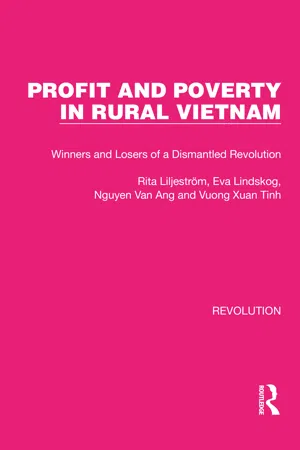
This book, first published in 1998, studies the social impact of Doi Moi, a policy of economic renovation, on the living conditions in state forest enterprises and agricultural cooperatives in northern Vietnam. It compares the authors' findings with those of 1987, before the formal adoption of the new economic policies – essentially the opening up of the economy to market forces.
eBook - ePub
Profit and Poverty in Rural Vietnam
Winners and Losers of a Dismantled Revolution
- 294 pages
- English
- ePUB (mobile friendly)
- Available on iOS & Android
eBook - ePub
Profit and Poverty in Rural Vietnam
Winners and Losers of a Dismantled Revolution
About this book
Information
ONE Introduction: Winners and Losers of a Dismantled Revolution
Background
In 1993, Borje Ljunggren, the then head of the Swedish International Development Agency's (SIDA) Asian section, suggested that Eva Lindskog and I should return to the areas where our 1987 study on the living conditions in state forest enterprises and agricultural cooperatives was conducted (Liljeström et al 1987, 1988). The aim, to try to assess the impact of Doi Moi on rural households, we could not have approved more. The market-oriented economic reforms are known as Doi Moi. Literally doi means change and moi means new.
The 1987 study was motivated by an alarming report by Katarina Larsson and Lars-Erik Birgegárd (1985) about the forestry workers' deplorable working and living conditions, and furthermore, the authors suspected the state enterprises of using forced labour. According to them, “Some workers felt that their recruitment had contained elements of subtle coercion or that they had been cheated; others had the sense of being compelled to stay in the forest while wanting to leave” (from Liljeström et al 1987: 3).
The 1987 study had the broad goal of “analysing the recruitment and living conditions of the forestry workers in the light of the cultural, social and economic conditions prevailing in Vietnam” (Terms of Reference). Contrary to earlier on-the-spot evaluations, the Liljeström team tried to set the conditions of forestry workers in a wider context. We found no evidence of institutionalized “forced” labour. However, we were able to identify two exceptional instances where the usual regulations of labour recruitment were clearly violated (Liljeström et al 1987). In 1987, it was unique for a team of foreign social scientists to be allowed to conduct fieldwork in rural northern Vietnam, especially as economic conditions were at a very low point.
The state was bankrupt and the mass of people were extremely poor. Consequently, local state enterprises and cooperatives used unofficial methods to overcome their stagnation and lack of basic means. These solutions proved more productive than the formal system, and they were successively accepted officially and eventually adopted, thus opening the way for market economy.
While the economic changes in Vietnam have been rapid and impressive, one keeps wondering how they have affected employees in the state forestry and members of the agricultural cooperatives whom we met in 1987. Borje Ljunggren knew of our vantage point for comparing the present conditions with our field notes and interviews from 1987.
The investigation took place in a fluid and rapidly shifting situation. The ongoing changes meant that we could not even be sure that the brigades were still organized as such or that the agricultural cooperatives of the late 1980s still existed. However, we intended to discover what had happened to previous structures and, as far as possible, to describe what had replaced them. Particular attention was to be paid to the consequences of Doi Moi for women and men, for local ethnic groups and for the Kinh, who have migrated into the region.
Preparations in Hanoi and Selection of Study Locales
In December 1993 we went to Hanoi in order to prepare for our study on the impact of Doi Moi. The institutions we visited had all come into being in the wake of Doi Moi.
We were briefed by Mr Doan Trung My, land and law inspector at the Land Use and Management Department. He was involved in the 1988 Land Law and the 1993 Amendment of the Land Law. He made an excellent presentation of the land-user's five rights (exchange, transfer, lease, inheritance, and mortgage of land use), which aim to make land available to 70-80 per cent of the rural population and to encourage investment of labour and money in land.
In 1993, the Committee of Ethnic Minorities and Mountainous Areas had been set up. We introduced ourselves to Dr Vu Quang Dinh, the international relations officer, who told us about the committee and its task as an advisory body to government on shaping policies towards ethnic minorities.
Our fieldwork in Ha Tuyen province in the spring of 1987 had left a lasting impression on us. This was our very first sojourn among the forest brigades. Today, Ha Tuyen is divided into two provinces, Tuyen Quang and Ha Giang. We decided to return to the southern and northern parts of the former Ha Tuyen. In Tuyen Quang we chose Minh Dan brigade, Tan Thanh forest enterprise, as one case, remembering the discontent that prevailed in 1987, the extreme poverty, the weeping infants in the nursery, the nocturnal rats, the powerful nurse Mrs Bun, and the workers sneaking to us behind her back. In May 1987, we had spent a week in Brigade 481, Chiem Hoa forest enterprise. In spite of the extremely hot and humid weather our notes and memories were vivid, and we included Brigade 481 among our cases. The adjacent villages of Lam Tien and Phuc Tarn were also chosen.
In Ha Giang province, we selected Brigade 5, Vinh Hao forest enterprise, because we wanted to see how far the aspirations to turn it into a forest village had succeeded. The neighbouring village of Khuoi Nieng was also included. We believed that in all these places people would recognize us, and we would enjoy the trust given to caring visitors who returned, especially as we had visited those brigades in both 1988 and 1989.
During our previous fieldwork we had been intrigued by the minority people, but not able to understand the relationship between them and the majority Kinh. At that time, ethnicity was not recognized as an issue; nor did the Swedish aid consider the presence of ethnic minorities. By choosing a remote district where minorities were a majority, we intended to learn more about them. Besides, we wanted to compare the three familiar areas with one that was untouched by Swedish aid. That is why we chose Hoang Su Phi forest enterprise and Po Lung mountain village as our fourth case.
The Kinh And Ethnic Minorities
The mountain area of northern Vietnam contains great cultural diversity. Historically, the population consists of native people such as the Muong, Tay, and Thai, as well as ethnic migrants, mainly from China, including the Dao, H'Mong, Ha Nhi, and Lo Lo. There were large migrations to northern Vietnam thousands of years ago (e.g. the Thai) and more recently, in the past 200-300 years (such as the H'Mong). Additionally, sporadic clandestine migration of families and clans across the Vietnam-China and Vietnam-Laos borders has occurred. It is difficult to gather and validate statistics about these movements. At present there are thirty-one officially recognized ethnic groups which speak languages belonging to seven distinct linguistic groups. A ranking by size is given in Table 1.
| Ethnic Group | Population |
|---|---|
| Kinh | 2,500,000 |
| Tay | 1,000,000 |
| Nung | 600,000 |
| Thai | 600,000 |
| H'Mong | 530,000 |
| Muong | 460,000 |
| Dao | 440,000 |
Of the thirty-one ethnic groups, seventeen have populations under 10,000, and a few under 1,000 (Rambo and Cue 1996). Their ethnic territories comprise three ecological zones: the low-lying valley region at about 400 metres above sea level; the intermediate region from 400 to 800 metres; and the upper region above 800 metres. If the Red River is held to divide northern Vietnam, then the valley region to the east is the home of the Tay and the Nung ethnic groups, while the west is home to the Muong and the Thai. Living near and occasionally intermingling with ethnic groups in the low-lying region, there are ethnic groups from the intermediate region, such as the Dao, the Giay, the San Chi, the Kho Mu, and the Xinh Mun. The H'Mong, Ha Chi, and Lo Lo live in the upper region. However, the classification is relative because in some places the majority of a group lives in a low-lying region, while a minority of the same group lives in the highlands, as for instance the Nung. Some ethnic groups in the intermediate region, like the Dao, settle in the valleys. Indeed, according to Rambo and Cue (1996), a distinctive feature of the northern mountain region is that many different ethnic groups live with one another within the same territory


Figures 2-5: Many different ethnic groups live with one another within the same territory [RL].
For example, out of the 109 districts and towns in the eleven northern provinces, more than half (fifty-nine) have ten or more ethnic groups present, with nine having fifteen or even more. There is not a single jurisdiction with an area exceeding 300 square kilometres that comprises only one ethnic group. Only 3 per cent of the villages are mono-cultural, the vast majority having three or more ethnic groups.
From time immemorial ethnic groups in northern Vietnam have lived by agriculture and animal husbandry. Many ethnic valley dwellers such as the Tay, Muong, Thai and Nung have practised an advanced wet-rice cultivation. Ethnic groups living in the intermediate and high regions cultivate terraced fields or hilly land. They also raise several kinds of fowl and cattle.
Of the four villages in our study, three are situated in the valley region and one in the high mountain region. Although these villages are different, the ethnic groups living in them share general historical, economic and social characteristics common to other ethnic groups in the northern mountain region. In this region, the Kinh account for a large percentage of the population, especially after 1954 when North Vietnam was liberated from French rule. With the state's policy of placing key officials in the mountain region and of reclaiming wasteland, the number of Kinh people in the valleys increased.
In the 1960s it became government policy to establish state forest enterprises in the northern provinces. The majority of the workers were recruited from the delta. The state also encouraged farmers to migrate and open up new land in the mountain regions. The Kinh believed that they had a mission to civilize ethnic minorities.
The migration fundamentally altered the upland demographic balance. In the years between the 1969 and 1989 censuses, the Kinh population in Ha Tuyen province increased by 426 per cent. In the northern region as a whole, the number of Kinh rose from 640,000 to almost 2.6 million.
The massive Kinh migration, combined with high rates of population growth among indigenous minorities, resulted in a tripling of the region's population density between 1960 and 1989. Thus, average densities increased in former Ha Tuyen province from twenty-six to seventy-five per square kilometre. This increased pressure on rural resources has had a devastating effect on the environment (Rambo and Cue 1996).
To sum up, the population consists of diverse ethnic minorities as well as the Kinh, the Vietnamese majority. The state forestry recruited mainly Kinh workers, while members of the agricultural cooperatives are both Kinh and from local ethnic groups.
Milestones In The Renovation Of The Land Relationship
The land relationship should here be understood as the relationships between men in regard to land. These relationships have been expressed as the rights of government, of cooperatives, of farmers, and of the state forestry over land, and as the obligations of each land-user towards society.
Early years
The land relationships of Vietnamese farmers have undergone remarkable changes over the past half-century. Before 1953, the peasants had no land: they were employees of landlords through the system of tenancy. Land renting was common in northern Vietnam from feudal times until 1954.
In May 1954, the French colonial regime in Vietnam collapsed, and in the same year the Geneva Agreement was signed. Since then, northern Vietnam has followed a socialist path. Land reform began as early as 1953 and was eventually executed in 1957. Most of the arable land was confiscated and distributed to the landless peasants. The yield from the land increased rapidly and the growth in agriculture was higher than during the previous decades. This continued in the early years of land collectivization. The revolutionary ardour of the masses rose, and they were ready to follow the party in building socialism.
Collectivization of the land relationship established public ownership of the means of production. The political leaders and intellectuals had been convinced that private property was the main obstacle to equality and social justice. The Communist Party had great ambitions to secure rapid economic growth for the good of the people. However, regarding the land relationship, the objectives of collectivization were almost the opposite of those of the land reform between 1953 and 1957.
Unfortunately, the economy did not unfold as planned. It can be said that in the years between 1978 and 1980 the economy of Vietnam fell into a deep recession, the ultimate cause of which was low agricultural productivity. The manner in which the cooperatives applied equal distribution during wartime deprived farmers of their initiative and incentive. Sluggishness and torpor were widespread. The rice yield fell and the peasants faced a permanent shortage of food. The target of 21 million tonnes of food was set up for 1980, but only 14 million tonnes were produced. Cooperative management deprived the farmers of their role as managers of the land. The predominance of the cooperatives actually amounted to an ownerless regime over land and the other means of production. The consequences only became fully apparent when the cooperatives no longer received subsidies from the state, and when the spirit of permanent sel...
Table of contents
- Cover
- Half Title
- Title Page
- Copyright Page
- Original Title Page
- Original Copyright Page
- Contents
- List of Figures
- List of Tables
- Preface
- Acknowledgements
- List of Abbreviations
- List of Weights and Measures
- List of Terms
- 1. Introduction: Winners and Losers of a Dismantled Revolution
- Case 1: Standing on Two Feet
- Case 2: Two Models of Modernization
- Case 3: “Neither Bat nor Rat ”
- Case 4: “All Have to Eat Rice ”
- 15. Summary: The Impact of Doi Moi
- Epilogue
- References
- Index
Trusted by 375,005 students
Access to over 1.5 million titles for a fair monthly price.
Study more efficiently using our study tools.
Frequently asked questions
Yes, you can cancel anytime from the Subscription tab in your account settings on the Perlego website. Your subscription will stay active until the end of your current billing period. Learn how to cancel your subscription
No, books cannot be downloaded as external files, such as PDFs, for use outside of Perlego. However, you can download books within the Perlego app for offline reading on mobile or tablet. Learn how to download books offline
Perlego offers two plans: Essential and Complete
- Essential is ideal for learners and professionals who enjoy exploring a wide range of subjects. Access the Essential Library with 800,000+ trusted titles and best-sellers across business, personal growth, and the humanities. Includes unlimited reading time and Standard Read Aloud voice.
- Complete: Perfect for advanced learners and researchers needing full, unrestricted access. Unlock 1.5M+ books across hundreds of subjects, including academic and specialized titles. The Complete Plan also includes advanced features like Premium Read Aloud and Research Assistant.
We are an online textbook subscription service, where you can get access to an entire online library for less than the price of a single book per month. With over 1.5 million books across 990+ topics, we’ve got you covered! Learn about our mission
Look out for the read-aloud symbol on your next book to see if you can listen to it. The read-aloud tool reads text aloud for you, highlighting the text as it is being read. You can pause it, speed it up and slow it down. Learn more about Read Aloud
Yes! You can use the Perlego app on both iOS and Android devices to read anytime, anywhere — even offline. Perfect for commutes or when you’re on the go.
Please note we cannot support devices running on iOS 13 and Android 7 or earlier. Learn more about using the app
Please note we cannot support devices running on iOS 13 and Android 7 or earlier. Learn more about using the app
Yes, you can access Profit and Poverty in Rural Vietnam by Rita Liljeström,Eva Lindskog,Nguyen Van Ang,Vuong Xuan Tinh in PDF and/or ePUB format, as well as other popular books in Politics & International Relations & Politics. We have over 1.5 million books available in our catalogue for you to explore.