This book, first published in 1983, is a radical reinterpretation of the Hungarian revolution in the context of world politics and Eastern Europe as a whole. It examines the events and protagonists with a fresh eye, and relies on witnesses and participants for the rigorous documentary backing.
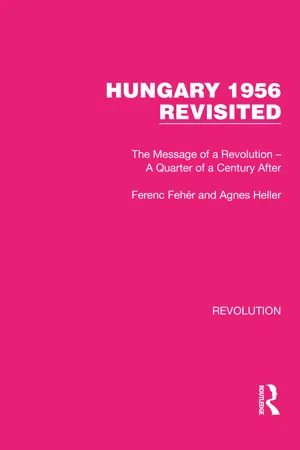
eBook - ePub
Hungary 1956 Revisited
The Message of a Revolution – A Quarter of a Century After
- 190 pages
- English
- ePUB (mobile friendly)
- Available on iOS & Android
eBook - ePub
Hungary 1956 Revisited
The Message of a Revolution – A Quarter of a Century After
About this book
Information
1 The Impact on the World
It would be a splendid opening to our essay to state that the Hungarian revolution of 1956 was a phoenix that rose from its ashes. Unfortunately, the statement would be inaccurate, for it did not. But this uprising is far from being the forgotten event that all its gravediggers, who now act out the roles of philanthropic and moderate statesmen, would like it to be. It is not a historical symbol guiding the decisions of social actors, but has become part of popular historical mythology. What this revolution meant and against what enemies it was fought (if not against the ‘Russians’, which is too vague a description) have become as much obscured for people all over the world - people whose memory has been indelibly engraved with scenes of jubilant crowds smashing Stalin’s statue and Soviet tanks on the streets of Budapest - as has the exact meaning of every other important historical event. But at least all those who were sufficiently mature to comprehend these scenes in what was predominantly a pre-television era have not forgotten them, and the events of 1956 need surprisingly little explanation when mentioned in conversation, whether it be in Iceland or in New Zealand. It is our intention here to contribute to the transformation of the Hungarian revolution from a vague myth to a far more concrete symbol: a symbol that will promote the process of ‘learning from history’ for every interested reader, but for one in particular - the leftist socialist radical, who has an enormous historical debt in this respect.
(i) The Hungarian Revolution and Superpower Politics
The decade following the end of the Second World War - the era of the Cold War - was dominated by two apparently totally contradictory, but functionally almost equivalent, conceptions regarding the genesis, the character, and the prospects of longevity of the communist-ruled regimes of Eastern Europe. The first viewpoint stated with an air of doctrinaire superiority - and this was the dominant tone, particularly in the American press - that all East European and Asian communist systems were simply Soviet exports, and that if they did not enjoy Soviet military and secret police presence and support they would automatically collapse. Yet subsequent events of the most varied character and value-content in Yugoslavia, China, Albania and other countries testified to an infinitely more complex situation. In the first place, the proponents of this theory could not account for the truly astonishing fact that the Yugoslav communists, in a national war of independence which in itself would reduce rather than widen communist policy objectives, could attain the irrevocable communist course which the Spanish Republic, in a civil war the objectives of which were clearly social in character, could not. (And the Soviet presence in Eastern Europe is no explanation. It is well known that Stalin warned Yugoslav communists against ‘rash’ radicalism rather than encouraged it.) Nor, for that matter, could this theory provide any coherent interpretation of the Chinese communist victory - an event that was not a Bolshevik coup d’etat like the Russian revolution, but a change preceded by a long history of communist administration of vast provinces, which meant a practical test for hundreds of millions of people, enabling them to choose between the communists and the Kuomintang. If we add to this that it was widely known then in the West, and has been amply documented since, that both changes of course, in the main, occurred contrary to Stalin’s intentions, the poverty of this conception can only be accounted for by the fact that ‘experts in politico-sociology’, in their unassailable dogmatism, simply underestimated the real needs for socialism in Europe and for radical change of any kind in Asia which communist dictatorships thriving on these needs have used and abused. But Tito’s post-1948 regime, stable and unchallenged, already undermined the self-confidence of this theory - a theory destined to be wholly refuted by the complete absence of any socially representative liberal-capitalist alternative in a China which had been gripped by a variety of powerful social convulsions mobilising and counter-mobilising tens of millions in a social dynamic unprecedented in communist regimes. And today Albania, repulsive and Orwellian as it is, still calls for an analytical and not a rhetorical explanation. Taken all in all, the function of this conception was simple enough: it was the self-hypnotic technique of an intellectually sterile Cold War policy - a policy attempting to instil into its militants a confidence which was never really there.
Parallel to this theory, though diametrically opposite in content, there emerged an equally important, if less publicised, conception of the Cold War. This was the belief in the indestructibility of communist systems from within. The proponents of this view - generals, leaders of the Allied intelligence community, and ultra-conservative politicians - departed both from the idea that socialism was a ‘perversion’ and from the firm conviction that this creed, no matter under what name it appeared, would be unequivocally rejected by the masses if it were in their power to do so. Once a totalitarian system was established, zealots of the second position contended (and Churchill placed himself amongst them in accusing the British Labour Party of intending to introduce a ‘Gestapo system’ to facilitate its planning policy), such self-purging from within became impossible unless military aid was given to the enslaved nations. One particularly dangerous moment when this attitude gained control was during the Korean War, when MacArthur, who had been invested with enormous semi-independent military and political powers, and who had assumed the role of the arch-inquisitor of anti-communist crusades, allowed an unbridled zeal born of despair to provoke the Chinese intervention that brought the world to the brink of destruction. Such catastrophic scenarios would undoubtedly have been repeated had not the Hungarian revolution of 1956 eliminated for ever this idea of the indestructibility of the Soviet regimes from within. This was the first consequence of the Hungarian revolution which can truly and without exaggeration be called world-historical. It provided a number of important lessons that have not yet been digested by Western diplomats, East European statesmen, or Western leftists - lessons all the more important because both theories outlined above coincided as far as their practical function was concerned. Both of them catered, even if from opposite angles, for the ideological and practical demands of the Cold War.
Moreover, it has often been asked just what impact this uprising could possibly have had on the decisions of the policy-making bodies of a superpower that is impervious to the suggestions or warnings of the State Department. It is here that a few facts long forgotten by all but the experts should be borne strongly in mind. To begin with, it was the Soviet government who, after being publicly accused by the Polish Government-in-Exile (in London) of perpetrating the Katyn massacres of 1940, after the Germans had uncovered the corpses of murdered Polish army officers, undertook in consequence of these developments to break off all relations with the representatives of a Poland fighting in a common cause. That government might not necessarily have been reelected, but it undoubtedly stood in a relationship of some legitimacy with the Russians. No amount of pressure or supplication on the part of the Western Allies could bring Stalin to an apparent truce with - or, at least, a suspended hostility towards - the Polish leaders, and later he simply imposed the so-called Lublin Committee (a communist government with certain subsequent non-communist additions) upon the country, despite vigorous protests and without even holding formal negotiations with the émigré forces. Also, as we know from Churchill’s vivid description, as well as from other sources, it was in an equally unceremonious way in 1944 that Vyshinsky, in the name of the Soviet government, ‘dismissed’ the government of their then ally, Romania, in order to install a more pro-Soviet one. In the following decade Soviet military power only increased. Nevertheless, for the thirteen days between 23 October and 4 November 1956, the Soviet leadership felt compelled to issue self-apologetic government communiqués. What is more, they entered into formal negotiations with - and made what proved to be false promises to - a social force and a government (Imre Nagy’s second cabinet) which deep down they had always regarded as counter-revolutionary, and which they had outsmarted and deceived from the outset, and whose members they later executed or imprisoned. Nor did 4 November, the day of the second and final intervention, witness an end to such things. The Russians held numerous secret or semi-secret negotiations with various political forces. In Budapest these negotiations initially included the workers’ councils, former ‘rightist’ and ‘leftist’ social democrats, writers and others, and former politicians of the post-war parliamentary system, the most representative of whom was the former secretary-general of the Hungarian Smallholders’ Party, Béla Kovács, whom the Soviet military police simply abducted in 1947 en pleine pluralisme et démocratie, kept in the GULAG and released only shortly before the revolution. In Romania, where the sympathisers of Imre Nagy - mainly radical socialists no longer espousing specific doctrines were concentrated, equally endless negotiations were held with the aim of broadening the scandalously and dangerously narrow power-base of Kádár’s new government. These negotiations were all conducted, either wholly or in part, by the Russians’ Hungarian proxies, until such time as the Russian leaders judged some of them important enough to be removed from the hands of their emissaries. All of these things serve to illustrate that, in contrast to the opinions of several scholarly interpreters, the pragmatic Soviet leadership did not underestimate the crucial importance of tiny Hungary and her ‘counter-revolution’.
Only when we have indicated - though we have not yet documented - the global importance of the Hungarian revolution can we establish its first element of significance: the impact on the Western world. Despite the ‘false consciousness’ of many Hungarians in revolt, their rebellion was directed against all signatories of the Yalta and Potsdam agreements, against the Western protagonists as well as the Eastern. In order to emphasise a point, sometimes it is best to turn to the primary sources - especially when the chronicler has the great capacity of laconically evoking the Shakespearian moments upon which history turns. Here is how Churchill describes the moment in which he made his fateful deal with Stalin concerning Eastern Europe, on 9 October 1944 in Moscow:
The moment was apt for business, so I said, ‘Let us settle about our affairs in the Balkans. Your armies are in Rumania and Bulgaria. We have interests, missions, and agents there. Don’t let us get at cross-purposes in small ways. So far as Britain and Russia are concerned, how would it do for you to have ninety per cent dominance in Rumania, for us to have ninety per cent of the say in Greece, and go fifty-fifty about Yugoslavia?’ While this was being translated I wrote out on a half-sheet of paper:
Rumania Russia 90% The others 10% Greece Great Britain (in accord with U.S.A.) 90% Russia 10% Yugoslavia 50-50% Hungary 50-50% Bulgaria Russia 75% The others 25% I pushed this across to Stalin who had by then heard the translation. There was a slight pause. Then he took his blue pencil and made a large tick upon it, and passed it back to us. It was all settled in no mare time than it takes to set dawn.Of course we had long and anxiously considered our point and were only dealing with immediate war-time arrangements. All larger questions were reserved on both sides for what we then hoped would be a peace table when the war was won.After this there was a long silence. The pencilled paper lay in the centre of the table. At length I said, ‘Might it not be thought rather cynical if it seemed we had disposed of these issues, so fateful to millions of people, in such an offhand manner? Let us burn the paper.’ ‘No, you keep it,’ said Stalin.1
In this memorable scene so brilliantly described by Churchill the most repulsive feature of the Yalta and Potsdam agreements comes immediately to the fore: the unassailable conviction shared equally by the ‘Big Three’ that they had the unquestionable right to decide the future of the world among themselves, without even going so far as to discuss the pertinent details with the parties (and sometimes the continents) involved.
Naturally, they produced several arguments in defence of this stance. The first was that only they, the superpowers, could serve as safeguards against the revival of fascism - an argument which of course neglected to take into account their original part in, and responsibility for, its emergence. The stories have been recounted many times of how Britain tried to use Hitler as an anti-Bolshevik weapon up to the very last, when the instrument turned against the apparent master; or how the Soviet leaders teleguided the German communist movement to do everything in its power to destroy the Weimar democracy and the Social Democratic Party, thereby becoming an accomplice, even if a suicidal one, in Hitler’s victory, and how they shared the Polish loot with Hitler in 1939; or how the United States stayed away, as much in a selfish as in an aloof manner, and for as long as it was politically and militarily possible, from the European affairs in which an early intervention and an emphatic warning in the mid-1930s could have changed dramatically the state of affairs. Nor was there any indication during the Yalta-Potsdam period that any of them would behave in a wider or a more humane manner.
The second argument was moral in nature, strange as it may sound on the part of certain signatories of these agreements: since they had borne the brunt of the war, had suffered its greatest ravages, and had seen the greatest number of victims, they therefore had all prerogatives in the decisions of victory. Now, even if we disregard the questionable logic and the even more questionable justification of Stalin’s crocodile tears over Soviet war victims - millions of whom were his victims, the waste products of his irresponsible and criminal unpreparedness for war emergency (as is sufficiently proved by Khrushchev’s so-called ‘secret speech’ and A. M. Nekrich’s famous book, June 22, 1941 (Columbia, SC: University of South Carolina Press, 1968), on the first year of the Soviet-German war) - and even if we also disregard Churchill’s not particularly refined racist propaganda directed against the ‘Huns’ - this alleged but mythical cause of all international ills for which a panacea was sought in the existence of thirty-five small German states instead of in a united one - then this statement about the ‘greatest suffering’ is true only in absolute and not in relative terms. For instance, there can be no doubt that in the war Poland suffere...
Table of contents
- Cover
- Half Title
- Title Page
- Copyright Page
- Original Title Page
- Original Copyright Page
- Table of Contents
- Dedication
- Preface
- Acknowledgements
- 1 The Impact on the World
- 2 The Impact on Hungary
- Index
Trusted by 375,005 students
Access to over 1.5 million titles for a fair monthly price.
Study more efficiently using our study tools.
Frequently asked questions
Yes, you can cancel anytime from the Subscription tab in your account settings on the Perlego website. Your subscription will stay active until the end of your current billing period. Learn how to cancel your subscription
No, books cannot be downloaded as external files, such as PDFs, for use outside of Perlego. However, you can download books within the Perlego app for offline reading on mobile or tablet. Learn how to download books offline
Perlego offers two plans: Essential and Complete
- Essential is ideal for learners and professionals who enjoy exploring a wide range of subjects. Access the Essential Library with 800,000+ trusted titles and best-sellers across business, personal growth, and the humanities. Includes unlimited reading time and Standard Read Aloud voice.
- Complete: Perfect for advanced learners and researchers needing full, unrestricted access. Unlock 1.5M+ books across hundreds of subjects, including academic and specialized titles. The Complete Plan also includes advanced features like Premium Read Aloud and Research Assistant.
We are an online textbook subscription service, where you can get access to an entire online library for less than the price of a single book per month. With over 1.5 million books across 990+ topics, we’ve got you covered! Learn about our mission
Look out for the read-aloud symbol on your next book to see if you can listen to it. The read-aloud tool reads text aloud for you, highlighting the text as it is being read. You can pause it, speed it up and slow it down. Learn more about Read Aloud
Yes! You can use the Perlego app on both iOS and Android devices to read anytime, anywhere — even offline. Perfect for commutes or when you’re on the go.
Please note we cannot support devices running on iOS 13 and Android 7 or earlier. Learn more about using the app
Please note we cannot support devices running on iOS 13 and Android 7 or earlier. Learn more about using the app
Yes, you can access Hungary 1956 Revisited by Ferenc Fehér,Agnes Heller in PDF and/or ePUB format, as well as other popular books in Politics & International Relations & Politics. We have over 1.5 million books available in our catalogue for you to explore.