This book, first published in 1983, goes beyond the 'black and white' literature of many East–West observers to offer a more nuanced assessment of the achievements of the Eastern bloc countries of the early 1980s. It covers the emergence of 'Eastern Europe' from revolution and war, the politics and economics of the new countries and their relationships with the West.
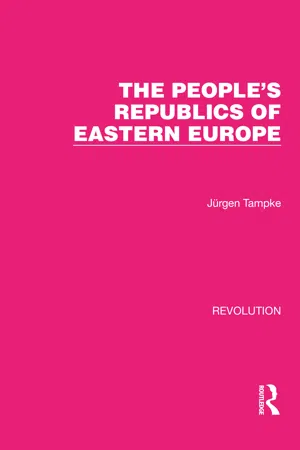
- 176 pages
- English
- ePUB (mobile friendly)
- Available on iOS & Android
eBook - ePub
The People's Republics of Eastern Europe
About this book
Information
1 THE EMERGENCE OF THE NEW EASTERN EUROPE (1943-7)
European history since the middle of the nineteenth century has been characterised by social confrontation. The antagonists have been broadly labelled as the ‘establishment’, which originally comprised the traditional elite centred upon crown, Church and aristocracy, and the left. As the nineteenth century and modern industrialisation progressed this elite absorbed the entrepreneurial and professional middle classes. Subsequently, at least in Western Europe these traditional forces, which were not necessarily opposed to progress qua progress, proved themselves capable of absorbing the moderate workers’ movement that broadly accepted the status quo in respect of the structure of class society and hoped to introduce gradual social and economic reform. The opponents of this historical consensus, left-wing socialists, anarchists and especially revolutionary Marxists were bent upon the overthrow of the established order and its replacement by a socially and economically egalitarian society. They had their supporters: initially they were drawn from the dissatisfied and impoverished artisan class, but with the spread of industrialisation the protest came to include broader sections of the working class. In some parts of Europe, more particularly in South and South-eastern Europe, radical left-wing thought also permeated the rural areas.
Until the First World War the political establishment overcame all these challenges with little difficulty. The Paris Commune and the Russian Revolution of 1905, for example, were soon suppressed, although they hinted at the growing support the opposition to the system was gaining. At the end of the First World War the revolutionary potential which had accumulated in Europe became fully evident for the first time. In fact many historians today maintain that the war itself was the subsummation and the product of Europe’s domestic crisis rather than the result of a breakdown of international diplomacy.1 They argue that the economic and social tension brought about by industrialisation had engendered such a serious crisis in society that governments embarked upon adventurous and essentially aggressive foreign policies to divert attention from the domestic contradictions and to rally the people in support of the status quo. For the Hapsburg, Hohenzollern and Romanov dynasties, the war for their survival ironically led to their undoing and a wave of revolution spread throughout Central and Eastern Europe between 1917 and 1920.
Following the Soviet model that emerged in Russia, workers’ councils were set up in a number of centres. With the one decisive Russian exception, this first major confrontation ended with the defeat of the revolutionary left. Divisions amongst themselves, lack of capable leadership and the residual vitality of liberal ideals in the West of Europe were among the factors which ensured that by 1920 the pre-war consensus was able to re-establish itself. For Eastern Europe, however, the outcome of the First World War only intensified historical conflicts. Governments in Southern and Eastern Europe increasingly moved to the political right, with most states by the 1930s becoming semi-Fascist if not outright Fascist. Nevertheless, the defeat and discredit of Fascism by 1945 in Germany and in Eastern Europe left communism in a strong if not an invincible position.
The situation that enabled the communists to challenge the old order in Eastern Europe2 arose from four major factors. These were: the political, economic and social record of the inter-war governments, the traumatic experience and national disaster of the Second World War, the general swing in Europe to the left, which was largely brought about by the determined opposition to Fascism of communists and finally — important, but not as central as many historians maintain - the victory of the Soviet troops over Germany.
The countries that were liberated by Soviet troops and which today constitute the people’s republics of Eastern Europe emerged from the disintegration of four empires: the Turkish, Russian, Austro-Hungarian and German. Bulgaria, Romania, Albania and the Serbian parts of what was to become Yugoslavia arose in the nineteenth century, as the territory of the ‘sick man of Europe’ was gradually pushed eastwards. The new Poland was made up of former German, Austrian and Russian territories. The latter also conceded Bessarabia to Romania. The new order in Europe emerged primarily as a result of the collapse of the Austro-Hungarian empire.
The year 1918 saw the collapse of the old Danube monarchy. After nearly half a millenium of existence as a great - at times even the leading - power, in 1918 it finally succumbed to the logic of its internal national contradictions. Ideas of a multinational community of nations did not seem to belong to the twentieth century and the aspirations for national independence. For 50 years nationals and liberals amongst the numerous ethnic groups of the Hapsburg empire had demanded independence; now at last they had succeeded. Hungary, Czechoslovakia and Yugoslavia joined the ranks of small states in that part of Europe. It soon emerged, however, that the new arrangement was even more fragile than the empire it had replaced.
As is well known, the post First World War peace treaties did not solve problems of nationality in Eastern Europe. Czechoslovakia consisted of a majority of Czechs and Slovaks but one-third of its 15 million people comprised national minorities of Poles, Ruthenians, Hungarians and especially Germans. In Poland only two-thirds of its population were Polish and in Yugoslavia, in addition to the conflict between Serbs and Croats, there were 1.7 million Albanians, Hungarians and Germans in a total population of 12 million.
Romania profited considerably from the First World War. It not only annexed Bessarabia in the wake of the Bolshevik Revolution in Russia, but it also incorporated Transylvania and other parts of Eastern Hungary and came to include 1 1/2 million Hungarians among its population.
It was the Romanian expansion that occasioned a prolongation of the war beyond the armistice. When the Hungarian government under Mihaly Karolyi failed to stop the loss of territory, Budapest saw the establishment of a Soviet government under Bela Kun. With widespread support in Budapest, a communist-social democratic government was set up on 20 March 1919 headed by Kun and the leaders of the social democrats, Sigismund Kunfi and Alexander Gabai. Other noticeable ministers in the Hungarian revolutionary government included the Hungarian post Second World War Communist Party leader Matyas Rakosi and the philosopher Georg Lukacz. Edicts ordered the socialisation of housing, banks, retail distribution and the land, and the rigorous suppression of black market activities; even aristocratic sports such as racing were forbidden. The Kun Government repelled the Romanian invasion of Hungary but failed to maintain power in Budapest. The Hungarian proletarian dictatorship was harsh but there was less terror under Kun than under the White regime that followed. The counterrevolution led by Admiral Horthy and supported by Romanian troops was responsible for the deaths of thousands of workers suspected of supporting the Kun Government. Few Communists survived. Those who did went underground for the next 25 years or escaped to the Soviet Union.
One year later Poland and the Soviet Union were also at war. Like the Romanians, the Polish government hoped to benefit from the collapse of Tsarism in Russia. A very generous interpretation of Poland’s Eastern boundaries before her partition by Prussia, Russia and Austria in the eighteenth century led the Polish government to claim White Russia,Lithuania and Ukrainian territories. But by 1920 the Red Army was strong enough to counter the Polish forces; in fact the Soviet troops almost reached Warsaw in their counter-offensive. The Allies were not favourably disposed towards the creation of a Greater Poland and agreed to the ‘Curzon line’, which is basically the Polish-Soviet frontier today. Nevertheless a final drive by the Polish general Josef Pilsudski managed to establish the inter-war boundary just west of Minsk, far into White Russia.
In the other countries the problem of ethnicity, nationality and territory did not lead to all-out war but the nationality problem lingered. In Yugoslavia the division between Serbs and Croats remained bitter throughout, with the crisis reaching a peak in 1928 when the leader of the Croatian Peasant Party, Stjepan Radic, was assassinated in the Belgrade parliament. Most bellicose on the issue of national minorities was the country which was comparatively least affected by the outcome of the war, namely Germany. Admittedly not every German lived in the territory administered by the Weimar Republic but compared to the Austro-Hungarian empire and also to Russia, the German losses in territory and people imposed by the peace treaty were modest. The most outspoken group of Germans outside the Republic, the Sudeten Germans, had never belonged to the German empire. Nevertheless it is with the Sudeten Germans that the demagogic factors associated with passionate and violent nationalism reveal themselves most clearly in the 1930s. Then the Sudeten Nazi Party, supported by the Hitler Government, used the nationality issue to bring about the destruction of Czechoslovakia.
Serious as the nationality problem was, it was not the main issue in Eastern Europe between the wars. More important was the nature of the political system. Great hopes were held for post-war liberal parliamentary democracy but the spirit of Versailles, with its slogans of democracy and national freedom, did not fall on very fertile soil in the new states. The Hungarian Prime Minister Karolyi, with his idea of a liberal Hungary forming part of a Danubian democratic federation, was the first to be disillusioned when his country’s neighbours attacked the remnant of the former Hungarian part of the dual monarchy. After the brief episode of Bela Kun, Hungary was the first country to turn to a thinly veiled dictatorship under Admiral Horthy. Bulgaria too never saw the emergence of genuine democratic government. Between 1919 and 1923 there was the so-called ‘dictatorship of the village over the town’. Here the Agrarian Party and its leader, Alexander Stamvalishy, pursued an anti-middle-class, anti-urban policy which was chiefly concerned with the economic well-being of the peasantry. The subsequent ten years saw the country shaken by waves of terrorism from both left and right, which did not abate until a coup in 1934 established a military dictatorship.
The sophisticated democratic system did not work well in Poland either. An impressive legal and parliamentary system was created in March 1921, with a constitution based on the third French Republic. This gave the supreme power to a democratically elected Lower House (the Sejm) leaving a limited power of veto to the Upper House and the President. The radical difference between this and previous forms of government in Poland, together with the introduction of proportional representation and the exuberant individualism of the Polish intelligentsia, soon led to difficulties. With 92 political parties there was extreme atomisation, to say the least. In 1927 Marshall Pilsudski decided to put an end to ‘the chaos’ and established a military dictatorship.
In Yugoslavia, a year after Radic’s assassination in 1928, the King declared a royal dictatorship. Following a decade of genuine attempts to make constitutional government and liberal institutions work, Romania followed suit in 1930 when the King assumed full control of government to establish a ruthless and corrupt regime. Albania’s history was marred by the deep division between the Moslem, Catholic and Orthodox faiths and between the still largely tribal peoples of the northern mountains and the developed plainsmen of the south. In December 1924 Ahmed Zogu, a tribal chieftain from the north, seized power. With Italian military and economic support he consolidated his position and had himself declared King of Albania in 1928. Italian influence continued to grow during the 1930s until the country became a formal protectorate of fascist Italy in April 1939.
By 1938, therefore, with the exception of Czechoslovakia, where democratic institutions survived until the German dismemberment of the nation, parliamentary government had failed to survive in Eastern Europe. There was considerable disillusionment with party politics among most sections of the population. The British historian, James Joll, sums up the inter-war history of Eastern Europe aptly when he concludes that ‘peopled by a backward and impoverished peasantry and lacking administrative experience - these countries did not have the substructure of the political traditions to sustain a sophisticated party system of government’.3
The unimpressive political record of the nations of Eastern Europe during the inter-war years is not only to be explained by the lack of a parliamentary or liberal tradition. An even more important reason lies in the economic weakness which was characteristic of all these countries including Czechoslovakia. The Austro-Hungarian empire had formed an economic entity which before the First World War had all economic sectors showing annual rates of increased production of the order of 3 to 4 per cent. The economic fragmentation caused by the outcome of the First World War brought the growth rate down to 1.5 per cent in all countries with the exception of Bulgaria.4
Modernisation, which began in the late nineteenth century, was halted and failed to achieve the earlier anticipated stage of development. In fact, some sectors of the economy evinced complete stagnation. In others, growth was modest and proceeded without producing general socio-economic advancement. The development of railways, which constituted the backbone of the pre-First World War industrial dynamism of the region, came to a halt. This of course was also the case in the advanced industrial countries of Western Europe. However, not only was the railway density in Eastern and South-eastern Europe far below that of the Western countries when stagnation se...
Table of contents
- Cover
- Half-Title Page
- Title Page
- Copyright Page
- Original Title Page
- Original Copyright Page
- Table of Contents
- Introduction
- 1 The Emergence of The New Eastern Europe (1943-7)
- 2 Planned Economy and Cold War (1948-53)
- 3 Confrontation and Consolidation (1954-9)
- 4 The Hungarian People’s Republic: Liberal Socialism?
- 5 The German Democratic Republic: Economic Miracle?
- 6 Romania: Mediator Between East and West?
- 7 Czechoslovakia 1968: A Reappraisal
- 8 The Polish People’s Republic: Catholics and Cultivators
- 9 Yugoslavia: Communist League And Workers’ Councils
- 10 Towards a Consumer Society
- 11 Convergence or Divergence
- 12 Recreation and Entertainment
- Index
Trusted by 375,005 students
Access to over 1.5 million titles for a fair monthly price.
Study more efficiently using our study tools.
Frequently asked questions
Yes, you can cancel anytime from the Subscription tab in your account settings on the Perlego website. Your subscription will stay active until the end of your current billing period. Learn how to cancel your subscription
No, books cannot be downloaded as external files, such as PDFs, for use outside of Perlego. However, you can download books within the Perlego app for offline reading on mobile or tablet. Learn how to download books offline
Perlego offers two plans: Essential and Complete
- Essential is ideal for learners and professionals who enjoy exploring a wide range of subjects. Access the Essential Library with 800,000+ trusted titles and best-sellers across business, personal growth, and the humanities. Includes unlimited reading time and Standard Read Aloud voice.
- Complete: Perfect for advanced learners and researchers needing full, unrestricted access. Unlock 1.5M+ books across hundreds of subjects, including academic and specialized titles. The Complete Plan also includes advanced features like Premium Read Aloud and Research Assistant.
We are an online textbook subscription service, where you can get access to an entire online library for less than the price of a single book per month. With over 1.5 million books across 990+ topics, we’ve got you covered! Learn about our mission
Look out for the read-aloud symbol on your next book to see if you can listen to it. The read-aloud tool reads text aloud for you, highlighting the text as it is being read. You can pause it, speed it up and slow it down. Learn more about Read Aloud
Yes! You can use the Perlego app on both iOS and Android devices to read anytime, anywhere — even offline. Perfect for commutes or when you’re on the go.
Please note we cannot support devices running on iOS 13 and Android 7 or earlier. Learn more about using the app
Please note we cannot support devices running on iOS 13 and Android 7 or earlier. Learn more about using the app
Yes, you can access The People's Republics of Eastern Europe by Jürgen Tampke in PDF and/or ePUB format, as well as other popular books in Politics & International Relations & Politics. We have over 1.5 million books available in our catalogue for you to explore.