This book, first published in 1982, examines the reality of the so-called revolution in Afghanistan. It focuses on the career of Hafizullah Amin, considered in the West as a near-genocidal mass murderer, intent on establishing a personal fiefdom in Afghanistan. However, this book argues that he was a man struggling against impossible odds to preserve his country's independence and at the same time drag it into the twentieth century. He commanded such loyalty and support within the Afghanistan Communist Party and the armed forces that the Russians had to invade to get rid of him.
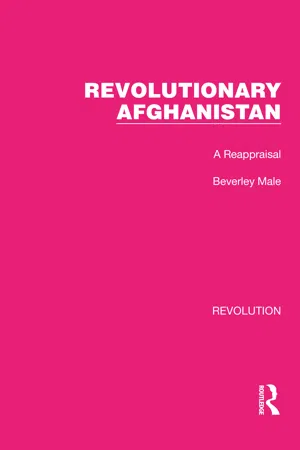
- 226 pages
- English
- ePUB (mobile friendly)
- Available on iOS & Android
eBook - ePub
About this book
Information
1 IN SEARCH OF HAFIZULLAH AMIN
When Soviet tanks rumbled across the Afghan border and down through the Hindu Kush in December 1979 the Western world was shaken from its post-Christmas torpor. Why had the Russians made such a dramatic and potentially dangerous move? For some the answer was simple: they thought the Soviets were heading for the oil fields and warm waters of the Persian Gulf. The fact that if this was so the Russians were going the long way around and doing it the hard way was an inconvenience swiftly dismissed by the protagonists of the expansionist school.
Others saw the Soviet move as essentially defensive, although they were divided over precisely what it was the USSR was defending itself against. Two such schools of thought argued that the Soviet objective was to prevent the imminent overthrow of a neighbouring communist government but they differed over the nature of the threat confronting that government. One group believed it came from an invincible Islamic tide, already sweeping Iran and Pakistan, intolerant of the alien, atheist, Marxist philosophy represented by the People’s Democratic Party of Afghanistan, and with serious implications for the security of the Soviet Central Asian republics to the north. The other, discounting the political importance of Islam, claimed that the Afghan government had too narrow a base of support and had alienated even this by its harsh measures. It was losing its grip, not before an Islamic rebellion, but in the face of mounting internal chaos. In either case, the overthrow of the Afghan government would have serious consequences for the USSR.
These two theories proved convenient for both the right and the left. For the right, the imminent collapse of the PDPA government before an overwhelming Islamic uprising was important, for a socialist revolution must not be allowed to appear successful. For the left, the myth that the government was no longer in control of a situation which threatened the survival of the PDPA regime is essential, because it saves the necessity of explaining the destruction by the Soviet Union of a perfectly competent socialist government.
A third school of thought argued that, as a result of the instability in Iran and the seizure of the American hostages in Tehran the USSR perceived the international environment as suddenly more menacing. It therefore moved to replace a government in Afghanistan which, even though it was socialist, Moscow could not control and regarded as potentially hostile, with one more amenable to Soviet tutelage.
At the centre of this controversy was one man, Hafizullah Amin, the Afghan President destroyed by the Soviet intervention. Seldom has any revolution been so widely misrepresented as that which began in Afghanistan in April 1978, or any revolutionary leader so viciously slandered as Hafizullah Amin. For the most part Amin has been condemned with scant regard for the evidence by his enemies across the ideological spectrum. They claim that he was at once so cunning and powerful that no one could outmanoeuvre him, and so weak and unpopular that he was about to be overthrown. The fact remains that Amin commanded immense personal loyalty among members of the PDPA and the armed forces. When he was finally overthrown, it was not by any internal Afghan opposition, but by four thousand specially trained Soviet airborne troops, backed by three divisions of the Soviet army. Despite the claims of Babrak Karmal, the new Soviet-backed Afghan president, that Amin had lost the support of the Revolutionary Council, Karmal was able to retain only four of Amin’s ministers, while three of the former president’s closest supporters, including one who had been involved in the early stages of the April 1978 uprising, were executed in June 1980.1
For the persistent misrepresentation of events in Afghanistan the Western media bears special, but by no means sole, responsibility.
Afghanistan has traditionally been recognised as a difficult country from which to report and about which to collect information, but the problem was compounded, after the 1978 Revolution, by journalists who arrived with preconceived ideas which they never questioned. Those who bothered to interview President Taraki or his Foreign Minister Hafizullah Amin seldom reported these interviews (the texts of which were usually published in the Kabul Times or broadcast over Kabul Radio) in any depth. Despite the frequently hostile and ignorant questions, Taraki and Amin patiently tried to explain what their revolution was about. Consistently they requested that Western journalists report accurately and honestly what they had been told, what they had seen. They might as well have saved their breath. The stories were written long before the journalists set foot in Kabul. One American journalist who went to Kabul in the wake of the April Revolution did not wait for President Taraki’s first press conference on 6 May despite the uncertainty in the West regarding the aims of the new leadership. ’I had all the atmosphere I needed, and I figured I could get the rest from the wire-services’, he said.2 A New York Times report gave more column inches to an unidentified student malcontent than it did to the Afghan Foreign Minister, with whom the journalist had recently had a long interview, and even then, he managed to quote Amin out of context.3
In contrast, press conferences given by leaders of the Afghan counterrevolution in Pakistan were reported sympathetically and uncritically, their extravagant claims taken at face value. Propaganda was one of their principal and most effective weapons, and the journalists who swallowed the line and wrote up the stories became the de facto allies of the counter-revolution.
The problem of misleading reporting grew worse as the power struggle within the Afghan leadership developed through the summer of 1979. Most writers failed even to attempt to discover the issues involved, remaining content to take the easy way out and explain the conflict in terms of personalities. The chief victim of this apparently deliberate campaign of slander was Hafizullah Amin, whose central role in the People’s Democratic Party and in the Afghan government, though widely recognised, has been widely misunderstood.
In the wake of the Soviet invasion of December 1979, in the course of which Amin was overthrown and probably killed, the Soviet and Afghan propaganda machines have joined the Western media in an all-out attempt to discredit him. Evidence which contradicts conventional wisdom has often been ignored, and if reported at all, is not allowed to interfere with well established myths.
Consider the widely accepted image of Amin as a ruthless executioner, destroying any who opposed him – a man whose actions, it is often suggested, bordered on genocide. Let us look at the record. There can be little doubt, in the light of the subsequent activities of Babrak Karmal and his associates, that there was more than a grain of truth in the allegations made by Taraki and Amin in September 1978 that Karmal and the Parchamites, along with certain senior army officers, were plotting against them. Yet Babrak Karmal, Anahita Ratebzada, Nur Ahmad Nur, Abdul Wakil and Mahmoud Baryalai were merely posted abroad as ambassadors. When the full extent of their activities was discovered they were recalled. Instead of returning to Afghanistan they vanished. There was some speculation in the Western press that they had been killed. Several others were arrested and imprisoned, including the Defence Minister, Abdul Qadir, the Planning Minister, Sultan Ali Kishtmand, the Public Works Minister, Mohammad Rafie and the Chief of the General Staff Lieutenant-General Shahpur. Again there was wide speculation that they had been summarily executed. However, in October 1979, after he emerged victorious from the power struggle with Taraki, Amin as President commuted the death sentences passed on Qadir and Kishtmand and reduced the prison sentence awarded Rafie. The only prominent member of that conspiracy who presumably was executed was Lieutenant-General Shahpur. Was this action of Amin’s that of a ruthless killer? Compare it with the record of Babrak Karmal since he became President!
Consistently, people believed to have been executed at Amin’s behest have reappeared in Babrak Karmal’s Revolutionary Council, or among the ranks of rebel leaders in Peshawar, yet no admission has ever been made that earlier assessments of Amin might have been mistaken.
But what, people will ask, became of the 17,000 prisoners in Puli Charki prison in Kabul, who ‘vanished’ during Taraki’s and Amin’s rule? Surely this proves that Amin was a mass murderer?
Even if the figure of 17,000 deaths was correct, it would not be a particularly large figure in the context of the bitter counter-revolutionary campaign being waged by the remnants of the ancien regime whose own record of violence, before and after the April Revolution, is well documented. And it is not clear that Hafizullah Amin would bear the sole responsibility. But where did this figure of 17,000 come from?
When I was in Kabul in March 1979 the common figure for prisoners in Puli Charki, cited by expatriate Westerners, was 12,000. I was unable to find any documentation for this figure and efforts to discover its source led me repeatedly to the American Embassy. I therefore discounted it as a further sample of the ‘black propaganda’ being spread about the Afghan government. Then, in a report published by Amnesty International in September 1979,4 the figure of 12,000 appeared publicly for the first time. It was thereafter sanctified by this prestigious international organisation. Amnesty International was particularly critical of what it regarded as lack of co-operation from the Afghan government, and of its alleged record of human rights violations. They did acknowledge that the record of previous Afghan governments in this respect also left something to be desired, but it is significant that they never bothered to send a delegation to Afghanistan before the April 1978 Revolution.
Press reports subsequently referred to a list published in Kabul of 12,000 ‘missing’ persons, although the list has never materialised. Hafizullah Amin denied any knowledge of such a list, and also denied that there were anything like 12,000 political prisoners in Puli Charki. He did however acknowledge the existence of some political prisoners in Afghanistan, estimating the number at ‘about 1000’ a rather unusual candour, for government leaders seldom admit to holding political prisoners at all.5
After the Soviet invasion, when the doors of Pull Charki were ‘flung open’ by the Karmal regime, 2000 political prisoners emerged. What happened, then, to the other 10,000? There was never any suggestion in the Western media that Amin’s estimate of 1000 was a more nearly correct figure and that Amnesty International and the Western press had been wrong. No: the ‘missing’ 10,000 must have been executed by Amin, along with another 7,000 thrown in for good measure, a figure no one has ever attempted to explain!
The present Afghan government and the Soviet Union have also played a not inconsiderable part in perpetuating the image of Amin as a mass murderer, although Babrak Karmal has so far been completely unsuccessful in discovering even a single mass grave, despite his early exhortations to the Afghan people to search for the many he claimed existed. And yet the myth of Amin as a mass murderer persists, perpetuated by refugees who fled an Afghanistan no longer being run in their class interest; by Babrak Karmal’s regime, which depends heavily on it in order to legitimise its own seizure of power; by the US which uses Amin’s ‘appalling human rights record’ to excuse its failure to heed his appeals; and by a group of leftist intellectuals outside Afghanistan for whom the alternative is too embarrassing to contemplate.
The portrayal of Amin as a butcher, while the most vicious of them, is not the only persistent myth concerning him. Scarcely less dangerous, since it provides much of the basis for the other, is the myth that he was a ruthless megalomaniac unable to rest until he had destroyed all his rivals, and which identifies him as the real power in Afghanistan from the time of the April revolution or soon after. Amin was certainly a powerful figure, both in the party before the revolution and in the government afterwards, though his power has usually been exaggerated, was always under challenge, and was nowhere near decisive until he became President in September 1979.
His appointment as Prime Minister at the end of March 1979, whereby he is commonly assumed to have pushed Taraki sideways into the Presidency and grabbed supreme power for himself was in fact a neat manoeuvre on Taraki’s part to isolate Amin, leaving him with the prestigious sounding title of Prime Minister, but retaining real power in the office of the President. Amin was in the unenviable position of being held responsible for the chaos which developed in Afghanistan during the summer of 1979, without being able to do anything to prevent it. Once he regained control of the Defence Ministry, and especially after he became President, far from losing his grip in the face of either a religious-inspired rebellion, or mounting internal chaos, he began to implement policies which showed every sign of stopping the rot and consolidating the revolution. But his efforts were cut short after only three months by the Soviet military intervention.
Another persistent belief among some Westerners, especially Americans, is that Amin was fanatically pro-Soviet. As a socialist, Amin could be expected to adopt a similar position on many international issues to that of the Soviet Union. Nor is it surprising that the PDPA government, of which he was an influential member, sought Soviet advice and assistance in economic planning and development. As a realist, Amin recognised that Afghanistan was, and had been, locked into a position of military and economic dependence on the Soviet Union long before the April 1978 revolution. His aim was to minimise this dependence, to keep other options open, and, at least from the end of 1978, to prevent further Soviet encroachment into Afghanistan. Most important he sought to keep control of the levers of power in Afghan hands.
Although the image of Amin as a Soviet stooge took a battering when the news leaked out of Soviet involvement in the attempt to kill him in September 1979, and was further shaken by the Soviet invasion in December in which he was overthrown, it is still propagated by Americans who use it to help explain their government’s failure to hear and to heed the signals Amin was sending out long before September 1979.
It has been challenged from the left by the equally damaging allegation that Amin was a CIA agent. This has been taken up with enthusiasm only by Babrak Karmal who uses it as a device to legitimise his own regime. Despite his claim to have known that Amin worked for the CIA from the 1950s, and his assertion that he ha...
Table of contents
- Cover
- Half-Title Page
- Title Page
- Copyright Page
- Original Title Page
- Original Copyright Page
- Table of Contents
- Preface
- 1. In Search of Hafizullah Amin
- 2. Three Revolutionaries
- 3. A House Divided: The Pdpa, 1965-1973
- 4. The Making of a Revolution: The PDPA, 1973-1978
- 5. The Inheritance: Afghanistan, 1978
- 6. Strategy for Reform
- 7. The Eid Conspiracy
- 8. A Treaty and a Murder: Closing the American Option
- 9. The Question of Leadership
- 10. The Summer of Discontent
- 11. The Endgame
- 12. ‘... And the People Remain’
- Select Bibliography
- Table 1 Afghanistan 1978: Some Social Indicators
- Table 2 Distribution of Land in Afghanistan, 1978
- Table 3 literacy in Afghanistan
- Index
Trusted by 375,005 students
Access to over 1.5 million titles for a fair monthly price.
Study more efficiently using our study tools.
Frequently asked questions
Yes, you can cancel anytime from the Subscription tab in your account settings on the Perlego website. Your subscription will stay active until the end of your current billing period. Learn how to cancel your subscription
No, books cannot be downloaded as external files, such as PDFs, for use outside of Perlego. However, you can download books within the Perlego app for offline reading on mobile or tablet. Learn how to download books offline
Perlego offers two plans: Essential and Complete
- Essential is ideal for learners and professionals who enjoy exploring a wide range of subjects. Access the Essential Library with 800,000+ trusted titles and best-sellers across business, personal growth, and the humanities. Includes unlimited reading time and Standard Read Aloud voice.
- Complete: Perfect for advanced learners and researchers needing full, unrestricted access. Unlock 1.5M+ books across hundreds of subjects, including academic and specialized titles. The Complete Plan also includes advanced features like Premium Read Aloud and Research Assistant.
We are an online textbook subscription service, where you can get access to an entire online library for less than the price of a single book per month. With over 1.5 million books across 990+ topics, we’ve got you covered! Learn about our mission
Look out for the read-aloud symbol on your next book to see if you can listen to it. The read-aloud tool reads text aloud for you, highlighting the text as it is being read. You can pause it, speed it up and slow it down. Learn more about Read Aloud
Yes! You can use the Perlego app on both iOS and Android devices to read anytime, anywhere — even offline. Perfect for commutes or when you’re on the go.
Please note we cannot support devices running on iOS 13 and Android 7 or earlier. Learn more about using the app
Please note we cannot support devices running on iOS 13 and Android 7 or earlier. Learn more about using the app
Yes, you can access Revolutionary Afghanistan by Beverley Male in PDF and/or ePUB format, as well as other popular books in Politics & International Relations & Politics. We have over 1.5 million books available in our catalogue for you to explore.