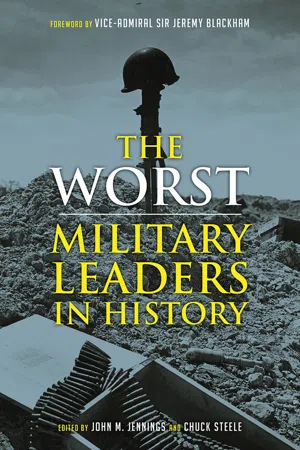
For this book, fifteen distinguished historians were given a deceptively simple task: identify their choice for the worst military leader in history, and then explain why theirs is the worst.
From the clueless Conrad von Hötzendorf and George A. Custer to the criminal Baron Roman F. von Ungern-Sternberg and the bungling Garnet Wolseley, this book presents a rogues' gallery of military incompetents. While there are plenty of books that analyse the keys to success, this collection offers lessons of failure to avoid. In other words, The Worst Military Leaders in History, now in paperback, is a 'how-not-to' guide to leadership.
eBook - ePub
The Worst Military Leaders in History
- English
- ePUB (mobile friendly)
- Available on iOS & Android
eBook - ePub
The Worst Military Leaders in History
About this book
Information
PART 1
CRIMINALS
1
ROMAN FEDOROVICH
VON UNGERN-STERNBERG
ROMAN FEDOROVICH
VON UNGERN-STERNBERG
John M. Jennings
The Russian Civil War of 1918–22 was in several respects a sequel to the First World War. Its sheer physical scope was enormous: the battlefronts ranged across a vast area from Archangel in the north to Crimea in the south, from the gates of Warsaw in the west to Vladivostok in the east. The pitiless, fratricidal struggle between Reds and Whites claimed the lives of millions of combatants and civilians. Moreover, it was a conflict with significant international ramifications, as a multitude of foreign powers dispatched armed forces to Russia to aid the Whites, while the Reds for their part attempted to foment a world communist revolution. In this monumental conflict, inept military leadership played no small role in the defeat of the Whites. Lacking the effective command and control structure of the Red Army, the White military was essentially a hotchpotch of local armies led by a motley and ill-disciplined assortment of commanders who often behaved more like warlords than responsible military professionals. Arguably, the worst of these was Roman Fedorovich von Ungern-Sternberg, who led a reckless and ill-fated invasion of the Soviet Union in 1920.
Ungern, a junior officer during the First World War, was thrust by the circumstances of the Russian Civil War into the leadership of a band of White fighters operating along a section of the Trans-Siberian Railroad. A fanatical monarchist, he then launched a foray into neighbouring Mongolia, which he planned to use as the springboard for an offensive to destroy the Soviet Union and restore nothing less than the Russian, Chinese and Mongol empires. Ungern’s pursuit of this grandiose military fantasy with a pitifully small army, as well as his single-minded ferocity in carrying out the struggle against the Reds, which included the torture and murder of both real and imagined enemies, led his contemporaries to dub him the ‘Mad Baron’ and the ‘Bloody Baron’. Despite a distinct lack of enthusiasm among the Mongols for his crusade, due largely to their revulsion at his cruelty, Ungern nevertheless proceeded to invade the Soviet Union in the summer of 1920, with predictably disastrous results. Ultimately his own troops, exasperated by defeat and Ungern’s brutal leadership, mutinied and turned him over to the Reds, who duly shot him.

Roman Fedorovich von Ungern-Sternberg under interrogation by the Soviet army, September 1921.
Roman Fedorovich von Ungern-Sternberg was born on 22 January 1886 into a world of aristocratic privilege, but his life was characterized by instability almost from the start. His parents, an Estonian noble and an Austrian baroness, separated in 1891 due to his father’s idiosyncratic behaviour.1 After being expelled from secondary school, Ungern began preparing for a career as a naval officer, but when the Russo-Japanese War broke out in 1904, the impetuous youth volunteered for army service. Although the hostilities were winding down by the time he arrived at the front, the teenaged baron earned a medal for bravery and a promotion.2
After returning from the front, Ungern barely managed to graduate from military school in 1908, and as a junior officer he refused to follow the conventional path of service in an infantry regiment. Instead, in June 1908 he joined the First Argun Regiment of the Transbaikalian Cossacks, which was posted at Dauria station, a stop along the Trans-Siberian Railway.3 The frontier posting appealed to Ungern, who was most at home on horseback in the wild, living the same rough life as the Cossacks under his command, but who was manifestly uncomfortable in the more socially polished and conventional environment inhabited by his fellow officers. As Baron Peter Wrangel, Ungern’s commander during the First World War and a future leader of the Whites, described him:
He was a man of queer contrasts. He had an original, penetrating mind, but at the same time an astonishing lack of culture, an extremely narrow outlook, the shyness of the savage, a foolish swagger, and an unbridled temper. He was very extravagant, though his means were exceptionally small.4
Heavy drinking apparently made Ungern even more hot-tempered and unpredictable, for during one drinking bout the enraged Baron struck a fellow officer, who responded by slashing him across the forehead with a sabre. Ungern was court-martialled and expelled from his regiment. He was subsequently dispatched to the western Mongolian town of Hovd, arriving there in February 1913 to assist with training the new army of Mongolia.5
A suzerain of the Qing Empire since the seventeenth century, Mongolia was able to achieve nominal independence in 1911 as Manchu rule in China collapsed. The titular leader of the newly independent Mongolia was the eighth Javzandamba Hutagt, who was believed to be a reincarnation of the Buddha. Despite a personal lifestyle that was far from ecclesiastic, as he was a drunkard and had become blind after contracting syphilis, the Hutagt was an astute politician.6 In July 1911 he summoned the leaders of the aristocracy and clergy to a conference to discuss Mongolia’s political future. Subsequently, a delegation was dispatched to St Petersburg with an appeal to Tsar Nicholas II for Russian aid.7 Unfortunately for the Mongolian delegation, it arrived at a time when there was little enthusiasm for such a foreign policy adventure among the Tsar’s officials and it was sent home largely empty-handed.8
Despite Russia’s rebuff, the Mongolian revolution proceeded. On 4 December 1911 the Qing Resident in Urga, the capital, fled to the Russian consulate for protection after the demoralized Chinese garrison surrendered.9 His escort was under the command of Grigorii M. Semenov, a junior officer of mixed Buriat Mongol–Cossack descent who had been posted to Urga with a small detachment of Cossacks to guard the Russian consulate.10 Semenov, like Ungern, was a courageous junior officer, but was also constitutionally undisciplined and unpolished. Eventually the paths of these two officers crossed during the First World War, and their fortunes would become closely linked during the Russian Civil War.
Ungern’s later stay in Hovd coincided with the high point of Tsarist Russian influence over Mongolian affairs. Military advisers like Ungern and Semenov helped to modernize the army, while civil advisers overhauled the finances and administrative structure of the new government. During this period Ungern steeped himself further in the language and culture of Mongolia, spending most of his free time alone in the wild on horseback or in consultations with Mongolian clerics, who apparently fostered his growing interest in mystical Buddhism.11
In the summer of 1914 Ungern was dispatched to Europe with the First Nerchinsk Cossack Regiment. His service on the Eastern Front from 1914 to 1916 was characterized by a combination of exceptional bravery in battle, which won him the St George’s Cross, the highest medal for valour in the Imperial Russian Army, and wild behaviour away from the battlefront, most notoriously the drunken assault of a hotel porter who had refused his demand for a room. Although he received a light punishment of two months’ confinement for that incident – his superiors noted in his favour that he had been injured five times in battle – such eccentricity ensured that the Baron would never rise above the rank of captain.12
In early 1917 Ungern’s regiment was transferred to Persian Azerbaijan, where the Russian army was fighting against the Ottoman Turks. By that time he had made the acquaintance of Semenov, who was also a captain in the Nerchinsk regiment. Ungern and Semenov had much in common: they were exceptionally courageous junior officers, as Semenov had also won the St George’s Cross; they had both served in Mongolia; and both were keen students of Mongolian language and culture.13
In March 1917 Nicholas II abdicated, which must have horrified Ungern. Although the new Provisional Government pledged to continue fighting, army discipline began to deteriorate. As the Russian soldiers began to desert in ever-increasing numbers, Ungern recruited a detachment of volunteers from among the local inhabitants of Persian Azerbaijan, the Aisars, in an attempt to shame the Russians into staying at the front. Although the experiment with the Aisars failed, Semenov pursued the idea of recruiting non-Russian units. He contacted Buriat Mongol acquaintances in his native Transbaikalia (a region of Siberia to the east of Lake Baikal) to sound them out about organizing military detachments, and at the same time he broached the idea to the military chain of command.14
Semenov’s proposal eventually was accepted by the War Ministry, which ordered him to Chita, the regional capital of Transbaikalia.15 Ungern subsequently joined him, but they quickly learned that the authority of the Provisional Government was virtually non-existent, and that chaos reigned throughout the region. Although Semenov had begun to make enough headway through the myriad of local revolutionary committees to begin selecting volunteers by the end of September, the Bolshevik seizure of power in November 1917 ended that effort. Semenov and Ungern became fugitives and had to split up to evade arrest by the Soviet authorities.
They eventually reunited in late November at Dauria, a station on the Trans-Siberian Railway in Transbaikalia, where they discovered that the garrison consisted of one company of militia assigned to guard German and Turkish prisoners of war.16 Asserting his dubious authority with the defunct Provisional Government, Semenov was able to gain tenuous control over the ill-disciplined garrison, aided by some of the prisoners of war, who were formed into a company of military police by Ungern. Semenov dispatched agents to Buriat and Cossack leaders in Transbaikalia with appeals for volunteers and horses, and he contacted General Dmitrii L. Khorvat, the chief administrator of the Chinese Eastern Railway, for assistance in forming a volunteer detachment to protect the region against encroachment by the Bolsheviks.17
With little immediate outside support forthcoming, on 18 December 1917 Semenov and a handful of Cossack junior officers and enlisted men moved eastward along the railway to Manchuria station. Finding the garrison there as unruly as the one at Dauria, Semenov decided to disarm and disperse it. Ordering the Baron to come with a train of empty freight cars, Semenov bluffed the Manchuria garrison into disarming by persuading the men that a fully armed battalion was on the way from Dauria. When Ungern and his ‘battalion’ of four other men arrived, the entire garrison was loaded into the empty freight cars and sent far away to the west. After this success, Semenov and Ungern disarmed and disbanded the Dauria garrison in the same way.18
Such activities were part of the emergence of the White movement, which was arising spontaneously across Russia in armed opposition to the depredations of the new Soviet regime, and in the chaotic conditions of the Civil War, previously insignificant figures like Semenov and Ungern could quickly rise to positions of prominence among the Whites. Indeed, by January 1918 Semenov had recruited five hundred volunteers for his unit, which was now known as the Special Manchurian Detachment (SMD). With this force, Semenov and Ungern were able to occupy more and more stations along the railway, further enhancing their power and authority. Semenov appointed Ungern as the military governor of Hailar, a small town on the Russian–Chinese border, but Ungern’s efforts to establish order there met with widespread resistance from the garrison, which also had to be disarmed and dispersed.19
Moreover, the Allied powers, alarmed that a potential Soviet alliance with the Central Powers might decisively tip the wartime balance of power, had begun to support anti-Bolshevik leaders like Semenov. By February 1918 the British and the French were paying Semenov monthly instalments of cash to purchase arms and equipment.20 Semenov’s most significant foreign ally, though, was Japan. For expansionists in Japanese civil and military circles, the Russian Civil War presented an opportunity to detach Transbaikalia and Primorye (the Russian Maritime Territory), and Semenov seemed amenable to the idea of becoming the regional ruler under Japan’s auspices. In October 1918 the SMD, which had reorganized and refitted with Japanese cash and equipment, and was supported in the field by Japanese troops, launched a major offensive northward into Transbaikalia and seized Chita.21
The capture of Chita was the pinnacle of Semenov’s fortunes in the Civil War. The SMD did not undertake any further offensive operations, but instead remained in Transbaikalia and binged on criminality and drunken debauchery. Gangs of SMD thugs known as the razvedkas roamed the railway lines on armoured trains, terrorizing the local population with indiscriminate robberies, rapes and murders in the name of rooting out Red partisans.22
The degeneracy of the SMD started at the top with Semenov. He seems to have spent most of his time in Chita enriching himself with bribes and loot, and then drunkenly partying with his lackeys and many mistresses. Having achieved a measure of respectability when he was elected field ataman (chieftain) of the Transbaikalian Cossacks in June 1918, the inflated Semenov refused to subordinate himself to the White ‘supreme ruler’ Admiral Aleksandr Kolchak, whose regime was based in Omsk. The two eventually reconciled, but their dispute did irreparable harm to the White war effort.23
By the end of 1919 a Red Army counteroffensive had dislodged Kolchak’s army from its foothold on the western slopes of the Ural Mountains and driven the Whites into a headlong retreat to the east. Kolchak himself was captured and shot by Soviet authorities in Irkutsk in February 1920, but not before appointing Semenov commanderin-chief of the White Far Eastern Army.24 This proved to be a hollow gesture, as the Far Eastern Army consisted of Semenov’s now militarily worthless detachment and the fleeing remnants of Kolchak’s army. At the same time, Semenov faced mounting pressure from partisan units that were springing up all across Transbaikalia in anticipation of the Red Army’s arrival. The fatal blow to Semenov came when the Japanese Army began to withdraw from Transbaikalia in the summer of 1920. When that process was completed in the autumn, the SMD collapsed. The remnants fled east to Primorye, where the Whites were preparing a last stand.25
In the meantime Ungern, who had moved back to Dauria from Hailar, was growing estranged from Semenov: in fact, the paths of the two had begun to diverge from around the time that Semenov established himself in Chita. Although the Baron remained Semenov’s nominal subordinate and neither would admit publicly to a rift, Ungern was a ‘loose cannon’ by nature, while Semenov was utterly incapable of, and uninterested in, maintaining effective command and control over his subordinates.26 Moreover, Ungern, whose personal asceticism had become even more pronounced during the Civil War, disapproved of the Ataman’s corruption and debauched lifestyle. In particular, the notoriously antisemitic Ungern was disgusted with Semenov for having an open affair with a Jewish cabaret performer, ‘Mashka’ Sharaban. Ungern even named one of his horses ‘Mashka’ to show his disgust.27
Most importantly, while at Dauria the Baron managed to raise and equip a considerable detachment on his own. This unit, known as the Asiatic Cavalry Division (ACD), numbered approximately 1,500 men equipped with rifles, some machine guns, and four artillery pieces as of August 1920. The ACD was a polyglot melange of Russians, Cossacks, Buriat Mongols, Chinese and a small detachment of Japanese organized in units along national lines, but all under the command of Russian officers.28 Recruits came from a number of sources: original adherents of Semenov and Ungern, leftovers from the failed attempt to create non-Russian na...
Table of contents
- Front Cover
- Half Title
- Title Page
- Copyright
- Contents
- Foreword
- Introduction
- PART 1: CRIMINALS
- PART 2: FRAUDS
- PART 3: THE CLUELESS
- PART 4: POLITICIANS
- PART 5: BUNGLERS
- REFERENCES
- BIBLIOGRAPHY
- CONTRIBUTORS
- ACKNOWLEDGEMENTS
- PHOTO ACKNOWLEDGEMENTS
Trusted by 375,005 students
Access to over 1.5 million titles for a fair monthly price.
Study more efficiently using our study tools.
Frequently asked questions
Yes, you can cancel anytime from the Subscription tab in your account settings on the Perlego website. Your subscription will stay active until the end of your current billing period. Learn how to cancel your subscription
No, books cannot be downloaded as external files, such as PDFs, for use outside of Perlego. However, you can download books within the Perlego app for offline reading on mobile or tablet. Learn how to download books offline
Perlego offers two plans: Essential and Complete
- Essential is ideal for learners and professionals who enjoy exploring a wide range of subjects. Access the Essential Library with 800,000+ trusted titles and best-sellers across business, personal growth, and the humanities. Includes unlimited reading time and Standard Read Aloud voice.
- Complete: Perfect for advanced learners and researchers needing full, unrestricted access. Unlock 1.5M+ books across hundreds of subjects, including academic and specialized titles. The Complete Plan also includes advanced features like Premium Read Aloud and Research Assistant.
We are an online textbook subscription service, where you can get access to an entire online library for less than the price of a single book per month. With over 1.5 million books across 990+ topics, we’ve got you covered! Learn about our mission
Look out for the read-aloud symbol on your next book to see if you can listen to it. The read-aloud tool reads text aloud for you, highlighting the text as it is being read. You can pause it, speed it up and slow it down. Learn more about Read Aloud
Yes! You can use the Perlego app on both iOS and Android devices to read anytime, anywhere — even offline. Perfect for commutes or when you’re on the go.
Please note we cannot support devices running on iOS 13 and Android 7 or earlier. Learn more about using the app
Please note we cannot support devices running on iOS 13 and Android 7 or earlier. Learn more about using the app
Yes, you can access The Worst Military Leaders in History by John M. Jennings, Chuck Steele, John M. Jennings,Chuck Steele in PDF and/or ePUB format, as well as other popular books in History & Military Biographies. We have over 1.5 million books available in our catalogue for you to explore.