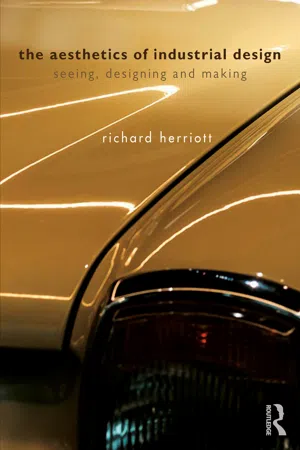
The Aesthetics of Industrial Design
eBook - ePub

The Aesthetics of Industrial Design

Seeing, Designing and Making

  1. 200 pages
  2. English
  3. ePUB (mobile friendly)
  4. Available on iOS & Android
eBook - ePub

The Aesthetics of Industrial Design

Seeing, Designing and Making

About this book

This textbook introduces design students to key principles of three-dimensional form, bridging aesthetics and practical design objectives. It explores how we see and what it is that characterises visually appealing and satisfactory design.

Written by an experienced designer, educator and researcher, The Aesthetics of Industrial Design equips students with the knowledge and understanding of how aesthetically superior design is distinct from lesser work. It explains the key principles and concepts they can incorporate into their own designs, encourages readers to investigate and experiment with real design problems and enables them to verbally communicate their design intentions. The book prompts readers to critically reflect on their work and surroundings. Through numerous clear examples and illustrated case studies, which are guided by cognitive science and the application of aesthetic theory, the book brings together the basic aspects of design as form-giving. It explores the balance of function, material and appearance in detail and explains the reasons for common aesthetic faults and how to avoid them.

Aimed at undergraduate- and postgraduate-level students within the design fields, this book reveals the secrets to aesthetically successful products that readers can take from education into future practice.

Frequently asked questions

Yes, you can cancel anytime from the Subscription tab in your account settings on the Perlego website. Your subscription will stay active until the end of your current billing period. Learn how to cancel your subscription.
No, books cannot be downloaded as external files, such as PDFs, for use outside of Perlego. However, you can download books within the Perlego app for offline reading on mobile or tablet. Learn more here.
Perlego offers two plans: Essential and Complete
  • Essential is ideal for learners and professionals who enjoy exploring a wide range of subjects. Access the Essential Library with 800,000+ trusted titles and best-sellers across business, personal growth, and the humanities. Includes unlimited reading time and Standard Read Aloud voice.
  • Complete: Perfect for advanced learners and researchers needing full, unrestricted access. Unlock 1.4M+ books across hundreds of subjects, including academic and specialized titles. The Complete Plan also includes advanced features like Premium Read Aloud and Research Assistant.
Both plans are available with monthly, semester, or annual billing cycles.
We are an online textbook subscription service, where you can get access to an entire online library for less than the price of a single book per month. With over 1 million books across 1000+ topics, we’ve got you covered! Learn more here.
Look out for the read-aloud symbol on your next book to see if you can listen to it. The read-aloud tool reads text aloud for you, highlighting the text as it is being read. You can pause it, speed it up and slow it down. Learn more here.
Yes! You can use the Perlego app on both iOS or Android devices to read anytime, anywhere — even offline. Perfect for commutes or when you’re on the go.
Please note we cannot support devices running on iOS 13 and Android 7 or earlier. Learn more about using the app.
Yes, you can access The Aesthetics of Industrial Design by Richard Herriott in PDF and/or ePUB format, as well as other popular books in Architecture & Architecture General. We have over one million books available in our catalogue for you to explore.

Information

Publisher
Routledge
Year
2021
Print ISBN
9781032024196
eBook ISBN
9781000535242

Table of contents

  1. Cover
  2. Half-Title
  3. Endorsements
  4. Title
  5. Copyright
  6. Dedication
  7. Contents
  8. List of Illustrations
  9. Acknowledgements
  10. 1 How do we see?
  11. 2 Resolving the constraints
  12. 3 Lines, surfaces and curvature
  13. 4 Craftsmanship
  14. 5 The meaning of the object and its elements: Product semantics
  15. References
  16. Index