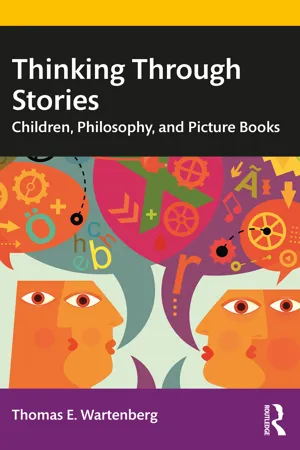
This book provides justification and instruction for exploring philosophy with children, especially by using picture books to initiate philosophical discussion. By demonstrating to teachers, and others that picture books often embed philosophical issues into their narratives, and that this makes picture books a natural place to go to help young children investigate philosophical issues, the author offers a straightforward approach to engaging young students. In particular, this volume highlights how philosophical dialogue enhances children's sense of self, provides a safe space for the discussion of issues that they are confronted with in living their lives, and develops an admirable method for resolving conflict that the children can use in other contexts.
- 124 pages
- English
- ePUB (mobile friendly)
- Available on iOS & Android
eBook - ePub
About this book
Information
1INTRODUCTION
DOI: 10.4324/9781003257455-1
When I was growing up in Great Neck, a suburb of New York City on Long Island, my parents would often take us to Manhattan as a special treat. We would drive the Long Island Expressway, often referred to sarcastically as the greatest parking lot in the world. Our route would take us through Queens where one cemetery followed another in a seemingly infinite sequence until we descended into semi-darkness of the Queens-Midtown Tunnel.
As a boy, I was terrified of those cemeteries, probably because they brought me face-to-face with the reality of death. As we drove past row after row of headstones and graves, I would slump onto the space between the front and rear seats of our family car, as if hiding there would somehow save me from the fate all those graves and their markers represented. Death was definitely something that freaked me out.
Perhaps surprisingly, my parents never commented on my odd behavior. I never discussed this with them while they were alive, so I don’t know how they rationalized their decision not to talk with me about it. Even in religious school—I was brought up going to a reform Jewish synagogue and was eventually Bar Mitzvahed—I don’t recall the subject of death ever coming up, which is odd given how central a role death plays in religion. The closest we ever came to discussing death in a meaningful way was to talk about why Jews did not believe in heaven, hell, or an afterlife.
Because no one ever discussed the significance of the fact that each of us will someday no longer exist, my fear of death festered without any outlet while I was growing up. It was not until I discovered philosophy as a high school student that I began to realize that death was a subject that philosophers had addressed throughout the ages. From Socrates’ claim that the life of a philosopher was simply preparation for death to Martin Heidegger’s claim that human beings flee the awareness of their own mortality, philosophers have discussed death in ways that can be helpful for those trying to come to terms with this most fundamental and terrifying fact about human life. Just realizing that other people have had the same concerns that I did as a child was very helpful to me in dealing with my own anxiety.
Had I been brought up in a more enlightened environment, I might have taken part in an elementary-school dialogue about death, one that I would have found very reassuring. Discovering that everyone—all of my classmates included—was scared of dying and unsure of what happened after death would have been profoundly reassuring and healing to me: reassuring, because I would no longer have thought of myself as odd for worrying about dying; healing, because I would then have seen myself as sharing a fundamental concern with my school peers.
Maybe this is one reason why I have become such a passionate advocate for discussing philosophy with children. I see philosophical discussions as one important vehicle for communicating with children and allowing them to express their deepest fears, desires, and beliefs. And in so doing, children learn that they are not as different from their classmates as they had feared, for they all have experienced some “weird thoughts,” such as “Could the world have just begun 5 minutes ago, with many false memories implanted in my brain?”
But the communication that takes place during philosophical dialogues does not just involve the expression of one’s beliefs, though that is an important part of it. It requires that one interact with others who are similar to oneself. In this respect, philosophy is not a solitary enterprise, requiring lots of time spent by oneself reflecting about the nature of reality. Instead, philosophy as practiced in elementary schools is a communal activity in which a group of young people talk to one another, listen to what everyone else has to say, and critically evaluate the reasons the students give in support of their beliefs.
Too often, philosophers have ignored the communal nature of their enterprise. René Descartes, for example, begins his Meditations on First Philosophy by acknowledging the context for his meditative practice: he has withdrawn to the country so that he will not be distracted by urban life and can single-mindedly devote himself to determining which, if any, of his beliefs he can know with certainty. But even as he claimed that doing philosophy required him to isolate himself, Descartes actually distributed copies of his Meditations to the leading philosophers of his day, who responded with objections to which Descartes then offered replies. Hardly what one would expect if philosophy were truly a solitary affair.
Philosophy for and with children (p4/wc, hereafter)—I am here using the awkward label that many have adopted to refer to this field—stands firmly in a tradition that sees philosophy as a communal enterprise.1 In so doing, p4/wc places itself into a philosophical tradition that can trace its lineage back at least to Baruch Spinoza who saw all of humanity as an aspect of a single, overarching entity which he characterized with the dual label, Deus sive Natura, God or Nature. More recently, the pragmatist tradition, inaugurated by Charles Sanders Peirce and developed by William James and John Dewey among others, posited philosophy as an activity requiring a group of people committed to engaging in a critical assessment of their most-cherished ideas.
With children, the group setting for philosophical dialogues is important for many reasons. As I have already mentioned, seeing that other children share one’s own concerns can be a powerfully liberating experience for a child who thinks of themselves as having fears and desires that no one else shares. Noticing that others have similar concerns can lead a child to feel less odd and unusual, since the “odd” beliefs they have will come to be seen as indicative of their philosophical nature.
An individual child may find it hard to reflect upon the sorts of issues that are the lifeblood of philosophy. In a group setting, with other children vying to express their ideas, such a child will be able to learn from what they see the other children doing. Working together, the children can come to develop ideas that none of them would have thought of working on their own. To put it somewhat paradoxically, p4/wc teaches children to think for themselves together.
1.1Why Don’t We Teach Children Philosophy?
Given the naturalness of children’s interest in discussing philosophical issues, it may be surprising to realize how infrequently philosophy is taught to pre-college students in the United States. Philosophy is often seen as the lynch pin of the humanities, anchoring the other humanistic disciplines such as literature, art, music, and the performing arts (theater, film, etc.). But unlike those other humanistic disciplines, philosophy is not one of the core subjects in the curricula of pre-college classes. While it is difficult to imagine an elementary school curriculum that did not include reading, writing, and art, the same cannot be said of philosophy. It is the rare school—other than religiously affiliated ones and those in the International Baccalaureate Program—that includes philosophy in its curriculum, especially for younger pre-college students.
Why is this so? One of the peculiarities of the Western philosophical tradition is its repeated insistence that philosophy is not a subject suitable for young people to study. Plato, the great Greek philosopher, argued in his dialogue, The Republic, that philosophy should only be studied by people toward the end of their lives, once they had been educated and pursued a career, thus not before the age of 50. In part, this was because he thought that a person could only do philosophy if they had already studied mathematics, literature, and other fields. Once a person had this background, they would be ready to embark on a philosophical education, but not before then.
We can understand why Plato believed young people should not be taught philosophy by situating this belief within Plato’s overall conception of philosophy. Plato believed that the things that most of us take to be real in the course of living our lives, things like tables, chairs, and beds, are not fully real, for they are subject to change and destruction. True reality, Plato maintained, must be unchanging and eternal, and he dubbed the separate realm in which such realities existed as the world of Forms. The Forms were those ultimately real things, like Beauty and Truth that the Appearances in our world only approximate. Unlike the constantly changing things of this world, the Forms remain the same, so that the Form of Beauty will always be beautiful and never admit its opposite, say, ugliness.
Plato’s general conception of philosophy is derived from this metaphysical view. While most people are only aware of the existence of ordinary things—Appearances in Plato’s terminology—the task of philosophy is to articulate and understand the nature of the ultimate reality, the Forms. While we all are aware of beautiful things, from a porcelain bowl to a stunning sunset, philosophers have to learn how to become aware of the Forms. This is not something that happens naturally, for it requires training.
The training that philosophers need involves sharpening their ability to perceive abstract objects. Aside from the Forms, the most obvious examples of abstract objects are those of mathematics. Just as the Form of Beauty is distinct from beautiful things, so the number 2 is distinct from pairs of things that provide us with empirical representations of the number. A student who studies mathematics learns to perceive and manipulate the abstract entities that are numbers (algebra) and shapes (geometry). This puts them on a path that will enable them to perceive the most abstract of objects, the Forms, at least in Plato’s view. That’s why he thought philosophers first had to be proficient in mathematics among other disciplines. Only once potential philosophers were fluent with mathematical objects would they be prepared to perceive the Forms themselves.
Very few people today accept Plato’s metaphysics, so that the rationale for barring young people from the study of philosophy no longer can be based in his ideas. Nonetheless, many philosophers agree with Plato that the very abstract nature of philosophy makes it an unsuitable subject for young people to study. This is the reason they would limit the study of philosophy to older students who had developed sufficient cognitive skills to engage in philosophical discourse.
As a result, philosophers have participated in the relegation of their own discipline to the fringes of pre-college education. Since philosophers do not believe that young students have the capabilities required for philosophical thinking, it’s not surprising that there is such widespread reluctance to introduce philosophy into the curricula of elementary schools.
A growing number of philosophers and educators in the United States and, indeed, across the globe have rejected this idea and come to realize that young people deserve the opportunity to study philosophy. Given the prevalence of the opposing view—that young people are not capable of doing philosophy—it is imperative that there be a sustained and systematic justification for teaching philosophy to young people. This book provides that justification, something not needed in fields that are widely assumed to be necessary for the education of young people, such as mathematics.
The book you have before you is the third one I have written about doing philosophy with young children. Big Ideas for Little Kids: Teaching Philosophy Through Children’s Literature is a how-to guide for those interested in introducing children to philosophy using picture books. A Sneetch Is a Sneetch and Other Philosophical Discoveries: Finding Wisdom in Children’s Literature provides an introduction to philosophy for adults that uses picture books to present philosophical ideas and theories.
Thinking Through Stories has a different aim than my two earlier books. I write it as a p4/wc practitioner who has been facilitating philosophical discussion among children for a quarter of a century. During that time, I have become increasingly cognizant of the need to provide children with the opportunity to take part in philosophical discussions. I have learned about the variety of different approaches people have taken to this project and seen it in action around the globe. At the same time, I felt a need to justify the passion I have for this endeavor and to explain why I see picture books as an excellent way to introduce philosophy to elementary-school children that is also a good way for adults, be they teachers, parents, or just interested citizens, to begin facilitating such discussions.
1.2Why Should We Teach Children Philosophy?
The two chapters that follow this one form the first section of the book and begin its argument in earnest by discussing why it is of critical importance to teach young children philosophy. Many people follow Plato in thinking of philosophy as a difficult subject that requires a great deal of maturity for its study. But the activity of philosophizing comes naturally to children as they attempt to understand their own experience. This is one of the reasons why it is important to give them the opportunity to take part in philosophical discussions.
Chapter 2 begins by looking at the traditional rationale for teaching children philosophy, namely that they lack the ability to reason. While this might explain adults’ interest in having children learn philosophy, it doesn’t explain why teaching them philosophy makes sense from a child’s point of view. I present three justifications for introducing philosophy in elementary school that a child could endorse: engaging in philosophical dialogues enhances children’s sense of self, provides a safe space for the discussion of issues that they are confronted with in living their lives, and develops an admirable method for resolving conflict that the children can use in other contexts.
Chapter 3 presents an additional and very important rationale for introducing children to philosophy that has not been as widely recognized as it should be: thinking philosophically supports children’s innate sense of wonder about the world. Although young children’s capacity for wonder is indicated by their repeatedly asking “Why?,” as they grow older they routinely lose that capacity, partly as a result of adults’ interest in suppressing their nearly constant questioning. But, like children, philosophers also have a heightened sense of wonder in comparison with your average adult. Thus, children’s sense of wonder provides a significant reason to support their inclination to pursue the study of philosophy.
Another aim of this book is to demonstrate the validity of using picture books as what we call “prompts” or “stimuli” for philosophical dialogues. I begin to make my case for this position toward the end of Chapter 3, where I demonstrate that the appeal of Arnold Lobel’s wonderful Frog and Toad story “Cookies” lies in the coincidence of: (i) the philosophical puzzles surrounding the concept of will power; (ii) children’s development of the capacity to exercise will power or what psychologists call “executive function” between the ages of 3 and 5; and (iii) children’s struggle to exercise that capacity in their lives. The conjunction of these three factors helps us understand why discussing “Cookies” can be so engaging and helpful to children, providing support for my advocacy for doing philosophy with young people using picture books.
1.3Why Picture Books?
The second section of Thinking Through Stories focuses on different methodologies for introducing philosophy to young children. The two central methods that I consider use stories as prompts or stimuli for philosophical discussions. The question I pose is what are the advantages and disadvantages of using novels expressly written for philosophy discussions as opposed to commercially published p...
Table of contents
- Cover Page
- Endorsements Page
- Half-Title Page
- Title Page
- Copyright Page
- Dedication Page
- Contents
- List of figure
- Preface
- 1 Introduction
- PART I The Case for Philosophy for/with Children
- PART II Why Picture Books?
- PART III Issues about Facilitating Picture-Book Philosophy Discussions
- Appendix: Glossary of Philosophical Terms and Names of Philosophers
- Bibliography/Works Cited
- Index
Trusted by 375,005 students
Access to over 1.5 million titles for a fair monthly price.
Study more efficiently using our study tools.
Frequently asked questions
Yes, you can cancel anytime from the Subscription tab in your account settings on the Perlego website. Your subscription will stay active until the end of your current billing period. Learn how to cancel your subscription
No, books cannot be downloaded as external files, such as PDFs, for use outside of Perlego. However, you can download books within the Perlego app for offline reading on mobile or tablet. Learn how to download books offline
We are an online textbook subscription service, where you can get access to an entire online library for less than the price of a single book per month. With over 1.5 million books across 990+ topics, we’ve got you covered! Learn about our mission
Look out for the read-aloud symbol on your next book to see if you can listen to it. The read-aloud tool reads text aloud for you, highlighting the text as it is being read. You can pause it, speed it up and slow it down. Learn more about Read Aloud
Yes! You can use the Perlego app on both iOS and Android devices to read anytime, anywhere — even offline. Perfect for commutes or when you’re on the go.
Please note we cannot support devices running on iOS 13 and Android 7 or earlier. Learn more about using the app
Please note we cannot support devices running on iOS 13 and Android 7 or earlier. Learn more about using the app
Yes, you can access Thinking Through Stories by Thomas E. Wartenberg in PDF and/or ePUB format, as well as other popular books in Education & Education General. We have over 1.5 million books available in our catalogue for you to explore.