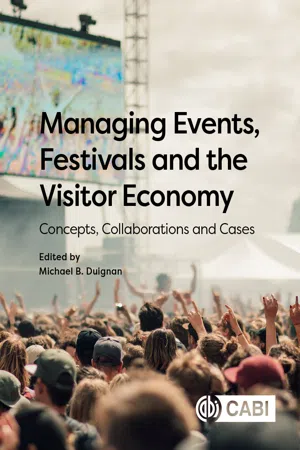
This edited text, intended to support a research-informed approach to learning and teaching, presents an array of concepts, collaborations and in-depth cases related to managing events, festivals and the visitor economy. Authors offer an array of philosophical, political, cultural, and ethical perspectives on how to achieve this across a range of contexts, from Cambodia, China, Egypt to the British cathedral city of Lincoln. Though recognising individual difference, each chapter unites in their common pursuit of supporting the United Nations Sustainable Development Goals (UNSDGs). This is significant as utilising the UNSDGs as a normative organising framework for how we all think about, plan, and manage a 'good' visitor economy is increasingly ubiquitous. It is with this in mind that each chapter provides explicit links to the UNSDGs and policy and/or practical implications, along with a series of critical self-assessment questions to reflect on the chapter's key arguments. This collection aims to satiate what appears to be an increasing appetite of readers and students alike who seek exposure to rigorous debate in and out of the classroom.
eBook - ePub
Managing Events, Festivals and the Visitor Economy
Concepts, Collaborations and Cases
- 192 pages
- English
- ePUB (mobile friendly)
- Available on iOS & Android
eBook - ePub
Managing Events, Festivals and the Visitor Economy
Concepts, Collaborations and Cases
About this book
Information
1 Managing the Visitor Economy: Concepts, Collaborations, and Cases
MICHAEL B. DUIGNAN*
University of Surrey, Guildford, UK

*Email: [email protected]
Managing the visitor economy sounds, on the face of it, like a functional endeavour. Indeed, it is and the contributing authors and I hope reading this book will be of use in that regard. However, these chapters offer much more: a vast array of philosophical, political, cultural, and ethical perspectives on how best to organise the visitor economy. The book presents a series of international cases, from Cambodia to China, Egypt to the British cathedral city of Lincoln. Therefore, it, if not explicitly, implicitly intimates a view on ‘how things are done’ differently around the world and at various levels of analysis, whether that be assessing Malta’s national overtourism problem, or creating dementia-friendly destinations across Scotland’s visitor sites.
Though recognising individual difference, the chapters are united in their common pursuit of supporting the United Nations Sustainable Development Goals (UN SDGs) (https://www.un.org/sustainabledevelopment/sustainable-development-goals, accessed 9 July 2021) too. This is significant as utilising the UN SDGs as a normative organising framework for how we all think about, plan, and manage a ‘good’ visitor economy is increasingly ubiquitous. For reference, the UN SDGs build on the preceding UN Millennium Development Goals (https://www.un.org/millenniumgoals, accessed 9 July 2021) under the umbrella of other rights-based movements, more notably the 1948 UN Universal Declaration of Human Rights (https://www.un.org/en/universal-declaration-human-rights, accessed 9 July 2021).
The chapter authors and I commit to these ideals through relating each chapter’s significance to inclusive and sustainable development agenda and specific SDGs, alongside policy and practical advice for those of you likely to and already influencing the management of the visitor economy. Each author utilised a research-informed learning approach insofar as they collected data themselves to inform the focus and findings of each chapter. This is significant for two reasons. First, each chapter follows a highly structured approach, as one might expect of a peer-reviewed research article, allowing readers to follow easily how the argument was developed from beginning to end. Second, and relatedly, many of the chapter findings, discussions, and conclusions are rigorously supported not only by an examination of key literature but by the authors’ own empirical work, often working with stakeholders at the heart of the visitor economy – supporting an industry informed learning approach too. Take, for example, Chapter 6, Professor Fyall and Professor Hara’s collaborative chapter with Mostafa Selima from the Egyptian Ministry of Tourism, concerning the creation of a new flagship visitor attraction, the Grand Egyptian Museum, Cairo. Several others have explicitly written with (e.g. Chapter 4 – Professor Wee’s piece on German Heimat tourists co-written with Werner Gilde) or have worked closely with key stakeholders in the visitor economy to bring readers closer to the phenomenon under investigation and the industry and/or policy quandary at the heart of the chapter (e.g. Professor Halpenny and Dr Yan’s work at the ‘Ice on Whyte’ festival for Chapter 5). Readers will also find at the beginning of each chapter a conceptual framework illustrating the key issues, ideas, concepts, theories, etc. guiding the theoretical and empirical focus of each piece. Often, such clarity can be missing. However, a clear and concise conceptual framework is vital if the reader is to (i) fully understand the central ideas driving each work, and (ii) understand how these ideas correspond to the learning objectives presented at the beginning of every chapter. For those who have been generous enough to read my work this far, I hope very much that this collection satiates what appears to be the increasing appetite of readers and students alike for exposure to rigorous debate in and out of the classroom.
2 Studying the Complexities of Events and Festivals and Relationships to the Visitor Economy
MARTIN ROBERTSON1*, JUDITH MAIR2, LEONIE LOCKSTONE-BINNEY3, AND MICHAEL B. DUIGNAN4
1Edinburgh Napier University, Edinburgh, UK; 2University of Queensland, St Lucia, Australia 3Griffith University, Southport, Australia; 4University of Surrey, Guildford, UK
* Email: [email protected]
Highlights
• Argues festivals and events are complex management and organisational contexts.
• Suggests overlaying events management studies with organisational studies is a fruitful space for theoretical and applied analysis.
Learning Objectives
• To illustrate how festivals/events offer a unique organisational setting for management scholars to conduct empirical analysis and drive theory development.
• To suggest ways festival/event scholars can draw on management and organisational theory as a way to better examine and understand the complex processes and practices of production and consumption that characterise small-, medium-, and particularly large-scale sporting and cultural events/festivals.
• To evaluate and explain why the two points above are needed and how to achieve this.
Introduction
This chapter reasons that festivals/events offer a unique organisational setting for management scholars to conduct empirical analysis and drive theory development. And, conversely, how festival/event scholars can draw on management and organisational theory as a way to better examine and understand the complex processes and practices of production and consumption that characterise small-, medium-, and particularly large-scale sporting and cultural events/festivals. This argument emerged in 2019 as a key outcome of the Council for Australasian Tourism and Hospitality Education (CAUTHE) 29th Annual Conference: Special Interest Group (SIG) on ‘Events’, and we use this chapter to take a deeper look at why this could be of value to both sides and how this could be achieved.
Sector Studies Linking Up to Broader Literatures
Driven by the increasing profile of major cultural, religious, and sporting occasions, the popularity of events is at an all-time high. Capitalising upon this interest, event management and event studies has emerged in recent decades as a field of study, closely related to leisure, tourism, and hospitality. A number of reviews and summations of the extant literature (Getz, 2000, 2008, 2010, 2012; Harris et al., 2000; Lee and Back, 2005; Yoo and Weber, 2005; Mair, 2012; Kim et al., 2013; Mair and Whitford, 2013; Lockstone-Binney, 2018; Lockstone-Binney and Ong, 2019) have tracked the burgeoning interest in the field and the growing body of events research.
Seminal in the field is the work of Donald Getz in terms of mapping the scope and boundaries of event management education and research. Getz’s numerous reviews have situated ‘event studies’ as the highest level of event education (2007, 2008), positioned at the pinnacle of a pyramid structure, with what he labels the more applied level of ‘event design and event production’ at the base and ‘event management’ the intermediary between the two. In a later work, Getz (2012) mapped the dominant discourses in the field. Most thoroughly he mapped a classical discipline-based discourse that draws upon social science disciplines to explain event experiences, incorporating social, cultural, environmental, and economic phenomena, as distinct from the more applied discourses of ‘event tourism’ and ‘event management’. In doing so, he called for ‘those who consider themselves to be event scholars to assess and interpret the vast and growing literature from many disciplines and fields’ (Getz, 2012, p. 182).
With events forming an increasingly regular part of everyday life while utilising public space and temporary structures, the importance of effective management is highlighted. This professionalisation has facilitated the bridging of the gap between applied event knowledge and event studies. Nevertheless, event studies and event management suffer from a lack of acceptance as a recognised field of study (Baum et al., 2013).
Events research initially focused on impact assessments relating to economics and finance (Kim et al., 2013). These facilitated interest in event management’s organisational aspects, including studies of event marketing, operations, trends, and forecasts (Park and Park, 2016). As the field has evolved, the focus has shifted to examine attendees and their experiences, particularly concerning motivation, expectations, satisfaction, and other behavioural and experiential dimensions (Kim et al., 2013). These themes continue to be discussed within the events literature as a broader range of events become study subjects.
The development of basic theories grounded in the event experience has been slow to eventuate, despite recognition that such development would lend credence to event studies’ status as a disciplinary field (Getz, 2000; Baum et al., 2013; Getz and Page, 2016; Duignan, 2021a, 2021b). Additionally, the events literature has been critiqued as lacking criticality (Baum et al., 2013). Park and Park’s (2016) study of the topic trends of event management research from 1998 to 2013 speculates that instrumentality dominates the analysis of events, with studies often only concerned with the proximate value of events to allied sectors (Getz, 2012; Baum et al., 2013), rather than the study of event value in and of itself. In addition, this instrumentality has overwhelmingly been viewed with a positive lens, without sufficient critical reflection (Rojek, 2014). The rise of critical event studies (Lamond and Platt, 2016; Spracklen and Lamond, 2016; Robertson et al., 2018b) is an evolution in the field. This follows the urging of Tribe (2008) to resist an overly positivist agenda by engaging in critical research to pave the way for creating evaluation and governance structures better equipped to advocate for ethical practices.
Robertson and colleagues’ (2018b) edited collection on critical event studies published in the Event Management journal offers clear evidence of an emerging transition in event studies, acknowledging a movement towards critical events studies. Given the universal nature of organised events in modern society, it is important not to underestimate event studies’ capacity to determine, affect, and/or drive new paths of research. The second part of this chapter speaks to how management and organisation studies (MOS) scholars can take advantage of events to reshape existing thinking and develop new MOS discipline ideas. Likewise, event management and event studies would benefit from this multidisciplinary research agenda to garner broader acceptance and recognition of an emerging academic field.
Making the Case: Festivals and Events as Complex Management and Organisational Settings
The following segment is written for two purposes. First, to aid students’ understanding of the organisational and operational complexity of planning, managing, and delivering events and festivals. Second, it is used to build the case for events and festivals as a nascent yet critically important ‘exploitable context’ for MOS scholars to use as a way to reshape existing – and drive new – concepts and ideas. This is suggested to be particularly important as MOS scholars typically use the ‘firm’ level as the principal object of analysis. There is further work needed to apply and test propositions in an events ...
Table of contents
- Cover
- Half Title
- Dedication
- Title
- Copyright
- Contents
- List of Contributors
- List of Figures and Tables
- Part 1 Introduction
- Part 2 Concepts, Collaborations, and Cases
- Index
- Cabi
- Back
Trusted by 375,005 students
Access to over 1.5 million titles for a fair monthly price.
Study more efficiently using our study tools.
Frequently asked questions
Yes, you can cancel anytime from the Subscription tab in your account settings on the Perlego website. Your subscription will stay active until the end of your current billing period. Learn how to cancel your subscription
No, books cannot be downloaded as external files, such as PDFs, for use outside of Perlego. However, you can download books within the Perlego app for offline reading on mobile or tablet. Learn how to download books offline
Perlego offers two plans: Essential and Complete
- Essential is ideal for learners and professionals who enjoy exploring a wide range of subjects. Access the Essential Library with 800,000+ trusted titles and best-sellers across business, personal growth, and the humanities. Includes unlimited reading time and Standard Read Aloud voice.
- Complete: Perfect for advanced learners and researchers needing full, unrestricted access. Unlock 1.5M+ books across hundreds of subjects, including academic and specialized titles. The Complete Plan also includes advanced features like Premium Read Aloud and Research Assistant.
We are an online textbook subscription service, where you can get access to an entire online library for less than the price of a single book per month. With over 1.5 million books across 990+ topics, we’ve got you covered! Learn about our mission
Look out for the read-aloud symbol on your next book to see if you can listen to it. The read-aloud tool reads text aloud for you, highlighting the text as it is being read. You can pause it, speed it up and slow it down. Learn more about Read Aloud
Yes! You can use the Perlego app on both iOS and Android devices to read anytime, anywhere — even offline. Perfect for commutes or when you’re on the go.
Please note we cannot support devices running on iOS 13 and Android 7 or earlier. Learn more about using the app
Please note we cannot support devices running on iOS 13 and Android 7 or earlier. Learn more about using the app
Yes, you can access Managing Events, Festivals and the Visitor Economy by Michael B. Duignan in PDF and/or ePUB format, as well as other popular books in Business & Hospitality, Travel & Tourism Industry. We have over 1.5 million books available in our catalogue for you to explore.