An overview of deadly diseases from throughout world history spanning from prehistoric civilizations to the twenty-first century.
All you need for a plague to go pandemic are population clusters and travelers spreading the bacterial or viral pathogens. Many prehistoric civilizations died fast, leaving cities undamaged to mystify archeologists. Plague in Athens killed 30% of the population 430–426 BCE. When Roman Emperor Justinian I caught bubonic plague in 541 CE, contemporary historian Procopius described his symptoms: fever, delirium and buboes—large black swellings of the lymphatic glands in the groin, under the arms and behind the ears. That bubonic plague killed twenty-five million people around the Mediterranean. Later dubbed Black Death, it killed fifty million people 1346-1353, returning to London forty times in the next 300 years. The third bubonic plague pandemic started 1894 in China, claiming fifteen million lives, largely in Asia, before dying down in the 1950s after visiting San Francisco and New York. But it also hit Madagascar in 2014, and the Congo and Peru. The cause, yersinia pestis was identified in 1894. Infected fleas from rats on merchant ships were blamed for spreading it, but Porton Down scientists have a worrying explanation why the plague spread so fast.
Any disease can go epidemic. Everyday European infections brought to the Americas by Cortes' conquistadores killed millions of the natives, whose posthumous revenge was the syphilis the Spaniards brought back to Europe. The mis-named Spanish flu, brought from Kansas to Europe by U.S. troops in 1918 caused more than fifty million deaths. Fifty years later, H3N2 flu from Hong Kong killed more than a million people.
One coronavirus produces the common cold, for which neither vaccine nor cure has been found, despite the loss of millions of working days each year. Chillingly, historian Douglas Boyd lists many other sub-microscopic killers still waiting for tourism and trade to bring them to us.
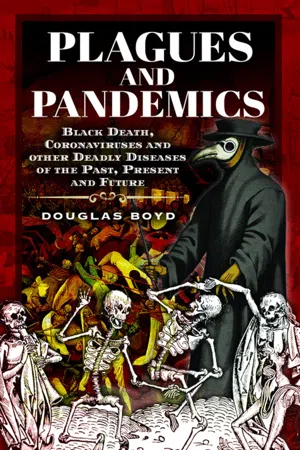
eBook - PDF
Plagues and Pandemics
Black Death, Coronaviruses and Other Deadly Diseases of the Past, Present and Future
- 233 pages
- English
- PDF
- Available on iOS & Android
eBook - PDF
Plagues and Pandemics
Black Death, Coronaviruses and Other Deadly Diseases of the Past, Present and Future
About this book
Information
Topic
MedicineSubtopic
World HistoryTable of contents
- Cover
- Book Title
- Copyright
- Contents
- Glossary
- Introduction
- Chapter 1 Ancient Plagues
- Chapter 2 Of Cities and Armies
- Chapter 3 What Makes a Pandemic?
- Chapter 4 Research and Regulations
- Chapter 5 A Plethora of Plagues
- Chapter 6 The Great Plague Arrives in England
- Chapter 7 The Plague Progresses
- Chapter 8 Death Goes on Regardless
- Chapter 9 The Great Fire
- Chapter 10 Plague, Typhus, Cholera Take Your Pick
- Chapter 11 Getting to Know the Enemy
- Chapter 12 Sundry Fevers and the Spanish ’flu
- Chapter 13 Covid-19 Emerges
- Chapter 14 Pandemic and Panic
- Chapter 15 Pathogens A-plenty
- Chapter 16 A Pause for Thought
- Appendix
- Acknowledgements
- Further Reading
- Notes and Sources
- Index
Trusted by 375,005 students
Access to over 1.5 million titles for a fair monthly price.
Study more efficiently using our study tools.
Frequently asked questions
Yes, you can cancel anytime from the Subscription tab in your account settings on the Perlego website. Your subscription will stay active until the end of your current billing period. Learn how to cancel your subscription
No, books cannot be downloaded as external files, such as PDFs, for use outside of Perlego. However, you can download books within the Perlego app for offline reading on mobile or tablet. Learn how to download books offline
Perlego offers two plans: Essential and Complete
- Essential is ideal for learners and professionals who enjoy exploring a wide range of subjects. Access the Essential Library with 800,000+ trusted titles and best-sellers across business, personal growth, and the humanities. Includes unlimited reading time and Standard Read Aloud voice.
- Complete: Perfect for advanced learners and researchers needing full, unrestricted access. Unlock 1.5M+ books across hundreds of subjects, including academic and specialized titles. The Complete Plan also includes advanced features like Premium Read Aloud and Research Assistant.
We are an online textbook subscription service, where you can get access to an entire online library for less than the price of a single book per month. With over 1.5 million books across 990+ topics, we’ve got you covered! Learn about our mission
Look out for the read-aloud symbol on your next book to see if you can listen to it. The read-aloud tool reads text aloud for you, highlighting the text as it is being read. You can pause it, speed it up and slow it down. Learn more about Read Aloud
Yes! You can use the Perlego app on both iOS and Android devices to read anytime, anywhere — even offline. Perfect for commutes or when you’re on the go.
Please note we cannot support devices running on iOS 13 and Android 7 or earlier. Learn more about using the app
Please note we cannot support devices running on iOS 13 and Android 7 or earlier. Learn more about using the app
Yes, you can access Plagues and Pandemics by Douglas Boyd in PDF and/or ePUB format, as well as other popular books in Medicine & World History. We have over 1.5 million books available in our catalogue for you to explore.