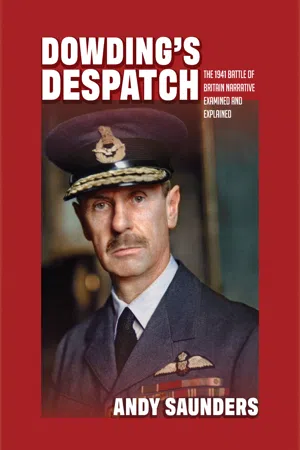
eBook - ePub
Dowding's Despatch
The 1941 Battle of Britain Narrative Examined and Explained
- 220 pages
- English
- ePUB (mobile friendly)
- Available on iOS & Android
eBook - ePub
About this book
In September 1946, the London Gazette published a despatch from Air Chief Marshal Sir Hugh C T Dowding that was titled simply: The Battle of Britain. Written and submitted to the Air Ministry in 1941, this document became the very framework for the accepted Battle of Britain narrative which has been established across the following eighty years. Set out by the leader of the 'Few' himself, its authoritative tone could surely be considered a definitive outline of the battle, how it was fought and the eventual outcome. It even retrospectively set the dates for the commencement and conclusion of the campaign. In this work, Andy Saunders takes a critical look at Dowding's despatch and analyses the facts and details contained in that important document. He also puts 'flesh on the bones' of the matters that the former commander-in-chief of RAF Fighter Command outlines, adding intriguing historical detail and perspective to the 1946 publication. Additionally, Andy looks at the behind-the-scenes machinations at the highest levels of government and Air Ministry before the despatch finally saw the light of day. As a historical document, Dowding's London Gazette despatch is worthy of the critical analysis and factual expansion which the author provides in what is a uniquely different look at the Battle of Britain, with illustrations throughout.
Information
Subtopic
20th Century HistoryIndex
HistoryAIR CHIEF MARSHAL SIR HUGH C.T. DOWDING’S DESPATCH ON THE BATTLE OF BRITAIN
The Air Ministry, September, I946
THE BATTLE OF BRITAIN
The following despatch was submitted to the Secretary of State for Air on August 20th, I94I, by Air Chief Marshal Sir Hugh C.T. Dowding, G.C.B., G.C.V.O., C.M.G., A.D.C., Air Officer Commanding-in-Chief, Fighter Command, Royal Air Force.
PREAMBLE
I. I have been instructed by the Air Council to write a Despatch on the Air Fighting of last Autumn, which has become known as the “Battle of Britain.” The conditions are a little unusual because, firstly, the Battle ended many months ago, secondly, a popular account of the fighting has already been written and published, and, thirdly, recommendations for Mention in Despatches have already been submitted.
__________
The term Battle of Britain was first used by Prime Minister Winston Churchill when, on 18 June 1940, he told the House of Commons: ‘What General Weygand called the Battle of France is over. I expect that the Battle of Britain is about to begin.’
The question of the dates between which the battle was fought have long been open to some interpretation and debate. However, the dates of the battle were addressed by Dowding in the paragraphs below.
__________
2. I have endeavoured, therefore, to write a report which will, I hope, be of Historical interest, and which will, in any case, contain the results of more than four years’ experience of the Fighter Command in peace and war.
August 20, I94I.
__________
The background to how and why this despatch came to be written is already covered in the prologue to this book. However, a summary of the command he led is appropriate here.
The principal defensive ‘instrument’ of the overall air-defence system of the British Isles was the RAF’s air-arm dedicated to the provision of home-defence fighters: Fighter Command.
At the time of the huge RAF Expansion Plan of 1935, five new Home Commands were established to fulfil the home-based functions of the air force: Bomber, Coastal, Training, Maintenance and Fighter Commands. The latter came into being on 14 July 1936 with Air Marshal Sir Hugh Dowding as Air Officer Commanding-in-Chief.
Under the pre-war leadership of Dowding, modern fighter aircraft (the Spitfire, Hurricane and Defiant) came into service and ‘new’ fighter squadrons were either formed or re-formed. As a result of the foresight and leadership of Dowding, a system was in place by 1940 which was organised into operational groups (Nos. 10, 11, 12 and 13 Groups) with squadrons strategically placed around Britain to offer the most effective defence of potential military and industrial targets as well as centres of population.
NB: Between November 1943 and October 1944, RAF Fighter Command became RAF Air Defence Great Britain [RAF ADGB] but reverted to RAF Fighter Command on 15 October 1944. In 1968, it was subsumed into the RAF’s new structure as part of RAF Strike Command.
THE BATTLE OF BRITAIN PART I. – PRELIMINARY
3. In giving an account of the Battle of Britain it is perhaps advisable to begin by a definition of my conception of the meaning of the phrase. The Battle may be said to have started when the Germans had disposed of the French resistance in the Summer of I940, and turned their attention to this country.
__________
In retrospect, this would have seemed the most logical date on which to consider the Battle of Britain to have commenced. Or, at least, the day after the last British forces had been evacuated from France. (See commentary on Paragraphs 11–13.) However, Dowding also suggested yet another date in Paragraph 14.
__________
4. The essence of their Strategy was so to weaken our Fighter Defences that their Air Arm should be able to give adequate support to an attempted invasion of the British Isles. Experiences in Holland and Belgium had shown what they could do with armoured forces operating in conjunction with an Air Arm which had substantially achieved the command of the Air.
5. This air supremacy was doubly necessary to them in attacking England because the bulk of their troops and war material must necessarily be conveyed by sea, and, in order to achieve success, they must be capable of giving air protection to the passage and the landing of troops and material.
6. The destruction or paralysis of the Fighter Command was therefore an essential prerequisite to the invasion of these islands.
__________
Whilst Dowding’s comments and observations here are essentially accurate, the question of an attempted invasion of the British Isles is a far more nuanced one than simply the weakening (or defeat) of RAF Fighter Command and thereby gaining air superiority.
__________
7. Their immediate objectives might be Convoys, Radio-Location Stations, Fighter Aerodromes, Seaports, Aircraft Factories, or London itself. Always the underlying object was to bring the Fighter Command continuously to battle, and to weaken its material resources and intelligence facilities.
__________
Dowding’s observations as to German objectives are prefixed here with ‘might be’. In fact, the despatch was written after the event when it was already known that these were the German objectives – and in that order. Whilst the scope of targets might perhaps have been predictable, or perhaps already known in advance through ULTRA intercepts, it might otherwise be difficult to have predicted the coastal convoy attacks – unless it was presumed these attacks were simply to bring RAF Fighter Command to battle.
__________
8. Long after the policy of “crashing through” with heavy bomber formations had been abandoned owing to the shattering losses incurred, the battle went on. Large fighter formations were sent over, a proportion of the fighters being adapted to carry bombs, in order that the attacks might not be ignorable.

Pictured here is a bomb-laden Messerschmitt Bf 109-E of JG 26 about to set out for a sortie over England.
9. This last phase was perhaps the most difficult to deal with tactically. It will be discussed in greater detail later on.
__________
It was certainly the case that ‘heavy bomber formations’ (see also commentary to Paragraph 10) had suffered heavy losses but it would be difficult to label them as ‘shattering’.
While the losses were heavy, and likely could not be sustained, it is worth noting that all such losses had generally been made up quickly, both in aircraft and personnel. That said, these losses drove continuing German air attacks to be switched to night attacks to reduce losses.
The use of Messerschmitt 109s as fighter-bombers was also part of the altered Luftwaffe tactics and meant that regular daylight raids of this nature on London and the south-east had the result of keeping large swathes of the capital and southern England under continual or lengthy periods of air-raid alert: fighter-bombers by day, bombers by night.
To implement this tactic, one Staffel of each Gruppe of every Jagdgeschwader based on the Channel Coast was designated a fighter-bomber (Jabo) unit, with the other two Staffeln of the Gruppe generally designated as escorts. The bomb-carrying Messerschmitt 109s were equipped with one centreline bomb rack capable of carrying a single 250-kg bomb.

Dowding refers to the policy of large bomber formations ‘crashing through’ during the Battle of Britain. Ultimately, such daylight formations were abandoned by the Luftwaffe in 1940.
__________
I0. Night attacks by Heavy Bombers were continuous throughout the operations, and, although they persisted and increased in intensity as Day Bombing became more and more expensive, they had an essentially different purpose, and the “Battle of Britain” may be said to have ended when the Fighter and Fighter-Bomber raids died down.
__________
While night-bombing attacks1 had been conducted sporadically throughout the period of the Battle of Britain, it was only with the launch of the raids on London on 7 September 1940 that the almost continual night-bombing of London and other targets through to May 1941 were seen.
The deployment of fighter-bombers from the autumn of 1940 continued through into 1941, and it is difficult to pin down any specific date when they ‘died down’. Indeed, these attacks ultimately evolved into the extensive and damaging ‘Tip and Run’ campaign of 1942-1943, and it would be difficult, if not risible, to consider the Battle of Britain to have continued until the last Jabo attack on Britain on 6 June 1943. But it certainly continued beyond the end of October 1940.
However, given that the last day of the Battle of Britain had already been ‘established’ as 31 October in the 1941 HMSO publication The Battle of Britain, August–October 1940, it seems clear that Dowding must have concurred with the view that 31 October was the end of the battle. But, as stated above, it did not coincide with any appreciable downturn of fighter-bomber attacks. (See also commentary on Paragraphs 11–13 in respect of the dates of the Battle of Britain.)
__________
II. It is difficult to fix the exact date on which the “Battle of Britain” can be said to have begun. Operations of various kinds merged into one another almost insensibly, and there are grounds for choosing the date of the 8th August, on which was made the first attack in force against laid objectives in this country, as the beginning of the Battle.
I2. On the other hand, the heavy attacks made against our Channel convoys probably constituted, in fact, the beginning of the German offensive; because the weight and scale of the attack indicates that the primary object was rather to bring our Fighters to battle than to destroy the hulls and cargoes of the small ships engaged in the coastal trade. While we were fighting in Belgium and France, we suffered the disadvantage that even the temporary stoppage of an engine involved the loss of pilot and aircraft, whereas, in similar circumstances, the German pilot might be fighting again the same day, and his aircraft be airborne again in a matter of hours.
I3. In fighting over England these considerations were reversed, and the moral and material disadvantages of fighting over enemy country may well have determined the Germans to open the attack with a phase of fighting in which the advantages were more evenly balanced. I have therefore, somewhat arbitrarily, chosen the events of the I0th July as the opening of the Battle. Although many attacks had previously been made on convoys, and even on land objectives such as Portland, the I0th July saw the employment by the Germans of the first really big formation (70 aircraft) intended primarily to bring our fighter defence to battle on a large scale.
__________
The impact of Dowding’s statements relative to the commencement date of the Battle of Britain, as contained in Paragraph 11, not only set the historically accepted dates of the battle but it also had an impact on officially determining who was and who was not to be regarded as a Battle of Britain participant.
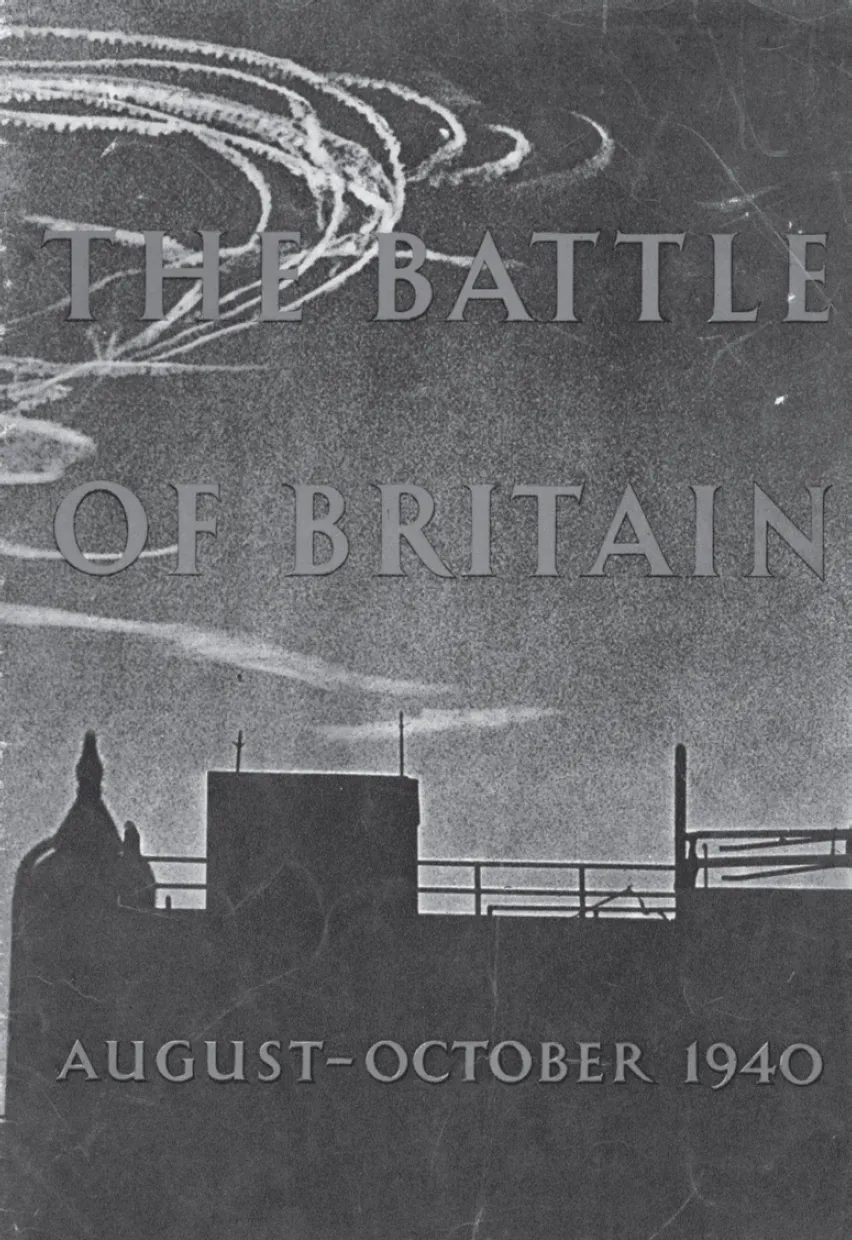
The cover of the HMSO booklet illustrated here is the second edition which carried ...
Table of contents
- Cover
- Title
- Dedication
- Copyright
- Contents
- Introduction
- Battle of Britain – Cecil Day-Lewis
- Prologue
- Biography of Air Chief Marshal Sir Hugh C. T. Dowding
- Air Chief Marshal Sir Hugh C.T. Dowding’s Despatch on the Battle of Britain
- Appendix “C.” – 6th A.A. Division, July-October I940
- Appendix “C.C.” – I – Ammunition Expenditure and Claims, Category I
- Appendix “C.D.” – Ammunition Expenditure and Enemy Aircraft Destroyed Throughout Anti-Aircraft Command for July, August and September I940
- Appendix “F.” – Note on the Offensive and Defensive Equipment of Aircraft
- Appendix I – Proposed Foreword for Dowding’s Despatch
- Appendix II – Copy of Appendix “A.”
- Appendix III – Copy of Appendix “C.A.”
- Appendix IV – Copy of Appendix “C.B.”
- Appendix V – Copy of Appendix “D.”
- Appendix VI – Copy of Appendix “E.”
- Appendix VII – Brief Chronology of Air Fighting Events in the Period Covered by the Despatch
- Appendix VIII – Government Departments and Appointments
- Selected Bibliography
- Endnotes
Trusted by 375,005 students
Access to over 1.5 million titles for a fair monthly price.
Study more efficiently using our study tools.
Frequently asked questions
Yes, you can cancel anytime from the Subscription tab in your account settings on the Perlego website. Your subscription will stay active until the end of your current billing period. Learn how to cancel your subscription
No, books cannot be downloaded as external files, such as PDFs, for use outside of Perlego. However, you can download books within the Perlego app for offline reading on mobile or tablet. Learn how to download books offline
Perlego offers two plans: Essential and Complete
- Essential is ideal for learners and professionals who enjoy exploring a wide range of subjects. Access the Essential Library with 800,000+ trusted titles and best-sellers across business, personal growth, and the humanities. Includes unlimited reading time and Standard Read Aloud voice.
- Complete: Perfect for advanced learners and researchers needing full, unrestricted access. Unlock 1.5M+ books across hundreds of subjects, including academic and specialized titles. The Complete Plan also includes advanced features like Premium Read Aloud and Research Assistant.
We are an online textbook subscription service, where you can get access to an entire online library for less than the price of a single book per month. With over 1.5 million books across 990+ topics, we’ve got you covered! Learn about our mission
Look out for the read-aloud symbol on your next book to see if you can listen to it. The read-aloud tool reads text aloud for you, highlighting the text as it is being read. You can pause it, speed it up and slow it down. Learn more about Read Aloud
Yes! You can use the Perlego app on both iOS and Android devices to read anytime, anywhere — even offline. Perfect for commutes or when you’re on the go.
Please note we cannot support devices running on iOS 13 and Android 7 or earlier. Learn more about using the app
Please note we cannot support devices running on iOS 13 and Android 7 or earlier. Learn more about using the app
Yes, you can access Dowding's Despatch by Andy Saunders in PDF and/or ePUB format, as well as other popular books in History & 20th Century History. We have over 1.5 million books available in our catalogue for you to explore.