Chronic pain is a silent epidemic — it is estimated to affect 20-30% of the population. A good understanding of the disease, diagnosis and management are imperative in providing patient-centred care. A broad range of practitioners will frequently encounter patients with chronic pain. This book covers important topics in chronic pain relevant to many clinicians including, but not limited to, anaesthetists, intensive care professionals, surgical and nursing staff, junior doctors, operating department practitioners, general practitioners and medical students. It makes essential reading for healthcare workers and is also an invaluable first reference for physiotherapists, healthcare managers, psychologists and researchers with a need for an overview of the key aspects of this topic. This book will not only be an invaluable resource for trainee anaesthetists but also for practising anaesthetists with an interest in teaching the basics of chronic pain; it is also a succinct aid for clinical practice. Medical students and junior doctors, who are about to embark on a career in anaesthesia or intensive care medicine, will also find the book to be a useful educational tool. Subjects discussed range from the comprehensive assessment of chronic pain to the multimodal management of chronic pain. It is written in a simple and consistent style that can be easily understood and applied to day-to-day clinical practice.This material will be an important tool for professional exams. It is an ideal companion for candidates who are preparing for their final exams that include the topic of chronic pain and will help to assess their preparation and guide appropriate revision. Questions on chronic pain appear in written and structured oral examinations. This book will be handy for candidates preparing for examinations conducted by the Royal College of Anaesthetists, UK (FRCA), The College of Anaesthesiologists of Ireland (FCAI), the European Society of Anaesthesiology (EDAIC), the European Society of Intensive Care Medicine (EDIC), the Australian and New Zealand College of Anaesthetists (FANZCA), the National Board of Examinations of India (Dip NB), and the American and Canadian board exams, as well as other competitive exams across the globe. Candidates appearing for advanced pain examinations will find this book useful to refresh their knowledge on pain medicine. The authors are consultants in pain medicine with clinical and teaching experience in university hospitals across the UK. They regularly conduct successful pain education courses which consistently attract good feedback. They conduct regular final FRCA and FFPMRCA exam courses attended by candidates from all over the country.

eBook - ePub
Chronic pain management
- English
- ePUB (mobile friendly)
- Available on iOS & Android
eBook - ePub
Chronic pain management
About this book
Information
Topic
MedicineSubtopic
Anesthesiology & Pain ManagementChapter1
Pain — definition and classification
Shyam Balasubramanian
Pain is defined as “an unpleasant sensory and emotional experience associated with, or resembling that associated with, actual or potential tissue damage.” The International Association for the Study of Pain (IASP) has recently revised this definition (2020).
Table 1.1. Differences between acute and chronic pain.
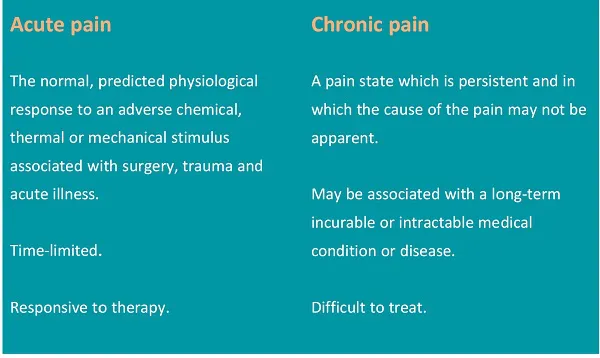
Pain can be acute or chronic (■ Table 1.1). Chronic pain is defined as pain that lasts or recurs for longer than 3 months.
| Acute pain | Chronic pain |
|---|---|
| The normal, predicted physiological response to an adverse chemical, thermal or mechanical stimulus associated with surgery, trauma and acute illness. | A pain state which is persistent and in which the cause of the pain may not be apparent. |
| Time-limited. | May be associated with a long-term incurable or intractable medical condition or disease. |
| Responsive to therapy. | Difficult to treat. |
Chronic pain can be classified in different ways. Mainly, it can be due to malignancy or chronic non-cancer pain. The term ‘functional pain’ is used when patients present with pain of no obvious organic origin. One simple classification for chronic non-cancer pain is shown in ■ Figure 1.1.
Recently, the IASP has developed a new classification system for chronic pain. Basically, this system divides chronic pain into two classes — chronic primary pain or chronic secondary pain.
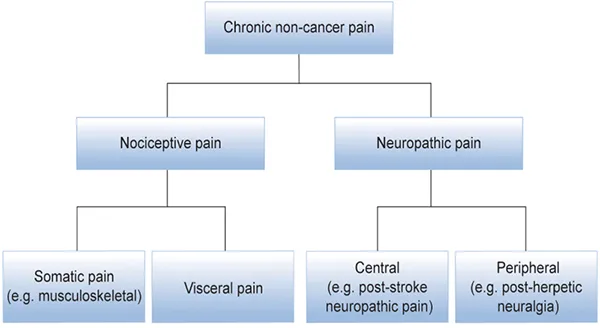
Figure 1.1. A simple classification for chronic non-cancer pain.
Chronic primary pain
Chronic primary pain is defined as pain in one or more anatomical regions that:
• Persists or recurs for longer than 3 months.
• Is associated with significant emotional distress (e.g. anxiety, anger, frustration or depressed mood) and/or significant functional disability (interference in activities of daily life and participation in social roles).
• The symptoms are not better accounted for by another diagnosis.
The subclassification of chronic primary pain is as follows:
• Chronic widespread pain.
• Complex regional pain syndrome (CRPS).
• Chronic primary headache or orofacial pain.
• Chronic primary visceral pain.
• Chronic primary musculoskeletal pain.
Chronic secondary pain
Chronic secondary pain syndromes are linked to other diseases as the underlying cause, for which pain may initially be regarded as a symptom.
The subclassification of chronic secondary pain includes:
• Chronic cancer-related pain — pain caused by the cancer itself (by the primary tumour or by metastases) or by its treatment (surgery, chemotherapy and radiotherapy).
• Chronic post-surgical or post-traumatic pain — chronic pain that develops or increases in intensity after a surgical procedure or a tissue injury and persists beyond the healing process, i.e. at least 3 months after the surgery or tissue trauma.
• Chronic neuropathic pain — pain caused by a lesion or disease of the somatosensory nervous system.
• Chronic secondary headache or orofacial pain.
• Chronic secondary visceral pain — persistent or recurrent pain originating from internal organs of the head or neck region or of the thoracic, abdominal and pelvic cavities. It is often associated with emotional, cognitive and behavioural disability.
• Chronic secondary musculoskeletal pain — chronic pain in bones, joints and tendons arising from an underlying disease. It can be due to persistent inflammation, associated with structural changes or caused by altered biomechanical function due to diseases of the nervous system.
In clinical practice, often these subclassifications coexist. For example, CRPS can present with a predominant neuropathic pain quality. Musculoskeletal back pain can cause sciatic nerve root irritation resulting in neuropathic radicular pain (sciatica). A Pancoast tumour (malignancy in the apex of the lung) can cause cancer pain, neuropathic pain due to involvement of the intercostal nerves and brachial plexus, musculoskeletal pain due to invasion into the intercostal muscles and chest wall, chemotherapy-induced peripheral neuropathic pain, etc.
Key Points
• Pain is an unpleasant sensory and emotional experience associated with, or resembling that associated with, actual or potential tissue damage.
• Pain can be acute or chronic; chronic pain can be primary or secondary.
• Often, various subclassifications of pain can coexist.
References
1. IASP terminology. The International Association for the Study of Pain. https://www.iasp-pain.org/Education/Content.aspx?ItemNumber=1698. Accessed on 20th July 2020.
2. Comment for IASP. https://www.iasp-pain.org/PublicationsNews/NewsDetail.aspx?ItemNumber=9218. Accessed on 20th July 2020.
3. Treede RD, Rief W, Barke A, et al. Chronic pain as a symptom or a disease: the IASP classification of chronic pain for the international classification of diseases: (ICD-11). Pain 2019; 160(1): 19-27.
Chapter2
Assessing a patient with chronic pain
Pradeep Mukund Ingle
Challenges in pain assessment
The challenges in pain assessment are:
• There is no objective measure available currently.
• It is a sensory and emotional experience.
• The complex, multidimensional and subjective nature of pain makes assessment difficult.
• Pain presentation may be both physical and behavioural.
• The amount of pain does not always correlate with the amount of actual tissue damage.
• Tests such as a functional MRI or PET-brain activation may show the areas in the brain that ‘light up’ in response to pain but these are not practical to perform in each patient on a regular basis.
Why should we assess pain?
The management of pain is dependent upon its severity. The cause of pain can be ascertained through the process of pain assessment.
The three dimensions of pain (ABCs of pain)
• Affective-motivational — relates to...
Table of contents
- Cover
- Title Page
- Copyright Page
- Contents
- Foreword
- Contributors
- Abbreviations
- Chapter 1 : Pain — definition and classification, Shyam Balasubramanian
- Chapter 2 : Assessing a patient with chronic pain, Pradeep Mukund Ingle
- Chapter 3 : Physiology of chronic pain, Mahesh Kodivalasa
- Chapter 4 : The biopsychosocial model, Thanthullu Vasu
- Chapter 5 : Back pain, Shyam Balasubramanian
- Chapter 6 : Neck pain, Thanthullu Vasu
- Chapter 7 : Osteoarthritis and osteoporosis, Thanthullu Vasu
- Chapter 8 : Neuropathic pain, Shyam Balasubramanian
- Chapter 9 : Complex regional pain syndrome, Thanthullu Vasu
- Chapter 10 : Fibromyalgia, Thanthullu Vasu
- Chapter 11 : Rheumatological considerations, Thanthullu Vasu
- Chapter 12 : Painful diabetic neuropathy, Pradeep Mukund Ingle
- Chapter 13 : Post-herpetic neuralgia, Pradeep Mukund Ingle
- Chapter 14 : Chronic post-surgical pain (CPSP), Mahesh Kodivalasa
- Chapter 15 : Prevention of chronic post-surgical pain, Mahesh Kodivalasa
- Chapter 16 : Post-amputation pain, Shyam Balasubramanian
- Chapter 17 : Pain in sickle cell disease, Pradeep Mukund Ingle
- Chapter 18 : Visceral pain, Mahesh Kodivalasa
- Chapter 19 : Facial pain, Mahesh Kodivalasa
- Chapter 20 : Headaches, Mahesh Kodivalasa
- Chapter 21 : Pelvic pain, Mahesh Kodivalasa
- Chapter 22 : Cancer pain, Mahesh Kodivalasa
- Chapter 23 : Injection therapy for chronic pain — nerve blocks, Shyam Balasubramanian
- Chapter 24 : Injection therapy for chronic pain — facet interventions, Thanthullu Vasu
- Chapter 25 : Injection therapy for chronic pain — radiofrequency procedures, Thanthullu Vasu
- Chapter 26 : Injection therapy for chronic pain — epidural injections, Shyam Balasubramanian
- Chapter 27 : Injection therapy for chronic pain — neurolytic procedures, Shyam Balasubramanian
- Chapter 28 : Injection therapy for chronic pain — stellate ganglion block, Shyam Balasubramanian
- Chapter 29 : Injection therapy for chronic pain — lumbar sympathetic block, Shyam Balasubramanian
- Chapter 30 : Injection therapy for chronic pain — coeliac plexus block, Shyam Balasubramanian
- Chapter 31 : Infusion therapies in chronic pain management, Shyam Balasubramanian
- Chapter 32 : Ultrasound in chronic pain, Shyam Balasubramanian
- Chapter 33 : Radiation — physics and risks, Arul James and Thanthullu Vasu
- Chapter 34 : Complementary therapies, Thanthullu Vasu
- Chapter 35 : Physiotherapy in chronic pain, Thanthullu Vasu
- Chapter 36 : Psychology in chronic pain, Thanthullu Vasu
- Chapter 37 : Pain management programmes, Pradeep Mukund Ingle
- Chapter 38 : Spinal cord stimulators and intrathecal pumps, Arul James and Thanthullu Vasu
- Chapter 39 : Placebo and pain relief, Shyam Balasubramanian
- Chapter 40 : Pain management in drug abusers, Pradeep Mukund Ingle
- Chapter 41 : Pain management in intensive care, Ravindra Pochiraju and Mahesh Kodivalasa
- Chapter 42 : Pain management in special populations, Mahesh Kodivalasa
- Chapter 43 : Pharmacology — simple analgesics — paracetamol, Pradeep Mukund Ingle
- Chapter 44 : Pharmacology — non-steroidal anti-inflammatory drugs (NSAIDs), Pradeep Mukund Ingle
- Chapter 45 : Pharmacology — opioids, Rajinikanth Sundara Rajan and Pradeep Mukund Ingle
- Chapter 46 : Problems of opioid use in chronic pain, Thanthullu Vasu
- Chapter 47 : Pharmacology — gabapentinoids, Pradeep Mukund Ingle
- Chapter 48 : Pharmacology — other anti-neuropathic agents, Harnarine Murally and Pradeep Mukund Ingle
- Chapter 49 : Pharmacology — local anaesthetics, Vanja Srbljak and Pradeep Mukund Ingle
- Chapter 50 : Pharmacology — topical agents, Ashok Puttappa and Pradeep Mukund Ingle
- Chapter 51 : Pharmacology — steroids, Mahesh Kodivalasa
- Chapter 52 : Pharmacology of other medications — alpha-2 agonists, NMDA antagonists, muscle relaxants and others, Mahesh Kodivalasa
- Chapter 53 : National guidelines in chronic pain, Thanthullu Vasu
- Chapter 54 : Guidance for primary care clinicians, Mahesh Kodivalasa, Gopi Boora and Uday Idukallu
- Chapter 55 : Pain management in difficult times (COVID-19), Thanthullu Vasu
- Index
- Back Cover
Trusted by 375,005 students
Access to over 1.5 million titles for a fair monthly price.
Study more efficiently using our study tools.
Frequently asked questions
Yes, you can cancel anytime from the Subscription tab in your account settings on the Perlego website. Your subscription will stay active until the end of your current billing period. Learn how to cancel your subscription
No, books cannot be downloaded as external files, such as PDFs, for use outside of Perlego. However, you can download books within the Perlego app for offline reading on mobile or tablet. Learn how to download books offline
Perlego offers two plans: Essential and Complete
- Essential is ideal for learners and professionals who enjoy exploring a wide range of subjects. Access the Essential Library with 800,000+ trusted titles and best-sellers across business, personal growth, and the humanities. Includes unlimited reading time and Standard Read Aloud voice.
- Complete: Perfect for advanced learners and researchers needing full, unrestricted access. Unlock 1.5M+ books across hundreds of subjects, including academic and specialized titles. The Complete Plan also includes advanced features like Premium Read Aloud and Research Assistant.
We are an online textbook subscription service, where you can get access to an entire online library for less than the price of a single book per month. With over 1.5 million books across 990+ topics, we’ve got you covered! Learn about our mission
Look out for the read-aloud symbol on your next book to see if you can listen to it. The read-aloud tool reads text aloud for you, highlighting the text as it is being read. You can pause it, speed it up and slow it down. Learn more about Read Aloud
Yes! You can use the Perlego app on both iOS and Android devices to read anytime, anywhere — even offline. Perfect for commutes or when you’re on the go.
Please note we cannot support devices running on iOS 13 and Android 7 or earlier. Learn more about using the app
Please note we cannot support devices running on iOS 13 and Android 7 or earlier. Learn more about using the app
Yes, you can access Chronic pain management by Vasu, Thanthullu,Balasubramanian, Shyam,Kodivalasa, Mahesh,Ingle, Pradeep Mukund in PDF and/or ePUB format, as well as other popular books in Medicine & Anesthesiology & Pain Management. We have over 1.5 million books available in our catalogue for you to explore.