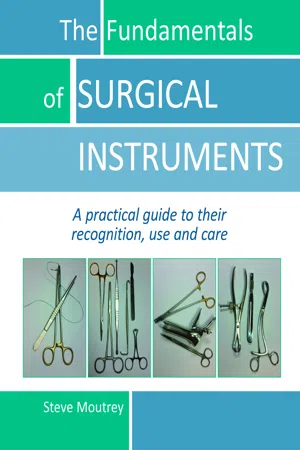
This book provides a sound introduction to surgical instrumentation, including their recognition, use and care. It provides useful information that is essential for operating department practitioners, nurses, scrub practitioners, surgeons under training, surgical technologists, junior doctors and medical students. Descriptions of how and where the instruments are used will also aid in the knowledge required for their application, providing an understanding of instruments for specific procedures. The book is relevant to surgical practice around the world. It also aligns with the core curriculum of the Association of Surgical Technologists in the United States. This book provides the fundamental knowledge required for students and qualified staff working within the perioperative environment, to ensure the safe and efficient use of surgical instrumentation and ultimately the care of the surgical patient as a result.Steve Moutrey has a vast experience within the operating theatre environment spanning more than 40 years, starting his career in the Royal Navy (26 years), and then moving into the NHS. He is now a Senior Lecturer within the School of Health Sciences and Social Work at the University of Portsmouth and teaches on perioperative courses and allied areas.Excerpts from some reviews: "I am impressed by Steve Moutrey's writing style, which is clear, direct, and succinct... [His] experience as a practitioner and educator is evident in his writing. As a former surgical technology educator and author of similar texts, I can attest to the difficulty of presenting entry-level surgical instrumentation. Mr. Moutrey offers a simplified discussion enhanced with relevant illustrations that will reduce any confusion..." Jon Paul Price, BSOE MBAHealthcare Education Advisor/ConsultantFormer CEO, Accreditation Review Committee for Surgical Technology/Surgical Assisting, USAFormer CEO, National Board for Surgical Technology and Surgical Assisting, USA"This text is a clearly written guide to the concept of surgical instrumentation, aimed at both pre- and post- registration students within the perioperative environment... The wealth of illustrations support the text and should prepare the reader for the practicalities of instrument identification and handling.... I would highly recommend [the book] for all perioperative students who wish to gain a comprehensive introduction to surgical instrumentation." Roger King, BA Cert. Ed Pg Cert (Res) RODPSenior Lecturer/ODP Course LeaderUniversity of West London, UK"This book is aimed primarily at the scrub practitioner... It will also prove to be a useful text for other professions... including nurses, medical students, surgeons in training and others requiring fundamental knowledge of surgical instrumentation. It describes in pictures and words the basic surgical instrumentation that will be found in all operating theatres..., allowing easy and instant recognition of a large number of instruments... This book will be a most welcome and helpful tool..."Steve Barker, MB BS BSc MS FRCSConsultant Vascular and General SurgeonRoyal South Hants Hospital, Southampton, UK"The book covers various types of surgical instruments in current use and the various specialties these instruments are designed for... Steve Moutrey has drawn upon his vast knowledge and experience both in field hospitals with the military and also from his time within the static theatre environment in the NHS and private sector. It will prove to be a valuable teaching and learning tool to all who read it."Terry Pugh, FAETC IOSH RODPTheatre Clinical ManagerQueen Alexandra Hospital, Portsmouth, UK
- English
- ePUB (mobile friendly)
- Available on iOS & Android
eBook - ePub
About this book
Information
Topic
MedicineChapter 1
BASIC SURGICAL TECHNIQUES AND INSTRUMENT CLASSIFICATION
History
Surgery requires planned and accurate incisions using appropriate instruments to facilitate these. Historically, the visible anatomy available to a surgical practitioner was through trauma, and its understanding came from direct observation of this anatomy through these wounds. The development of surgical practice progressed through extending these traumatic wounds to gain access and vision, enabling the practitioner to facilitate such procedures as removal of foreign objects, for example, in battle trauma. It was the extension of these wounds that required the development of ‘cutting’ tools to seek the problem within the wound and to allow full visualisation of the internal structures. This brought about the development of relevant incising devices, or as we have come to know them now, as scalpels useful for draining of abscesses, trepanning skulls, amputations and, latterly, elective incisions for procedures such as cultural circumcision and cutting for bladder stones. These cutting tools or knives probably arose from the domestic knife, sword or cutlass that proved so adept at making an unintentional incision in the first place. The ‘blade’ was developed from many differing materials dependent upon the type of procedure performed; plant, mineral and animal products were used to useful effect. The lancet, a double-edged blade, was made from flint, shaped into a double-edged point to make a stab incision. Various bones and ivory were also fashioned into blades to provide incisions to denature or excise dead tissue. Shells and animal teeth, in particular, shark’s teeth, were all employed to stab or cut skin and tissue. The scalpel, cutting tool or saw, therefore, was the embodiment of a surgical instrument design and its development into specific metal implements. To facilitate differing procedures, the blade has been transformed into a multi-purpose instrument, made from metal being both unserrated and serrated; the serrated for use as a saw to cut through bone as in the trephine used on the skull, and the basic hand saw to perform amputations, both requiring differing actions of use to that of the ‘knife’. The sharp, single-edged blade to make accurate and clean incisions was probably derived from the blade that was folded away into a cover, as in the barber’s cut-throat razor. The handle, which could have been made from tortoiseshell, protected the blade and the surgeon as he carried it. The blade was folded away inside the handle which protected the surgeon from inadvertent personal injury, whilst it also protected the actual blade from being damaged or blunted. During the early 20th century these knives gradually disappeared and became solid, fixed bladed instruments.
Cutting instruments that were developed, alongside the saw to cut through bone, were certainly derived from the carpenter’s tools of the day — these became the chisels, osteotomes and gouges we now use in modern times. These were used for dismemberment by the surgeon to remove fingers, toes and hands as they thought it provided a quicker and less painful way of amputation due to the speed with which it could be performed. These were normally by ‘through-joint’ amputation; using this technique, bone did not need to be cut, so facilitating a speedy procedure and consequently a less painful patient experience.
The discovery of bronze brought about the use of metal in the manufacture of instruments, providing blades and lancets for bleeding patients. Later, with the smelting of iron, further enhancing of the manufacturing process was possible. Modern surgical instruments are made of stainless steel, a combination of various metals, with the addition of carbon, to chromium and iron. This combination adds to the strength of the instruments and increases their resistance to corrosion, especially with repeated exposure to cleaning and sterilisation. The high percentage of carbon adds to their strength, making them harder — especially important for surgical blades, allowing them to remain sharper for longer. Chromium is the additive that increases resistance to corrosion. Most modern instruments have various types of finish. Highly polished finishes help to protect the instrument from corrosion and allow repeated cleaning and sterilisation; most instruments have this type of finish. The main problem with this finish is that of glare and distraction to the surgeon during use, due to reflection of bright light. A dull finish overcomes this problem as it is less reflective but it can be more susceptible to staining over repeated use. A black chromium finish to the instrument is non-reflective, eliminating all glare and is the finish of choice in microsurgery when using a microscope; also, when using lasers, it may help to prevent deflection of the laser beam from the instrument.
Some modern alternatives to metal instruments may be seen in microsurgical blades. Disposable, carbon steel blades, commonplace now, are being replaced in some practice by new materials. In ophthalmic surgery, diamond blades are being used for an ultra-sharp and precision cutting edge. Lasers are also being employed, using laser light energy to make incisions in tissues.
Hand saws are being replaced with power tools carrying disposable oscillating saw blades, which cut through bone more accurately and with a consistent sharpness. An oscillating blade also causes less tissue damage to surrounding structures and tissue. All blades and drill bits are now being provided as single use and disposable, which ensures a standard and consistent sharpness to the cutting edge.
Instruments, their manufacture and materials used in their production, will no doubt continue to be developed to meet the needs of the surgeon and his/her task. Manufacturing companies will continue to respond to these changes as surgeons continue to develop new techniques and procedures. A suitable instrument will always be required to meet these needs and developments, and the surgeon will always be in the forefront of their design to facilitate these surgical demands.
Classification
Surgeons use techniques that will require him/her to perform tasks and interventions in a coherent and rational way; to this end he will need to:
•CUT (separate or dissect).
•GRASP (hold and clamp).
•HOLD BACK (retract or push back).
•SEARCH (examine or visualise).
•REMOVE (suction or mop).
•SUTURE (approximate and return tissue to an intended anatomical norm).
Surgical instruments can be divided into a number of groups that describe their function or specific use. They may also relate to the part of the body or tissue type they are designed to be used on — this, in particular, will determine the design of a surgical instrument. It comes as no...
Table of contents
- Cover
- Title Page
- Copyright Page
- Contents
- Foreword
- Reviews
- Chapter 1 Basic surgical techniques and instrument classification
- Chapter 2 Instruments for cutting and dissection
- Chapter 3 Retractors and speculums
- Chapter 4 Forceps
- Chapter 5 Clamps and clips
- Chapter 6 Suction devices
- Chapter 7 Searching and diagnostic instruments
- Chapter 8 Ancillary instrumentation
- Chapter 9 Intestinal instruments
- Chapter 10 Gynaecological instruments
- Chapter 11 Laparoscopic instruments
- Chapter 12 Orthopaedic instruments and power tools
- Chapter 13 Cardiac and thoracic instruments
- Chapter 14 The instrument tray and instrument sets
- Chapter 15 Care, cleaning and sterilisation
- Index
Trusted by 375,005 students
Access to over 1.5 million titles for a fair monthly price.
Study more efficiently using our study tools.
Frequently asked questions
Yes, you can cancel anytime from the Subscription tab in your account settings on the Perlego website. Your subscription will stay active until the end of your current billing period. Learn how to cancel your subscription
No, books cannot be downloaded as external files, such as PDFs, for use outside of Perlego. However, you can download books within the Perlego app for offline reading on mobile or tablet. Learn how to download books offline
Perlego offers two plans: Essential and Complete
- Essential is ideal for learners and professionals who enjoy exploring a wide range of subjects. Access the Essential Library with 800,000+ trusted titles and best-sellers across business, personal growth, and the humanities. Includes unlimited reading time and Standard Read Aloud voice.
- Complete: Perfect for advanced learners and researchers needing full, unrestricted access. Unlock 1.5M+ books across hundreds of subjects, including academic and specialized titles. The Complete Plan also includes advanced features like Premium Read Aloud and Research Assistant.
We are an online textbook subscription service, where you can get access to an entire online library for less than the price of a single book per month. With over 1.5 million books across 990+ topics, we’ve got you covered! Learn about our mission
Look out for the read-aloud symbol on your next book to see if you can listen to it. The read-aloud tool reads text aloud for you, highlighting the text as it is being read. You can pause it, speed it up and slow it down. Learn more about Read Aloud
Yes! You can use the Perlego app on both iOS and Android devices to read anytime, anywhere — even offline. Perfect for commutes or when you’re on the go.
Please note we cannot support devices running on iOS 13 and Android 7 or earlier. Learn more about using the app
Please note we cannot support devices running on iOS 13 and Android 7 or earlier. Learn more about using the app
Yes, you can access The Fundamentals of SURGICAL INSTRUMENTS by Moutrey, Steve in PDF and/or ePUB format, as well as other popular books in Medicine & Medical Theory, Practice & Reference. We have over 1.5 million books available in our catalogue for you to explore.