This book provides 300 practice MCQs divided into three practice papers. Correct answers follow, accompanied by short referenced notes drawing from recent important journal articles, major critical care textbooks and selected internet resources. Since there is no other dedicated intensive care MCQ book on the market, this book is relevant to the following groups: junior intensive care trainees, senior intensive care nursing staff wishing to enhance their medical knowledge, intensive care consultants as a teaching aid and trainees preparing for professional examinations. This MCQ book will also be ideal in preparation for the European Diploma in Intensive Care Medicine (EDIC) Part 1 examination, as the questions are matched as closely as possible in style and difficulty to those in the EDIC Part 1. The EDIC is an internationally recognised qualification for medical trainees in intensive care, set by the European Society for Intensive Care Medicine (ESICM). It is a two-part examination consisting of a 100-question multiple choice paper (Part 1) and a clinical and viva voce examination (Part 2). To ensure relevance, the questions are designed with reference to the training syllabus provided by the ESICM.
- English
- ePUB (mobile friendly)
- Available on iOS & Android
eBook - ePub
About this book
Information
Topic
MedicinePaper 1
Type ‘A’ questions
A1
Regarding electrolyte administration in the adult the following are true EXCEPT:
| a. | Infusion of potassium should not normally exceed 40mmol/h. |
| b. | Daily sodium requirement is 1-2mmol/kg. |
| c. | Most calcium in the extracellular fluid is protein-bound. |
| d. | 1g of magnesium sulphate contains 4mmol magnesium. |
| e. | The normal range for phosphate in the plasma is 0.8-1.5mmol/L (2.5-4.6mg/dL). |
A2
The following ECG is compatible with a diagnosis of:
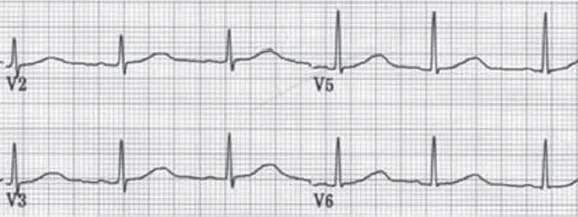
| a. | Hyperkalaemia. |
| b. | Hypocalcaemia. |
| c. | Hypothermia. |
| d. | Acute anterolateral myocardial infarction. |
| e. | Hyponatraemia. |
A3
The following reduce the risk of electrical injury in the ICU EXCEPT:
| a. | Mains isolating transformer. |
| b. | Earth leakage circuit breaker. |
| c. | Use of a common earth. |
| d. | Ensuring the patient has a good earth connection. |
| e. | Use of Class II equipment. |
A4
Which of the following is NOT an effective (>1°C/h fall in temperature) method of inducing therapeutic hypothermia in an ICU patient?
| a. | Cold air blanket. |
| b. | Ice water bodily immersion. |
| c. | Extracorporeal heat exchange. |
| d. | Rapid infusion of 30ml/kg bolus of crystalloid at 4°C. |
| e. | Central venous cooling catheter. |
A5
A 38-year-old window cleaner falls from the fifth floor of a building. On arrival in the Emergency Room, his Glasgow Coma Score (GCS) is 15 and he complains of pain, with bruising, of his chest wall. He also has a fractured left distal tibia and fibula. Blood pressure (BP) is 80/40mmHg, heart rate (HR) is 130bpm and respiratory rate (RR) is 30 breaths per minute. The CXR shows a small right-sided pulmonary contusion and a sternal fracture. The ECG shows right bundle branch block and T-wave inversion in V1. Despite rapid infusion of 3L of crystalloid his blood pressure falls to 60/40mmHg and his heart rate increases further. Insertion of bilateral chest drains has no effect. Abdominal ultrasound shows no evidence of free fluid. The MOST LIKELY diagnosis is:
| a. | Extensive pulmonary contusion. |
| b. | Cardiac tamponade. |
| c. | Myocardial infarction. |
| d. | Fat embolism. |
| e. | Ruptured spleen. |
A6
A 22-year-old man is being observed in the ICU following an incident where he was stabbed in the left flank. He was initially haemodynamically stable, but deteriorates several hours later, becoming pale and clammy with a HR of 125bpm, RR of 26 breaths per minute and BP of 78/58mmHg. His chest X-ray shows no abnormality. Regarding the immediate resuscitation of this patient which ONE of the following is TRUE?
| a. | Human albumin 4% will be no more effective than crystalloid for fluid resuscitation. |
| b. | Blood substitutes should be used in preference to crystalloid for initial resuscitation if available. |
| c. | Level 1 evidence supports the use of hypotensive resuscitation in this setting. |
| d. | A transfusion trigger of 7-9g/dl should be used. |
| e. | A central venous catheter should be placed immediately to guide further fluid therapy. |
A7
A 55-year-old woman is thrown from a motorbike during a collision and is found unresponsive at the roadside by the paramedics. On arrival in the Emergency Room she is haemodynamically stable; BP is 131/74mmHg, HR is 85bpm, RR is 8 breaths per minute and SpO2 is 98% on 15L of oxygen via a non-rebreathing mask. Her GCS is 6 and she has a dilated unreactive left pupil. Following rapid sequence induction of anaesthesia and tracheal intubation, a CT brain scan shows normal brain parenchyma with blood in the lateral ventricles. She is transferred to the ICU for further management. The following are adverse prognostic factors EXCEPT:
| a. | Female gender. |
| b. | Her age. |
| c. | A dilated unreactive pupil. |
| d. | Her GCS after resuscitation. |
| e. | Subarachnoid blood on CT scan. |
A8
A 51-year-old homeless man is brought into hospital with a severe headache, neck stiffness and vomiting. He complains of a 6-week period of feeling ‘rotten’. On examination he has opisthotonus, mild papilloedema and photophobia. He is drowsy and has a temperature of 37.9°C. Blood tests include a white cell count of 13x103/mL. Lumbar puncture shows clear cerebrospinal fluid (CSF) with a lymphocytic pleocytosis, protein 1g/L, glucose 1.5mmol/L (27.3mg/dL). India ink stain is negative. The most likely diagnosis is:
| a. | Tuberculous meningitis. |
| b. | Viral meningitis. |
| c. | Pneumococcal meningitis. |
| d. | Cryptococcal meningitis. |
| e. | None of the above. |
A9
Which statement regarding right ventricular infarction is FALSE?
| a. | Right atrial pressure is usually <10mmHg. |
| b. | It usually signifies occlusion in a branch of the right coronary artery. |
| c. | Right to left shunting is a recognised complication. |
| d. | Inferior myocardial infarction is usually present. |
| e. | Right corona... |
Table of contents
- Cover Page
- Title Page
- Copyright Page
- Contents
- Preface
- Foreword
- Abbreviations
- How to use this book
- Paper 1
- Paper 2
- Paper 3
Trusted by 375,005 students
Access to over 1.5 million titles for a fair monthly price.
Study more efficiently using our study tools.
Frequently asked questions
Yes, you can cancel anytime from the Subscription tab in your account settings on the Perlego website. Your subscription will stay active until the end of your current billing period. Learn how to cancel your subscription
No, books cannot be downloaded as external files, such as PDFs, for use outside of Perlego. However, you can download books within the Perlego app for offline reading on mobile or tablet. Learn how to download books offline
We are an online textbook subscription service, where you can get access to an entire online library for less than the price of a single book per month. With over 1.5 million books across 990+ topics, we’ve got you covered! Learn about our mission
Look out for the read-aloud symbol on your next book to see if you can listen to it. The read-aloud tool reads text aloud for you, highlighting the text as it is being read. You can pause it, speed it up and slow it down. Learn more about Read Aloud
Yes! You can use the Perlego app on both iOS and Android devices to read anytime, anywhere — even offline. Perfect for commutes or when you’re on the go.
Please note we cannot support devices running on iOS 13 and Android 7 or earlier. Learn more about using the app
Please note we cannot support devices running on iOS 13 and Android 7 or earlier. Learn more about using the app
Yes, you can access MCQs in Intensive Care Medicine by Benington, Steve,Nightingale, Peter,Shelly, Maire in PDF and/or ePUB format, as well as other popular books in Medicine & Medical Theory, Practice & Reference. We have over 1.5 million books available in our catalogue for you to explore.