A pocket handbook on the practical and safe use of drugs in inflammatory bowel disease to achieve best patient outcome in day-to-day practice. A book written by experts in inflammatory bowel disease covering the latest and most promising treatment modalities in patients with simple and complex inflammatory bowel disease. 20 short chapters illustrating therapeutic pathways to summarise current best practice on the management of ulcerative colitis and Crohn's disease including special scenarios: management of extraintestinal manifestations, cancer surveillance, pregnancy, fertility and breast feeding, screening for infections, bone diseases and anaemia. Suitable for all medical professionals involved in the care of patients with inflammatory bowel disease: established and trainee gastroenterologists, gastrointestinal surgeons, nurse specialists, general practitioners and general physicians.
- English
- ePUB (mobile friendly)
- Available on iOS & Android
eBook - ePub
About this book
Information
Topic
MedicinePart 1 Introduction
Management of ulcerative colitis
Ailsa L. Hart BMBCh MRCP PhD Senior Clinical Lecturer, Imperial College and Consultant Gastroenterologist, St Mark’s Hospital, London, UK
Ulcerative colitis is an inflammatory bowel disease of unknown cause (idiopathic) that affects up to 120,000 people in the UK with between 6,000 and 12,000 new cases being diagnosed each year.
The principal symptoms of ulcerative colitis include diarrhoea with rectal bleeding, abdominal pain and cramps, usually relieved by defecation. Symptoms depend on the extent and severity of disease. When disease extends beyond the rectum, patients tend to complain of diarrhoea (often with blood and mucus), faecal urgency and faecal incontinence. Patients with disease limited to the rectum (proctitis) tend to present with rectal bleeding and mucus discharge and a proportion of these patients complain of constipation, as opposed to diarrhoea. Patients with a more severe colitis have associated systemic symptoms of fever, vomiting and anorexia. One way of classifying ulcerative colitis is using the Montreal classification (Table 1) which takes into account the part of the colon affected 1.
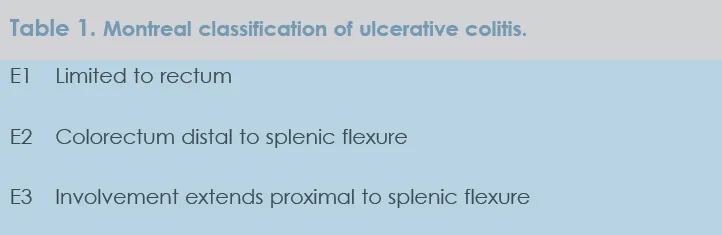
Ulcerative colitis tends to begin in the rectum and extends proximally affecting the bowel in a continuous fashion. Approximately one third of patients have disease confined to the rectum (proctitis) or the rectum and sigmoid (proctosigmoiditis) at the time of diagnosis. Approximately one third of patients will have a pancolitis at diagnosis. Disease can progress and extend, so that patients who have rectal or rectosigmoid involvement at presentation can progress to have disease affecting the proximal colon in 10-30% of patients at 10-year follow-up and in up to 50% at 25-year follow-up 2, 3.
The pattern of disease can follow different courses. Most patients have a chronic intermittent course with periods of remission and relapse 3; a cumulative relapse rate in the first year after diagnosis is about 50% irrespective of disease extent. Other patients have chronic continuous symptoms. Some patients have a single attack and subsequent remission. Some patients have a fulminant course leading to colectomy within the first disease episode. About 10% of patients have long-term remission after the initial disease episode. The extent of disease at diagnosis does not seem to affect the subsequent disease activity. When patients are followed up long term, disease activity in the previous year appears to be a good indicator of the subsequent course of disease 3. For example, a full year in remission is prognostically favourable and predicts an 80% probability of staying in remission for another year. The more years in remission, the higher the probability of experiencing yet another year in remission. On the other hand relapse in the previous year predicts a 70% probability of relapse in the subsequent year.
Both disease activity and extent determine treatment choice in the management of ulcerative colitis. For this reason this section is divided into chapters in which the extent of disease (e.g. proctitis, left-sided disease, extensive disease) and severity of disease (e.g. acute severe ulcerative colitis) are taken into account.
Each chapter has an algorithm of care, but in practice the care is individualised to the patient. Factors that contribute to the individual management of patients include patient preferences and beliefs; external factors such as schooling, work and family lives that may influence timing and choice of certain treatments; intolerance to medications; and other comorbidities. A clear agenda with a time-bound approach needs to be discussed with the patient, so that expectations of both the patient and health care professionals can be explored and met.
Treatment goals in ulcerative colitis include induction and maintenance of remission, mucosal healing, avoidance of admission to hospital, avoidance of surgery, minimising the risk of cancer, and optimised quality of life. Definition of remission and the contribution of clinical aspects, endoscopy, biomarkers and histopathology remain to be decided, but the bar should be raised with regards to what patients and physicians aim to achieve. An improvement in symptoms and wellbeing is unlikely to predict long-term outcome and is no longer optimal.
Treatment options for ulcerative colitis are increasing with development of new drug formulations and dosing strategies. There is a greater appreciation that assessment needs to occur in a timely fashion so that therapy can be escalated and optimised. There is also increased awareness of compliance problems that may need to be discussed and addressed.
References
| 1. | Silverberg MS, Satsangi J, Ahmad T, et al. Toward an integrated clinical, molecular and serological classification of inflammatory bowel disease: Report of a Working Party of the 2005 Montreal World Congress of Gastroenterology. Can J Gastroenterol 2005; 19 Suppl A: 5-36. |
| 2. | Ayres R... |
Table of contents
- Cover Page
- Title Page
- Copyright Page
- Contents
- Contributors
- Foreword
- Dedications
- Part 1: Introduction Management of ulcerative colitis
- Part 2: Introduction Management of Crohn’s disease
- Part 3: Introduction Current issues in other scenarios
Trusted by 375,005 students
Access to over 1.5 million titles for a fair monthly price.
Study more efficiently using our study tools.
Frequently asked questions
Yes, you can cancel anytime from the Subscription tab in your account settings on the Perlego website. Your subscription will stay active until the end of your current billing period. Learn how to cancel your subscription
No, books cannot be downloaded as external files, such as PDFs, for use outside of Perlego. However, you can download books within the Perlego app for offline reading on mobile or tablet. Learn how to download books offline
Perlego offers two plans: Essential and Complete
- Essential is ideal for learners and professionals who enjoy exploring a wide range of subjects. Access the Essential Library with 800,000+ trusted titles and best-sellers across business, personal growth, and the humanities. Includes unlimited reading time and Standard Read Aloud voice.
- Complete: Perfect for advanced learners and researchers needing full, unrestricted access. Unlock 1.5M+ books across hundreds of subjects, including academic and specialized titles. The Complete Plan also includes advanced features like Premium Read Aloud and Research Assistant.
We are an online textbook subscription service, where you can get access to an entire online library for less than the price of a single book per month. With over 1.5 million books across 990+ topics, we’ve got you covered! Learn about our mission
Look out for the read-aloud symbol on your next book to see if you can listen to it. The read-aloud tool reads text aloud for you, highlighting the text as it is being read. You can pause it, speed it up and slow it down. Learn more about Read Aloud
Yes! You can use the Perlego app on both iOS and Android devices to read anytime, anywhere — even offline. Perfect for commutes or when you’re on the go.
Please note we cannot support devices running on iOS 13 and Android 7 or earlier. Learn more about using the app
Please note we cannot support devices running on iOS 13 and Android 7 or earlier. Learn more about using the app
Yes, you can access Inflammatory Bowel Disease by Hart, Ailsa L,Ng, Siew C, Hart, Ailsa L , Ng, Siew C in PDF and/or ePUB format, as well as other popular books in Medicine & Medical Theory, Practice & Reference. We have over 1.5 million books available in our catalogue for you to explore.