The Objective Structured Clinical Examination (OSCE) is a highly reliable and valid tool for the evaluation of trainees in anaesthesia. It enables examiners and trainers to assess a number of competencies in an organised way. Performance in the OSCE is considered to be a fair reflection of the level of knowledge and skill attained during anaesthesia training. Apart from having a wide and deep knowledge on the subject, trainees are expected to have the capacity to demonstrate their competency in a short period of time allotted for each station. The authors of this book have a rich experience in successfully conducting OSCE courses in the United Kingdom. The sample OSCE sets in the book closely simulate the style and content of the Royal College of Anaesthetists' examination format. The book contains 100 OSCE stations with answers based on key practical procedures, clinical skills, communication skills, data interpretation, anaesthetic equipment and the management of critical incidents on a simulator. This book will also help candidates all over the world to pass highly competitive postgraduate examinations in anaesthesia. It is an invaluable educational resource for all anaesthetists.
eBook - ePub
The Objective Structured Clinical Examination in Anaesthesia
Practice papers for teachers and trainees
- English
- ePUB (mobile friendly)
- Available on iOS & Android
eBook - ePub
The Objective Structured Clinical Examination in Anaesthesia
Practice papers for teachers and trainees
About this book
Information
Topic
MedicineOSCE
set 1
Station 1.1 Anaesthetic equipment: circle absorber
Information for the candidate
In this station you will be asked to check a breathing system as you routinely do before starting a list.
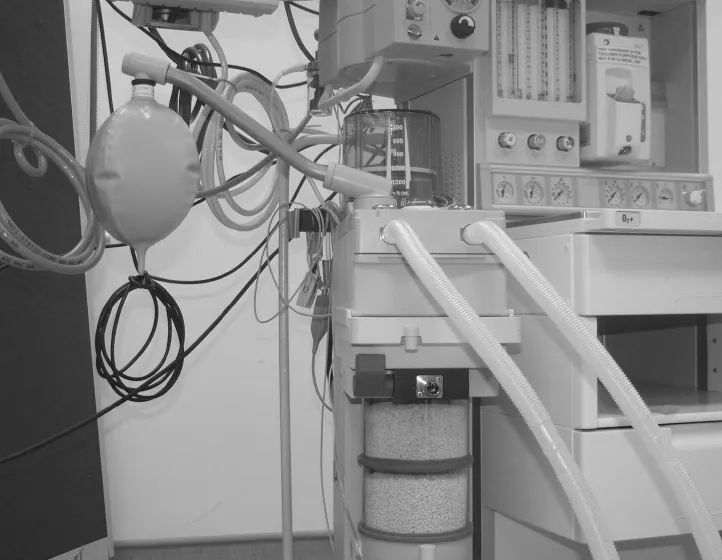
Figure 1.1a Anaesthetic machine with circle absorber system.
Examiner’s mark sheet
| Can you please check the breathing system on this anaesthetic machine? | |||
| marks | |||
| ♦ | Ensures that soda lime is present and is not used up (check colour). | 1 |  |
| ♦ | Visually inspects the system. | 1 | |
| ♦ | Identifies the blocked filter. | 2 | |
| ♦ | Appropriately performs the leak test. | 2 | |
| ♦ | Identifies that it is leaking at the water drain. | 2 | |
| ♦ | Checks function of the one-way valves by connecting bags at both ends. | 2 | |
| What are the benefits in using this system? | 4 | | |
| ♦ | Economy: fresh gas flow (FGF) can be reduced to less than a litre per minute and consumption of volatile agents is reduced. | ||
| ♦ | Humidification: inspired gas will be saturated with water vapour from the expired gas. | ||
| ♦ | Reduced heat loss: in addition to conservation of heat, the exothermic reaction of CO2 absorption assists in maintaining body temperature. | ||
| ♦ | Reduced atmospheric pollution: by using low FGF, escape of volatile anaesthetic agents into the atmosphere is minimised. | ||
| What happens if the unidirectional valve malfunctions? | 1 | | |
| Malfunction of the unidirectional valve leads to mixing of inspired gas with expired gas containing CO2 and results in hypercapnIa. | |||
| What is the mesh size of the granules? | 1 | | |
| 4-8 mesh or 3-4mm spheres. | |||
| What do you understand by 4-8 mesh? | 1 | | |
| Strainers with 4 mesh have four equal strands per linear inch in both vertical and horizontal axes. Similarly, strainers with 8 mesh have 8 equal strands per linear inch in both vertical and horizontal axes. Granules of 4-8 mesh size pass through the strainers with 4-8 mesh. | |||
| What are the constituents of soda lime? | 1 | | |
| NaOH, Ca(OH)2, KOH, water and silica. | |||
| Name some contaminants that can be produced in this system | 2 | | |
| Compound A and B are produced with sevoflurane. Desflurane, isofurane and enflurane react with dry soda lime to produce carbon monoxide. Methane and acetone are other compounds that may be produced. | |||
Total: /20
Information for the exami...
Table of contents
- Cover Page
- Title Page
- Copyright Page
- Contents
- Preface
- Foreword
- Acknowledgements
- Abbreviations
- OSCE set 1
- OSCE set 2
- OSCE set 3
- OSCE set 4
- OSCE set 5
Trusted by 375,005 students
Access to over 1.5 million titles for a fair monthly price.
Study more efficiently using our study tools.
Frequently asked questions
Yes, you can cancel anytime from the Subscription tab in your account settings on the Perlego website. Your subscription will stay active until the end of your current billing period. Learn how to cancel your subscription
No, books cannot be downloaded as external files, such as PDFs, for use outside of Perlego. However, you can download books within the Perlego app for offline reading on mobile or tablet. Learn how to download books offline
Perlego offers two plans: Essential and Complete
- Essential is ideal for learners and professionals who enjoy exploring a wide range of subjects. Access the Essential Library with 800,000+ trusted titles and best-sellers across business, personal growth, and the humanities. Includes unlimited reading time and Standard Read Aloud voice.
- Complete: Perfect for advanced learners and researchers needing full, unrestricted access. Unlock 1.5M+ books across hundreds of subjects, including academic and specialized titles. The Complete Plan also includes advanced features like Premium Read Aloud and Research Assistant.
We are an online textbook subscription service, where you can get access to an entire online library for less than the price of a single book per month. With over 1.5 million books across 990+ topics, we’ve got you covered! Learn about our mission
Look out for the read-aloud symbol on your next book to see if you can listen to it. The read-aloud tool reads text aloud for you, highlighting the text as it is being read. You can pause it, speed it up and slow it down. Learn more about Read Aloud
Yes! You can use the Perlego app on both iOS and Android devices to read anytime, anywhere — even offline. Perfect for commutes or when you’re on the go.
Please note we cannot support devices running on iOS 13 and Android 7 or earlier. Learn more about using the app
Please note we cannot support devices running on iOS 13 and Android 7 or earlier. Learn more about using the app
Yes, you can access The Objective Structured Clinical Examination in Anaesthesia by Mendonca, Cyprian,Balasubramanian, Shyam in PDF and/or ePUB format, as well as other popular books in Medicine & Medical Theory, Practice & Reference. We have over 1.5 million books available in our catalogue for you to explore.