In this era of evidence-based medicine, clinicians treat common conditions according to guidelines and protocols derived from the results of randomised clinical trials. This book will help vascular specialists when they have to treat a patient with an unusual condition where they may have no experience and there is little published scientific information. The Joint Vascular Research Group has collected rare vascular conditions in a register for over a decade, and this book reviews the experience, together with the best information from the surgical literature. The authors give a practical guide on the diagnosis and management of rare vascular disorders. This book should be read by everyone who manages patients with vascular disease.
- English
- ePUB (mobile friendly)
- Available on iOS & Android
eBook - ePub
About this book
Information
Topic
MedicineChapter 1
The Rare Diagnosis and Operations Register
This book is born out of an idea conceived during a Joint Vascular Research Group meeting in the mid 1990s. At the time, the project was called the Rare Diagnosis and Operations Register.
The Rare Diagnosis and Operations Register is a collection of unusual vascular diagnoses and operations seen or performed by members of the Joint Vascular Research Group. Members contribute cases to the author who stores them in a database, which is then available to any member of the group. It was set up in May 1995 following the spring meeting of the Joint Vascular Research Group.
Aims
The database was set up with a number of aims in mind. These are as follows:
| ♦ | To create a collection of unusual cases. |
| ♦ | To provide members with the opportunity of publishing, separately or jointly, collective reports of unusual vascular conditions. |
| ♦ | To allow expertise and advice to be disseminated between members for the management of unusual cases. |
| ♦ | To encourage contribution to the JVRG generally by promoting a competitive culture. |
Method
From the outset, members were asked to contribute any cases they thought unusual. In order to encourage as many members to contribute as many cases as possible, no preconditions were set.
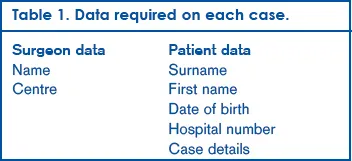
To facilitate data collection, a minimum of data were required on each case. These are summarised in Table 1. Latterly, hospital number has become the only patient identifier collected.
Each case submitted was entered in a database with the date of submission. At the beginning, there were a small number of categories that we particularly wanted to collect, though submissions were not confined to those groups. When more than three similar non-categorised cases were submitted, a new category was created.
To start there were six categories. These included: popliteal entrapment, major vessel arteritis, carotid body tumour, mesenteric ischaemia, cystic degeneration and lupus. At the time of writing there are 30 categories and these are shown in Table 2.
Table 2. Categories of cases submitted.
Aortocaval fistula
Aorto-enteric fistula
Arm ischaemia
Arteriovenous malformation
Brachial embolus
Leg ulcer calcification
Carotid artery surgery
Carotid body tumour
Cystic degeneration
Deep vein thrombosis
Radiotherapy arteritis
Ehlers-Danlos syndrome
Klippel-Trenaunay syndrome
Systemic lupus erythematosus
Mid-aortic syndrome
Major vessel arteritis
Mesenteric ischaemia
Mycotic aneurysm
Other odd aneurysms
Paget Schroetter syndrome
Popliteal entrapment
Profunda femoris aneurysms
Right to left shunt or paradoxical embolism
AAA with renal abnormality
Subclavian steal syndrome
Thoracic outlet compression
Vascular trauma
Visceral aneurysms
Vena caval obstruction
Arterial disease in patients under 40 years
The reports
Regular reports have been produced which are circulated to the membership. Reports are in several parts:
| ♦ | A table of numbers submitted by category and by centre in total and since the last report. |
| ♦ | A list of all new cases showing contributing surgeon, category and details of case. |
| ♦ | A list of non-categorized cases with their details by centre. |
| ♦ | A newsletter. |
| ♦ | A proforma for subsequent case submissions. |
Early on the cases were attributed to individual surgeons but as the size of the group has increased cases are now classified by referring centre. There are now 22 centres with approximately 30 contributing surgeons. Sent with the report are a newsletter and a proforma for completion during the next time interval. More recently, submissions directly by email have become possible.
The res...
Table of contents
- Cover Page
- Title Page
- Copyright Page
- Contents
- Contributors
- Foreword
- The Joint Vascular Research Group
- Chapter 1: The Rare Diagnosis and Operations Register
- Chapter 2: Anatomical variation for the vascular specialist
- Chapter 3: Paediatric arterial problems
- Chapter 4: Major vessel arteritis including lupus
- Chapter 5: Takayasu's arteritis
- Chapter 6: Behcet's disease
- Chapter 7: Ehlers-Danlos syndrome
- Chapter 8: Moyamoya disease
- Chapter 9: Fibromuscular dysplasia
- Chapter 10: Radiation-induced arterial disease
- Chapter 11: Peripheral vascular anomalies
- Chapter 12: Major iliofemoral venous thrombosis, phlegmasia, and caval filters
- Chapter 13: Pelvic congestion syndrome
- Chapter 14: Klippel-Trenaunay syndrome
- Chapter 15: Subcutaneous calcification in leg ulcers
- Chapter 16: Carotid and vertebral artery dissection
- Chapter 17: Carotid body tumour
- Chapter 18: Carotid aneurysms
- Chapter 19: Thoracic outlet syndrome
- Chapter 20: Paget Schroetter syndrome
- Chapter 21: Subclavian steal syndrome
- Chapter 22: Acute arm ischaemia
- Chapter 23: Aneurysm of an aberrant right subclavian artery
- Chapter 24: Abdominal aortic aneurysm with horseshoe kidney
- Chapter 25: Aortocaval fistula
- Chapter 26: Aorto-enteric fistula
- Chapter 27: Aortic aneurysm associated with HIV
- Chapter 28: Mid-aortic syndrome
- Chapter 29: Visceral artery aneurysms
- Chapter 30: Mesenteric ischaemia
- Chapter 31: Retroperitoneal lymph node dissection for metastatic germ cell tumours
- Chapter 32: Infection following aortic and carotid surgery
- Chapter 33: Mycotic aneurysms
- Chapter 34: Rare causes of arterial embolism
- Chapter 35: Vascular involvement in limb sarcoma
- Chapter 36: Profunda femoris aneurysms
- Chapter 37: Popliteal aneurysm
- Chapter 38: Popliteal artery entrapment syndrome
- Chapter 39: Cystic adventitial disease
- Chapter 40: False aneurysms
- Chapter 41: Buerger's disease
Trusted by 375,005 students
Access to over 1.5 million titles for a fair monthly price.
Study more efficiently using our study tools.
Frequently asked questions
Yes, you can cancel anytime from the Subscription tab in your account settings on the Perlego website. Your subscription will stay active until the end of your current billing period. Learn how to cancel your subscription
No, books cannot be downloaded as external files, such as PDFs, for use outside of Perlego. However, you can download books within the Perlego app for offline reading on mobile or tablet. Learn how to download books offline
Perlego offers two plans: Essential and Complete
- Essential is ideal for learners and professionals who enjoy exploring a wide range of subjects. Access the Essential Library with 800,000+ trusted titles and best-sellers across business, personal growth, and the humanities. Includes unlimited reading time and Standard Read Aloud voice.
- Complete: Perfect for advanced learners and researchers needing full, unrestricted access. Unlock 1.5M+ books across hundreds of subjects, including academic and specialized titles. The Complete Plan also includes advanced features like Premium Read Aloud and Research Assistant.
We are an online textbook subscription service, where you can get access to an entire online library for less than the price of a single book per month. With over 1.5 million books across 990+ topics, we’ve got you covered! Learn about our mission
Look out for the read-aloud symbol on your next book to see if you can listen to it. The read-aloud tool reads text aloud for you, highlighting the text as it is being read. You can pause it, speed it up and slow it down. Learn more about Read Aloud
Yes! You can use the Perlego app on both iOS and Android devices to read anytime, anywhere — even offline. Perfect for commutes or when you’re on the go.
Please note we cannot support devices running on iOS 13 and Android 7 or earlier. Learn more about using the app
Please note we cannot support devices running on iOS 13 and Android 7 or earlier. Learn more about using the app
Yes, you can access Rare Vascular Disorders by Parvin, Simon, D, Earnshaw, Jonothan, J in PDF and/or ePUB format, as well as other popular books in Medicine & Medical Theory, Practice & Reference. We have over 1.5 million books available in our catalogue for you to explore.