Die Reihe Europäisch-Jüdische Studien repräsentiert die international vernetzte Kompetenz des »Moses Mendelssohn Zentrums für europäisch-jüdische Studien« (MMZ). Der interdisziplinäre Charakter der Reihe, die in Kooperation mit dem Selma Stern Zentrum für Jüdische Studien Berlin-Brandenburg herausgegeben wird, zielt insbesondere auf geschichts-, geistes- und kulturwissenschaftliche Ansätze sowie auf intellektuelle, politische, literarische und religiöse Grundfragen, die jüdisches Leben und Denken in der Vergangenheit beeinflusst haben und noch heute inspirieren. Mit ihren Publikationen weiß sich das MMZ der über 250jährigen Tradition der von Moses Mendelssohn begründeten Jüdischen Aufklärung und der Wissenschaft des Judentums verpflichtet.
eBook - ePub
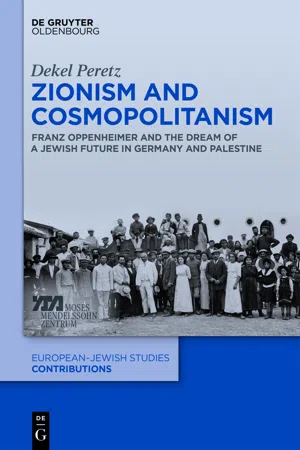
Zionism and Cosmopolitanism
Franz Oppenheimer and the Dream of a Jewish Future in Germany and Palestine
- 315 pages
- English
- ePUB (mobile friendly)
- Available on iOS & Android
eBook - ePub
Zionism and Cosmopolitanism
Franz Oppenheimer and the Dream of a Jewish Future in Germany and Palestine
About this book
Information
Chapter 1 The Young Oppenheimer’s Utopian Horizon: Socialism, Darwinism and Rassenhygiene
Race, Antisemitism and Jewishness
Until these final chapters [of Oppenheimer’s autobiography], one cannot say that this formerly active fraternity member is carrying something like the cross of his Jewishness with him – but then he is carrying it after all.1
Franz Oppenheimer was born on March 30, 1864, in Berlin’s Spandauer Vorstadt, the city’s old Jewish Quarter. Like many of his generation, he grew up in an accultured German Jewish home. His birth house on Krausnick Street was just around the corner from the grand New Synagogue, which would open its portals two and a half years after his birth. Oppenheimer’s father, Julius, was a reform rabbi serving in the Johannis Street Synagogue, Berlin’s first reform temple. Hence, the logical starting point for an inquiry into Oppenheimer’s Jewishness would be his upbringing in reform Judaism and its ingrained social message.
In his autobiography Oppenheimer framed his major career turning points in the ethical core of his upbringing, which included scorn for “Mammonism” widespread among educated Jewish middle class families like Oppenheimer’s.2 This was a guiding principle both in his initial decision to pursue a career in medicine following in the footpaths of his maternal grandfather, and in his later transition to academic sociology and social reform.3 Accordingly, biographers commonly explained Oppenheimer’s Jewish identity by reference to tikkun olam, which literally means “to repair the world,” and is a central precept of Liberal Judaism calling for positive action to improve the lot of the socially deprived.4
Following Oppenheimer’s self-proclamations would not be necessarily wrong, but it could be misleading in reference to the centrality reform Judaism played for him. As will be seen in the discussion of Oppenheimer’s Zionist inclinations, he was certainly influenced by the universal message of the prophets of Israel, an important staple of reform Judaism. Yet all too often Oppenheimer downplayed the influence of Judaism on his thinking, as in this example: “When I look inwards, I find ninety-nine percent Kant and Goethe and only one percent Old Testament, and even that is considerably mediated by Spinoza and Luther’s Bible.”5 The fact that his father was a reform Rabbi could have actually had an adverse effect on his Jewish knowledge, according to Franz Rosenzweig who once described Oppenheimer as “this impressive hot-headed person who is so ignorant in Jewish matters as only a rabbi’s son can be.”6
In his memoirs, Oppenheimer recounted further sources for his interest in society’s woes. He attributed his political and ethical awakening to philosophers such as Immanuel Kant and Leonard Nelson, as well as to encounters with prominent figures in Berlin’s bohemian scene such as SPD politician and anarchist Bruno Wille.7 Together with his sister Paula and his friend and brother-in-law Richard Dehmel, Oppenheimer frequented bohemian and naturalist circles such as the Friedrichshagener Dichterkreis, also trying his luck with poetry. Like a true naturalist writer, he focused his gaze on the suffering of society’s poor and downtrodden, especially those affected negatively by industrialization and urbanization. His adherence to the methodology of the natural sciences in his sociological undertakings could also be interpreted as an expression of his intellectual proximity to naturalism in a formative period.8
Lisa Silverman has expounded on the problem of using rigid preconceptions of Judaism or “trying to fit individuals and events into the predetermined boundaries of a grander scheme,” suggesting instead an analytical approach that “takes into account concerns of contingency, agency and often completely overlooked, unconventional or marginal issues – elements that can perhaps better address those unarticulated aspects of ‘Jewish experience’ that may not feature traces of explicit ‘Jewish content.’” Silverman also advised against using the term “Jewish identity,” which she considered to be conceptually overloaded; she suggests instead the use of “‘Jewishness’ as an analytical category … that is, the relationship between the constructed ideals of the ‘Jewish’ as opposed to the ‘non-Jewish’ – rather than any fixed notions of religion, ethnicity or culture.” Such an approach focuses on exploring the perceived boundaries between “Jewish” and “non-Jewish,” enriching our understanding of the Jewish experience within dynamic cultural frameworks.9
The prevalence of Jews in medical professions at the turn of the century is a prime example of the German Jewish experience woven into German cultural and social life.10 Medicine seemed to promise safe and stable earnings, as well as social esteem. However, this was also a time of crisis for the medical profession. The introduction of statutory health insurance and the excess supply of doctors increased competition for more lucrative private patients, aggravating the frustration and resentment of non-Jewish colleagues at Jewish physicians. Since pursuing an academic career for nonbaptized Jewish doctors was all but impossible, many of them turned to clinical specializations that enabled them to set up private practices.11 Oppenheimer specialized in otolaryngology. He established a private practice, yet he struggled to attract patients. His public appointment as a general practitioner in a nearby first aid post helped. Insufficient earnings – along with his frontline experience treating a woeful Berlin underclass beset by a city undergoing rapid urbanization and industrialization – led him to close his practice in 1896 and follow a new calling as a social economist.
The discipline of sociology was deeply rooted in social medicine. Oppenheimer’s medical background was not lost in the transition but, on the contrary, shaped his sociological stance. The convergence of sociology and medicine in Oppenheimer’s methodology and organicist thinking has already been adequately discussed in the literature.12 Yet his Jewish perspective in this development has been widely ignored. His special interest in matters of race and the relationship between biology and sociology – as well as his dedication to combating academic racism and antisemitism – bear witness to such a relationship.
Antisemitism was a formative experience for Oppenheimer. Contrary to Kurt Tucholsky’s critic quoted at the outset of this chapter, Oppenheimer’s autobiography, completed two years before Hitler’s rise to power, is full of references to personal experiences and internalization, refutations of racial stereotypes, and expressions of Jewish pride – albeit not aimed specifically at combating the Nazi party.13 Tucholsky’s recognition of Jewishness solely in the final chapters of Oppenheimer’s autobiography, describing his explicit activity during the First World War for the relief of Jews in occupied Eastern Europe and in combating institutional antisemitism within the German military, can be perceived as a further manifestation of the problem of identifying Jewishness with Jewish content described by Silverman. Yet Tucholsky took a more sophisticated position in line with Silverman’s approach. In his short review of Oppenheimer’s autobiography, he mainly criticized Oppenheimer’s apparent vanity. As the “cross of Jewishness” Tucholsky singled out Oppenheimer’s relish in his mingling with Germany’s military elite and royalty and denounced it as subservience peeking out from beneath the cloak of conceitedness.14
Putting Tucholsky’s particular definition of the “cross of Jewishness” aside, a sense of its burden is omnipresent in Oppenheimer’s autobiography, which can be read as an apologetic defense against antisemitic slander, and at times as a proud manifest of Jewish belonging to Germany. The autobiography commenced with the following words: “I certainly can’t claim that I was ‘baptized’ [Oppenheimer used here the Berlin dialect jedooft] with Spree water’; but I am an authentic Berliner, even a ‘fully authentic’ one [here, too, Oppenheimer wrote in Berlin dialect janz echter].” Oppenheimer played on the tension between not being baptized yet being totally immersed in the local dialect. He hypothesized that real Berliners were not high society in fine neighborhoods, but the social others, the proletariat, at Berlin’s furthest outskirts, in the Jewish quarter, and in other less well-to-do neighborhoods. In Berlin dialect these were labeled “Berlin j. d.” an acronym for janz draußen [way out] or “Berlin V” meaning Viehhof [stockyard] – a play both on the supposedly wild nature of these social outcasts, as well as the nickname for the Jewish quarter’s Scheunenviertel [Barn Quarter].15
Oppenheimer was famous for utilizing the Berliner dialect in his extremely popular lectures and public talks. The dialect amplified Oppenheimer’s wit, humor and charisma. On occasion of Oppenheimer’s seventieth birthday a contemporary recalled:
My earliest Zionist memories show me an unforgettable picture of Franz Oppenheimer on the podium in front of an overfilled hall promoting with almost fanatical enthusiasm the “Oppenheimerian Utopia” … “Jeben Sie mir doch endlich das lumpige Jeld!” [“give me at last the paltry money” in Berlin dialect] he called at the end and stormed out. The phrase lived on in our circle as a saying … it revealed the whole man: the Berliner as well as the Jew.16
Besides the dialect’s entertainment bonus, it was a conscious expression of Oppenheimer’s feeling of deep rootedness and belonging in Germany and Berlin, as well as the liberal conception that a shared tongue forms the foundation for belonging. Oppenheimer traced his maternal family’s settlement in Berlin to the seventeenth century and emphasized that his paternal side was part of an old dynasty mainly from lower Saxony and along the Rhine where Jews lived “before the first Germanics glimpsed the stream.” His father’s side supposedly also had Sephardic origins carrying the family name Ben Ari, meaning “lion’s son.” The lion was a part of the insignia of the tribe of Juda and implied the family’s noble descent from the house of David, according to Oppenheimer: “I will not deny that it is not an unpleasant consciousness to be aware of genealogical roots so deep in the soils of historical heroic epochs and to feel an offspring of Goliath’s slayer. Who can still boast such old nobility?”17 Oppenheimer’s claim to Sephardic lineage was not uncommon among German Jewry and especially Jewish anthropologists who in the time of the rise of race science came to view the Sephardi “as the equivalent of the Jewish ‘Aryan,’ a glorious figure, characterized by his nobility, breeding and poise. He was portrayed as the physical counterpoint to the ignoble Jew of Central and Eastern Europe.”18
Oppenheimer’s interest in physical anthropology and racial theories permeated his autobiography. The supposed ignobility of the mixed breed manifested itself in the stereotypical Jewish racial features that Oppenheimer ascribed to himself. He internalized Enlightenment conceptions presupposing racial theory connecting aesthetics and morality, epitomized by notions of classical beauty that idealized facial features above all others.19 Oppenheimer felt he could never satisfy these ideals due to the inalterability of his nose. He described his ugliness as a baby with large eyes and an oversized nose,20 adding that even though his complexion gradually improved, he could never attain “classical beauty” since the “famous ‘Hittite nose’ remained and branded me as a member of a race which was generally viewed and treated with a traditional – and somewhat benign – enmity by the blonde Berliner.”21 As a sociologist and patriotic Berliner, he distinguished between traditional resentment utilized f...
Table of contents
- Title Page
- Copyright
- Contents
- Acknowledgements
- List of Abbreviations
- Introduction
- Chapter 1 The Young Oppenheimer’s Utopian Horizon: Socialism, Darwinism and Rassenhygiene
- Chapter 2 Biology, Sociology and the Jews
- Chapter 3 Oppenheimer’s Path to Zionism
- Chapter 4 Altneuland – A German Colonial Journal
- Chapter 5 Altneuland’s Entanglement in German Racial and Colonial Discourses
- Chapter 6 When Fantasies Meet Realities
- Conclusion
- Bibliography
- Register
Trusted by 375,005 students
Access to over 1.5 million titles for a fair monthly price.
Study more efficiently using our study tools.
Frequently asked questions
Yes, you can cancel anytime from the Subscription tab in your account settings on the Perlego website. Your subscription will stay active until the end of your current billing period. Learn how to cancel your subscription
No, books cannot be downloaded as external files, such as PDFs, for use outside of Perlego. However, you can download books within the Perlego app for offline reading on mobile or tablet. Learn how to download books offline
Perlego offers two plans: Essential and Complete
- Essential is ideal for learners and professionals who enjoy exploring a wide range of subjects. Access the Essential Library with 800,000+ trusted titles and best-sellers across business, personal growth, and the humanities. Includes unlimited reading time and Standard Read Aloud voice.
- Complete: Perfect for advanced learners and researchers needing full, unrestricted access. Unlock 1.5M+ books across hundreds of subjects, including academic and specialized titles. The Complete Plan also includes advanced features like Premium Read Aloud and Research Assistant.
We are an online textbook subscription service, where you can get access to an entire online library for less than the price of a single book per month. With over 1.5 million books across 990+ topics, we’ve got you covered! Learn about our mission
Look out for the read-aloud symbol on your next book to see if you can listen to it. The read-aloud tool reads text aloud for you, highlighting the text as it is being read. You can pause it, speed it up and slow it down. Learn more about Read Aloud
Yes! You can use the Perlego app on both iOS and Android devices to read anytime, anywhere — even offline. Perfect for commutes or when you’re on the go.
Please note we cannot support devices running on iOS 13 and Android 7 or earlier. Learn more about using the app
Please note we cannot support devices running on iOS 13 and Android 7 or earlier. Learn more about using the app
Yes, you can access Zionism and Cosmopolitanism by Dekel Peretz in PDF and/or ePUB format, as well as other popular books in History & Sociology. We have over 1.5 million books available in our catalogue for you to explore.