The Society of Light and Lighting (SLL) and its predecessors, the Lighting Division of the Chartered Institution of Building Services Engineers (CIBSE) and the Illuminating Engineering Society (IES), have published recommendations on lighting practice since 1936. From the beginning, these recommendations, called Codes for Lighting, have all contained details of the illuminances required for use in different applications together with qualitative guidance on how to implement these recommendations. Over the years, as the understanding of how lighting conditions can affect visual performance and cause visual discomfort has increased, additional quantitative lighting criteria have been added, notably those concerned with the level of colour rendering required and with limiting discomfort glare. For many years, the IES Code for Lighting was the de facto standard for lighting provision in the United Kingdom. However, in 2002, the Committee for European Standardisation (CEN) took on the task of providing lighting recommendations, and, since then the British Standards Institution has adopted the CEN recommendations for use in the United Kingdom. As a result, there are now a range of British Standards that specify the quantitative lighting requirements for a wide range of applications. Consequently, the role of the SLL Code for Lighting has shifted from being the only source for quantitative lighting recommendations to being a guide on how to interpret the British Standard recommendations and how to implement them in practice.This edition of the SLL Code for Lighting takes the changes in lighting guidance a step further by a process of separation and concentration. The separation involves moving the details of vision, lighting technology and lighting applications into another publication, the SLL Lighting Handbook. The concentration occurs because this SLL Code for Lighting provides information on three fundamental matters of relevance to lighting practice. These matters are: A summary of what is known about the effects of lighting on task performance, behaviour, safety, perception and health as well as its fi nancial and environmental costs.A compendium of all the lighting recommendations relevant to the United Kingdom with suggestions as to how these should be interpreted. This compendium covers recommendations for both interior and exterior lighting in normal conditions. A detailed description of all the calculations required for quantitative lighting design. While it is a fact that, today, most lighting calculations are done using software that simply implements the fundamental calculations described here, without knowledge of these calculations, it is difficult to assess the meaning and merit of the results produced by software.
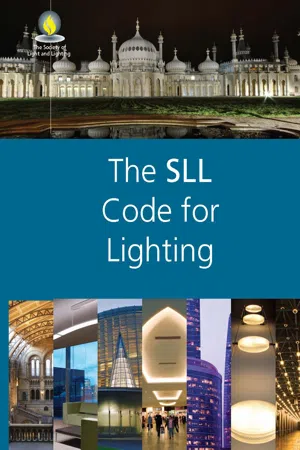
- 342 pages
- English
- PDF
- Available on iOS & Android
eBook - PDF
SLL Code for Lighting
About this book
Information
Publisher
The Chartered Institution of Building Services Engineers/ The Society of Light and LightingYear
2012eBook ISBN
9781906846213
Table of contents
- The SLL Code for Lighting OFC
- Code for Lighting Prelim
- Chapter 1: The balance of lighting
- Chapter 2: Indoor workplaces
- Chapter 3: Outdoor workplaces
- Chapter 4: Road lighting
- Chapter 5: Daylight
- Chapter 6: Energy
- Chapter 7: Construction (Design and Management) Regulations
- Chapter 8: Basic energy and light
- Chapter 9: Luminous flux, intensity, illuminance, luminance and their interrelationships
- Chapter 10: Direct light
- Chapter 11: Indirect light
- Chapter 12: Photometric datasheets
- Chapter 13: Indoor lighting calculations
- Chapter 14: Outdoor lighting calculations
- Chapter 15: Measurement of lighting installations and interpreting the results
- Chapter 16: Colour
- Chapter 17: Daylight calculations
- Chapter 18: Predicting maintenance factor
- Chapter 19: Glossary
- Chapter 20: Bibliography
- Index
Trusted by 375,005 students
Access to over 1.5 million titles for a fair monthly price.
Study more efficiently using our study tools.
Frequently asked questions
Yes, you can cancel anytime from the Subscription tab in your account settings on the Perlego website. Your subscription will stay active until the end of your current billing period. Learn how to cancel your subscription
No, books cannot be downloaded as external files, such as PDFs, for use outside of Perlego. However, you can download books within the Perlego app for offline reading on mobile or tablet. Learn how to download books offline
Perlego offers two plans: Essential and Complete
- Essential is ideal for learners and professionals who enjoy exploring a wide range of subjects. Access the Essential Library with 800,000+ trusted titles and best-sellers across business, personal growth, and the humanities. Includes unlimited reading time and Standard Read Aloud voice.
- Complete: Perfect for advanced learners and researchers needing full, unrestricted access. Unlock 1.5M+ books across hundreds of subjects, including academic and specialized titles. The Complete Plan also includes advanced features like Premium Read Aloud and Research Assistant.
We are an online textbook subscription service, where you can get access to an entire online library for less than the price of a single book per month. With over 1.5 million books across 990+ topics, we’ve got you covered! Learn about our mission
Look out for the read-aloud symbol on your next book to see if you can listen to it. The read-aloud tool reads text aloud for you, highlighting the text as it is being read. You can pause it, speed it up and slow it down. Learn more about Read Aloud
Yes! You can use the Perlego app on both iOS and Android devices to read anytime, anywhere — even offline. Perfect for commutes or when you’re on the go.
Please note we cannot support devices running on iOS 13 and Android 7 or earlier. Learn more about using the app
Please note we cannot support devices running on iOS 13 and Android 7 or earlier. Learn more about using the app
Yes, you can access SLL Code for Lighting by Peter Raynham (principal author) in PDF and/or ePUB format, as well as other popular books in Technology & Engineering & Construction & Architectural Engineering. We have over 1.5 million books available in our catalogue for you to explore.