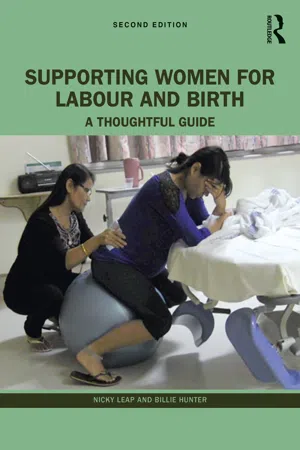
This new edition provides an up-to-date and thoughtful guide to supporting women in labour, looking at a range of techniques and approaches that promote a safe and positive experience of birth for women and their families. Across the world, support in labour has been shown to reduce obstetric interventions and improve outcomes for women and babies. Written by two highly experienced midwifery authors, this text draws on a wide range of cutting-edge research on this topic, identifying how the evidence can be applied to everyday practice. Narratives from women and practitioners, including midwives, doulas, childbirth educators and students, are used to illustrate a range of situations where the quality of support is central to the quality of the experience and outcome. Supporting Women for Labour and Birth encourages readers to reflect on their experiences and examine the evidence provided by both research and experiences of women and practitioners in order to explore how this could be incorporated into their practice. The only book to deal directly with the practical and emotional issues associated with labour support, this is an ideal text for student midwives and an important reference for practising midwives, doulas and other childbirth practitioners.
- 286 pages
- English
- ePUB (mobile friendly)
- Available on iOS & Android
eBook - ePub
About this book
Information
1 What do we mean by ‘support’ in labour?
DOI: 10.4324/9781003092520-2
Introduction
‘Continuous support in labour’ or ‘one-to-one support in labour’ are terms used to describe the recognised gold standard of a woman having someone alongside her, responding to her physical and emotional needs throughout whatever transpires during her labour. In this chapter we shall explore the features and value of support during labour, with reference to the experiences of women, and those who provide support, including: midwives, doulas and the woman’s chosen labour supporters or birth companions. The importance of this support cannot be over-stated, as this childbirth educator and birth supporter notes:
We’ve had all this emphasis on giving women choices – and that comes quite a way down the hierarchy of importance for me. Support is the most important thing, and with support comes encouragement. Just connecting with the woman and telling her, you know, demonstrating through your body language and also through murmuring comforting and encouraging words that she’s doing really well.(Childbirth educator/birth supporter, Sandall et al., 2010, unpublished data)
We recognise that you may be working in a situation where the culture and organisation of the birthing environment dictates that continuous support for women in labour is the exception rather than the rule. The concepts that we shall be discussing in this chapter are still relevant: however fragmented or fleeting your interactions are with a woman in labour, you can make a difference to her experience through the way you connect with her. We encourage you to remember the oft-quoted words of autobiographer, poet and Black activist Maya Angelou:
I’ve learned that people will forget what you said, people will forget what you did, but people will never forget how you made them feel.(www.goodreads.com/author/quotes/3503.Maya_Angelou)
Conceptualising support in labour
Definitions of support in labour
Multiple definitions and meanings are attributed to support in labour; this can cause confusion about how studies are compared and how the concept of one-to-one support is translated into practice (Sosa et al., 2012).
Box 1.1 Research Briefing: The concept of continuous support in labour
Sosa, G., Crozier, K. and Robinson, J. (2012). What is meant by one-to-one support in labour: analysing the concept. Midwifery, 28, 451–457.
This paper provides an overview of evidence related to one-to-one support in labour and discusses the complexities associated with the myriad of ways that the concept has been interpreted and incorporated into policy and practice in different settings. The researchers suggest that translating evidence into practice is problematic when there is no unanimous agreement about the level of presence, who should provide it, when it should happen and what type of model of care should be applied.
The Cochrane systematic review, Continuous Support for Women During Childbirth, identifies beneficial elements of supportive care in labour that were identified in 26 randomised controlled trials from 17 different countries, involving 15,858 women:
Research shows that women value and benefit from the presence of a support person during labour and childbirth. This support may include emotional support (continuous presence, reassurance and praise) and information about labour progress. It may also include advice about coping techniques, comfort measures (comforting touch, massage, warm baths/showers, encouraging mobility, promoting adequate fluid intake and output) and speaking up when needed on behalf of the woman.(Bohren et al., 2017, p.3)
In an article designed to encourage American obstetric nurses to value their role in providing supportive care, Penny Simkin offers a broader definition, suggesting that supportive care can be defined as:
non-medical care that is intended to ease a woman’s anxiety, discomfort, loneliness and exhaustion, to help her draw on her own strengths and to ensure that her needs and wishes are known and respected. It includes physical comfort measures, emotional support, information and instruction, advocacy and support for the partner.(Simkin, 2002, p.721)
The tone of this definition reflects qualitative studies suggesting that, when women reflect on the support that they received during labour, emotional support – feeling cared for as an individual – tends to be rated more highly than competence or physical care (Lunda et al., 2018). A 16-year-old woman reflecting on the birth of her first baby offers an example of this:
I felt really close to them. They were like sisters to me, they were really close, just making me feel that I was fine.(Mother, Leap, 2007, unpublished data)
Rosemary Mander (2001) questions the value of separating out different definitions of midwifery support, suggesting that the boundaries are often blurred; instead she suggests that it is useful to think of midwifery relationships as having the potential to embrace the full complexity of the physiological and psychological impacts of emotional and practical support. This means placing the individual woman at the centre of care; thus support is directly related to the concepts of ‘woman centred care’ (Leap, 2009) and ‘being with woman’ as opposed to ‘being with institution’ (Brodie, 1996; Hunter, 2004).
Evidence for continuous support in labour
Updated versions of the Cochrane systematic review of continuous support for women during childbirth (Bohren et al., 2017) continue to identify a reduction in: caesareans, instrumental births, the use of intrapartum analgesia and epidurals, and low Apgar scores. Women who have continuous support are more likely to have shorter labours and report a positive experience of labour and birth.
Box 1.2 Research Briefing: The Cochrane systematic review of continuous support for women during childbirth
Bohren, M.A., Hofmeyr, G.J., Sakala, C., Fukuzawa, R.K. and Cuthbert, A. (2017) Continuous support for women during childbirth. Cochrane Database of Systematic Reviews, Issue 7. Art. No.: CD003766. doi: 10.1002/14651858.CD003766.pub6.
The key text for studying high-level evidence about continuous support in labour, the Cochrane systematic review, can be accessed freely via the Internet. Apart from encouraging you to study the comprehensive description of studies and findings in this review, we recommend the Background, Discussion and Authors’ Conclusion sections as these provide a wealth of information to inform discussion and practice.
Bohren, M.A., Berger, B.O., Munthe-Kaas, H., Tunçalp, Ö. et al. (2019). Perceptions and experiences of labour companionship: a qualitative evidence synthesis. Cochrane Database of Systematic Reviews, Issue 3. Art. No.: CD012449. doi: 10.1002/14651858.CD012449.pub2
This review complements the Cochrane systematic review of continuous support in labour in exploring the perceptions and experiences of women, partners, community members, healthcare providers, administrators and others regarding labour companionship, drawing on 52 qualitative studies. The review is a source of rich information about the features of support that women appreciate and factors that affect the successful implementation and sustainability of labour companionship in facilities.
Evidence-based guidelines: continuous support in labour
The evidence for the considerable benefits of continuous support in labour has informed a number of practice guidelines; for example, the World Health Organization recommends a companion of choice for all women throughout labour and childbirth (WHO, 2018, 2020). Evidence-informed guidelines published by the Royal College of Midwives in the form of ‘Blue Top Guidance’ include a section on supporting birth companions.
Box 1.3 Recommended Resource: Birth companions: Recommendations for practice
RCM. (2018). Birth companions. Midwifery Care in Labour Guidance for All Women in All Settings. RCM Midwifery Blue Top Guidance. No. 1. London: Royal College of Midwives, pp.23–24. https://www.rcm.org.uk/media/2539/professionals-blue-top-guidance.pdf.
This section of the guideline focuses on supporting birth companions from the woman’s family and friends. Evidence is identified to inform recommendations and practice points, including the following considerations:
- Making companions feel welcome, valuing their contribution, and asking whether they would like to receive suggestions on the ways they can provide support
- Recognising that not all companions need to be directed to ways to physically support the birthing mother
- Making sure a member of staff is tasked with providing information and support to the birth companion if an emergency arises
- Avoiding using the word ‘fathers’ when speaking about groups of parents and asking women and their families how they want to be addressed; this is one aspect of providing inclusive and sensitive care for lesbian couples
- Welcoming doulas as part of the woman’s birth support network
Factors affecting the implementation of continuous support in labour
The Cochrane review of perceptions and experiences of labour companionship (Bohren et al., 2019) found that most maternity services did not appear to address the key features of continuous support in labour that are associated with improved outcomes and experiences for women (Bohren et al., 2017). The authors suggest a range of institutional policies and practices that can inhibit the implementation of continuous support in labour, including the following factors:
- Health workers and women not recognising the benefits of companionship
- A lack of space and privacy in birth environments
- Failure to design or implement policies to promote companionship
- Fears of increased risks of infection
- Resistance and conflict due to a lack of understanding of how to work alongside companions
Similar findings were identified in a review of factors that affect the implementation of schemes to enable women to have a companion of their choice (Kabakian-Khasholian and Portela, 2017). Although healthcare providers thought that companions might be useful in facilities with midwifery and nursing shortages, negative attitudes were common. Concerns were expressed about: cross infection; crowding; the cultural preferences of the companion; interference with clinical decision making; and the companion interfering with activities in the labour ward.
Developing a vision for continuous support in labour for all women
As research evidence of improved outcomes associated with continuous support in labour grew throughout the twenty-first century, a familiar catch cry in midwifery circles has been: ‘If one-to-one sup...
Table of contents
- Cover Page
- Half Title Page
- Title Page
- Copyright Page
- Dedication Page
- Contents Page
- List of figures Page
- List of tables Page
- Foreword to 1st edition Page
- Foreword to 2nd edition Page
- Acknowledgements Page
- Prologue Page
- Introduction to the 2nd edition
- 1 What do we mean by ‘support’ in labour?
- 2 Approaches to pain in labour
- 3 Addressing fear and anxiety about labour and birth
- 4 Supporting women preparing for labour and birth
- 5 Communication and thoughtful encouragement
- 6 Supporting women for normal birth
- 7 Supporting women in labour: Practicalities
- 8 Supporting women with complex needs in labour
- 9 Emotions and labour support
- Epilogue
- List of Reflective Activities, Student Assignments and Assessments
- Index
Trusted by 375,005 students
Access to over 1.5 million titles for a fair monthly price.
Study more efficiently using our study tools.
Frequently asked questions
Yes, you can cancel anytime from the Subscription tab in your account settings on the Perlego website. Your subscription will stay active until the end of your current billing period. Learn how to cancel your subscription
No, books cannot be downloaded as external files, such as PDFs, for use outside of Perlego. However, you can download books within the Perlego app for offline reading on mobile or tablet. Learn how to download books offline
Perlego offers two plans: Essential and Complete
- Essential is ideal for learners and professionals who enjoy exploring a wide range of subjects. Access the Essential Library with 800,000+ trusted titles and best-sellers across business, personal growth, and the humanities. Includes unlimited reading time and Standard Read Aloud voice.
- Complete: Perfect for advanced learners and researchers needing full, unrestricted access. Unlock 1.5M+ books across hundreds of subjects, including academic and specialized titles. The Complete Plan also includes advanced features like Premium Read Aloud and Research Assistant.
We are an online textbook subscription service, where you can get access to an entire online library for less than the price of a single book per month. With over 1.5 million books across 990+ topics, we’ve got you covered! Learn about our mission
Look out for the read-aloud symbol on your next book to see if you can listen to it. The read-aloud tool reads text aloud for you, highlighting the text as it is being read. You can pause it, speed it up and slow it down. Learn more about Read Aloud
Yes! You can use the Perlego app on both iOS and Android devices to read anytime, anywhere — even offline. Perfect for commutes or when you’re on the go.
Please note we cannot support devices running on iOS 13 and Android 7 or earlier. Learn more about using the app
Please note we cannot support devices running on iOS 13 and Android 7 or earlier. Learn more about using the app
Yes, you can access Supporting Women for Labour and Birth by Nicky Leap,Billie Hunter in PDF and/or ePUB format, as well as other popular books in Medicine & Gynecology, Obstetrics & Midwifery. We have over 1.5 million books available in our catalogue for you to explore.