This sequel to Randall Collins' world-influential micro-sociology of violence introduces the question of time-dynamics: what determines how long conflict lasts and how much damage it does. Inequality and hostility are not enough to explain when and where violence breaks out. Time-dynamics are the time-bubbles when people are most nationalistic; the hours after a protest starts when violence is most likely to happen. Ranging from the three months of nationalism and hysteria after 9/11 to the assault on the Capitol in 2021, Randall Collins shows what makes some protests more violent than others and why some revolutions are swift and non-violent tipping-points while others devolve into lengthy civil wars. Winning or losing are emotional processes, continuing in the era of computerized war, while high-tech spawns terrorist tactics of hiding in the civilian population and using cheap features of the Internet as substitutes for military organization. Nevertheless, Explosive Conflict offers some optimistic discoveries on clues to mass rampages and heading off police atrocities, with practical lessons from time-dynamics of violence.
- 306 pages
- English
- ePUB (mobile friendly)
- Available on iOS & Android
eBook - ePub
About this book
Information
Part I Time-Dynamics
Chapter 1 C-Escalation and D-Escalation A Theory of the Time-Dynamics of Conflict
DOI: 10.4324/9781003245629-3
Introduction
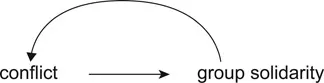
A basic principle of social conflict was stated more than 100 years ago by Georg Simmel ([1908] 1955), and elaborated 50 years later by Lewis Coser (1956): external conflict increases group solidarity.
Solidarity also causes more conflict (Figure 1.1). Solidarity is a crucial weapon in conflict. Groups with solidarity are more capable of mobilizing and fighting; and groups that already have high solidarity are especially sensitive to threats to their boundaries.
The two most fundamental social processes—solidarity and conflict—are connected. The theory of social solidarity was classically stated by Emile Durkheim ([1912] 1964), in explaining how religious rituals produce feelings of group membership. Ingredients are: assembling the group face-to-face; focusing attention on the same object, and becoming mutually aware of each other’s focus, thereby creating intersubjectivity; repeating the same actions so that people fall into a shared rhythm. These processes magnify whatever emotion participants are feeling. If the build-up continues without being interrupted or distracted, the group develops an excitement that Durkheim called “collective effervescence”—this is the exciting place to be, the experience that takes you out of your individual self and into something larger and more important.
The feelings and ideas experienced during these shared moments linger in participants’ minds and bodies. They feel group solidarity, a sense of “we-ness.” They acquire symbols of group membership, whatever they focused upon during the ceremony: Durkheim points to primitive tribal tokens as well as sacred objects of the literate religions (a cross, a Bible, a Koran), and notes that political rituals work the same way, making sacred objects out of a flag, a leader, or a slogan. And individuals get an emotional jolt out of taking part in such rituals: it makes you feel stronger, more dedicated, more energetic.
The ritual theory of solidarity was expanded by Erving Goffman (1967), who noted that not just formal ceremonies but also the common gestures of everyday greetings and politeness generate personal links of solidarity. Goff-man called this “interaction ritual” (IR). Operating through the rhythmsof talk and bodily alignment, IRs are the building-blocks of friendship, of networks, and of social classes and other groups with which we feel unconscious solidarity. I have stated the theory more formally in a set of ingredients and outcomes intensified by feedback loops (Collins 2004a). I emphasize a crucial point: rituals do not automatically produce solidarity. They can succeed or fail. Some rituals are extremely powerful (the rituals of a religion when one converts to it; the rituals of a political movement when its rallies are most intense). But many rituals fail; their ingredients are not strong enough to get off the ground (anyone who has gone to a dull party or sat through a boring speech knows what I mean). Many rituals, both formal macro-rituals and informal micro-rituals, are in the middle ground, mildly attractive and mildly influential, but fading away over a period of time if they are not repeated.1
Conflict is one of the strongest influences on social rituals; that is to say, conflict itself, insofar as it is conflict between groups, tends to produce very strong rituals. This is shown in Figure 1.2. The boxes on the left are three major ingredients. Conflict raises the level of each. Threat motivates people to assemble. Paying attention to the enemy produces a very strong mutual focus of attention—we can’t turn our attention away, and we become acutely attuned to how the people around us are reacting to the threat. Anger and fear of the enemy are among the strongest and most contagious emotions.
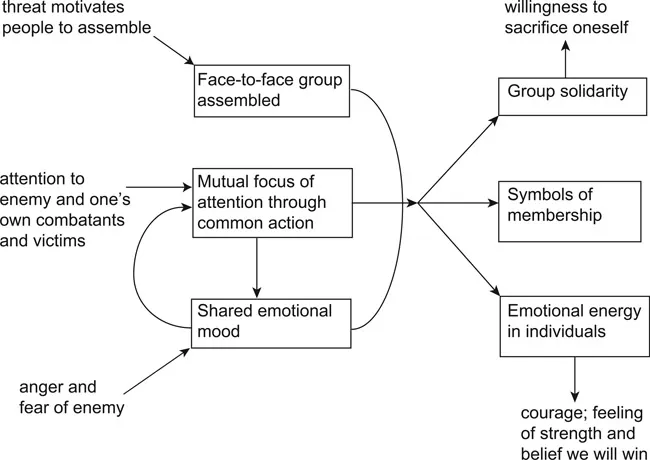
On the right side of the model are three major outcomes of successful interaction ritual: Group solidarity, as Durkheim noted, makes you willing to sacrifice yourself for the group. Interaction ritual produces idealized symbols of membership, marking off good and evil at the boundary of the group. And it produces high emotional energy (EE), that is, confidence and enthusiasm; in conflict, emotional energy takes the form of courage, feeling strength in the group and belief that we will win in the end.
These outcomes are highest when the interaction ritual is at its most intense; interaction ritual is a set of variables, and we are going to trace their rise and fall over time. Conflict theory is not the opposite of a theory of human ideals, social cooperation and solidarity; we don’t have a sentimental good theory of human beings, on one hand, and a cynical conflict theory, on the other. It is all part of the same theory.
C-Escalation
We now have a series of feedback loops, and I am going to add some more. Conflict and solidarity cause each other to rise, and thus we have the familiar spiral of conflict escalation. Plus, we add what I will call the atrocities/polarization loop (Figure 1.3).
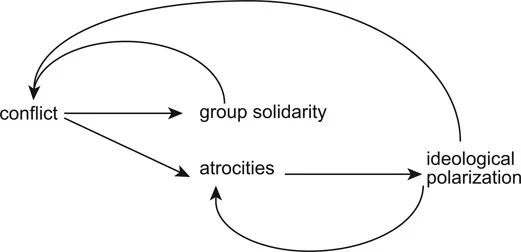
Atrocities are actions by the opponent that we perceive as especially hurtful and evil, a combination of physical and moral offense that we find outrageous. Atrocities generate righteous anger, an especially Durkheimian emotion, bringing about the imperative feeling that we must punish the perpetrators, not just for ourselves but as a matter of principle.
The atrocities loop starts already at the level of conflict talk. This is apparent in small-scale conflicts, such as arguments, and trash-talking that precedes fights (Collins 2008: 337–369, and references therein). Conflict talk is a combination of insulting the other, boasting about one’s own power, and making threats. On the micro-level, most of this is only Goff-manian frontstage performance, but in an escalating situation partisans take it as real; we remember our opponent’s worst utterances and repeat them among ourselves, to keep up the emotional stimulus for our own high-solidarity ritual. In gossip as in politics, negatives are remembered much more strongly than positives (Baumeister et al. 2001; Rozin and Royzman 2001).
And as time goes along, stories circulate about atrocities the enemy has carried out, mobilizing more people onto our side, increasing the size of our interaction ritual. As conflicts escalate over time, some of the atrocities turn out to be real; but some of them are only rumors, and many are exaggerated. During the period of escalation, it is difficult to distinguish between rumors and realities; in the heightened interaction ritual, no one is interested in the distinction.
When conflict turns violent, there are several sociological reasons why atrocities really do occur. The most important point is that violence is generally incompetent and imprecise. Most persons in threatening situations stay back from the action, and relatively few actually fight; even those posing as belligerents usually do not get beyond threatening gestures and verbal bluster. Those who do fire guns, use weapons, or launch bodily blows miss their targets most of the time. This incompetence is a major source of atrocities.
Micro-sociological research looks at violence-threatening situations in as much detail as possible, seeking the micro-mechanisms that determine who does what and with what effect. It makes use of photos and videos, participants’ accounts, ethnographic observations, forensic reconstructions (such as bullet paths and numbers of shots fired), data on bodily physiology, and subjective phenomenology. Becoming familiar with masses of such data makes a micro-sociologist skeptical of taking at face value what participants say about their motives for violence.2 Good interviewing needs to probe what participants did in the interactional sequence over time, including opponents, supporters, and bystanders. We want as much situational context as possible, especially on what happens in the early part of the encounter and its escalation. This helps overcome fallacies arising from sampling on the dependent variable, seeing only those cases where violence comes about.
The main thing we see is that fighters are full of confrontational tension and fear. Photos of combat, riots, brawls, hold-ups and other kinds of violence typically show body postures are tense; facial expressions most commonly display fear—and not just the victim, but the perpetrator. Fighters are pumped up with adrenaline and cortisol; their heart rate accelerates to levels where fine motor coordination (i.e. control of your fingers) is lost and perception is blurred (Grossman 2004). As a result, combatants often hit the wrong target, whether by friendly fire––hitting their own side—or by hitting innocent bystanders. Confrontational tension/fear (CT/F) makes most violence incompetent—virtually the opposite of surgically precise.3 This is a major source of atrocities.
For violence to actually happen, perpetrators must find a pathway around the barrier of CT/F. There are several such pathways, producing different types of violent scenarios. Most relevant here is the pathway of attacking the weak. The most successful tactic in real-life violence is for the stronger or more heavily armed to attack a weaker victim. In brawls, gang fights, and riots, almost all the damage is done by a group that manages to find an isolated victim. Thus, most violence is easily perceived as an atrocity, to be avenged by further violence, which the other side in turn also perceives as atrocity. As an exception, the ideal “fair fight” between evenly matched individuals does sometimes happen, but only in carefully arranged duels or exhibitions; such fair fights are not regarded as atrocities and do not result in escalation.4 This supports my point that it is the perception of atrocities that produces polarization, not just violence per se.
The most dramatic kinds of atrocities are what I have called “forward panic”: an emotional frenzy of piling on and overkill, that happens when a group engaged in prolonged confrontation suddenly experiences their tension released as dominance shifts overwhelmingly in their favor (Collins 2008: 83–133). The infamous Rodney King beating, captured on a cam-corder in 1991, was of this kind; so are many instances of police beatings that happen at the end of a high-speed chase. Also typical are one-sided beatings of individuals or small groups caught by bigger groups in riots, and massacres in military battles after one side has given up. An important micro-interactional feature is that the victims have lost all their emotional energy, becoming passive in the face of the victors’ onslaught.
The connection between atrocity and polarization is illustrated particularly clearly in an incident in the Palestinian intifada in October, 2000 (details, sources, and photo in Collins 2008: 421–423). Four off-duty Israeli soldiers had the bad luck to drive their jeep into a Palestinian funeral procession for a young boy killed the day before by Israeli troops. The outraged crowd of several hundred chased the soldiers into a building and killed them. In the photo, one of the killers waves his blood-stained hands to the crowd below, who cheer and wave back. Their faces show joy and solidarity, entrainment in the act of killing. From the Israeli side, this is an atrocity; for these Palestinians, it is an intensely moral interaction ritual, a celebration of what from their perspective appears are well-deserved justice.5
Atrocities cause atrocities in response. Neither side sees their own actions as atrocities, because of ideological polarization. From the opposing point of view, the enemy’s moral blindness is taken as proof that they are morally sub-human. Angry denunciation of enemy atrocities frequently make this charge, in varying vocabularies.
Polarization is an intensification of the Durkheimian process of identifying the solidarity group with good, and evil as what is outside its boundary. Intense conflict unifies the group in a tribalistic ritual, giving the palpable feeling that Durkheim argued is the source of the sacred, and the social construction of good and evil. As conflict escalates, polarization increases: the enemy is evil, unprincipled, stupid, ugly, ridiculous, cowardly, and weak––negative in every respect. Our side becomes increasingly perceived as good, principled, intelligent, brave, and all the other virtues.
Polarization is the source of many aspects of conflict that in calmer perspective we would regard as immoral and irrational. Polarization causes atrocities. Because we feel completely virtuous, everything we do is good, whether it be torture, mutilation, or massacre. And because at high polarization the enemy is completely evil, they deserve what is done to them. Genocidal massacres, like Rwanda in 1994, start with build-up of emotional polarization, broadcasting the threat of atrocities that the enemy has already carried out, or is about to carry out if we do not forestall them.6 Similar processes are found in the tortures carried out by US guards at Abu Ghraib military prison in 2004, in an atmosphere of small group ritualism and hilarity expressing intense emotional solidarity against a humiliated enemy (Graveline and Clemens 2010). Polarization is the dark shadow of the highest levels of successful interaction ritual. The more intense the feeling of our goodness, the easier it is to commit evil.
A second consequence of polarization is to escalate and prolong conflict. Even if a realistic assessment might show that further conflict is unwinnable, or that its costs would be too great, periods of high polarization keep partisans from seeing this. Because of polarization, both sides perceive themselves as strong and the enemy as, ultimately, weak; therefore we expect to win.
Mobilizing Allies through Atrocities and Polarization
The amount of escalation depends not only on emotional processes, but on numbers of participants and resources. Longer-lasting conflicts require further feedback loops. An embattled group first mobilizes its members locally; for large-scale conflict, it seeks sympathizers and allies (Figure 1.4).
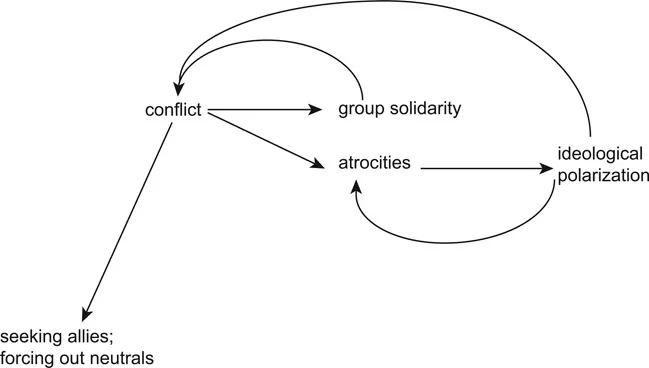
Table of contents
- Cover Page
- Half Title Page
- Title Page
- Copyright Page
- Contents Page
- List of Figures Page
- Acknowledgments Page
- List of Abbreviations Page
- Introduction: Emergent and Self-Propelling Conflicts
- Part I Time-Dynamics
- Part II The Eye of the Needle: Emotional Processes
- Part III War and Sport: Dynamics of Winning, Losing, and Stalemate
- Part IV Violence in Everyday Life
- Conclusion: Optimistic Discoveries in the Sociology of Violence
- Index
Trusted by 375,005 students
Access to over 1.5 million titles for a fair monthly price.
Study more efficiently using our study tools.
Frequently asked questions
Yes, you can cancel anytime from the Subscription tab in your account settings on the Perlego website. Your subscription will stay active until the end of your current billing period. Learn how to cancel your subscription
No, books cannot be downloaded as external files, such as PDFs, for use outside of Perlego. However, you can download books within the Perlego app for offline reading on mobile or tablet. Learn how to download books offline
Perlego offers two plans: Essential and Complete
- Essential is ideal for learners and professionals who enjoy exploring a wide range of subjects. Access the Essential Library with 800,000+ trusted titles and best-sellers across business, personal growth, and the humanities. Includes unlimited reading time and Standard Read Aloud voice.
- Complete: Perfect for advanced learners and researchers needing full, unrestricted access. Unlock 1.5M+ books across hundreds of subjects, including academic and specialized titles. The Complete Plan also includes advanced features like Premium Read Aloud and Research Assistant.
We are an online textbook subscription service, where you can get access to an entire online library for less than the price of a single book per month. With over 1.5 million books across 990+ topics, we’ve got you covered! Learn about our mission
Look out for the read-aloud symbol on your next book to see if you can listen to it. The read-aloud tool reads text aloud for you, highlighting the text as it is being read. You can pause it, speed it up and slow it down. Learn more about Read Aloud
Yes! You can use the Perlego app on both iOS and Android devices to read anytime, anywhere — even offline. Perfect for commutes or when you’re on the go.
Please note we cannot support devices running on iOS 13 and Android 7 or earlier. Learn more about using the app
Please note we cannot support devices running on iOS 13 and Android 7 or earlier. Learn more about using the app
Yes, you can access Explosive Conflict by Randall Collins in PDF and/or ePUB format, as well as other popular books in Social Sciences & Social Theory. We have over 1.5 million books available in our catalogue for you to explore.