- 220 pages
- English
- ePUB (mobile friendly)
- Available on iOS & Android
eBook - ePub
The Executive Guide to Implementing Quality Systems
About this book
Presenting an unusual and unique system for Continuous Quality Improvement (CQI), this new book is geared for executives who want or need to support quality improvement in their organizations. It is the contributions made by CEO's and upper management that moves the quality process forward, and because of this structure, The Executive Guide to Implementing Quality focuses on the concepts, thinking, and systems necessary for management to operationalize the CQI philosophy.
Because quality is not a management problem but rather a problem that involves and requires all people working together at all levels to participate and cooperate, management must engage the organization in the processes that will improve the quality of their goods or services. It is, however, management's job to lead, organize, structure, motivate, and involve the organization in those strategies and systems that will ensure quality improvement. This book explains how to do that.
Readers are given a series of exercises and explanations that will help them master the skills and understanding required to identify the management systems they need to support their quality improvement. After reading about a concept, they are asked to contribute to exercises designed to inspire creative and innovative thinking and the exploration of multi-functional options. And because it is the job of management to initiate the quality movement, this book shows how to change defensive thoughts like "that won't work for me" into "what is there that will work here."
In addition to showing management how to take the lead in installing CQI in their organization, it also shows how to install the concepts through leadership teams, how to bring out the best in people, how to get top performance from employees and become a world-class organization, and how to reinforce the behaviors necessary to achieve the visions and goals of the organization. This workbook is an easy-and-quick-to-use guide that shows how to identify the support systems that generate desirable outcomes and reinforces them through positive actions.
Overview
We have the opportunity in the coming decade to cut world poverty by half. Billions more people could enjoy the fruits of the global economy. Tens of millions of lives can be saved. The practical solutions exist. The political framework is established. And for the first time, the cost is utterly affordable. Whatever one's motivation for attacking the crisis of extreme poverty—human rights, religious values, security, fiscal prudence, ideology—the solutions are the same. All that is needed is action.
This report recommends the way forward. It outlines a way to attain this bold ambition. It describes how to achieve the Millennium Development Goals.
The Millennium Development Goals (MDGs) are the world's time-bound and quantified targets for addressing extreme poverty in its many dimensions—income poverty, hunger, disease, lack of adequate shelter, and exclusion—while promoting gender equality, education, and environmental sus-tainability. They are also basic human rights—the rights of each person on the planet to health, education, shelter, and security as pledged in the Universal Declaration of Human Rights and the UN Millennium Declaration.
How will the world look in 2015 if the Goals are achieved? More than 500 million people will be lifted out of extreme poverty. More than 300 million will no longer suffer from hunger. There will also be dramatic progress in child health. Rather than die before reaching their fifth birthdays, 30 million children will be saved. So will the lives of more than 2 million mothers.
There's more. Achieving the Goals will mean 350 million fewer people are without safe drinking water and 650 million fewer people live without the benefits of basic sanitation, allowing them to lead healthier and more dignified lives. Hundreds of millions more women and girls will go to school, access economic and political opportunity, and have greater security and safety. Behind these large numbers are the lives and hopes of people seeking new opportunities to end the burden of grinding poverty and contribute to economic growth and renewal.
The Millennium Development Goals are the most broadly supported, comprehensive, and specific poverty reduction targets the world has ever established
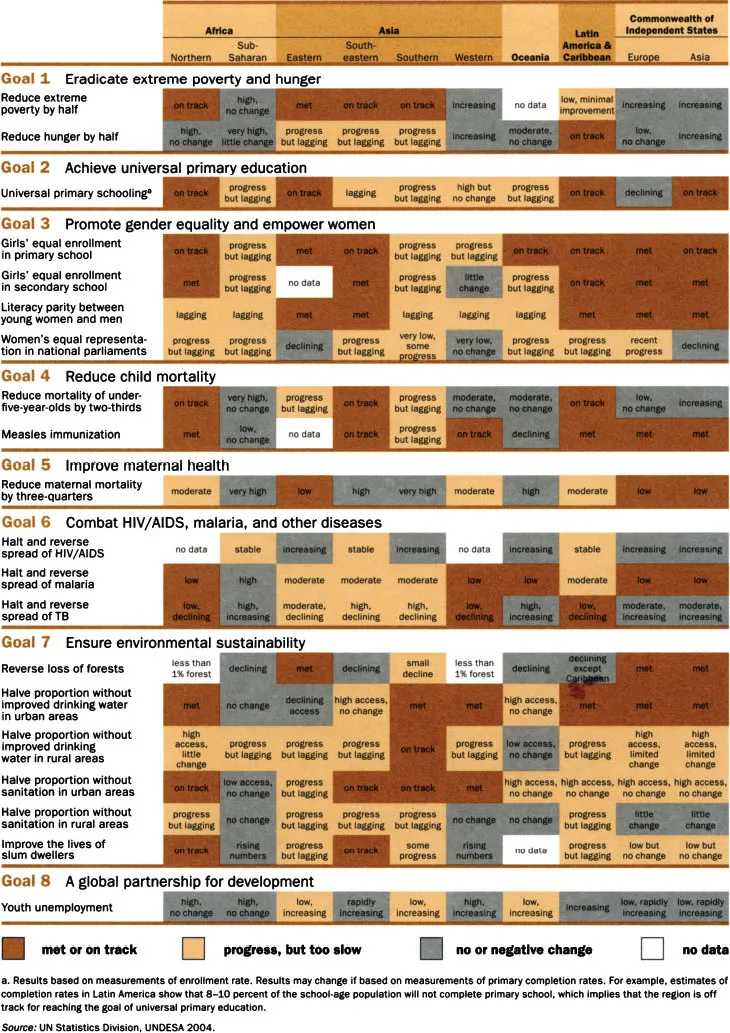
Many countries are on track to achieve at least some of the Goals by the appointed year, 2015. Yet broad regions are far off track (table 1). Sub-Saharan Africa, most dramatically, has been in a downward spiral of AIDS, resurgent malaria, falling food output per person, deteriorating shelter conditions, and environmental degradation, so that most countries in Africa are far off track to achieve most or all of the Goals. Climate change could worsen the situation by increasing food insecurity, spreading vector-borne diseases, and increasing the likelihood of natural disasters, while a prolonged decline in rainfall in parts of Africa has already wreaked havoc. Meanwhile, for some Goals, such as reducing maternal mortality and reversing the loss of environmental resources, most of the world is off track. The early target for gender parity in primary and secondary education—with a deadline of 2005—will be missed in many countries.
The Millennium Development Goals are too important to fail. It is time to put them on the fast-track they require and deserve. The year 2005 should inaugurate a decade of bold action. Based on work conducted by more than 250 of the world's leading development practitioners over the past two years in the context of the UN Millennium Project, this report presents a practical plan for achieving the Goals. Throughout, we stress that the specific technologies for achieving the Goals are known. What is needed is to apply them at scale. To that end, we present 10 key recommendations at the front of the report. More elaborate analysis and recommendations are set out in the 13 themati-cally oriented task force reports that underpin this plan.
This overview has four parts. The first describes why the Millennium Development Goals are important and the varied progress so far in achieving them. It then offers a diagnosis of why progress has been so mixed across regions and across Goals. The second presents the recommendations to be implemented at the country level, focusing on the processes, investments, policies, and scale-up strategies required to achieve the Goals. The third provides recommendations to guide the international system's support for country-level processes. The fourth estimates the costs and benefits of achieving the Goals, outlining the millions of lives that could be saved—and the billions of lives improved—through a very affordable but substantial increase in worldwide investments.
1 Why the Goals are important and why we're falling short
DOI: 10.4324/9780429332937-1
The Millennium Development Goals are the most broadly supported, comprehensive, and specific poverty reduction targets the world has ever established, so their importance is manifold. For the international political system, they are the fulcrum on which development policy is based. For the billion-plus people living in extreme poverty, they represent the means to a productive life.
 |
For the billion-plus people still living in extreme poverty, the MDGs are a life-and-death issue
For everyone on Earth, they are a linchpin to the quest for a more secure and peaceful world.
The fulcrum of international development policy
At the Millennium Summit in September 2000, the largest gathering of world leaders in history adopted the UN Millennium Declaration, committing their nations to a global partnership to reduce poverty, improve health, and promote peace, hu...
Table of contents
- Cover Page
- Title Page
- Copyright Page
- Table Of Contents
- Preface
- Contributors
- Task force reports
- Millennium Development Goals
- Ten key recommendations
- Half-Title Page
- Overview
- Notes
- References
- Acknowledgments
Trusted by 375,005 students
Access to over 1.5 million titles for a fair monthly price.
Study more efficiently using our study tools.
Frequently asked questions
Yes, you can cancel anytime from the Subscription tab in your account settings on the Perlego website. Your subscription will stay active until the end of your current billing period. Learn how to cancel your subscription
No, books cannot be downloaded as external files, such as PDFs, for use outside of Perlego. However, you can download books within the Perlego app for offline reading on mobile or tablet. Learn how to download books offline
Perlego offers two plans: Essential and Complete
- Essential is ideal for learners and professionals who enjoy exploring a wide range of subjects. Access the Essential Library with 800,000+ trusted titles and best-sellers across business, personal growth, and the humanities. Includes unlimited reading time and Standard Read Aloud voice.
- Complete: Perfect for advanced learners and researchers needing full, unrestricted access. Unlock 1.5M+ books across hundreds of subjects, including academic and specialized titles. The Complete Plan also includes advanced features like Premium Read Aloud and Research Assistant.
We are an online textbook subscription service, where you can get access to an entire online library for less than the price of a single book per month. With over 1.5 million books across 990+ topics, we’ve got you covered! Learn about our mission
Look out for the read-aloud symbol on your next book to see if you can listen to it. The read-aloud tool reads text aloud for you, highlighting the text as it is being read. You can pause it, speed it up and slow it down. Learn more about Read Aloud
Yes! You can use the Perlego app on both iOS and Android devices to read anytime, anywhere — even offline. Perfect for commutes or when you’re on the go.
Please note we cannot support devices running on iOS 13 and Android 7 or earlier. Learn more about using the app
Please note we cannot support devices running on iOS 13 and Android 7 or earlier. Learn more about using the app
Yes, you can access The Executive Guide to Implementing Quality Systems by Peter Mears,Frank Voehl in PDF and/or ePUB format, as well as other popular books in Business & Leadership. We have over 1.5 million books available in our catalogue for you to explore.