The Poetry of Ennodius offers the first translation into English verse of the entire eclectic corpus of sacred and secular poetry by Magnus Felix Ennodius (c. 473/4–521 CE), amply supplemented by detailed notes that elucidate the literary and cultural references essential for understanding this poet.
Ennodius' poetry offers the reader a remarkable window into how Roman literary culture continued to thrive in the aftermath of the traditional "fall" of Rome in 476 CE. A prolific writer of prose and poetry, Ennodius played an active role in the political and ecclesiastical disputes of Ostrogothic Italy, and he stands as an important exemplar of late antique literary culture. Readers of this volume will encounter esteemed bishops, delicate objects, pets, stately churches, fools, villains, and more in vivid panegyrics, travelogues, hymns, epistles, and epigrams found in the sweeping poetic archive assembled after Ennodius' death. From the grandiose "Declamation for the anniversary of the holy and most blessed Bishop Epiphanius in his 30th year as bishop of Pavia" to self-depricating descriptions of silverware that bears the poet's image, Ennodius' poetry sports with the expectations of his audience, composing verse that modulates from the beautiful to the conventional to the stunningly unusual, while always displaying an intimate knowledge of the literary traditions in which he writes and a deep engagement with previous authors, both from the distant classical past and the contemporary world of late antique prose and poetry. Through these poems, the reader can gain an appreciation of the intellectual and aesthetic world of an important bishop (and future saint) in the early sixth-century CE.
Featuring a lucid line-by-line verse translation from the Latin and extensive notes—both firsts in English—richly introduced by a scholarly introduction to Ennodius, his works, and era, and complemented by a comprehensive bibliography, The Poetry of Ennodius makes these works accessible for the first time to readers unfamiliar with Latin as well as those seeking a guide into the labyrinthine literary world of this challenging but rewarding poet. Students of the classics, late antique and medieval history, comparative literature, and early Christianity, as well as any independent reader interested in the enduring presence of classical Latin verse, will benefit from this book.
The Open Access version of this book, available at http://www.taylorfrancis.com, has been made available under a Creative Commons Attribution-Non Commercial (CC-BY-NC) 4.0 license.
In 510 CE Magnus Felix Ennodius, then a prominent deacon in the Church of Milan, found himself adrift on a dangerously flooded Po River as he attempted to visit a grieving relative:
the Padus then by chance submerged imprisoned fields,
with baleful foam the swollen river’s crest grew white,
as farmsteads’ pinnacles raced through unmoving waves …
(#5.15–17)
Less than a decade before, Ennodius had moved to Milan from Pavia (ancient Ticinum), embarking on a phase of his career that would see him produce a vast, chaotic archive of letters, declamations, speeches, saints’ lives, hymns, and miscellaneous verse—one of the great documentary corpora of sixth-century Ostrogothic Italy. Within two years of his perilous trip across the Po, he would return to Pavia as its bishop, and the stream of his writings would dry up. But the literary production from the time of his earliest position in Pavia (c. 494–497/498) until his deaconship in Milan (497/498–c. 512) provides a vital witness to the events, personalities, and culture of his age.
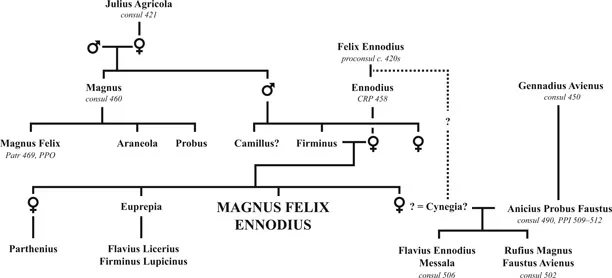
Ennodius was born around 474 CE to a prominent consular family with roots in Gaul.1 From Ennodius’ own writings the contours of his life are visible, although even the most basic details remain tantalizingly elusive. Key elements of his early life emerge from his writings, especially the so-called Eucharisticon de vita sua (“Thanksgiving for his Life,” 438V), which, in a manner reminiscent of Augustine’s Confessions, recounts how St. Victor of Milan miraculously cured Ennodius of serious moral and physical illness. Arles is often given as the city of his birth, but evidence for this is thin. From Ennodius’ letters an expansive—but hazy—image of his extended family emerges; yet he is frustratingly laconic about his immediate family, and it is often difficult to pin down the exact relationships at play (Figure 1). His father was probably named Firminus, likely the nephew of the Magnus who was consul in 460. About his mother we know nothing, although she may have been the granddaughter of the Felix Ennodius who had been pro-consul of Africa c. 420 CE.2 We read of two (or three) older sisters, an aunt who would raise him, a niece, and two nephews, whose careers Ennodius fostered. Numerous cousins and other relations of foggy connection make appearances in his letters.3 His family boasted connections with the famed Gallic author and bishop Sidonius Apollinaris, as well as the Emperor Avitus (455–456). His extended family continued to be tapped into the highest reaches of political power at the turn of the century. Of particular importance to Ennodius’ career would be Anicius Probus Faustus, both of whose sons—Rufius Magnus Faustus Avienus and Ennodius Messala—would attain the consulship in the first decade of the sixth century.4
Figure 1 A genealogy for Ennodius.
When Ennodius was orphaned at a young age, he was sent to live in Liguria with his paternal aunt. His intellectual promise and fiscal resources secured him a quality education.5 This formative period cemented Ennodius’ perspective on the world, which was very much that of the Italo-Roman aristocracy, his Gallo-Roman birth notwithstanding.6 The year 489 CE, however, brought yet more upheaval. Italy was invaded by Theodoric, king of the Ostrogoths, who would be the dominant political figure during the rest of Ennodius’ life. Over the next four years, northern Italy suffered immensely during the confrontation between Theodoric and Odovacer, who had ruled Italy since he deposed the last emperor in 476. Closer to home, within a year of Theodoric’s invasion, Ennodius’ aunt died. The 16-year-old Ennodius was taken in by a wealthy Pavian family and betrothed to their daughter.7 But when the material situation of the family deteriorated in the chaos and deprivations caused by the conflict, Ennodius’ engagement languished. Eventually, through the intervention of Faustus, who would become a close friend and ally, Ennodius came to the attention of Epiphanius, the bishop of Pavia. At his encouragement both Ennodius and his fiancée (or perhaps by then his wife) entered into religious life.8
Ennodius served the Church in Pavia until around the time of Epiphanius’ death in 497. We know that in 494 he accompanied Epiphanius on a successful diplomatic mission that secured the release of thousands of northern Italians who were being held hostage by the Burgundian king, Gundobad.9 And around 496, Ennodius made his public literary debut with a high-stakes performance of a poem celebrating the thirtieth anniversary of Epiphanius’ investiture as bishop of Pavia (43V = #2).10 Either just before or soon after Epiphanius’ death in 497, Ennodius was transferred to Milan, where he entered the service of the metropolitan Bishop Laurentius (490–511/512) and was soon elevated to the deaconate.
It was during his deaconate that nearly all of Ennodius’ surviving writings were composed. He may have played some role in educating sons of the local nobility, but his primary activities remained focused on the Church, and he played a key role in the tenacious dispute that had split the papacy in late 498 between rival popes: Symmachus and Laurentius (not the same man as the bishop of Milan).11 After the Palmary Synod confirmed the legitimacy of Symmachus in late 502, Ennodius was entrusted with composing an important document promulgating the decision, the “Booklet on the Synod” (Libellus Pro Synodo, 49V).12 He also continued his diplomatic work, travelling to familiar haunts like Pavia, as well as the court of Theodoric. In 506, he was again tasked with a diplomatic mission, this time back to Gaul at the request of Bishop Laurentius. Although his destination and purpose are unknown, it seems that he met with success, for soon after he was tasked with composing a prose panegyric for Theodoric (263V). Despite this, and another mission across the Alps in 508, Ennodius soon suffered a cruel blow to his ambition when he was passed over for promotion to the prestigious episcopate of Milan, which instead passed to Eustorgius II (511/512–518).13
Around this time, Ennodius’ health began to fail. We know he had travelled again to Gaul c. 510 (305V) and visited his sister the following spring (#5), but later that year ill health prevented him undertaking another diplomatic mission. When Ennodius recovered, he composed his Eucharisticon de vita sua (438V), from which so much of our knowledge about his life derives. Thereafter, a more serious and dogmatic Ennodius emerges, as he renounces the writing of secular works and encourages others to do the same—for a time, as he soon resumes writing such works.14
In late 513 Ennodius received his promotion, although not perhaps the one he sought. He returned to Pavia to become its tenth bishop. It is at this point that our archive fails; indeed, it is even silent on Ennodius’ elevation to the episcopate. While one can only assume that he continued to compose prayers, speeches, and letters as part of his professional and personal activities, they are all lost, and for his work as bishop and his diplomatic activities on behalf of Rome, we can only turn to later sources.15 The following year Pope Hormisdas tapped Ennodius to lead the first of two clerical embassies to Constantinople.16 In advance of the mission of 515, he composed a concise work in support of orthodoxy (In Christi Signo, 458V). Nevertheless, this and a second de...
Table of contents
Cover Page
Half Title Page
Series Page
Title Page
Copyright Page
Dedication Page
Contents Page
List of figures Page
Preface Page
Acknowledgements Page
List of abbreviations Page
1 Introduction
2 The poems
Appendices
Index
Trusted by 375,005 students
Access to over 1.5 million titles for a fair monthly price.
Study more efficiently using our study tools.
Frequently asked questions
Yes, you can cancel anytime from the Subscription tab in your account settings on the Perlego website. Your subscription will stay active until the end of your current billing period. Learn how to cancel your subscription
No, books cannot be downloaded as external files, such as PDFs, for use outside of Perlego. However, you can download books within the Perlego app for offline reading on mobile or tablet. Learn how to download books offline
Perlego offers two plans: Essential and Complete
Essential is ideal for learners and professionals who enjoy exploring a wide range of subjects. Access the Essential Library with 800,000+ trusted titles and best-sellers across business, personal growth, and the humanities. Includes unlimited reading time and Standard Read Aloud voice.
Complete: Perfect for advanced learners and researchers needing full, unrestricted access. Unlock 1.5M+ books across hundreds of subjects, including academic and specialized titles. The Complete Plan also includes advanced features like Premium Read Aloud and Research Assistant.
Both plans are available with monthly, semester, or annual billing cycles.
We are an online textbook subscription service, where you can get access to an entire online library for less than the price of a single book per month. With over 1.5 million books across 990+ topics, we’ve got you covered! Learn about our mission
Look out for the read-aloud symbol on your next book to see if you can listen to it. The read-aloud tool reads text aloud for you, highlighting the text as it is being read. You can pause it, speed it up and slow it down. Learn more about Read Aloud
Yes! You can use the Perlego app on both iOS and Android devices to read anytime, anywhere — even offline. Perfect for commutes or when you’re on the go. Please note we cannot support devices running on iOS 13 and Android 7 or earlier. Learn more about using the app
Yes, you can access The Poetry of Ennodius by Bret Mulligan in PDF and/or ePUB format, as well as other popular books in History & Ancient History. We have over 1.5 million books available in our catalogue for you to explore.